Table of contents

No study prices plumbing account-based marketing directly, so this page uses B2B-wide ABM Leadership Alliance and N.Rich benchmark data to show where plumbing programs are hitting the target and where they are missing it. The unit of analysis is program discipline - what gets tracked, measured, and called a success - not budget size.
Key Takeaways
- 67% of programs track pipeline growth as an ABM metric.
- 63% track revenue growth tied to ABM specifically.
- Only 33% track account engagement, and 28% track win rate/deals closed.
- Just 52% of programs measure ABM ROI at all.
- Among programs that do measure, 85% saw account engagement improve.
- 78% saw pipeline growth improve once it was tracked.
- 77% saw sales team satisfaction improve.
- 67% of B2B teams call ABM a core go-to-market motion.
- But only 26% call their own program a success.
- Just 22% run ABM on a dedicated platform; most use spreadsheets.
- Only 31% agree marketing and sales collaborate effectively on ABM.
- 81% still claim ABM ROI beats other marketing regardless.
- BOMA represents 16,500-plus commercial property members.
- AGC counts 6,500-plus leading general contractors.
- 30% of the average 2023 marketing budget went to ABM.
The gap: tracked versus achieved
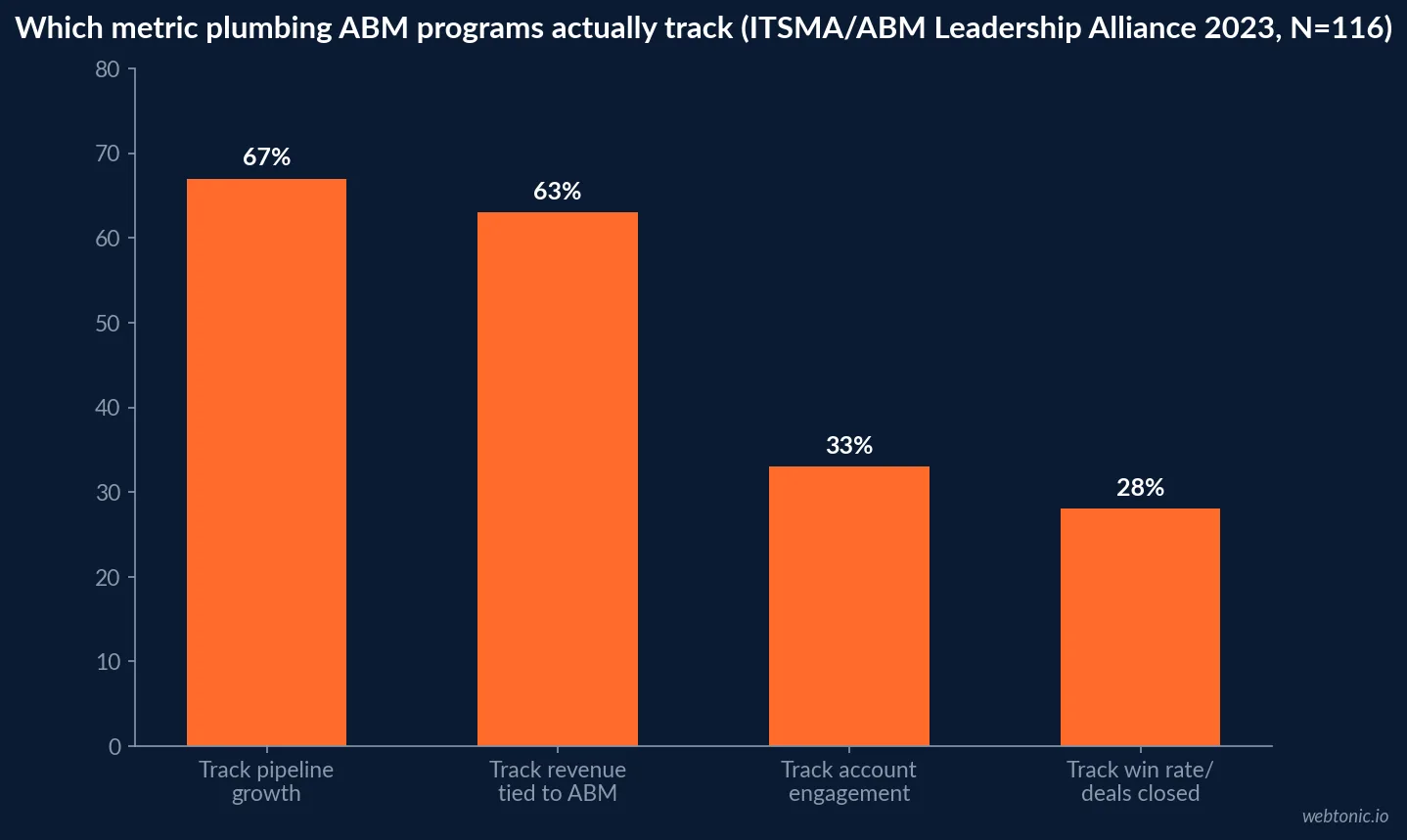
The phrase "still missing the target" is not a metaphor here - it describes an actual, measured gap in the benchmark data. The Momentum ITSMA and ABM Leadership Alliance 2023 ABM Benchmark Study found that among 116 programs, 67% track pipeline growth and 63% track revenue growth tied to ABM - the two most common metrics. But only 33% track account engagement and just 28% track win rate or deals closed. A plumbing company that only watches pipeline volume can miss that the accounts filling that pipeline are not the ones actually closing.
| Metric tracked | Share of 116 programs | What it misses if used alone | Source |
|---|---|---|---|
| Pipeline growth | 67% | Volume without quality of the accounts inside it | ITSMA/ABM Leadership Alliance 2023 |
| Revenue growth tied to ABM | 63% | Attribution disputes with sales | ITSMA/ABM Leadership Alliance 2023 |
| Account engagement | 33% | Whether the RIGHT accounts are engaging | ITSMA/ABM Leadership Alliance 2023 |
| Account team satisfaction | 29% | Whether sales trusts the leads | ITSMA/ABM Leadership Alliance 2023 |
| Win rate / deals closed | 28% | Whether any of it actually closes | ITSMA/ABM Leadership Alliance 2023 |
Why the ROI claim outruns the ROI proof
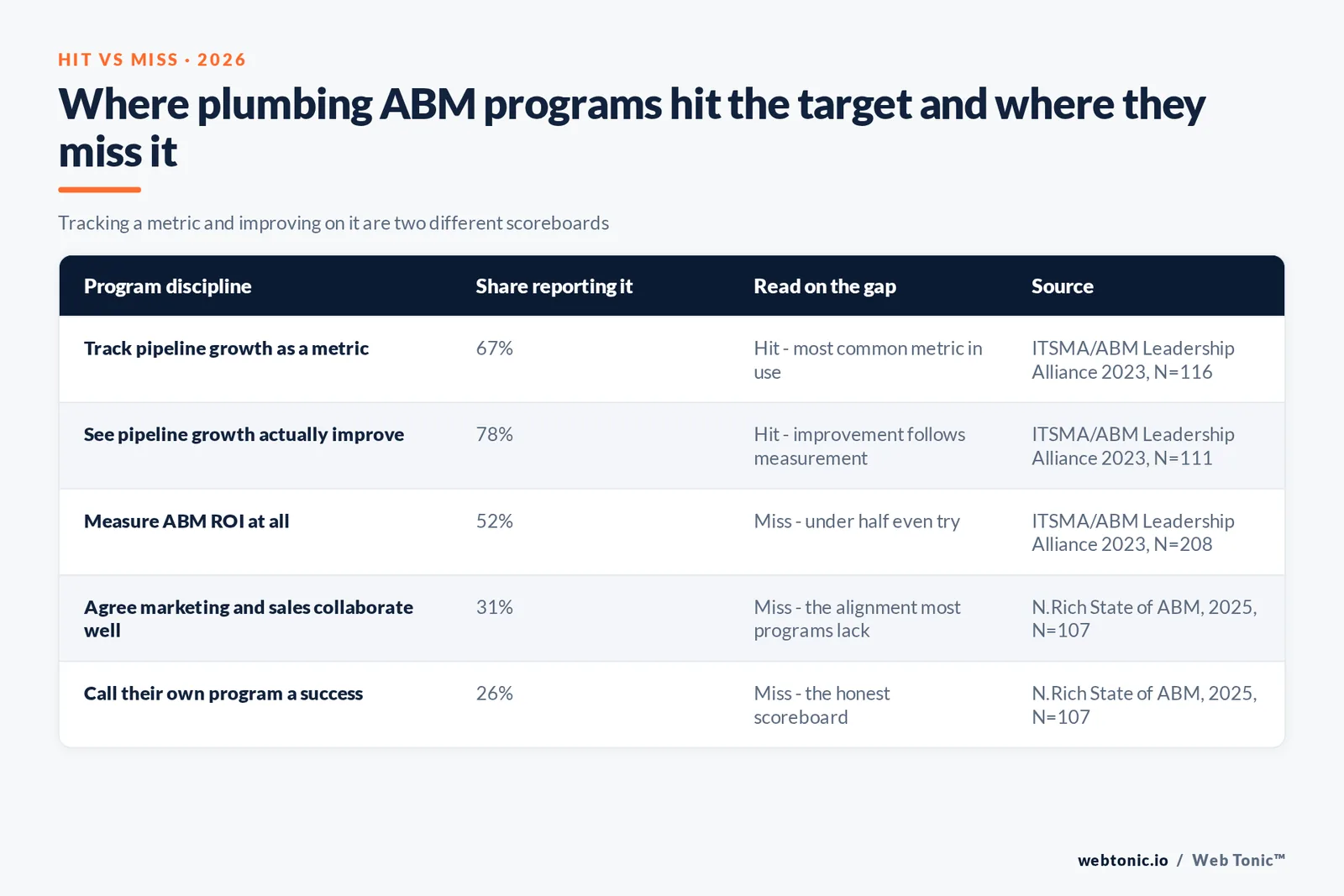
The same 2023 study found 81% of ABM marketers say ABM ROI beats their other marketing - but only 52% of programs measure ABM ROI at all. That means roughly three in ten programs are making an ROI claim with no measurement behind it. For a plumbing company weighing whether to expand a commercial ABM push, that 52% figure is the more useful number: it is the share of the industry actually equipped to tell you whether the approach is working.
| Claim vs. proof (2023 data) | Reported figure | Source |
|---|---|---|
| Say ABM ROI is higher than other marketing | 81% | ITSMA/ABM Leadership Alliance 2023, N=115 |
| Actually measure ABM ROI | 52% | ITSMA/ABM Leadership Alliance 2023, N=208 |
| Implied gap: claim without proof | ~29 points | Derived from the two figures above |
What "hitting the target" looks like once it is measured
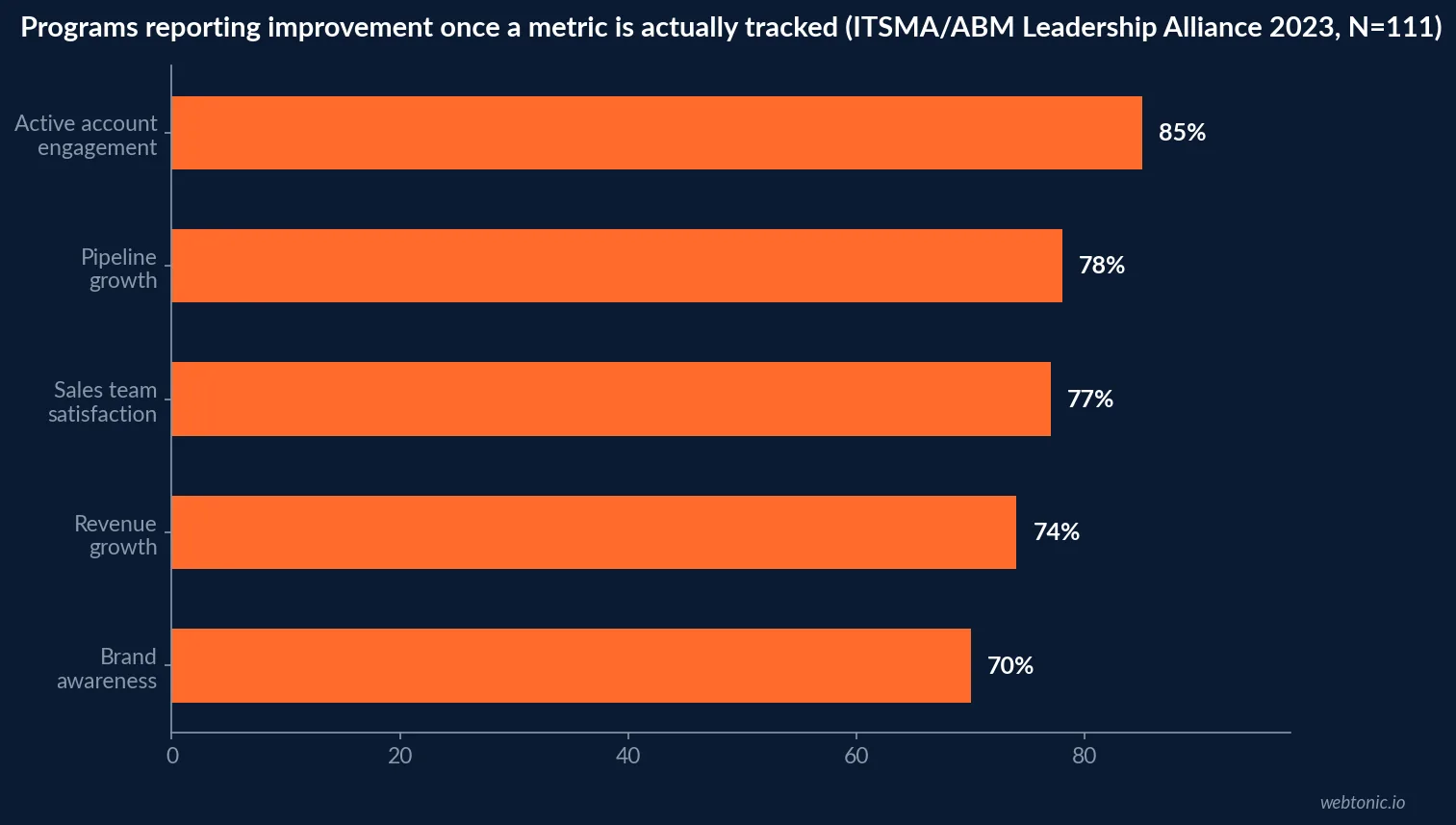
The upside case is real, not theoretical - it just depends on measurement actually happening. Among the 111 programs ITSMA tracked results for, 85% reported improved active engagement with selected accounts, 78% reported pipeline growth, 77% reported better sales team satisfaction, 74% reported revenue growth, and 70% reported improved brand awareness within target accounts. Those numbers describe programs that measured, not every program that tried.
The alignment problem behind the miss
N.Rich's 2025 State of ABM report, surveying 107 B2B go-to-market leaders, found 67% treat ABM as a core go-to-market motion - yet only 26% describe their own program as a success, just 22% run it on a dedicated platform, and only 31% agree marketing and sales collaborate effectively on it. For a plumbing company with a separate commercial division and residential sales team, that last figure is usually the real cause of a missed target: the commercial division's account list and the marketing team's target list were never actually reconciled.
| Alignment/maturity signal | Share of 107 teams | Source |
|---|---|---|
| Treat ABM as core GTM motion | 67% | N.Rich State of ABM 2025 |
| Marketing and sales agree they collaborate well | 31% | N.Rich State of ABM 2025 |
| Call their own program a success | 26% | N.Rich State of ABM 2025 |
| Run ABM on a dedicated platform | 22% | N.Rich State of ABM 2025 |
The commercial accounts that should be the actual target
Fixing the measurement gap only matters if the account list underneath it is real. For a plumbing company's commercial division, that means building against BOMA International's 16,500-plus members managing over 10.5 billion square feet of commercial space, and the Associated General Contractors of America's 6,500-plus leading general contractors among its 27,000-plus member firms - the multifamily developers and property managers who actually decide plumbing subcontracts and maintenance contracts, not individual homeowners.
| Commercial account type | Sizing source | Reported figure | Plumbing relevance |
|---|---|---|---|
| Building owners & managers | BOMA International, 2024 | 16,500+ members, 10.5B+ sq ft | Maintenance and re-pipe contract decisions |
| General contractors | AGC of America, 2025 outlook | 6,500+ leading GCs of 27,000+ firms | New multifamily/commercial construction bids |
| Facility managers | IFMA, Jan 2025 | 25,000+ members, 140+ countries | Multi-site plumbing maintenance contracts |
| High-spend property teams | BOMA attendee data, 2024 | 64% spend USD 1M+/yr on building products | Budget already exists for the plumbing contract |
The ABM Leadership Alliance's benchmark study summary also notes that the highest-scoring programs in its dataset run a defined account list against more than one channel at once - digital, events, and direct outreach together - rather than a single tactic run in isolation. For a plumbing company's commercial division, that argues for pairing the digital ABM platform above with the same face-to-face relationship-building estimators are likely already doing informally with GCs and property managers, rather than treating the two as competing budgets.
How the same misalignment shows up in what gets budgeted
The budget-side evidence tells the same story as the metrics-side evidence. ITSMA's 2023 data shows programs typically fund pipeline and revenue reporting first (the 67% and 63% figures above) because those numbers are the easiest to defend in a budget review, while account engagement and win-rate tracking - the metrics that would actually show a plumbing company's estimators which named accounts are converting - get funded last, at 33% and 28%. That funding order is backwards for a trade where the estimator relationship, not the marketing touchpoint, usually closes the deal.
A plumbing company correcting for this should budget the win-rate and account-engagement tracking first, even before adding a second channel or a bigger account list, since those are the two metrics most programs currently skip.
| Funding order (as commonly implemented) | Share tracking it | Funding order (recommended for plumbing) |
|---|---|---|
| Pipeline growth | 67% - funded first | Fund third |
| Revenue growth tied to ABM | 63% - funded second | Fund fourth |
| Account engagement | 33% - funded third or skipped | Fund first |
| Win rate / deals closed | 28% - funded last or skipped | Fund second |
A plumbing-specific reading of the alignment gap
Multifamily and commercial plumbing sits in an unusual spot: the field crews and estimators often already have informal relationships with the property managers and GCs on a company's biggest accounts, but that relationship knowledge rarely makes it into a marketing team's target list. That is very likely the practical cause behind N.Rich's 31% alignment figure for a plumbing company specifically - the account list marketing is running ABM against and the account list estimators already have live relationships with are two different documents, maintained by two different teams, updated on two different schedules.
Closing that gap costs nothing in tooling budget - it is a shared spreadsheet and a monthly review - and it is the single highest-leverage fix implied by every figure in this article, ahead of any platform purchase.
Closing the gap: budget and measurement together
B2B programs averaged 30% of total marketing budget on ABM in 2023, per ITSMA, with 66% planning to raise it again in 2024. For a plumbing company, the fix implied by all of the data above is not necessarily more budget - it is reallocating part of that budget toward the measurement and alignment work most programs skip: tracking win rate alongside pipeline, giving sales and marketing a shared account list, and choosing a dedicated platform over spreadsheets before scaling spend.
For the reporting infrastructure this requires, see Web Tonic's data intelligence services, for the account-based growth strategy layered on top see Web Tonic's growth marketing services, and to review a commercial-account list, contact Web Tonic.
Frequently Asked Questions
Why do so many plumbing ABM programs miss the target account?
Because tracking a metric and improving against it are not the same thing. ITSMA's 2023 ABM Benchmark Study shows 67% of programs track pipeline growth as a metric, but N.Rich's 2025 survey of 107 B2B teams found only 26% describe their own program as successful. The most common failure point is not the account list - it is the gap between measuring activity and measuring the result sales actually cares about.
What does 'success' even mean for a plumbing ABM program?
By the B2B benchmark data, a successful program is one that is measured at all: only 52% of ABM programs measure ROI in the first place, per ITSMA. Among programs that do measure, the results are strong - 85% report improved account engagement and 78% report pipeline growth - which means the honest fix for most underperforming plumbing programs is measurement discipline, not a bigger budget.
Is the marketing and sales alignment gap really that bad?
Yes, by the industry's own numbers. N.Rich's 2025 State of ABM report found only 31% of teams agree marketing and sales collaborate effectively on ABM, even though 67% say ABM is a core part of their go-to-market motion. For a plumbing company running a commercial division alongside a residential business, that misalignment usually means the field sales team and the marketing team are targeting different accounts without realizing it.
What are the actual named accounts a plumbing ABM program should target?
Commercial and multifamily property operators, not homeowners. BOMA International represents 16,500-plus members managing over 10.5 billion square feet of commercial space, and the Associated General Contractors of America counts 6,500-plus leading general contractors among its 27,000-plus member firms - both are real, buildable target lists for a plumbing company's commercial and new-construction divisions.
Does more tracking automatically fix a plumbing ABM program?
No - it has to be the right metric. ITSMA's data shows the most commonly tracked metrics are pipeline growth (67%) and revenue growth tied to ABM (63%), but account engagement is tracked by only 33% and win rate/deals closed by just 28%. A program that tracks pipeline but not win rate can look busy while still missing the accounts that actually convert.
Sources
Momentum ITSMA & ABM Leadership Alliance, 2023 ABM Benchmark Study
N.Rich, 2025 State of ABM report
BOMA International, 2025 fact sheet
Associated General Contractors of America, construction data
ABM Leadership Alliance, 2023 benchmark study summary
IFMA, membership announcement