Table of contents
LinkedIn cannot sell a $45-a-month quarterly plan profitably. It can sell a $30,000-a-year facility contract, and that is the only pest control use case the 2026 cost data supports.
Key Takeaways
- Cross-industry LinkedIn CPC reached $5.74 in 2026, up 9% year over year.
- Average LinkedIn CPM is $33.80 and average CPL is $94.
- Manager-level targeting costs $5.62 CPC and $89 CPL; C-suite costs $14.85 and $278.
- Native Lead Gen Forms convert at 6.1% with 28% drop-off versus 65% off-platform.
- Account-based audiences convert 2.7x better and cut CPL 38% versus broad targeting.
- The audience sweet spot for ABM is 50–500 companies.
- Document Ads generate 3.4x more dwell time and 2.6x more leads per dollar than static images.
- Professional services carry the platform's cheapest CPL at $40–$85.
- LinkedIn reaches over 1.05 billion members with 310 million monthly actives.
- 70% of B2B marketers rate LinkedIn their highest-quality lead source.
- A commercial pest control contract averages $30,000–$50,000 a year versus $1,500–$3,000 residential lifetime value.
- 95.5% of commercial pest control revenue is contracted.
- The commercial segment grew 9.0% against 7.9% for the industry overall.
- Commercial retention exceeds 94% against 82–87% residential.
- A 100,000 sq ft warehouse bills $400–$600 a month; a restaurant bills $85–$100.
- 20.9% of food facility inspections cite pest control violations.
- 80% of the B2B buying journey happens before a vendor is contacted.
- An average B2B purchase now involves 13 stakeholders.
- 74.6% of B2B sales take four months or more; compliance urgency compresses that to 30–90 days.
- Pest control commercial leads cost $40–$75 on Local Services Ads and return 20x–37x first-year ROAS.
What LinkedIn Actually Costs in 2026
Start with the price of the room. Cross-industry LinkedIn Sponsored Content CPC reached $5.74 in 2026, up 9% year over year, with an average CPM of $33.80 and an average CPL of $94. That is the steepest annual CPC rise on the platform since 2022.
| LinkedIn metric | 2026 average | Typical range |
|---|---|---|
| Cost per click | $5.74 | $3.12 (nonprofit) to $7.95 (legal) |
| Cost per thousand impressions | $33.80 | $19.80 to $48.20 |
| Cost per lead | $94 | $40 (professional services) to $180 (cybersecurity) |
| Click-through rate | 0.61% | 0.44% to 0.65% by industry |
| Lead Gen Form conversion rate | 6.1% | Roughly 5x an off-platform landing page |
| Off-platform form drop-off | 65% | 28% for native Lead Gen Forms |
| Year-over-year CPC change | +9% | +3% to +12% by vertical |
Two structural facts sit behind those numbers. LinkedIn now reaches more than 1.05 billion members with roughly 310 million monthly active users, and demand for senior audiences keeps compressing impression supply. Cheap clicks are not coming back.
Seniority, Not Industry, Sets the Price
For pest control the buyer is a facility manager, an operations manager or a food-safety director — which puts the media plan squarely in the mid-seniority band where LinkedIn is still affordable.
| Seniority targeted | Avg CPC | Avg CPL | Pest control relevance |
|---|---|---|---|
| C-suite (CEO, CFO, COO) | $14.85 | $278 | Only for multi-site national accounts |
| VP / SVP | $11.20 | $202 | Chain operations and procurement leadership |
| Director | $8.40 | $144 | Food-safety and facilities directors |
| Senior manager | $6.95 | $112 | Regional facilities management |
| Manager | $5.62 | $89 | The core facility manager buyer |
| Senior individual contributor | $4.20 | $67 | Site maintenance leads |
| Individual contributor | $3.18 | $48 | Rarely a decision maker |
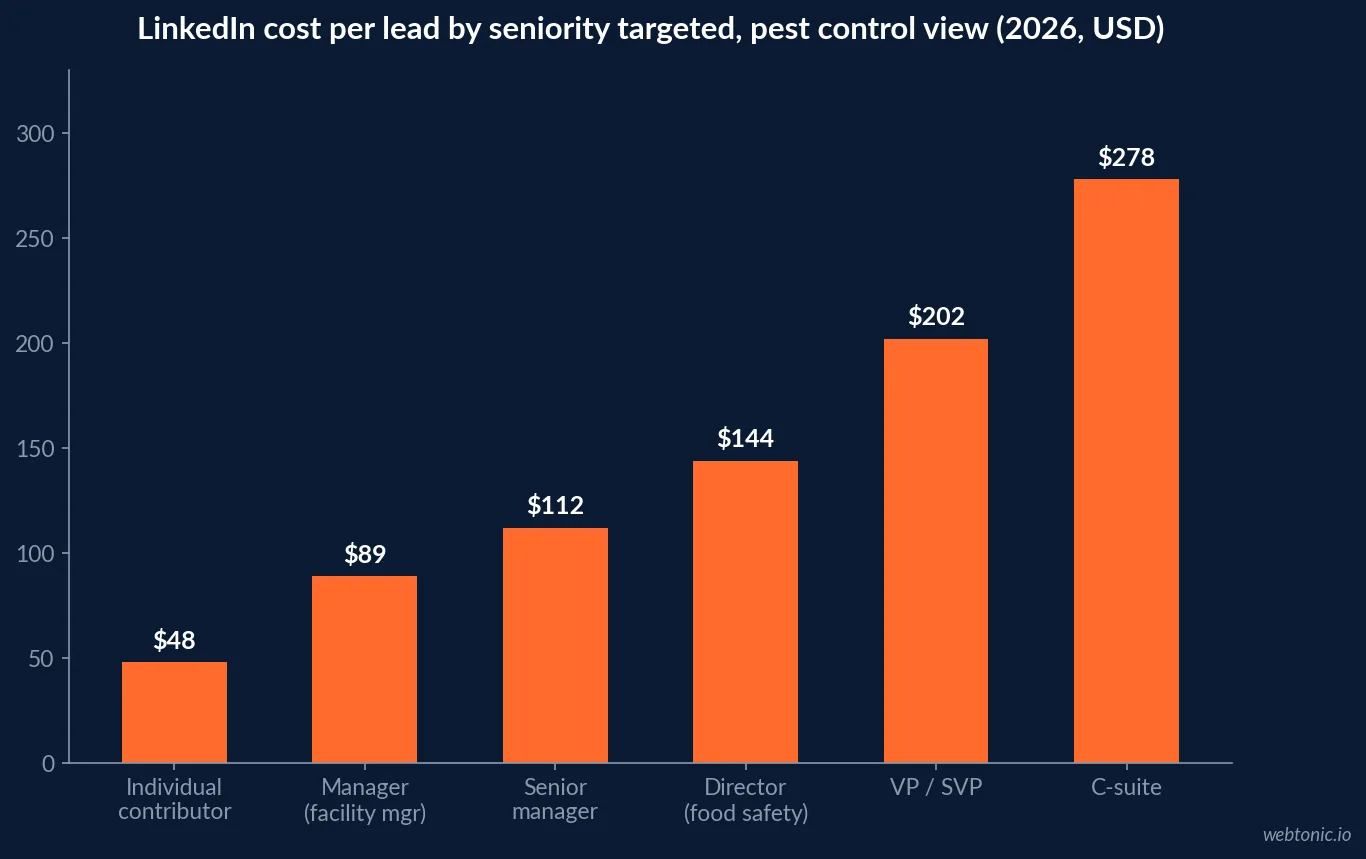
Targeting up the ladder without a reason is the most common way pest control advertisers waste money here. A warehouse operations manager approves a monthly pest programme; the CFO does not. Buying $278 leads to reach the person who signs a purchase order that the manager already specified triples the cost of the same contract.
Format choice pulls the price the other way. Thought Leader Ads run at roughly $2.29 CPC with a 2.68% CTR, against a platform CPC band of $5.26–$8.50 — a meaningful discount for a category where a named technical expert is genuinely more credible than a company page.
Why Residential Pest Control Fails the Math
Residential demand is urgent, local and phone-driven, and it is already served by cheaper channels. Pest control Local Services Ads leads run $15–$28 each with a 38–45% book rate, while commercial contract leads cost $40–$75 and return 20x–37x first-year ROAS. Against a $94 LinkedIn CPL for a homeowner who was not searching for anything, the comparison is not close.
| Channel | Cost per lead | Book / close signal | Best fit |
|---|---|---|---|
| Local Services Ads (residential) | $15–$28 | 38–45% book rate | Same-day residential demand |
| Local Services Ads (commercial) | $40–$75 | 20x–37x first-year ROAS | Small commercial accounts |
| Google Ads search | ~$5.99 CPC | Emergency intent converts fastest | Both, split by intent |
| LinkedIn broad targeting | $94 average | 6.1% form conversion | Awareness among facility staff |
| LinkedIn ABM audiences | ~38% below broad | 2.7x conversion lift | Named multi-site targets |
| LinkedIn C-suite targeting | $278 | Long cycle, committee decision | National account pursuit |
The rule of thumb is simple: if the buyer would type “exterminator near me” into a phone, LinkedIn is the wrong surface. If the buyer would never search at all because pest control is a renewable line item in a facilities budget, LinkedIn is one of the only surfaces that reaches them by job title. Our growth marketing work on home services accounts almost always keeps the residential budget on paid search and reserves social for the commercial pipeline.
The Commercial Contract Is the Only Prize Worth the CPL
Commercial economics are what make an expensive channel defensible. A residential customer is worth $1,500–$3,000 over the relationship while a commercial account under annual contract averages $30,000–$50,000, with 95.5% of commercial revenue contracted and the commercial segment growing 9.0% against 7.9% industry-wide.
| Commercial fact | Figure | Effect on media planning |
|---|---|---|
| Annual contract value | $30,000–$50,000 | Supports a $600–$1,200 acquisition cost |
| Residential lifetime value | $1,500–$3,000 | Cannot fund a $94 CPL at low close rates |
| Commercial revenue under contract | 95.5% | Predictable renewal, low churn risk |
| Commercial segment growth | 9.0% | Faster than the 7.9% industry rate |
| Sales cycle | 60–90 days typical | Requires nurture, not a single form fill |
| Stakeholders per B2B purchase | 13 | Multiple job titles must be targeted |
| Journey completed before vendor contact | 80% | Content has to do the early selling |
Three to five commercial contracts can lift a mid-size operator’s revenue 20–30% without proportional overhead, because route density improves as facility stops cluster. That is the real return being bought with a $144 director-level lead.
Compliance Buyers Are the Highest-Value Audience
The best LinkedIn audience in this category is not “businesses” — it is regulated facilities that cannot cut pest control from a budget. A 100,000 sq ft facility generates $400–$600 a month at 94% retention against $85–$100 a month for restaurants at 82–87%, and 20.9% of food facilities are cited for pest control violations — the most frequent FDA inspection issue.
| Facility type | Monthly value | Retention | LinkedIn targeting angle |
|---|---|---|---|
| Food warehouse / distribution | $400–$650 | 94%+ | FSMA documentation and audit readiness |
| Food processing | Premium of 3–5x base | 94%+ | Outcome-based service level agreements |
| Healthcare facilities | Contract-based | 94%+ | Joint Commission compliance evidence |
| Property management portfolios | Portfolio pricing | High | Tenant satisfaction and turnover |
| Restaurants | $85–$100 | 82–87% | Volume play, weakest LinkedIn fit |
Compliance also fixes the channel’s worst weakness, which is speed. 74.6% of B2B sales take four or more months, but an audit failure compresses the decision to 30–90 days. Creative that leads with documentation, inspection readiness and corrective-action turnaround therefore converts faster than creative that leads with price. And 65% of warehouse wins expand into portfolios of three to four facilities worth $18,000–$30,000 a year, so the second contract costs nothing to acquire.
Account-Based Targeting Beats Everything Else
Commercial pest control has a finite target list — every qualifying facility inside a service radius is knowable. That is exactly the condition where account-based targeting outperforms. Uploaded company lists combined with persona filters convert 2.7x better than industry plus seniority targeting alone and produce 38% lower CPLs once the audience matures, with a sweet spot of 50–500 companies.
| Targeting approach | Relative performance | When to use it |
|---|---|---|
| Uploaded account list + persona | 2.7x conversion, −38% CPL | Named facilities in the service radius |
| Industry + seniority | Baseline | Market entry, thin data |
| Predictive audiences | +19% CTR, −14% CPL | Scaling after 50+ conversions |
| Broad reach | Cheapest CPM, weakest quality | Brand recall in dense metros |
| Document Ads creative | 3.4x dwell, 2.6x leads per dollar | Compliance checklists, audit guides |
| Thought Leader Ads | ~$2.29 CPC, 2.68% CTR | Named technical expert credibility |
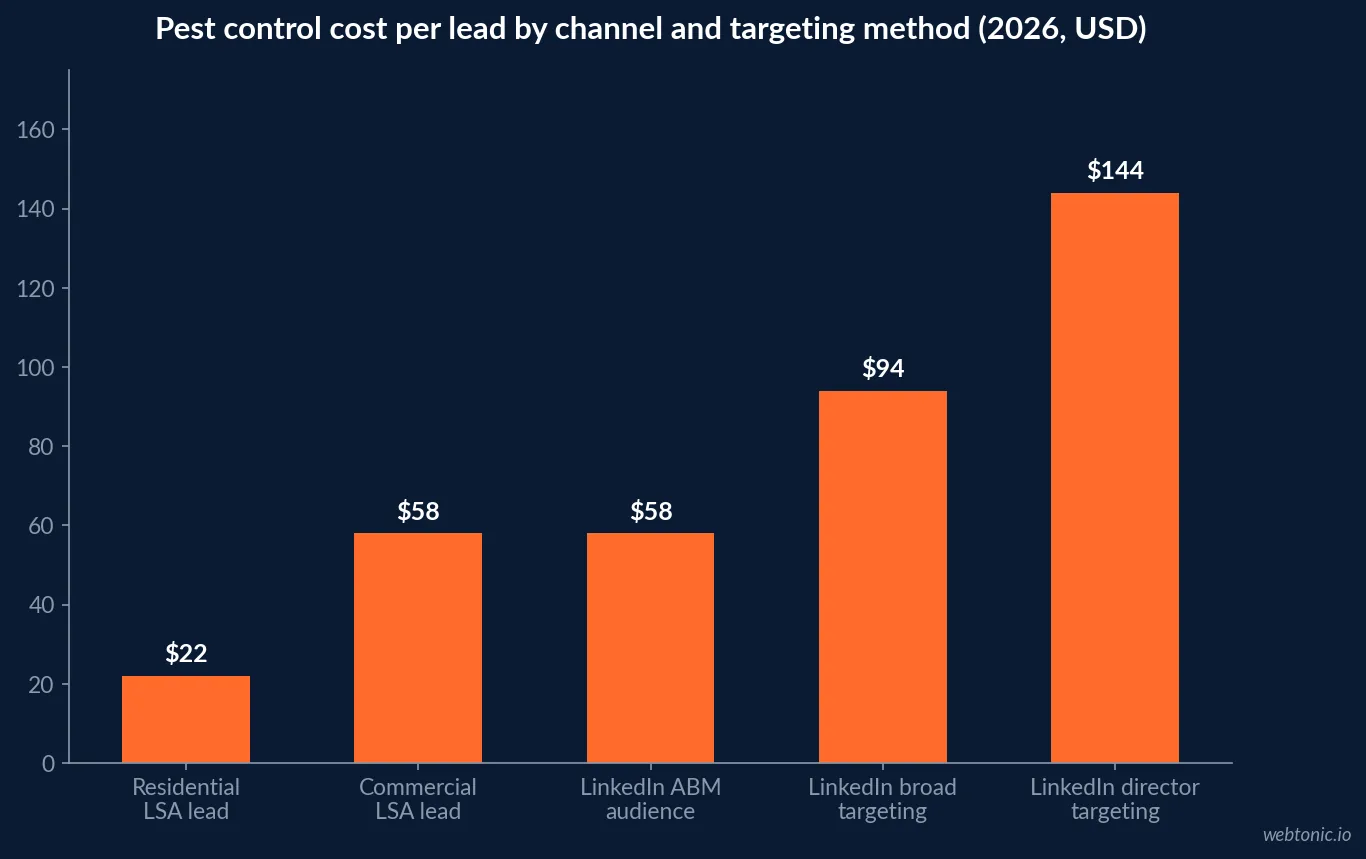
The practical build is a list of every food warehouse, processing plant, hospital, school district and property manager inside the route map, uploaded as a matched audience and layered with facilities, operations and food-safety job functions. Anything broader spends budget on job titles that will never sign a service agreement.
Creative That Works on a Facilities Audience
Facility managers are not buying pest control; they are buying a defensible inspection record. Document Ads dominate for exactly that reason — a downloadable FSMA pest-prevention checklist or a sample monthly inspection log is a genuine work tool, and it delivers 3.4x more dwell time than a static image.
Because 80% of the buying journey is complete before a vendor is contacted, the creative sequence matters more than any single ad. A workable three-stage sequence looks like this: a compliance document for cold accounts, a case study on a comparable facility type for engaged accounts, and a bid-request form for accounts that visited the commercial service page. Sending all three to the same audience simultaneously wastes the cheapest stage.
Retargeting is where the channel earns back its premium. Site visitors who read a commercial programme page are a tiny audience with high intent, and a $5.62 manager-level click against a contract worth $30,000 needs almost no volume to pay. Pair it with measurement discipline — our data intelligence engagements usually find that commercial enquiries are landing in the same untagged bucket as residential calls, which makes the channel look worse than it is.
Sales Follow-Through Decides the ROI
A commercial LinkedIn lead is not a booking. It is a name that needs a bid, a site walk and a service level agreement, and the residential customer service representative is rarely the right person to run that process. Industry survey work published in 2026 found technicians and ownership are the most common sources of sales activity, with outside sales representatives playing a secondary role at most firms — which is a structural problem for a channel that produces committee-based enquiries.
| Stage | Owner | Target | Failure mode |
|---|---|---|---|
| Lead form submission | Marketing | $90–$150 CPL | Broad targeting, wrong job titles |
| Qualification call | Commercial rep or owner | Within 24 hours | Routed to residential CSR queue |
| Site walk and survey | Technical lead | Within 7 days | Scheduled around residential routes |
| Bid and SLA | Owner / sales | 60–90 day cycle | Priced like residential work |
| Portfolio expansion | Account manager | 65% of wins expand | No structured account review |
Budget accordingly. A programme that generates 30 commercial enquiries a quarter at $120 each costs $3,600 in media and demands roughly a day a week of senior selling time. Firms unwilling to fund the second half of that sentence should spend the money on Local Services Ads instead.
How to Read These Benchmarks
Every figure above is a cross-industry average, and pest control is not in most LinkedIn benchmark panels. Use them as a range check, not a target: if your facility-manager CPL is $400, the audience is probably too narrow or the offer too generic, and if it is $30, you are likely reaching individual contributors who cannot buy.
The measurement that actually matters is cost per signed contract, tracked over two quarters. With a 60–90 day cycle and a 13-person buying committee, any judgement made on a single month of CPL data will be wrong. Model the channel the way B2B advertisers do — 80% of social-sourced B2B leads come from LinkedIn, and Lead Gen Forms consistently outperform landing pages on volume while trailing on qualification — and hold the residential budget somewhere cheaper. If you want a second read on the split, our team is happy to look at the account.
Frequently Asked Questions
Do LinkedIn Ads work for pest control companies?
Not for residential work. Cross-industry LinkedIn CPC averages $5.74 and CPL averages $94, which cannot compete with pest control Local Services Ads at $15–$28 per residential lead. LinkedIn only makes sense against commercial contracts, where a single account averages $30,000–$50,000 a year and 95.5% of commercial revenue sits under contract.
What does a LinkedIn lead cost when targeting facility managers?
Seniority drives the price. Manager-level targeting averages a $5.62 CPC and $89 CPL, director level $8.40 and $144, and C-suite $14.85 and $278. Facility and operations managers usually sit in the manager-to-director band, so plan on $90–$150 per raw lead.
How many leads does it take to win one commercial pest control contract?
Commercial pest control closes on a 60–180 day cycle with an average of 13 stakeholders involved in a B2B purchase. At a $120 CPL and a 10–20% lead-to-contract rate, effective acquisition cost lands near $600–$1,200 against a contract worth $18,000–$30,000 a year.
Are LinkedIn Lead Gen Forms better than sending traffic to a landing page?
For volume, yes. Native Lead Gen Forms convert at about 6.1% with a 28% drop-off, against 65% drop-off when traffic is pushed to an external form. Landing-page leads are fewer but qualify better, so most commercial pest programmes run forms for the top of the funnel and pages for bid requests.
Which pest control verticals justify LinkedIn spend?
Compliance-driven facilities. 20.9% of food facilities are cited for pest control violations, making service non-discretionary, and a 100,000 sq ft warehouse bills $400–$600 a month at 94% retention versus $85–$100 for a restaurant at 82–87%.
Sources
Digital Applied — LinkedIn Ads Benchmarks 2026
Foundry CRO — LinkedIn Ads Benchmarks by Industry 2026
Leadfeeder — LinkedIn Statistics 2026
GTM 8020 — LinkedIn Ads Statistics for B2B Lead Generation
Cube Creative — Commercial Pest Control Marketing Guide
Convex — Warehouse Pest Control Contract Values
PipelineOn — Pest Control Digital Marketing 2026
PCT — NPMA Survey on Pest Control Sales Sources