Table of contents

Personal injury law is one of the few Google Business Profile categories where the profile, Local Services Ads and a background check are structurally linked - a suspension on one channel can take out the other two at the same time. This page separates what any GBP tool can manage from what genuinely needs someone who has cleared Google's screening process before.
Key Takeaways
- 70% of cases at some personal injury firms now come through Local Services Ads, per Whitespark's contributor data, even when the same firm ranks well organically.
- Lawyers are classified as individual practitioners under Google's own Business Profile guidelines, alongside doctors and real estate agents.
- Support staff are not eligible for their own Business Profile under those same guidelines.
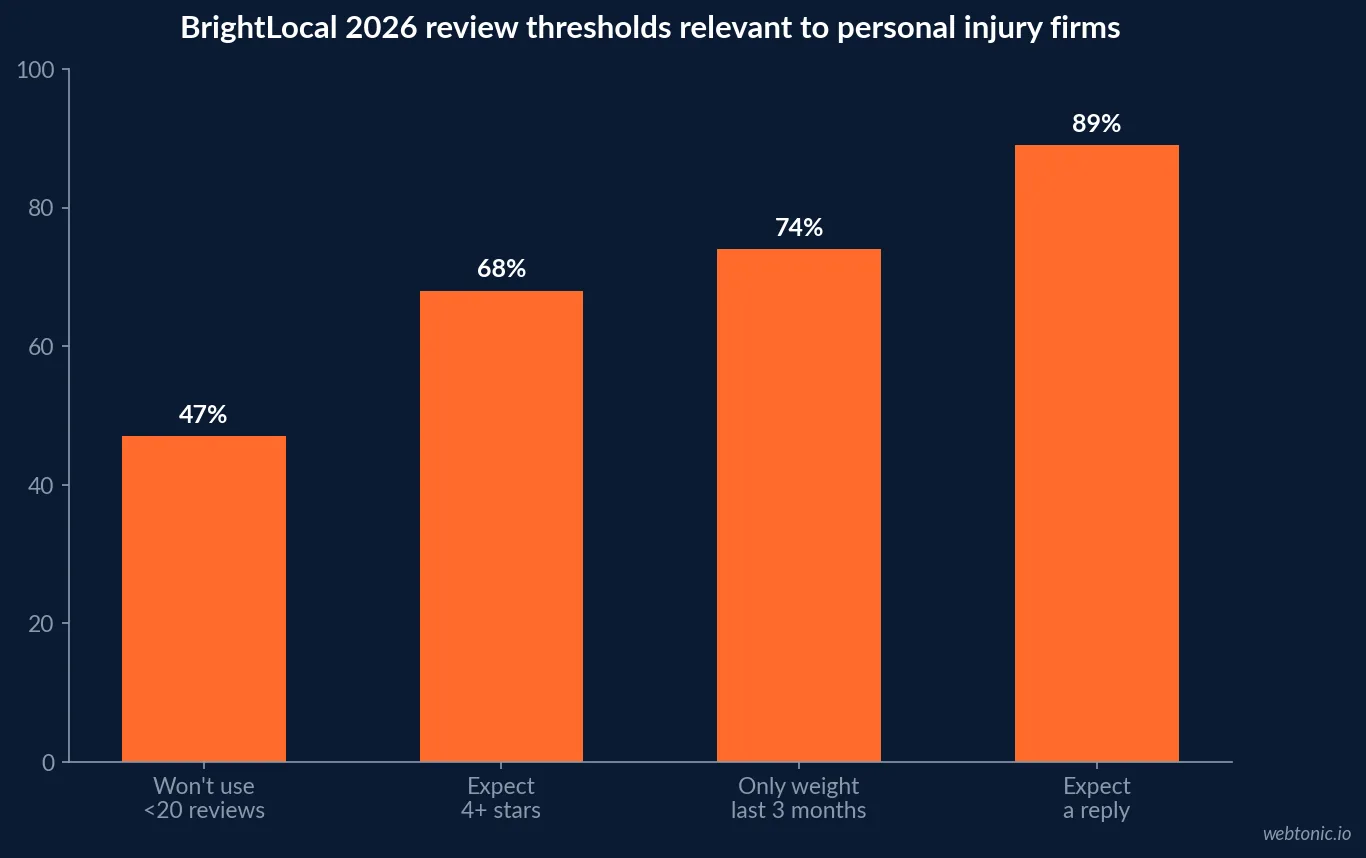
- 47% of consumers won't use a business with fewer than 20 reviews (BrightLocal LCRS 2026).
- 68% expect at least a 4-star average before they will consider a business (BrightLocal LCRS 2026).
- 74% only weight reviews written in the last three months (BrightLocal LCRS 2026).
- 89% expect a business to reply to its reviews (BrightLocal LCRS 2026).
- Google's Local Services screening runs identity and criminal-history checks on the business owner and field-worker roster in required categories.
- A company-level check covers civil litigation history - judgments and liens - as part of that same Local Services screening.
- A hard suspension blocks both the map listing and Local Services Ads until reinstatement, per Google's own suspension-risk guidance.
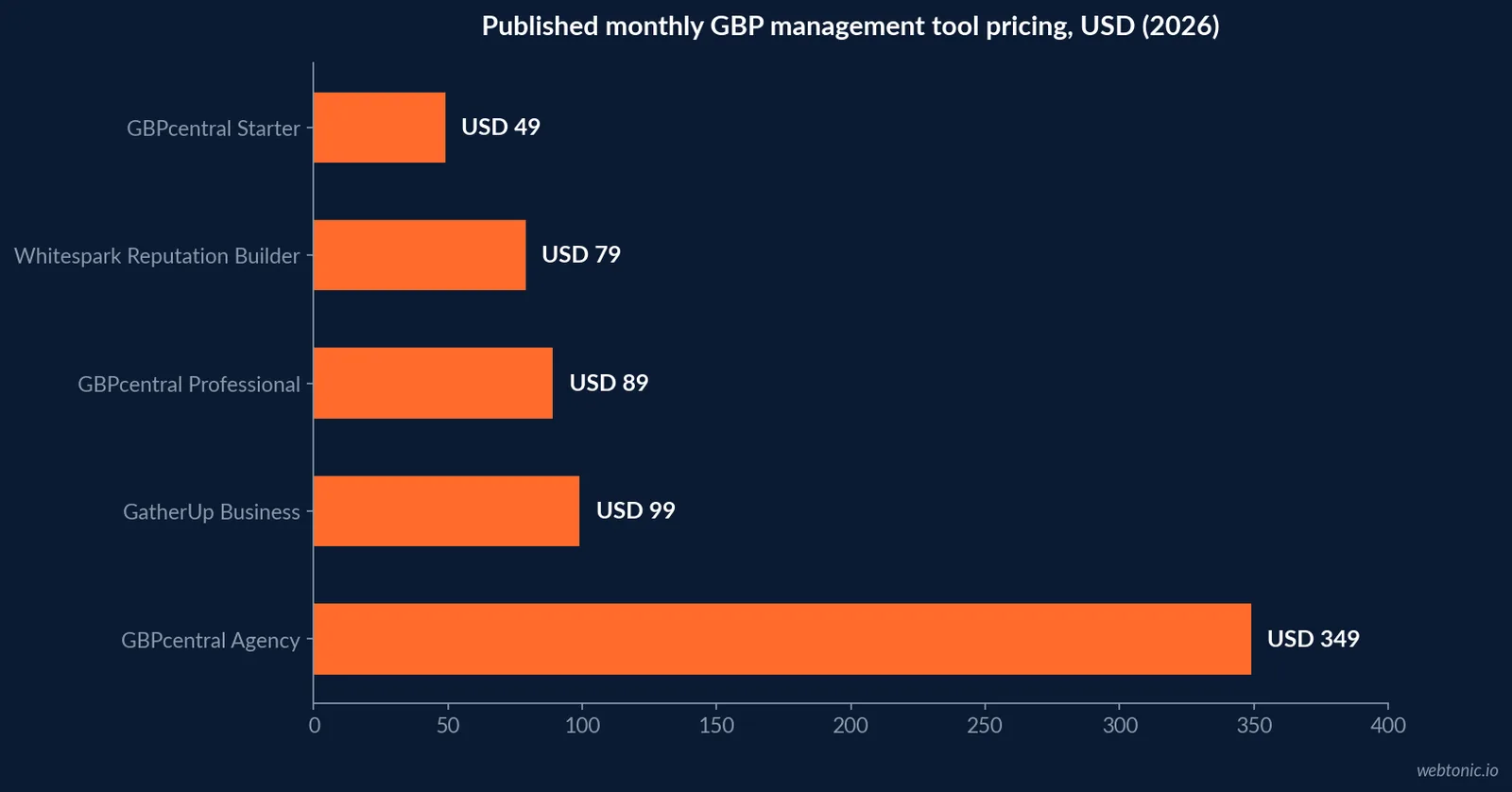
- Published GBP tool tiers run USD 49 to 349 a month across GBPcentral, Whitespark and GatherUp.
- Whitespark's contributors rank Reviews among the top 4 local ranking factors for 2026, alongside budget and bidding, service selection and response times.
- Review signals and behavioural signals gained importance in Whitespark's 2026 weighting compared with prior editions.
- 3 of the top 5 AI Search visibility factors are citation factors in the same 2026 report.
- Reply speed splits consumers into three tiers: 19%, 32% and 81% want a reply within different windows, per BrightLocal LCRS 2026.
- Google's own Performance report defines calls, direction requests and website clicks as the three trackable actions off a profile.
| Signal (2026) | Figure | Source | What it means for a PI firm |
|---|---|---|---|
| Case share via Local Services Ads | 70% (illustrative client data) | Whitespark 2026 Local Search Ranking Factors | LSA can outrun organic and local pack combined |
| Review floor to be considered | 47% won't use <20 reviews | BrightLocal LCRS 2026 | Under 20 reviews is a visible handicap |
| Star-rating floor | 68% expect 4+ stars | BrightLocal LCRS 2026 | A 3.8 average filters out most callers |
| Recency window that counts | 74% only weight last 3 months | BrightLocal LCRS 2026 | Review requests need to be continuous, not seasonal |
| Reply expectation | 89% expect a reply | BrightLocal LCRS 2026 | An unanswered 1-star review reads as unmanaged |
| Published GBP tool cost range | USD 49-349/month | GBPcentral, Whitespark, GatherUp, Vendasta pricing pages | Software floor before any agency labor is added |
Why this category runs its profile and its ad channel through the same door
Personal injury is a Local Services Ads category, and Local Services Ads sit directly beside the map pack for the exact searches a Google Business Profile is trying to win. Whitespark's 2026 Local Search Ranking Factors report - a survey of 47 local search experts scoring 187 ranking factors - includes a contributor note on exactly this dynamic: some personal injury clients "rank extremely well in both local and organic results, but still drive 70% of their cases through Local Services Ads." The profile and the ad placement are not competing channels for this category; they are stacked in the same result.
Practitioner listing vs firm listing: the rule that gets this category suspended
Google's own guidelines for representing your business on Google name lawyers explicitly as individual practitioners, in the same bracket as doctors, dentists and real estate agents. The rules are specific: a practitioner should create a dedicated profile only if they are public-facing and can be contacted directly at the verified location; support staff should not create their own Business Profiles; and a lawyer cannot run multiple profiles to cover different specializations. Where one location has several public-facing attorneys, the firm needs its own profile plus one profile per attorney, and the attorney's profile is titled with their name only, not the firm's brand.
Solo practitioners get the opposite instruction. If a lawyer is the only public-facing attorney at a branded location, Google's guidance is to share one profile with the firm, formatted as "[Firm]: [Attorney Name]". Firms that create separate profiles for every associate regardless of these rules are the ones most likely to trip a duplicate-listing or misrepresentation review.
| Situation | Correct Google Business Profile structure | Common mistake |
|---|---|---|
| Solo attorney, sole public-facing lawyer at the address | One shared profile: 'Firm: Attorney Name' | Separate profiles for the firm and the attorney |
| Multiple public-facing attorneys, one address | One firm profile + one profile per attorney (name only) | Attorney profile titled with the firm's brand name |
| Paralegals, intake staff, case managers | No individual Business Profile | Support staff issued their own listing to 'own' a search term |
| Attorney covering several practice areas | One profile, categories reflect all areas | Multiple profiles split by specialization |
| Firm with multiple offices | One profile per staffed location | One profile serving several unstaffed addresses |
The screening a firm clears before Local Services Ads will even run
Google's own Local Services screening and verification process requires background checks "for select users in the US and Canada," varying by category and location. Where required, the check covers identity and criminal history for the business owner and field-worker roster, including cross-checks against national sex offender, terrorist and sanctions registries, plus a company-level review of civil litigation history - judgments and liens - from federal and state courts. Google is explicit that the process does not include a credit check or credit pull.
For a firm running this in-house, the renewal cycle is a compliance task with a deadline, not a one-time setup. An agency that has already taken several firms through the same screening tends to know which submission gaps cause a delay before they cause one.
What actually moves rankings, per the people who watch it happen
Whitespark's 2026 survey groups its 187 factors into on-page, review, link and behavioural signals, each scored for local pack/Maps impact, local organic impact, conversion impact and, new for 2026, AI Search visibility impact. The report states plainly that "review signals and behavioural signals" gained weight in the 2026 edition compared with prior years, while on-page and link signals lost some. Separately, Whitespark's own contributor Q&A names the top 4 factors for local businesses generally as Budget & Bidding, Reviews, Service Selection and Response Times - three of which a firm controls entirely in-house.
Citations, meanwhile, are documented making a comeback for a different reason: the same report notes 3 of the top 5 AI Search visibility factors are citation factors, which matters as more legal searches route through AI Overviews and chat-style answers before a click ever happens.
Keyword-stuffed business names are one of the more common self-inflicted risks in this category. Sterling Sky's case study of 50 keyword-stuffing violations - most of them law firms - found enforcement is almost entirely manual and competitor-triggered, that 60% of violators received only a warning rather than a suspension, and that 100% of the study's subjects re-added the keywords after being caught, some doing it more than 8 times without being banned. Weak enforcement is not the same as no consequence: a firm relying on that gap is one competitor report away from a suspension it did not budget time for.
| Ranking factor group (Whitespark 2026) | 2026 trend | Firm-controlled? |
|---|---|---|
| Review signals | Gained importance | Yes - response cadence, volume, recency |
| Behavioural signals | Gained importance | Partly - CTR, driven by listing quality |
| On-page signals | Lost some weight | Yes - categories, services, description |
| Link signals | Lost some weight | Rarely - off-site effort |
| Citation signals | 3 of top 5 AI visibility factors | Yes - NAP consistency across directories |
The reply-speed data that decides whether a review helps or hurts
BrightLocal's 2026 Local Consumer Review Survey puts the reply expectation at 89% of consumers wanting a business to respond to its reviews, with reply-speed preferences splitting into 19%, 32% and 81% across progressively longer acceptable windows. Combined with the 74% of consumers who only weight reviews from the last three months, the practical requirement is a firm answering new reviews inside days, continuously, not in a monthly batch - which is exactly the kind of recurring, low-complexity task that published GBP software tiers are built to support.
In-house, software-assisted or agency: what each tier actually covers
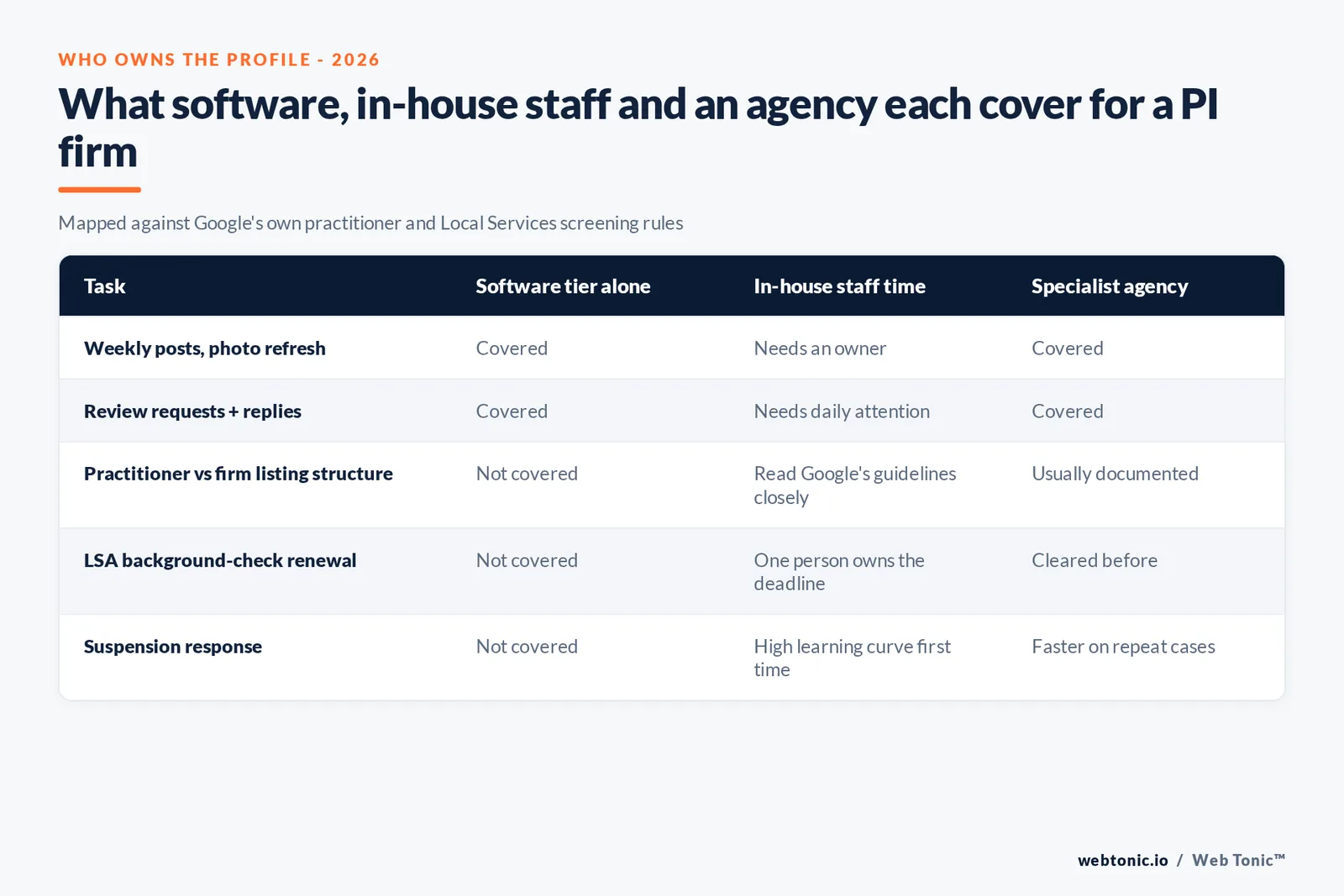
None of the published GBP tool vendors price a "personal injury law" package specifically, so the honest comparison is by task, not by industry-specific rate card. A published USD 49 to 349 a month software tier (GBPcentral, Whitespark's Reputation Builder at USD 79 per location, GatherUp at USD 99, or Vendasta's agency-tier platform starting at a USD 99 monthly minimum for firms managing multiple locations) covers posting cadence, review-request automation and rank tracking. None of it covers the practitioner listing structure above, the Local Services background-check renewal, or responding to a suspension notice - those are judgment calls that a tool does not make for you.
| What needs doing | Software tier alone | In-house staff time | Specialist agency |
|---|---|---|---|
| Weekly posts, photo refresh | Covered | Needs an owner | Covered |
| Review requests + reply drafts | Covered | Needs daily attention | Covered |
| Practitioner vs firm listing structure | Not covered | Needs Google's own guidelines read closely | Usually already documented |
| LSA background-check renewal | Not covered | One person owns the deadline | Has cleared it before |
| Suspension response and reinstatement | Not covered | High learning curve, first time | Faster on repeat cases |
| Published monthly cost | USD 49-349 | Internal labor, no published rate | Retainer, not publicly listed |
What the Performance report actually measures once the profile is live
Google's own Business Profile performance and insights guide defines exactly three trackable customer actions off a listing: calls - clicks on the call button, tracked once a phone number is added - direction requests, and website clicks. Views and searches sit upstream of those three actions, and Google explicitly notes that its direction-request count is adjusted for multiple taps, cancellations and spam, which means the raw number a firm sees is already a cleaned figure, not a click count. For a category where paid search alone can run past USD 130 per lead in high-CPC markets, the free version of the same three actions on the profile is the cheapest lead source a firm has, provided the listing stays live.
| Performance metric | Google's own definition | What a firm should watch for |
|---|---|---|
| Calls | Clicks on the call button; requires a phone number on the profile | A sudden drop can mean the number field was cleared in an edit |
| Direction requests | Adjusted for multiple taps, cancellations and spam | Compare month over month, not week over week - noisy at low volume |
| Website clicks | Clicks on the website link on the profile | Tie to call-tracking or a UTM to see what it actually converts |
| Views and searches | How people found the profile on Search and Maps | Upstream of the three actions above, not an action itself |
The suspension mechanics that make this category riskier to leave unmanaged
Google's Fake Engagement restrictions policy lays out what happens once violative review activity is confirmed on a profile: the listing can lose the ability to receive new reviews or ratings for a set period, have its existing reviews unpublished for a set period, or display a public warning that fake reviews were removed. None of those outcomes are announced in advance, and Google's broader Business Profile policies overview confirms the same restriction mechanism applies across every policy area, not only reviews - which is why a firm running paid Local Services Ads on top of the profile has more to lose from a policy trip than a business relying on organic visibility alone.
| Violation type | Possible restriction | Governing Google policy |
|---|---|---|
| Fake or incentivized reviews | New reviews blocked for a set period | Fake Engagement policy |
| Existing reviews found violative | Reviews unpublished for a set period | Fake Engagement policy |
| Confirmed violation, any policy area | Public warning displayed on the profile | All Business Profile policies |
| Category or listing misrepresentation | Listing edits reverted or profile suspended | Guidelines for representing your business |
What to buy and what to keep in-house
The recurring, low-judgment tasks - posting, review requests, rank checks - are exactly what published software tiers are priced to handle, and a firm with someone assigned an hour a week can run them without an agency. The compliance-shaped tasks - the practitioner/firm listing structure, the background-check renewal, and suspension response - carry a real cost of getting wrong: a lost profile or a paused ad channel in a category where Local Services Ads alone was reported carrying 70% of case volume. That is the part worth paying someone who has done it before, not the part worth automating with the cheapest available tier. Our growth marketing practice handles that split for firms that want the compliance risk owned by someone else, our Google Ads management team works the Local Services Ads side of the same account, and our review and reputation management data covers the response-cadence side of this in more depth across categories.
Frequently Asked Questions
Does a personal injury firm need one profile per attorney or one for the firm?
Both, under specific conditions. Google's own guidelines classify lawyers as individual practitioners: a public-facing attorney with a direct client base can hold a dedicated Business Profile, but support staff cannot, and a solo practitioner who is the only public-facing lawyer at a branded location should instead share one profile with the firm, named in the 'Firm: Attorney Name' format. A firm with several public-facing attorneys at one address needs a firm-level profile plus a separate profile per attorney, titled with the attorney's name only, not the firm's name.
Why does a personal injury firm's profile carry more suspension risk than most local businesses?
Three factors stack: it is a high-CPL, high-competition category where fake-review incentives run high; Google's Fake Engagement policy explicitly allows temporary review freezes and full profile restriction once violative activity is found; and a hard suspension does not just hide the map listing - it also disqualifies the firm from Local Services Ads until reinstatement, which cuts off the channel Whitespark's contributors say already carries a majority of cases for some firms. There is no published industry-wide suspension rate for law firms specifically, so treat this as elevated exposure, not a fixed percentage.
Do personal injury firms need a background check to run Local Services Ads next to their profile?
Yes, in the categories and locations where Google requires it. Google's own Local Services screening process runs identity and criminal-history checks on the business owner and, where applicable, the field-worker roster, plus a company-level check for civil litigation history such as judgments and liens. A firm managing this in-house needs someone who owns the renewal cycle; an agency that has run the process before typically clears it faster the first time.
How many reviews does a personal injury firm need before consumers will actually call?
BrightLocal's 2026 Local Consumer Review Survey puts the floor at 20: 47% of consumers say they won't use a business with fewer than 20 reviews, 68% expect at least a 4-star average, and 74% only weight reviews written in the last three months. For a category where the average consumer is choosing under emotional and financial pressure, that recency requirement means a profile earning reviews in bursts and then going quiet reads as stale within one quarter, not one year.
Is in-house or agency management the better buy for a personal injury firm's profile?
It depends on what is actually being bought. Google-published tool tiers (GBPcentral, Whitespark, GatherUp) cover posting, review requests and rank tracking for USD 49 to 349 a month and work fine for a single-location firm with someone assigned to run them weekly. What software cannot replace is the compliance workload - practitioner-listing structure, LSA background-check renewals and suspension response - which is where agencies that specialize in the category earn the retainer, because they have already cleared the screening process and the reinstatement process more than once.
Sources
Google Business Profile Help - Guidelines for representing your business, individual practitioners
Google Local Services Help - Screening and verification process
Google Business Profile Help - Understand your performance and insights
Google Business Profile Help - All Business Profile policies and guidelines
Google Business Profile Help - Restrictions for Fake Engagement policy violations
Whitespark - 2026 Local Search Ranking Factors report
BrightLocal - Local Consumer Review Survey 2026
GBPcentral - GBP management software pricing
Whitespark - Reputation Builder pricing
GatherUp - Pricing
Sterling Sky - GMB keyword stuffing penalties case study
Vendasta - Pricing