Table of contents
Attorneys & Legal Services carries the highest Google Ads cost per lead of any industry WordStream tracks, at USD 131.63 - so this page compares that search-cost reality against B2B account-based marketing benchmark data for the referral-source relationships a PI firm can target instead of, or alongside, paid search. The unit of analysis is the firm's channel-mix decision, not a single campaign.
Key Takeaways
- Legal has the highest Google Ads CPL of any tracked industry, at USD 131.63.
- That is nearly double the USD 70.11 all-industry average.
- Legal's click-through rate is 5.97%, in line with the broader market.
- But legal CTR rose 12.64% year over year, one of the largest gains tracked.
- Legal's average cost per click is USD 8.58.
- ABM benchmark data is B2B cross-industry, not PI-law specific - read it as a reference.
- Average ABM budget share is 30% of total marketing spend B2B-wide.
- 66% of B2B programs planned to raise ABM spend again in 2024.
- 81% say ABM ROI beats their other marketing.
- Only 52% actually measure ABM ROI.
- A referral-account gifting program starts near USD 20,000 a year on published vendor pricing.
- A mid-size account engagement platform starts near USD 5,000 a month.
- 85% of measured B2B ABM programs saw account engagement improve.
- 78% saw pipeline growth improve once tracked.
- Real Estate and Business Services are the next costliest industries by CPL.
The search-cost reality behind the question
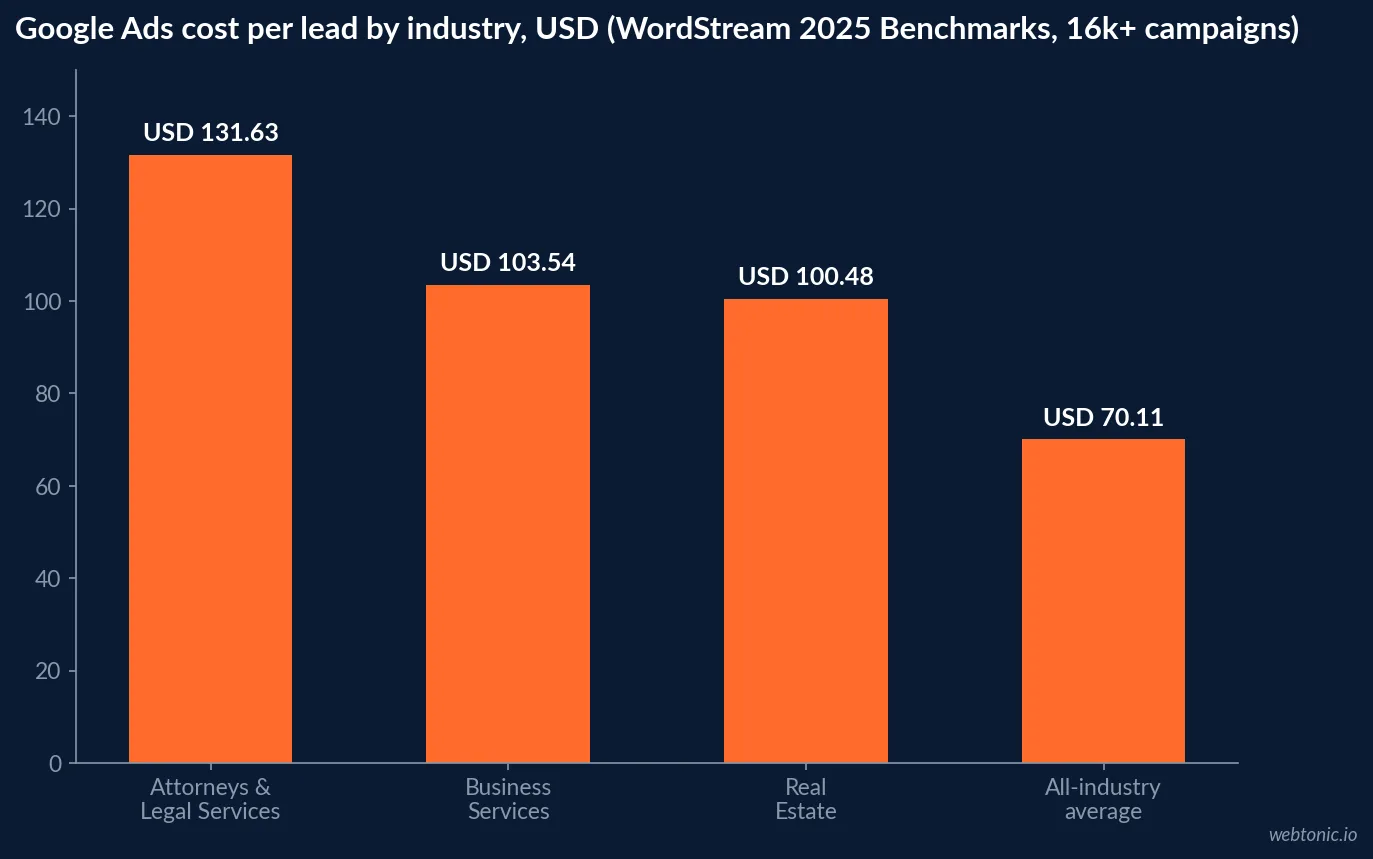
Before weighing any account-based strategy, a PI firm has to start from what search already costs. WordStream's 2025 Google Ads Benchmarks report, built from over 16,000 campaigns running April 2024 through March 2025, puts Attorneys & Legal Services at an average cost per lead of USD 131.63 - the single highest of the 23 industries in the study - against a USD 70.11 all-industry average (itself up 5.13% from USD 66.69 in 2024). Legal's average cost per click is USD 8.58, and its click-through rate is 5.97%, up 12.64% year over year - one of the largest CTR gains WordStream tracked across every industry in the report.
That combination - rising click-through, still-high cost per lead - means the constraint is competition among bidders for the same accident-related terms, not a weak ad. It is also the exact condition under which a separate acquisition channel, aimed at a different audience entirely, becomes worth pricing out.
| Industry | Avg. Google Ads CPL, 2025 | Avg. CTR, 2025 | YoY CTR change | Source |
|---|---|---|---|---|
| Attorneys & Legal Services | USD 131.63 | 5.97% | +12.64% | WordStream 2025 Benchmarks |
| Business Services | USD 103.54 | 5.65% | n/a in excerpt | WordStream 2025 Benchmarks |
| Real Estate | USD 100.48 | 8.43% | n/a in excerpt | WordStream 2025 Benchmarks |
| All-industry average | USD 70.11 | 6.66% | +3.74% | WordStream 2025 Benchmarks |
What ABM honestly means for a PI firm
There is no B2B buying committee evaluating a personal injury case - so a firm applying account-based marketing has to be precise about who the "account" actually is. It is not the accident victim. It is the referral relationship: referring physicians and chiropractors, other law firms passing conflicted or out-of-scope cases, and in some markets, employers or claims adjusters with recurring referral volume. That is a genuinely account-based motion - a named, finite list, engaged over time - but the benchmark data behind ABM budget share, ROI, and tooling cost comes from cross-industry B2B studies, not a PI-law-specific survey, and should be read as a reference point rather than a PI-specific finding.
| Who the 'account' actually is | Not who it is | Why it fits ABM |
|---|---|---|
| Referring physicians and chiropractors | Individual accident victims | Named, recurring relationship over time |
| Other law firms (conflict/overflow referrals) | General public search traffic | Repeat referral volume from one relationship |
| Employers with recurring workplace-injury referrals | One-off consumer leads | Ongoing account, not a single transaction |
The B2B budget and ROI reference points
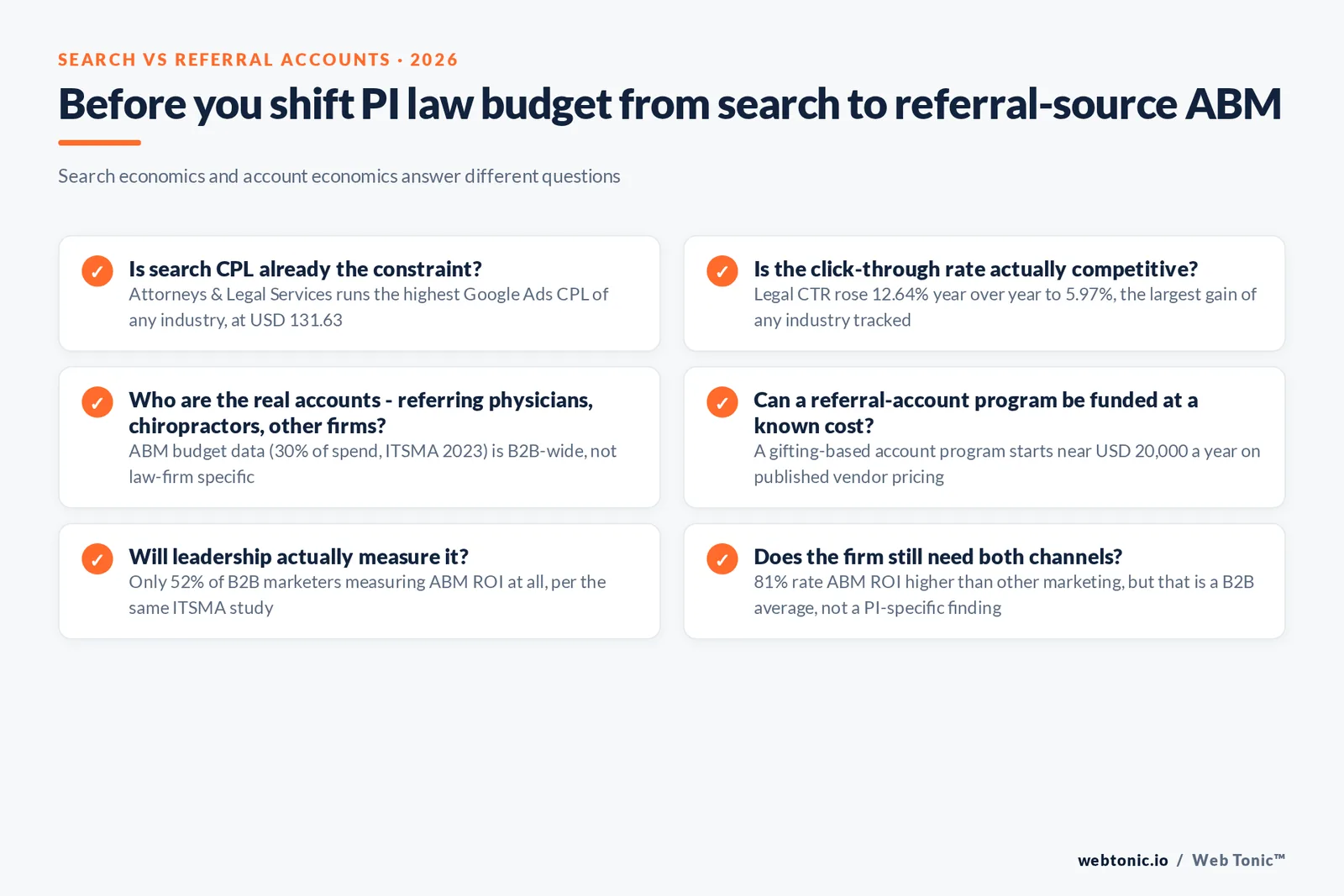
The Momentum ITSMA and ABM Leadership Alliance 2023 ABM Benchmark Study found B2B programs averaged 30% of total marketing budget on ABM, with 66% planning to increase that spend again in 2024. 81% of marketers say ABM ROI beats their other marketing - but only 52% actually measure ABM ROI at all. None of these figures were collected from law firms, and a PI firm should not apply the 30% figure literally to its own budget - it is a directional signal for how seriously B2B marketers now treat account-based work, not a PI-specific target.
| B2B benchmark (cross-industry, 2023) | Reported figure | How to read it for a PI firm | Source |
|---|---|---|---|
| Average ABM share of marketing budget | 30% | A directional signal, not a PI-specific target | ITSMA/ABM Leadership Alliance 2023 |
| Programs raising ABM spend again in 2024 | 66% | The trend is upward across B2B broadly | ITSMA/ABM Leadership Alliance 2023 |
| Say ABM ROI beats other marketing | 81% | An opinion more than half can't prove | ITSMA/ABM Leadership Alliance 2023 |
| Actually measure ABM ROI | 52% | Build measurement before spend, not after | ITSMA/ABM Leadership Alliance 2023 |
What a referral-account program costs to run
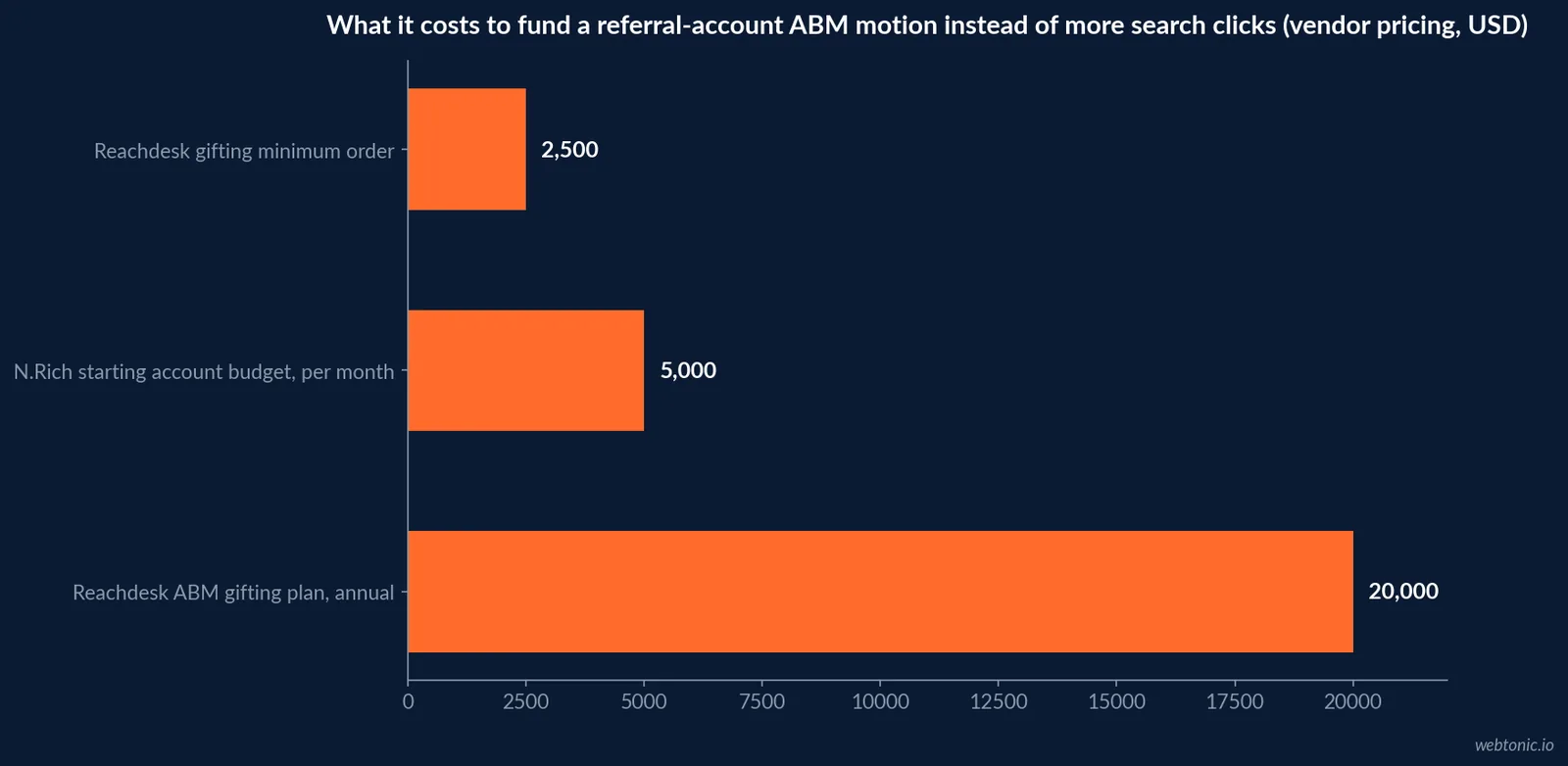
Two published vendor pricing pages give a PI firm a real cost floor for a referral-source program, separate from whatever it spends on search. Gifting and relationship-marketing platform Reachdesk publishes plans starting at USD 20,000 a year, with a USD 2,500 minimum order for custom branded merchandise sourced outside the platform - a fit for physician and referring-attorney relationship gifting. Account-based engagement platform N.Rich states a realistic starting point of USD 5,000 a month for a mid-size digital account program, for firms that want to run paid content toward a named list of referral-source contacts online rather than through physical gifting alone.
| Referral-account program tactic | Published cost | Source |
|---|---|---|
| Custom merchandise, minimum order | USD 2,500 | Reachdesk pricing page |
| Digital account engagement program, monthly | USD 5,000 | N.Rich pricing page |
| Annual gifting plan for a named referral list | USD 20,000/year | Reachdesk pricing page |
The ABM Leadership Alliance's benchmark study summary notes that the highest-scoring cross-industry programs typically combine at least one high-touch tactic - executive events, gifting, in-person outreach - with a digital layer, rather than running either alone. For a PI firm's referral-source program, that maps to pairing a modest gifting budget toward physicians and referring firms with ongoing digital content aimed at the same named list, instead of treating the two as alternatives.
What the upside looks like once it is measured
Among B2B programs that do measure results, ITSMA's 2023 data shows 85% reported improved account engagement, 78% reported pipeline growth, 77% reported better sales-side satisfaction, and 74% reported revenue growth attributed to the program. Translated to a referral-source context, "account engagement" becomes referral volume from a named physician or firm, and "revenue growth" becomes signed cases traced to that relationship - the same discipline, applied to a different definition of the account.
| What gets tracked once measurement is funded | Programs reporting improvement | PI-law translation |
|---|---|---|
| Active engagement with selected accounts | 85% | Referral volume from a named contact |
| Pipeline growth | 78% | New case intake tied to that referral |
| Sales team satisfaction | 77% | Intake team confidence in referral quality |
| Revenue growth attributed to ABM | 74% | Signed-case value traced to the relationship |
Where the CTR gain actually helps, and where it does not
Legal's 12.64% year-over-year CTR gain is genuinely good news for firms already running search - it means more of the auction is clicking through than a year ago, likely reflecting ad formats that blend in with organic results across every industry WordStream tracks, not something PI firms did differently. But a rising CTR does not lower CPL by itself when cost per click is also climbing, and WordStream's data shows legal's CPC at USD 8.58 sits mid-pack even as its CPL leads every industry - the expense concentrates downstream, in the conversion and case-qualification steps, not the click itself. That is a separate problem from channel mix, and one a referral-source program does nothing to fix.
Reading the two data sets together
The honest conclusion is that search and referral-source ABM answer different questions. Search cost per lead at USD 131.63 measures competition for consumer accident-related terms; it does not measure whether a firm has built out its physician and attorney-referral relationships in any structured way. A firm that is losing on search economics and has no referral-source program running in parallel is the clearest case for testing the roughly USD 20,000-a-year gifting-program floor above - not as a replacement for search, but as a second channel priced and measured on its own terms.
For measurement and reporting infrastructure across both channels, see Web Tonic's data intelligence services, for the search-side channel see Web Tonic's Google Ads services, and to review a referral-source account list, contact Web Tonic.
Frequently Asked Questions
Why is the Google Ads cost per lead so high for personal injury law?
Because it is the single most expensive industry WordStream tracks. Its 2025 Google Ads Benchmarks report (16,000-plus campaigns, April 2024-March 2025) puts Attorneys & Legal Services at a USD 131.63 average cost per lead, the highest of the 23 industries in the study, against a USD 70.11 all-industry average. The click-through rate is not the problem - at 5.97%, up 12.64% year over year, legal saw one of the largest CTR gains of any industry tracked. The cost sits in competition for the click, not a lack of clicks.
What does account-based marketing even mean for a personal injury firm - there is no B2B buyer?
The honest frame is that ABM does not target accident victims at all - it targets commercial and professional referral relationships: referring physicians, chiropractors, other law firms passing conflicted cases, and in some markets employers or insurance adjusters. The B2B ABM benchmark data below (budget share, ROI, tooling cost) comes from cross-industry studies, not a PI-law-specific survey, and should be read as a B2B-wide reference applied to that referral-relationship layer of a firm's marketing, never to consumer-facing accident-victim advertising.
Should a PI firm shift budget from search to referral-source ABM?
The data supports treating them as separate budgets rather than swapping one for the other. Search carries the highest CPL of any tracked industry (USD 131.63) precisely because so many firms compete for the same high-intent accident-related terms; referral-source ABM is a different acquisition motion aimed at a small, named list of physicians and firms, priced independently. Published vendor pricing puts a gifting-based account program at roughly USD 20,000 a year to start - a real number to weigh against the marginal cost of the next search click, not a replacement for search.
How much of a marketing budget goes to ABM in general, and does that apply to law firms?
Cross-industry B2B data from the Momentum ITSMA and ABM Leadership Alliance 2023 Benchmark Study puts average ABM budget share at 30% of total marketing spend, with 66% of programs planning to raise it again in 2024. That figure was not collected from law firms specifically, so it should inform - not dictate - how much of a PI firm's referral-development budget goes toward a formal account-based program versus informal relationship-building the firm may already be doing.
Is ABM actually measured, or is it another marketing claim without proof?
By the same benchmark study, only 52% of B2B programs measure ABM ROI at all, even though 81% claim it outperforms their other marketing. A PI firm building a referral-source program should set up tracking for the relationship - referrals received, case value, conversion to signed case - before spending on gifting or events, or it joins the roughly three in ten programs making an unmeasured claim.
Sources
WordStream, 2025 Google Ads Benchmarks
Momentum ITSMA & ABM Leadership Alliance, 2023 ABM Benchmark Study
Reachdesk, pricing page
N.Rich, pricing page
ABM Leadership Alliance, 2023 benchmark study summary