Table of contents
Key Takeaways
- Most painting contractor websites convert under 1% of visitors into leads — conversion-focused sites reach 4–7% (Pixlel).
- Home service landing pages convert at 5–15% versus 1–3% for homepages on identical paid traffic, delivering a 2–4× lift at zero added ad spend (PipelineOn).
- 94% of painting contractor websites are missing key conversion elements that turn browsers into buyers (ResultCalls).
- Contractors who implement proper conversion architecture hit 8–12% conversion rates on the same traffic volume as sub-3% sites (Garrett Handley).
- Color visualization tools increase painting website conversion by 3×, with visitors who try a color before filling out the contact form converting at triple the rate (PaintViz).
- One additional painting job per month from a conversion-optimized website produces $25,200 in gross profit per year — the site pays for itself in under 60 days (PainterWebLab).
A painting contractor's landing page is where ad spend either becomes revenue or evaporates. While most painters invest heavily in Google Ads and Meta campaigns, the page that receives that traffic determines whether clicks convert to estimates. Below, we break down the data on what separates high-converting painting pages from the industry average.
Painting Website Conversion Benchmarks
| Website Type | Avg. Conversion Rate | Top Performer Rate | Source |
|---|---|---|---|
| Standard painting website | Under 1% | — | Pixlel |
| Conversion-focused painting site | 4–7% | — | Pixlel |
| Avg. painting contractor website | 2–3% | — | ResultCalls |
| Quote forms on painter websites | 3–5% | — | PaintViz |
| Painting website (PipelineOn) | 3–4% | — | PipelineOn |
| Home service landing page (paid) | 5–15% | — | PipelineOn |
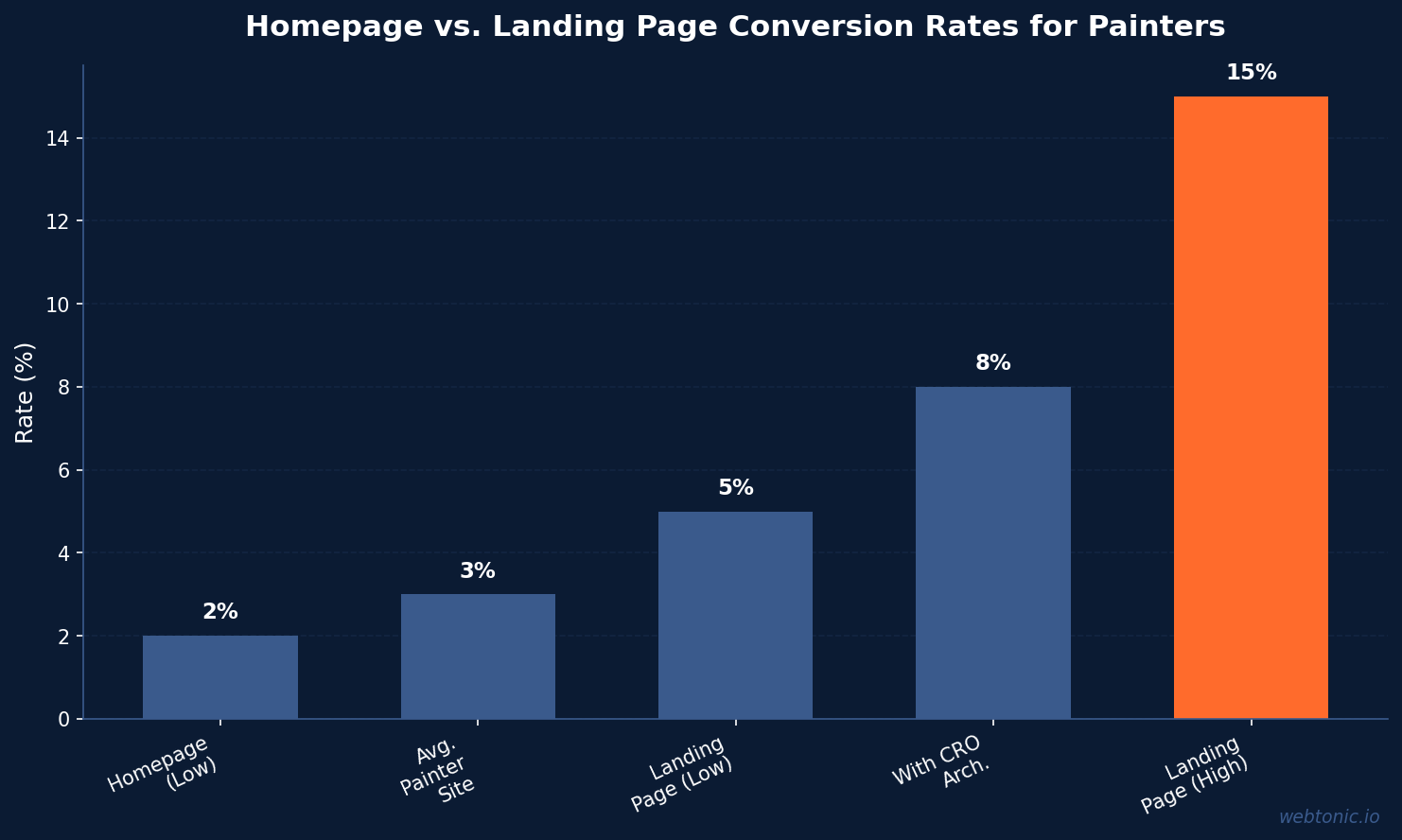
| Contractor conversion architecture | 8–12% | — | Garrett Handley |
| All-industry median LP | 6.6% | — | Unbounce 2024 |
Why Most Painting Websites Fail to Convert
ResultCalls found that 94% of painting contractor websites are missing key conversion elements. The average painting website converts only 2–3% of visitors into leads, meaning 96–97 out of every 100 visitors leave without taking action.
The most common failures fall into four categories:
- No above-the-fold CTA — visitors cannot find how to request an estimate within the first screen.
- Missing social proof — no reviews, no star ratings, no before/after gallery in the hero section.
- Slow load times — image-heavy painting sites without optimization routinely exceed 5 seconds on mobile, where 70%+ of paid home services traffic originates (Axerto).
- No phone number prominence — painting consumers are phone-first buyers; burying the number below the fold kills conversions.
Landing Pages vs. Homepages: The Conversion Gap
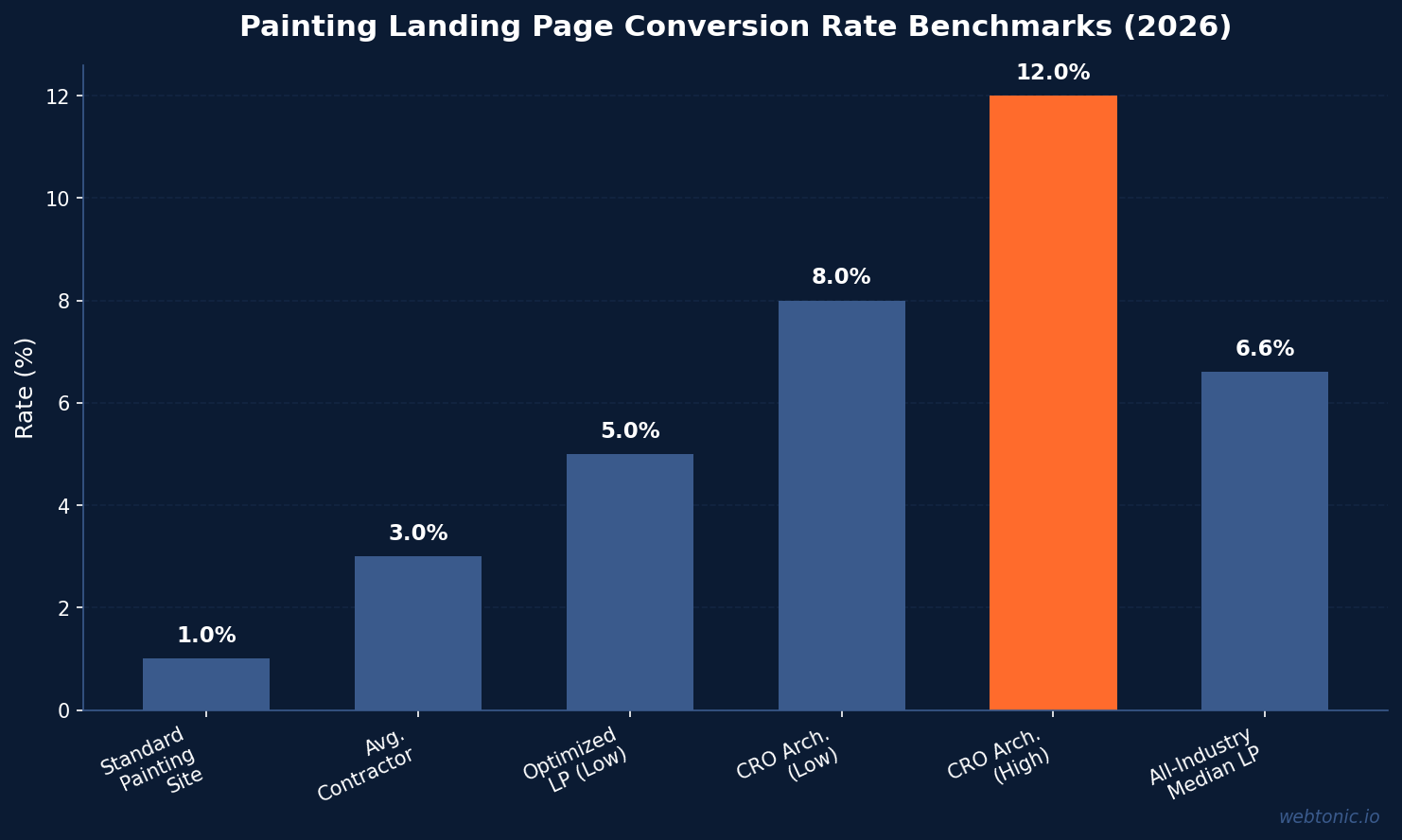
PipelineOn's 2026 analysis quantified the gap clearly: home service landing pages convert at 5–15% versus 1–3% for homepages on the exact same paid traffic. That 2–4× lift comes at zero added ad spend — the only cost is building and testing the dedicated landing page.
The reason is focus. A homepage serves multiple audiences (homeowners, commercial clients, potential employees, past customers) and dilutes the conversion path. A landing page matches the ad's promise exactly: one service, one geography, one call-to-action.
For painters running Google Ads at $13.74 per click, the math is simple. A homepage converting at 2% turns 100 clicks ($1,374) into 2 leads at $687 each. A landing page converting at 8% turns the same 100 clicks into 8 leads at $172 each — a 4× reduction in cost per lead without touching the ad campaign.
Conversion Architecture: What High-Performing Sites Do Differently
Garrett Handley's 2026 analysis found that contractors with proper conversion architecture hit 8–12% conversion rates on identical traffic volume. The gap between a 2% site and a 10% site is not explained by traffic quality, market size, or design aesthetics — it comes down to execution on specific structural elements:
| Conversion Element | Impact on CVR | % of Painting Sites Using |
|---|---|---|
| Above-fold tap-to-call CTA | +40–60% | ~35% |
| Before/after gallery in hero | +25–40% | ~20% |
| Review widget with star ratings | +30–50% | ~40% |
| Pricing context (ranges, not exact) | +15–25% | ~10% |
| Color visualization tool | +200% (3× lift) | <5% |
| Mobile-optimized form (3 fields) | +20–35% | ~45% |
Sources: Garrett Handley, PaintViz, Sharp Line Marketing.
Color Visualization: The Highest-Impact CRO Tool for Painters
PaintViz's Painter Pro case study revealed that visitors who tried a color visualization tool before filling out the contact form converted at 3× the rate of visitors who only saw the standard form. The interactive element creates psychological ownership — once a homeowner sees their house in a new color, they are far more invested in getting a quote.
Despite the massive conversion lift, fewer than 5% of painting contractor websites use a color visualizer. The technology is available as an embeddable widget costing $30–$100 per month, making it one of the highest-ROI conversion optimization investments for painting businesses.
Website ROI for Painting Contractors
PainterWebLab quantified the financial case: one additional job per month from a conversion-optimized website produces $25,200 in gross profit per year. The site pays for itself in under 60 days, even at custom build costs of $3,000–$5,000.
Dan Keenan Paint Company experienced an 887% traffic increase within 14 days of launching a redesigned website with dedicated service-plus-city landing pages. More importantly, Dan reported 2–3× the call volume almost immediately — a direct conversion lift from better page architecture.
PipelineOn reports that the average painting contractor closes 30–40% of estimates, with top performers hitting 50–60%. When combined with a 5–8% landing page conversion rate, the full-funnel math becomes compelling: 1,000 monthly visitors × 6% CVR × 35% close rate = 21 booked jobs.
Mobile Optimization and Page Speed Impact
With 70%+ of paid home services traffic coming from mobile devices (Axerto), mobile performance directly impacts painting landing page conversions. Search Engine Need sets the target at under 3 seconds load time on a 4G connection and a mobile PageSpeed score of 80+.
Kelly WM notes that image-heavy painting sites frequently suffer from poor performance — large before/after galleries without lazy loading and image compression push load times above 5 seconds, directly increasing bounce rates. A custom build with optimized galleries and clean Core Web Vitals consistently outperforms bloated templates.
The cost of speed matters most for Google Ads traffic: each additional second of load time beyond three seconds increases bounce rate by approximately 32%, turning expensive clicks into wasted spend. Painting sites investing in performance monitoring can recapture these lost conversions without increasing ad budgets.
Best Practices for Painting Landing Pages
- Build dedicated landing pages for each service (interior, exterior, cabinet, commercial) rather than sending all paid traffic to the homepage.
- Place a tap-to-call button above the fold — painting consumers are phone-first buyers, and mobile visitors need one-tap access to call.
- Include a before/after gallery within the first scroll — visual proof of work quality converts browsers into requesters.
- Add pricing context with ranges — stating "Most 2,000 sq ft interior jobs run $3,500–$6,500" pre-qualifies leads and eliminates tire-kickers (PainterWebLab).
- Embed a color visualization tool — the 3× conversion lift justifies the $30–$100/month cost for virtually every painting website.
- Keep forms to 3–5 fields maximum — name, phone, project type, and zip code. Every additional field reduces completion rates by 10–15%.
- Optimize images for mobile — compress before/after photos, enable lazy loading, and target under 3 seconds load time on 4G connections.
Landing Page Testing and Iteration Benchmarks
Conversion rate optimization for painting landing pages is not a one-time project — it requires structured testing. A/B testing headline variations alone can improve conversion rates by 10–30% according to industry benchmarks. For painting contractors, the highest-impact test elements in order of priority are: headline copy, hero image selection, CTA button color and text, form length, and social proof placement.
CO Consulting’s 2026 benchmark report based on Unbounce data from 464 million visits shows that the all-industry median landing page conversion rate is 6.6%, with the top 25% of pages converting above 11.2%. Painting contractors who benchmark against these numbers rather than their own historical performance often discover significant untapped conversion potential.
The testing cadence matters as much as the tests themselves. Running one meaningful A/B test every 2–3 weeks produces 15–20 optimization cycles per year, each potentially lifting conversion rate by 3–5%. Compounded over 12 months, this iterative approach can transform a 2% converting page into a 6–8% performer — tripling or quadrupling lead volume from the same traffic and ad spend.
Form Design and Lead Capture Optimization
Form design is the final conversion gate on any painting landing page. Reducing form fields from 7+ to 3–4 typically increases completion rates by 25–40%. The optimal painting lead form collects name, phone number, project type (dropdown), and zip code — enough information for the contractor to qualify the lead during the follow-up call without creating friction during submission.
PipelineOn emphasizes that multi-step forms outperform single-page forms by 15–20% for painting contractors. The technique works because micro-commitments (answering "What type of painting do you need?" before providing contact details) psychologically invest the visitor in completing the process. The first question should always be low-friction and project-related, never personal information.
Click-to-call buttons deserve equal attention. With 38% of painting leads converting directly by phone (ResultCalls), a prominent tap-to-call CTA that works on mobile is non-negotiable. Pages that offer both form and phone options typically capture 20–30% more total leads than form-only pages because they accommodate both preference types — methodical researchers who fill forms and urgent buyers who want to speak immediately.
FAQ
What is a good conversion rate for a painting landing page?
A well-optimized painting landing page should convert at 5–8% for paid traffic. The all-industry median landing page conversion rate is 6.6%, while contractors with proper conversion architecture hit 8–12%. Most painting websites without optimization convert under 3%.
How much does a painting landing page cost?
Template-based painting landing pages cost $30–$100 per month via platforms like Squarespace or Unbounce. Custom-built conversion-focused pages run $3,000–$5,000 one-time. The custom approach typically pays for itself within 60 days through increased lead volume.
Do painting companies need a dedicated landing page for Google Ads?
Yes. Landing pages convert at 5–15% versus 1–3% for homepages on the same paid traffic. At painting's $13.74 average CPC, switching from a homepage to a dedicated landing page can cut cost per lead by 60–75% without changing ad spend.
What elements should a painting landing page include?
The highest-impact elements are an above-fold tap-to-call CTA, a before/after gallery, review widgets with star ratings, pricing ranges, and a color visualization tool. Sites that implement all five elements consistently convert at 8–12% versus the industry average of 2–3%.
How does page speed affect painting landing page conversion?
Each additional second of load time beyond three seconds increases bounce rate by approximately 32%. With 70%+ of painting ad traffic coming from mobile devices, targeting under 3 seconds on 4G and a PageSpeed score of 80+ is critical for maintaining conversion rates.
Sources
Pixlel — Painting Contractor Website Conversion Guide
ResultCalls — Painting Website Conversion Audit
PipelineOn — Contractor Landing Page Tips 2026
PipelineOn — Painting Contractor Marketing
Garrett Handley — Contractor Conversion Rate 2026
PaintViz — Painter Pro Case Study
PainterWebLab — Painting Website Silo Architecture
Oxsome — Dan Keenan Paint Case Study
Sharp Line Marketing — High-Converting Painter Website 2026
Kelly WM — Painting Website Design
Axerto — Home Services Landing Pages
CO Consulting — Conversion Rate Benchmarks 2026