



Table of contents
Outsourcing advertising to a specialized agency can cut costs and accelerate results — companies that outsource lead generation see a 13% higher ROI than those managing campaigns in-house. This guide breaks down when outsourcing makes sense, what it costs, and how to choose the right marketing partner.
Key Takeaways
- 13% higher ROI for companies that outsource lead generation compared to in-house teams, according to 2026 outsourcing statistics.
- In-house marketing costs 2-3x more than outsourcing when accounting for benefits, recruitment, tools, training, and turnover.
- 68% of agency leaders identify paid advertising as the most promising channel for 2025-2026, driven by faster returns and greater control.
- Small businesses outsource for three core reasons: speed, flexibility, and access to specialists they cannot afford full-time.
- Cost per lead typically decreases by 20-40% when advertising is outsourced to a specialized digital marketing agency.
- The global digital marketing outsourcing market is projected to grow at a CAGR of 16.7% through 2028, reflecting accelerating adoption.
What Does Outsourcing Advertising Actually Mean?
Outsourcing advertising means delegating some or all of your paid media planning, execution, and optimization to an external marketing agency or specialist. This can range from a single channel (Google Ads management) to a full outsourced marketing department handling strategy, creative production, media buying, and performance reporting.
The distinction matters because many businesses think of outsourcing as an all-or-nothing decision. In practice, the most effective model is often a hybrid approach: keeping strategic oversight and brand voice in-house while outsourcing the execution-heavy work — media buying, ad creative iteration, A/B testing, and campaign optimization — to a team with specialized expertise and established tool access.
According to Revenue Memo's 2026 agency analysis, the marketing agency industry continues to grow because businesses increasingly recognize that advertising complexity has outpaced what most in-house teams can manage without dedicated platform expertise.
| Outsourcing Model | What You Delegate | Best For |
|---|---|---|
| Project-based | One-time campaigns, audits, or launches | Companies testing agency partnerships |
| Channel-specific | One platform (e.g., Google Ads or Meta Ads) | Teams with partial in-house capacity |
| Full outsource | Complete advertising strategy and execution | Startups or SMBs without marketing hires |
| Hybrid | Strategy in-house, execution outsourced | Mid-market with CMO but no media buyers |

The Real Cost: In-House vs Outsourced Advertising
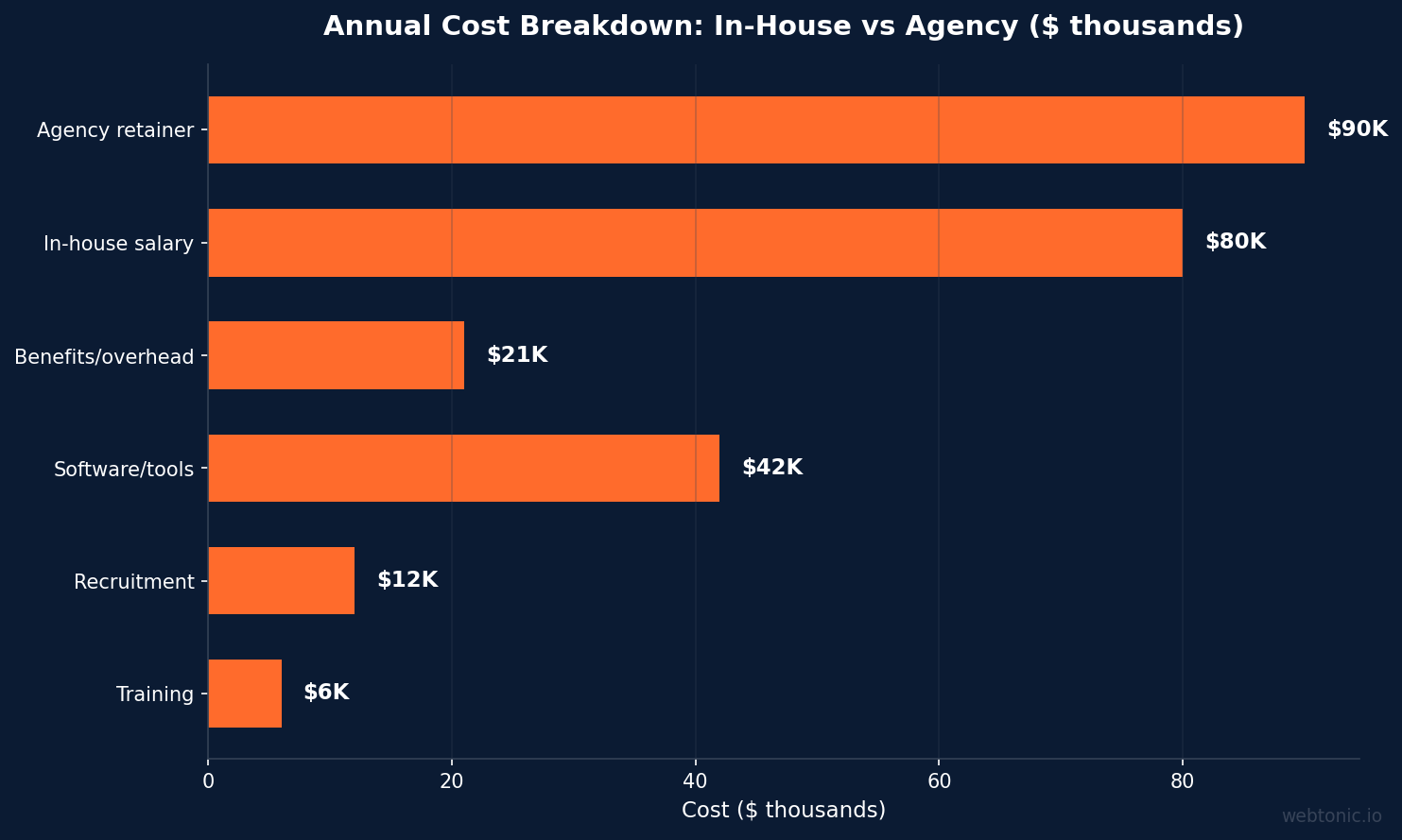
The cost comparison between in-house and outsourced advertising is one of the most misunderstood aspects of the decision. Most businesses look at agency fees in isolation and conclude outsourcing is expensive — but a comprehensive cost analysis from EverestX shows that in-house marketing costs 2-3x more when you factor in the full picture.
An in-house paid media specialist in the US costs $65,000-$95,000 in salary alone. Add benefits (20-30% of salary), recruitment fees ($8,000-$15,000 per hire), software licenses ($2,000-$5,000/month for tools like SEMrush, SpyFu, and analytics platforms), training costs, and management overhead. The fully loaded annual cost of a single in-house hire often exceeds $120,000-$150,000 — and that covers only one channel specialty.
An external advertising partner typically charges $3,000-$12,000/month (varying by scope and ad spend) and brings a team of specialists across Google Ads, Meta Ads, creative, analytics, and strategy. The cost per lead typically decreases by 20-40% because agencies operate at scale across multiple clients, sharing tool costs and applying cross-account learnings.
| Cost Factor | In-House (Annual) | Outsourced Agency (Annual) |
|---|---|---|
| Base salary / retainer | $65,000 - $95,000 | $36,000 - $144,000 |
| Benefits & overhead | $13,000 - $28,500 | $0 (included) |
| Software & tools | $24,000 - $60,000 | $0 (included) |
| Recruitment | $8,000 - $15,000 | $0 |
| Training & upskilling | $3,000 - $8,000 | $0 |
| Total range | $113,000 - $206,500 | $36,000 - $144,000 |
5 Signs You Should Outsource Your Advertising
Not every business should outsource, and not every phase of growth calls for it. According to MarketerHire's 2026 outsourcing guide, businesses outsource for three primary reasons: speed (start this week, not next quarter), flexibility (scale up for a launch, scale down after), and access to specialists they cannot afford full-time. Here are the clearest signals:
- Your ad spend exceeds your team's expertise: If you are spending more than $10,000/month on paid media without a certified specialist managing each platform, you are likely wasting 15-30% of that budget on inefficiencies.
- Campaign performance has plateaued: When in-house efforts hit a ceiling — declining ROAS, rising CPAs, stagnant conversion rates — an agency brings fresh performance creative approaches and cross-industry insights.
- You lack multi-channel capability: Running Google Ads, Meta Ads, LinkedIn, and programmatic simultaneously requires different skill sets. Outsourcing provides an entire team for the cost of one hire.
- Scaling speed matters: Agencies can deploy new campaigns in days, not the months required to recruit, hire, and onboard an in-house specialist.
- Data and reporting gaps: Professional agencies bring data intelligence infrastructure — dashboards, attribution models, and conversion tracking — that would take an in-house team months to build.


How to Choose the Right Advertising Agency
Selecting the wrong outsourcing partner is worse than keeping advertising in-house. According to AgencyAnalytics' 2025 benchmarks report, the most successful agency-client relationships share three traits: transparent reporting, clear KPI alignment, and proactive communication. Here is what to evaluate:
- Platform certifications: Verify Google Partner status, Meta Business Partner badges, and individual team certifications. These indicate hands-on proficiency, not just theoretical knowledge.
- Industry experience: Ask for case studies in your vertical. A SaaS advertising strategy differs fundamentally from local service advertising — generic expertise leads to generic results.
- Reporting cadence and transparency: Demand access to ad accounts (you should own them, not the agency), real-time dashboards, and at minimum weekly performance reports with actionable insights.
- Contract flexibility: Avoid long-term lock-ins. The best agencies offer month-to-month contracts because they retain clients through results, not contracts.
- Strategic depth: A good agency does more than execute campaigns — they challenge your assumptions, suggest new channels, and connect advertising performance to business outcomes like revenue and customer lifetime value.
Common Outsourcing Mistakes to Avoid
Even with the right agency, delegating ad management to an external partner can fail if the relationship is mismanaged. The most common pitfalls include:
- Abdication instead of delegation: Outsourcing does not mean disengaging. You still need to provide market context, competitive intelligence, and feedback on lead quality. The best results come from collaborative partnerships, not black-box arrangements.
- Choosing on price alone: The cheapest agency almost always delivers the weakest results. A $1,500/month retainer cannot fund the senior strategist time or tool access needed for serious advertising management — you get junior execution at best.
- No onboarding process: The first 30 days set the trajectory. Agencies need access to historical data, conversion tracking setup, brand guidelines, customer personas, and competitive context. Skipping onboarding wastes the first 2-3 months on discovery that should have been resolved upfront.
- Misaligned metrics: If you measure the agency on clicks while your business needs qualified leads, the relationship will fail. Align on business-outcome KPIs from day one.
- Switching agencies too fast: Most advertising campaigns need 60-90 days to exit the learning phase and optimize properly. Switching agencies every quarter resets progress and wastes budget on repeated setup costs.
Key Benefits of Outsourcing Marketing Functions
The benefits of outsourcing marketing extend beyond simple cost reduction. Companies that outsource marketing functions to a digital marketing agency gain access to specialized expertise that would require multiple full-time employees to replicate internally. A single agency engagement typically covers search engine optimization, social media marketing, email marketing, content marketing, and paid media — capabilities that an in-house marketing team would need 5-8 specialists to match.
An outsourced marketing team brings cross-industry perspective that no house marketing team can develop in isolation. When an agency manages marketing activities for 20-50 clients across different verticals, it accumulates pattern recognition for what works — which marketing strategy delivers results for businesses at different growth stages, which marketing services drive the highest ROI by sector, and which marketing efforts waste budget most often. This collective intelligence accelerates results for every client.
Outsourcing marketing also eliminates the scaling constraints of a fixed-size marketing department. During product launches or seasonal peaks, a marketing partner can allocate additional resources within days — no job postings, interviews, or onboarding delays. When volume drops, you scale marketing efforts back down without layoffs. This flexibility makes outsourcing marketing particularly valuable for small business and mid-market companies where revenue fluctuations make fixed marketing headcount risky.
Perhaps most critically, outsourcing marketing services removes the technology burden. Enterprise marketing requires $50,000-$200,000 annually in tool subscriptions — analytics platforms, ad management software, creative tools, CRM integrations, and reporting dashboards. An outsourced marketing team absorbs these costs into their retainer, giving you access to the full marketing technology stack without capital expenditure. For a small business considering whether to outsource marketing, this tool access alone often justifies the agency investment.
When to Keep Advertising In-House
Outsourcing is not universally the best choice. Consider keeping advertising in-house if your organization has sufficient scale to justify dedicated specialists (typically $500K+ monthly ad spend), if your product requires deep technical knowledge that is difficult to transfer to an external team, or if your industry has strict compliance requirements (healthcare, financial services) where external access to customer data creates regulatory risk.
As Guided Outsourcing's decision framework notes, the in-house model works when you can attract and retain top talent in a competitive hiring market — which is increasingly difficult for mid-market companies competing with tech giants for the same digital marketing professionals.
Many organizations find the optimal answer is a hybrid model: a lean in-house marketing team handling strategy, brand voice, and vendor management, while outsourcing execution to a specialized agency that brings platform expertise, creative production capacity, and cross-industry benchmarking data.
Related reading
- Ethos in Advertising: Examples and How Credibility Persuades
- Bandwagon Advertising: How the Popularity Appeal Works (With Examples)
- Advertising Slogans: 34 Famous Examples and the 4 Mechanics Behind Them
- Marketing Strategy Consulting services at Web Tonic
FAQ
How much does it cost to outsource advertising to an agency?
Agency costs vary widely based on scope, ad spend, and market. For small businesses, expect $2,000-$5,000/month for single-channel management. Mid-market businesses with multi-channel needs typically pay $5,000-$15,000/month. Enterprise engagements with full-service advertising management can exceed $25,000/month. Most agencies charge a flat retainer, a percentage of ad spend (typically 10-20%), or a hybrid of both.
How long does it take to see results from an outsourced agency?
Most advertising campaigns require 60-90 days to exit the learning phase and establish performance baselines. Significant optimization gains typically appear between months 3 and 6. If an agency promises immediate results, that is a red flag — sustainable advertising performance requires data accumulation, testing, and iterative refinement.
Should I give the agency access to my ad accounts?
You should always own your ad accounts. Grant agency access through platform partner features (Google Ads MCC, Meta Business Manager partner access) rather than sharing login credentials. This ensures you retain full control of your data, campaign history, and audience lists if the relationship ends.
What marketing functions are most commonly outsourced?
The most frequently outsourced functions are paid search (Google Ads), social media advertising (Meta, LinkedIn), SEO, content creation, and analytics/reporting. According to industry surveys, paid media management is outsourced most often because it requires specialized platform expertise and continuous optimization that is difficult to maintain with generalist in-house staff.
Can I outsource advertising for a local business?
Yes — local businesses are often the best candidates for outsourced advertising because they lack the volume to justify a full-time marketing hire. A specialized agency can manage Google Local Services Ads, geo-targeted search campaigns, and local social media advertising for a fraction of the cost of an in-house marketer while delivering better results through platform expertise and established optimization playbooks.
Sources
ZipDo — Outsourcing Marketing Services Statistics 2026
EverestX — Outsource vs In-House Cost Comparison 2026
AgencyAnalytics — Marketing Agency Benchmarks 2025
Revenue Memo — Marketing Agency Statistics 2026
MarketerHire — How to Outsource Marketing for Small Business
Guided Outsourcing — When Does Outsourcing Marketing Make Sense?
Doneverse — ROI of Outsourcing Marketing


