Table of contents
No benchmark study prices Meta Ads for orthodontics as its own category, so this page builds a working budget from the closest tracked proxy - Dentists and Dental Services - cross-checked against the American Association of Orthodontists' own patient data and Meta's health advertising rules. Every figure below states which industry it actually measures.
Key Takeaways
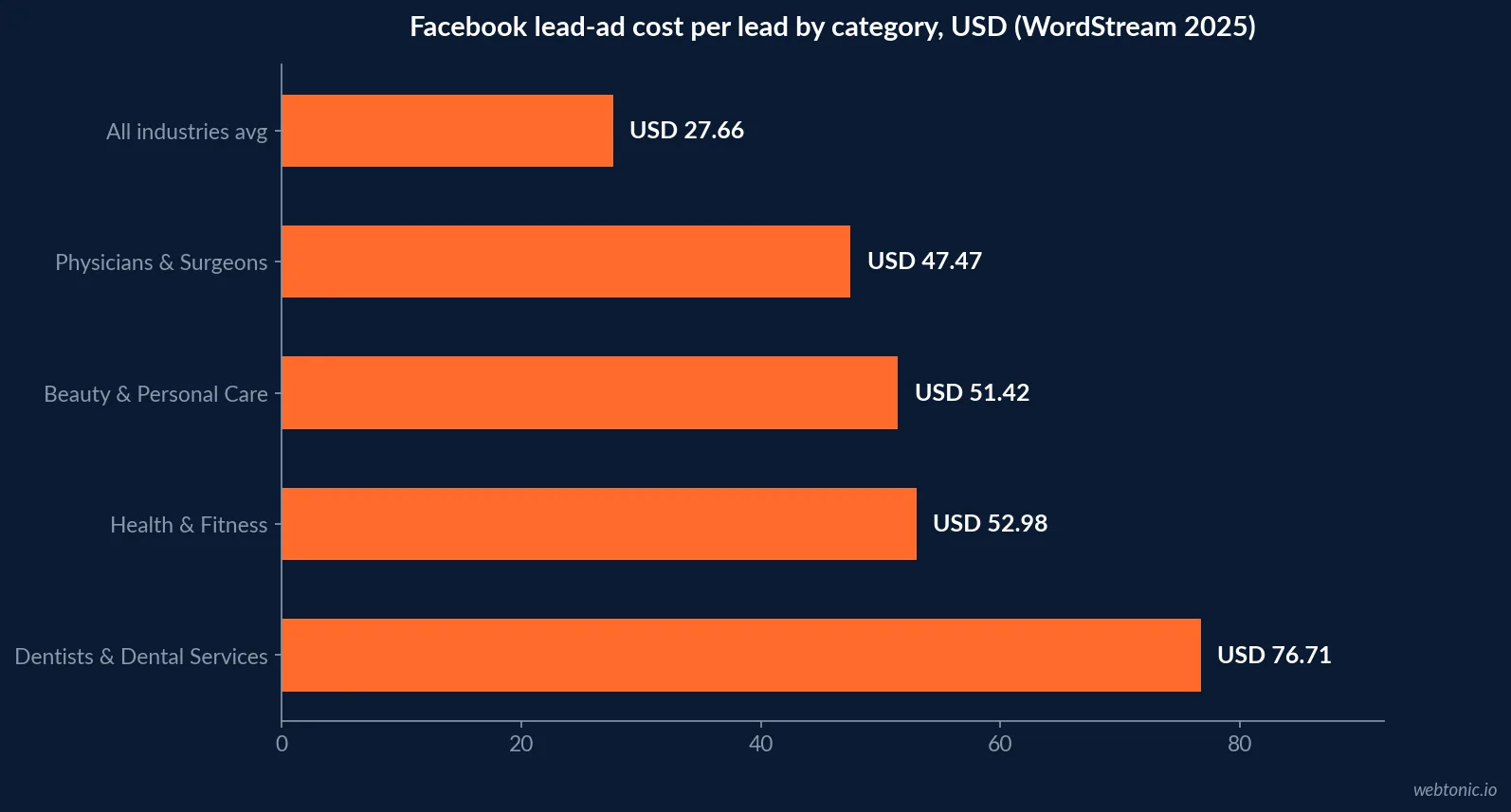
- Dental-proxy cost per lead is USD 76.71 on Meta, the highest of 15 tracked categories.
- That is 2.8 times the USD 27.66 all-industry average cost per lead.
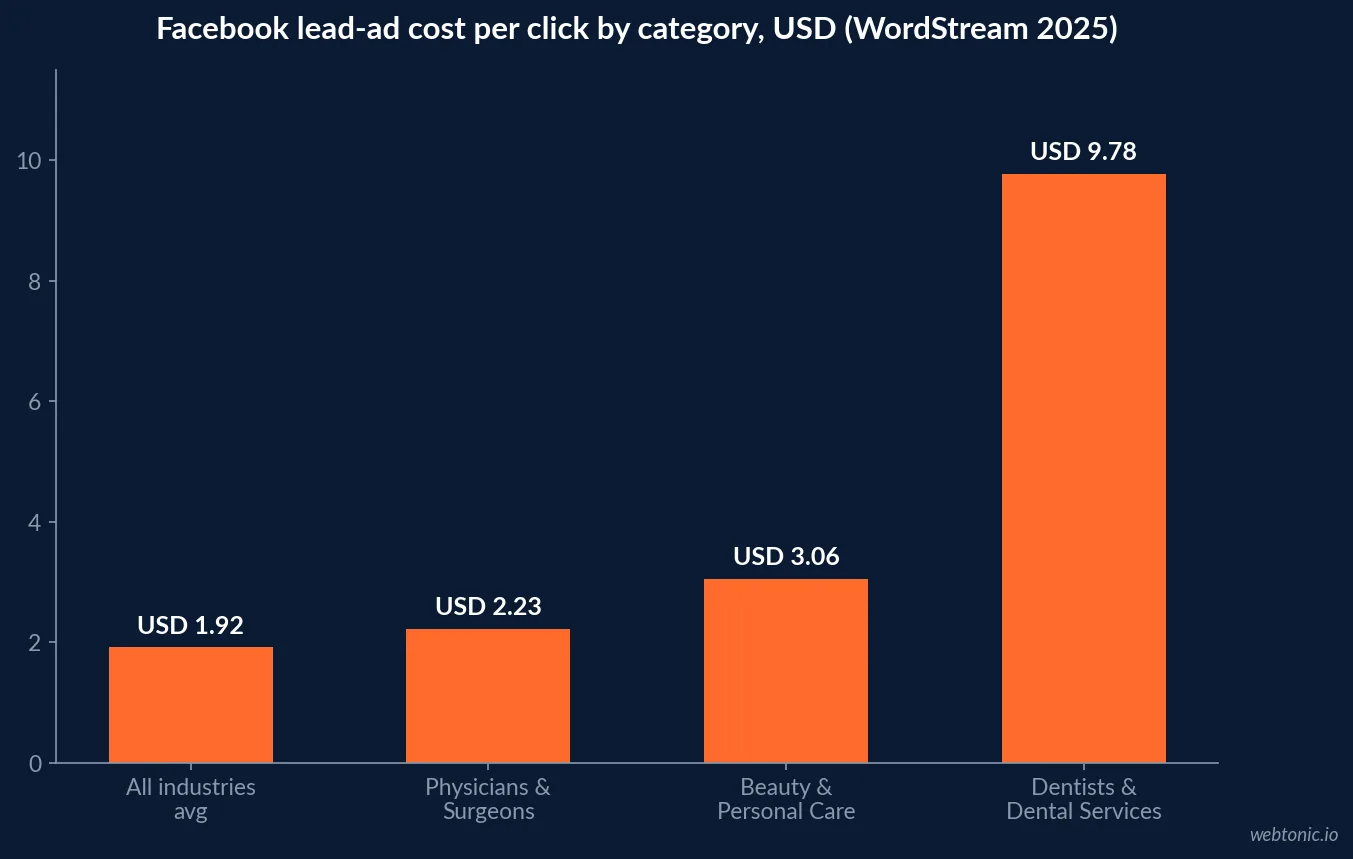
- Dental-proxy cost per click is USD 9.78, also the category ceiling.
- Dental-proxy click-through rate is just 1.05%, the lowest of the 15 categories.
- Dental-proxy cost per lead rose 97% year over year in the 2025 report.
- Physicians and Surgeons post a USD 47.47 cost per lead, a second healthcare proxy.
- Dental-proxy conversion rate is 6.38% once a lead ad is clicked.
- Per-member active patients hit 696 in 2024, a survey record, per the AAO.
- Adult patients reached 1.91 million, up from 1.64 million in 2022.
- 24% of AAO members cite the association's own referral tool as a patient source.
- Meta requires 18+ targeting on health and wellness ad categories.
- The FTC has pursued more than 200 cases over unsubstantiated health advertising claims.
- All-industry Meta lead-ad click cost is USD 1.92, a fifth of the dental proxy.
- 68% of AAO respondents are still practice owners, shaping who controls the ad budget.
Why "orthodontics Meta Ads statistics" do not exist as a clean data set
Ad-platform benchmark vendors track industries the way advertisers self-select a business category, and neither Meta nor WordStream's 2025 Facebook Ads Benchmarks report break "orthodontics" out from general dental. The nearest published proxy is Dentists and Dental Services, drawn from WordStream's sample of roughly 1,800 US Facebook lead and traffic campaigns. A second usable proxy is Physicians and Surgeons, which behaves more like elective specialty care. Neither is orthodontics. Both are the honest starting point.
| Metric (leads objective, 2025) | Dentists & Dental Services | Physicians & Surgeons | All industries |
|---|---|---|---|
| Click-through rate | 1.05% | 3.02% | 2.59% |
| Cost per click | USD 9.78 | USD 2.23 | USD 1.92 |
| Conversion rate | 6.38% | 4.51% | n/a (blended) |
| Cost per lead | USD 76.71 | USD 47.47 | USD 27.66 |
| YoY change in cost per lead | +97% | not disclosed | +20.9% |
How the same proxy category prices out on Google Ads, for context
Because Meta Ads is rarely the only paid channel on the table, it is worth showing how the same "Dentists and Dental Services" proxy prices on WordStream's 2026 Google Ads Benchmarks (13,000-plus campaigns, April 2025 to March 2026). Google Ads for the same proxy category runs a USD 8.00 cost per click, a 5.66% click-through rate, a 10.67% conversion rate, and a USD 72.97 cost per lead - close to Meta's dental-proxy CPL but reached through a much higher intent-to-conversion rate rather than Meta's cheaper clicks and lower conversion rate.
The practical read: Google Ads is capturing people already searching for an orthodontist, so it converts a smaller, pricier click at a much higher rate; Meta is interrupting a scroll, so it earns a cheaper click that converts less often. Both proxy categories land near a similar cost per lead through very different mechanics, which argues for running both rather than picking one on cost per lead alone.
| Metric, Dentists & Dental Services proxy (2025-2026) | Meta Ads (leads objective) | Google Ads |
|---|---|---|
| Click-through rate | 1.05% | 5.66% |
| Cost per click | USD 9.78 | USD 8.00 |
| Conversion rate | 6.38% | 10.67% |
| Cost per lead | USD 76.71 | USD 72.97 |
What a solo practice versus a DSO should actually do with this comparison
A newly opened, single-location practice with a small monthly budget cannot run both channels at full scale, so the comparison above becomes a sequencing decision rather than a permanent split. Google Ads' higher conversion rate makes it the more forgiving channel to start with on a small budget - fewer, more expensive clicks that convert more reliably means less capital is wasted while creative and targeting are still being tuned. Meta's cheaper clicks are better suited to building the retargeting and awareness pool once there is enough budget to run both channels as a funnel rather than as competitors for the same dollar.
Reading the auction: why dental clicks cost the most and convert the least often
The pattern in WordStream's data is internally consistent. Dentists and Dental Services post the lowest click-through rate of the 15 categories tracked (1.05%) alongside the highest cost per click (USD 9.78). Few people casually click a dental or orthodontic ad the way they click travel or entertainment content, so the clicks that do land come from a smaller, more qualified, more expensive pool. Meta's auction prices that scarcity directly into the bid, which is why the category also carries the steepest year-over-year increase in cost per lead of any category in the report, up 97%.
That combination - fewer clicks, more expensive clicks, decent conversion once clicked - is the real argument for tight creative and a narrow local radius rather than broad reach. Reach-heavy strategies pay the ceiling CPC for people who were never going to book a consult.
| Category | CPC | CTR | What the pairing implies |
|---|---|---|---|
| Dentists & Dental Services | USD 9.78 | 1.05% | Small, expensive, high-intent audience |
| Beauty & Personal Care | USD 3.06 | 2.55% | Mid-cost, mid-intent, broader appeal |
| Health & Fitness | USD 2.64 | 1.72% | Cheaper clicks, still low click rate |
| Physicians & Surgeons | USD 2.23 | 3.02% | More casual interest, lower per-click cost |
| All industries | USD 1.92 | 2.59% | The floor a generic quote will assume |
What the demand side actually looks like, per the AAO
The American Association of Orthodontists' 2025 Economics of Orthodontics and Patient Census Survey (635 responses, 2024 practice data) reports the highest per-member patient count in the study's history, dating back to 1987: 696 patients in active treatment per member in 2024, up from 574 in 2022 and over 10% above the previous record of 628 set in 2001. Nationally, that scales to an estimated 6.66 million patients in active treatment across US and Canadian AAO members, including 1.91 million adults, up from 1.64 million two years earlier.
That is genuine, association-verified demand growth, not an ad-platform metric. It answers whether a Meta budget is chasing a shrinking or growing pool of patients; it does not set what that budget should pay per lead, which is why the two data sets have to be read side by side and not conflated.
| AAO 2025 survey metric (2024 data) | Figure | Comparison |
|---|---|---|
| Active patients per member | 696 | Up from 574 in 2022; record since 1987 |
| Total active patients, US & Canada | ~6.66 million | Estimated from a 9,554-member base |
| Adult patients, United States | ~1.91 million | Up from ~1.64 million in 2022 |
| Members citing AAO referral tool as a source | 24% | Up from 20% in 2022, 17% in 2018 |
| Members who are practice owners | 68% | Down from 80% in 2018, similar to 69% in 2022 |
The compliance layer that sits on top of every number above
Two rulebooks apply before a single dollar of the budget above gets spent. Meta's Health and Wellness advertising policy requires ads promoting health-related products and services to be targeted to people 18 years or older and restricts claims about specific outcomes, which matters directly for orthodontics given how much of the patient base is minors whose parents, not the patient, are the actual ad audience. Separately, the FTC's Health Products Compliance Guidance notes the agency has settled or adjudicated more than 200 cases since 1998 over unsubstantiated health-related advertising claims, and it applies the same truthful-and-substantiated standard to before-and-after smile photos and patient testimonials that it applies to any other health claim.
Google Ads carries a parallel restriction for the search side of the same budget: Google's Personalized Advertising Policy classifies health, including chronic conditions requiring long-term care, as a sensitive interest category with restricted targeting options - relevant to orthodontics given how much of the treatment relates to a diagnosed condition rather than a purely cosmetic preference.
Neither rulebook changes the CPC and CPL figures above. Both change what the creative is allowed to say while it is trying to earn that click.
What the AAO data does not tell you about Meta Ads specifically
It is worth being precise about the boundary here. The AAO survey measures practice economics - patient counts, fees, ownership structure - not paid media performance. It says nothing about Meta click-through rates, nothing about cost per lead, and nothing about which platforms drove the 24% of respondents who cite the AAO's own referral tool as a patient source (that figure describes an association directory, not a paid social channel). Any article that borrows AAO growth numbers to imply a specific Meta Ads cost is combining two data sets that were never designed to answer the same question, and this page is deliberately not doing that.
Building the budget line by objective
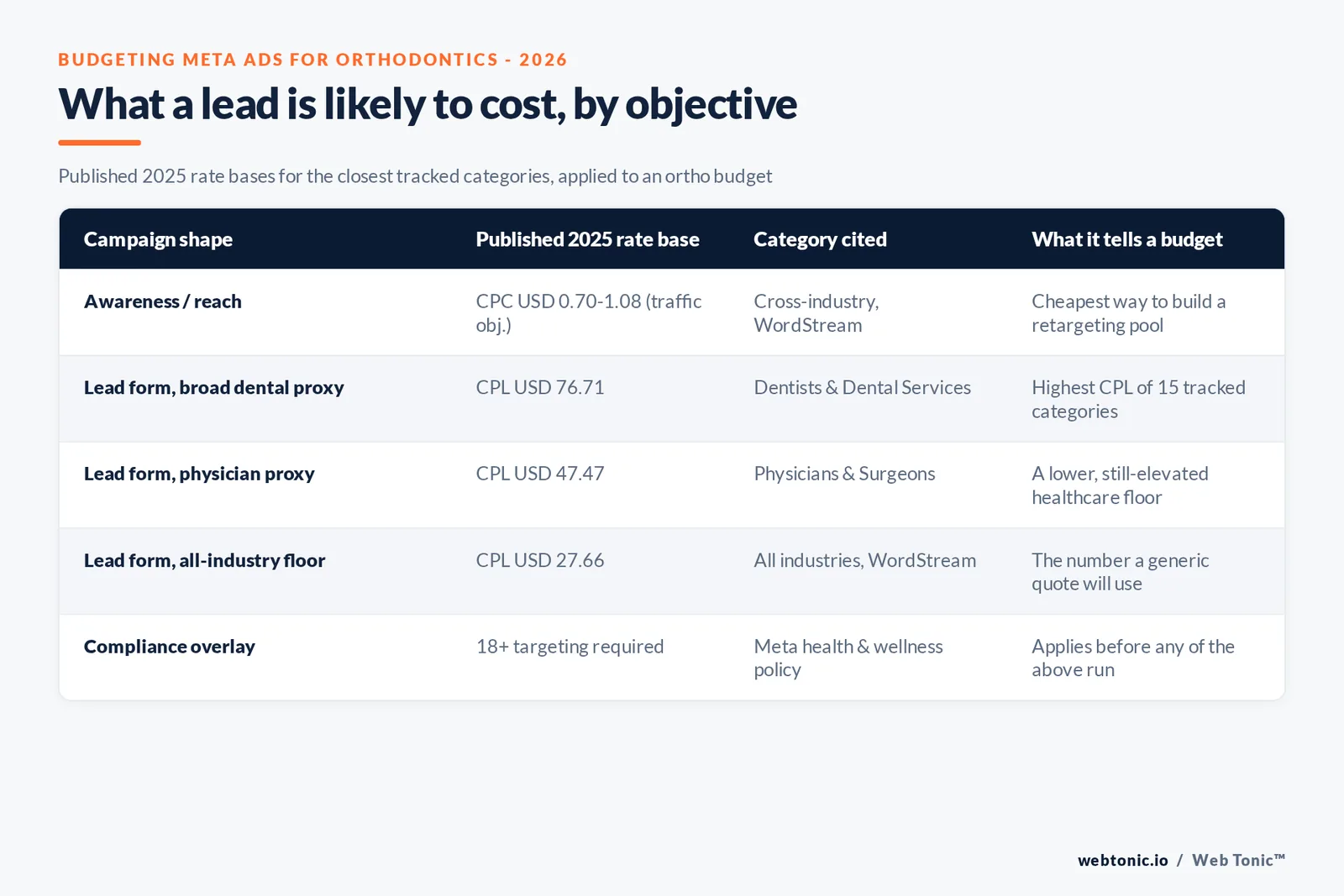
A workable approach treats the dental-proxy figures as the ceiling to plan against, not the expectation to accept blindly. Traffic and awareness objectives on Meta run far cheaper than lead objectives across every category WordStream tracks, which makes a two-stage funnel - cheap traffic/engagement to build a retargeting pool, then a lead objective against that warmer pool - a more defensible way to spend the same monthly budget than running lead ads cold from day one.
| Budget line | Rate base to plan against | Source | Purpose in the funnel |
|---|---|---|---|
| Cold lead generation | USD 76.71 dental-proxy CPL | WordStream 2025 | Direct consult booking, cold audience |
| Warm retargeting lead ads | Below category CPL once list is built | Practice's own account data | Cheaper leads from an engaged pool |
| Traffic / awareness | USD 0.70-1.08 CPC range | WordStream 2025, traffic objective | Building the retargeting pool cheaply |
| Physician-proxy comparison | USD 47.47 CPL | WordStream 2025 | Sanity check against a second healthcare vertical |
| All-industry floor | USD 27.66 CPL | WordStream 2025 | What a non-specialist quote will assume, incorrectly |
How to read this if the practice is part of a DSO
The AAO survey documents continued growth in DSO and OSO (dental and orthodontic support organization) employment models. Centralized, multi-location paid media buying can absorb an elevated dental-proxy cost per lead across a much larger patient pipeline and negotiate creative and testing budgets a single practice cannot. A solo or small-group practice bidding in the same Meta auction with a fraction of the volume should weight local radius targeting and creative specificity more heavily than a DSO would, because it has no volume discount to fall back on if the first few campaigns land above the dental-proxy ceiling.
Our Meta Ads management practice builds that kind of tiered, local-first structure for healthcare and specialty-care accounts; see our broader breakdown of what Facebook ads cost across industries and our companion piece on dental Facebook ad benchmarks for the general dental version of this same proxy-category problem.
What to test before increasing spend
Given a 1.05% click-through rate is the category floor, the highest-leverage test is creative, not budget. Practices that beat the dental-proxy CTR meaningfully are usually doing three things: showing real treatment outcomes rather than stock photography, leading with a specific offer (a free consult, a named financing plan) rather than a brand statement, and running separate creative for adult and teen/parent audiences given how differently those two groups make the decision to click. None of that changes the auction's floor price, but it changes how many of those expensive clicks actually convert at the 6.38% dental-proxy conversion rate or better.
If the account is not yet running, talk to us about setting one up with the compliance guardrails above built in from the first campaign, not retrofitted after a policy flag.
Frequently Asked Questions
How much should an orthodontics practice budget for Meta Ads?
No benchmark study prices Meta Ads for orthodontics by name, so build from the closest tracked proxy. WordStream's 2025 Facebook Ads Benchmarks put Dentists and Dental Services lead-ad cost per lead at USD 76.71, the highest of the 15 categories it tracks, against a USD 27.66 all-industry average. A practice running lead-generation Meta Ads should plan around the dental-proxy ceiling, not the cross-industry floor, until its own account has enough volume to set its own number.
Why is the dental and orthodontics proxy category so much more expensive than average?
Click-through rate is the tell. WordStream reports Dentists and Dental Services at a 1.05% lead-ad click-through rate, the lowest of the 15 tracked categories, while cost per click still runs USD 9.78, the highest tracked. People are not casually curious about orthodontic treatment the way they are about travel or retail, so the ads that do click come from a smaller, costlier, higher-intent pool, and Meta prices that scarcity into the auction.
Does the AAO's own patient data change how a practice should think about Meta Ads?
It changes the growth story more than the price. The AAO's 2025 Economics of Orthodontics survey reports the highest per-member active patient count in the survey's history, 696 in 2024 versus 574 in 2022, and 1.91 million adult patients nationally, up from 1.64 million. That is a genuine demand signal for a paid channel, but it is a practice-economics survey, not an ad-cost study, so it should inform whether to run Meta Ads, not what to bid inside them.
What compliance rules apply to orthodontics ads on Meta specifically?
Meta's Health and Wellness advertising policy requires ads promoting health-related products and services to be targeted to people 18 or older, restricts certain outcome claims, and sits alongside Meta's broader ban on ads that assert or imply someone has a specific health condition. The FTC's Health Products Compliance Guidance adds a second layer: any before-and-after result or patient testimonial used as an ad still has to be truthful and backed by evidence the practice actually has, not just permitted by the platform.
Should a solo practice run Meta Ads the same way a multi-location DSO does?
No. The AAO survey shows continued growth in DSO and OSO employment models, which usually centralize paid media buying across many locations and can absorb the elevated dental-proxy cost per lead across a bigger patient pipeline. A single-location practice is bidding in the same auction with a smaller budget and no volume discount, so a tighter local radius, stronger creative, and a hard look at cost per booked consult - not just cost per lead - matter more for it than for a DSO.
Sources
WordStream / LocaliQ - Facebook Ads Benchmarks 2025
American Association of Orthodontists - 2025 Economics of Orthodontics and Patient Census Survey
Meta Transparency Center - Health and Wellness advertising policy
Federal Trade Commission - Health Products Compliance Guidance
WordStream - How Much Do Facebook Ads Cost?
Google Advertising Policies Help - Health in personalized advertising