Table of contents
LinkedIn is a real channel in orthodontics, but not for reaching patients - the published data points to DSO/OSO recruiters, referral-partner outreach and B2B suppliers as the actual buyers. No association or ad platform publishes an orthodontics-specific LinkedIn benchmark, so this page builds the buyer profile from the AAO's own referral and employment data and labels every cross-industry cost figure as such.
Key Takeaways
- 41% of new orthodontic patients still arrive via referral from a general dentist, unchanged since 2018.
- 35% of referrals come from existing patients, also flat since 2018.
- 14% of AAO members now work in a DSO/OSO modality, up from 6% in 2018.
- 47% of female orthodontists joined a DSO/OSO as their first career opportunity, against 20% of male orthodontists.
- US dental DSO affiliation more than doubled from 7.2% in 2015 to 16.1% in 2024 (ADA HPI, all-dentistry figure).
- More than 1 in 4 dentists up to 10 years post-graduation are DSO-affiliated, the highest of any career-stage cohort (ADA HPI).
- 66% of referring general dentists say the orthodontist's skill is the top factor in who they refer to (peer-reviewed survey research).
- Case complexity drives 41% of referral decisions, patient age drives 21%.
- No LinkedIn ad benchmark by dental specialty is currently published by WordStream, LocaliQ or LinkedIn itself.
- 68% of orthodontists reported being a practice owner in 2024, down from 80% in 2018 - the shrinking owner share is itself a B2B audience shift LinkedIn can target.
The patient is not the LinkedIn audience - the referring dentist is
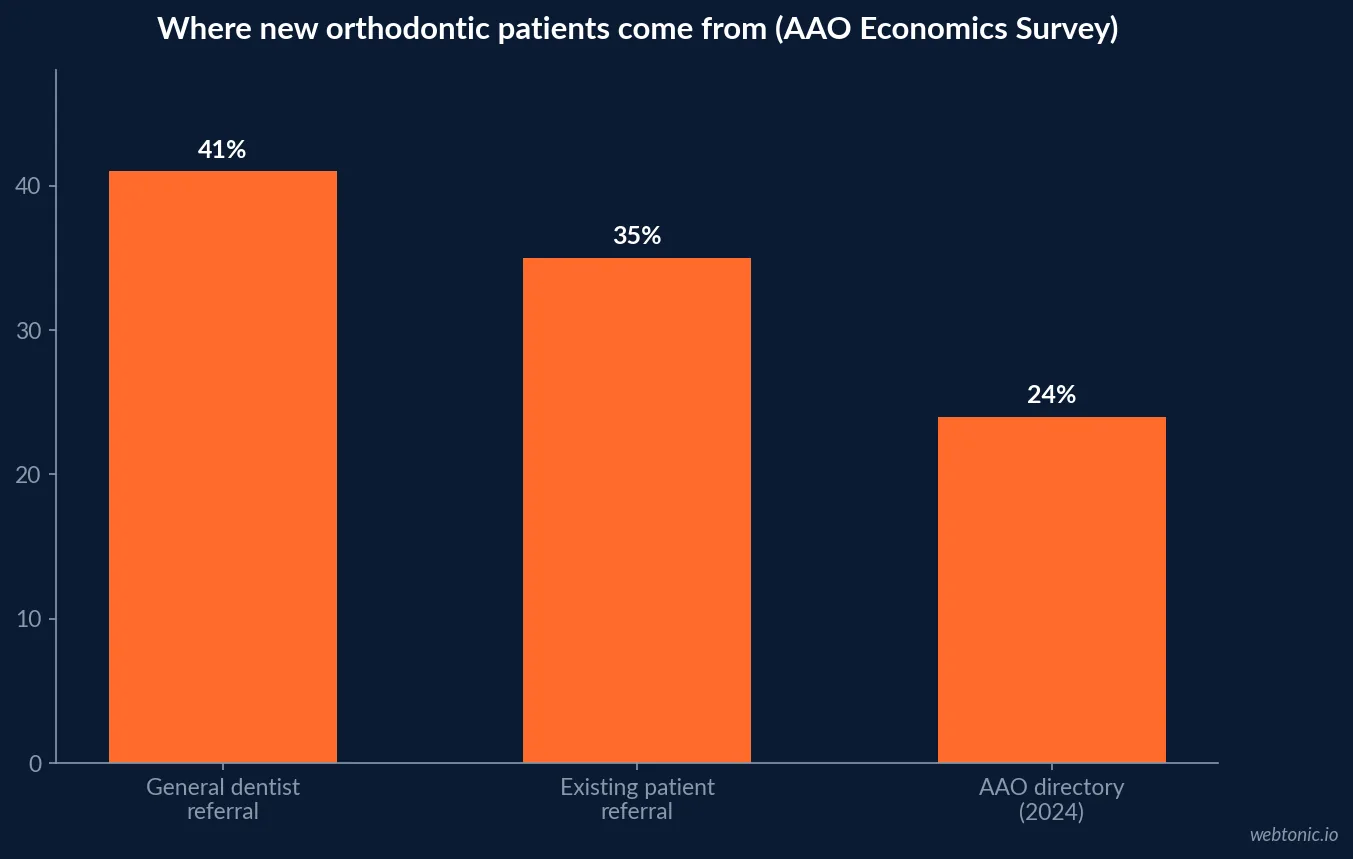
Orthodontic patient acquisition runs almost entirely through channels other than a professional network. The AAO's 2023 Economics of Orthodontics survey found 41% of referrals came from general dentists and 35% from existing patients, both essentially unchanged from 2018 - meaning three-quarters of new patients arrive through a relationship, not a consumer ad impression. Peer-reviewed research on what drives those referral decisions (published in the American Journal of Orthodontics and Dentofacial Orthopedics) found referring dentists weigh the orthodontist's skill (66%) most heavily, followed by proximity to the patient (34%), case complexity (41%) and patient age (21%). That is a professional B2B relationship a general dentist manages - exactly the kind of job-title and practice-type targeting LinkedIn is built for, and exactly what a consumer-facing LinkedIn feed ad to patients is not.
| Where new orthodontic patients come from (AAO 2023 survey) | Share | vs. 2018 |
|---|---|---|
| General dentist referral | 41% | Unchanged |
| Existing patient referral | 35% | Unchanged |
| AAO Find an Orthodontist directory (2024 figure) | 24% | Up from 17% in 2018 |
The DSO/OSO growth curve is the real B2B LinkedIn story
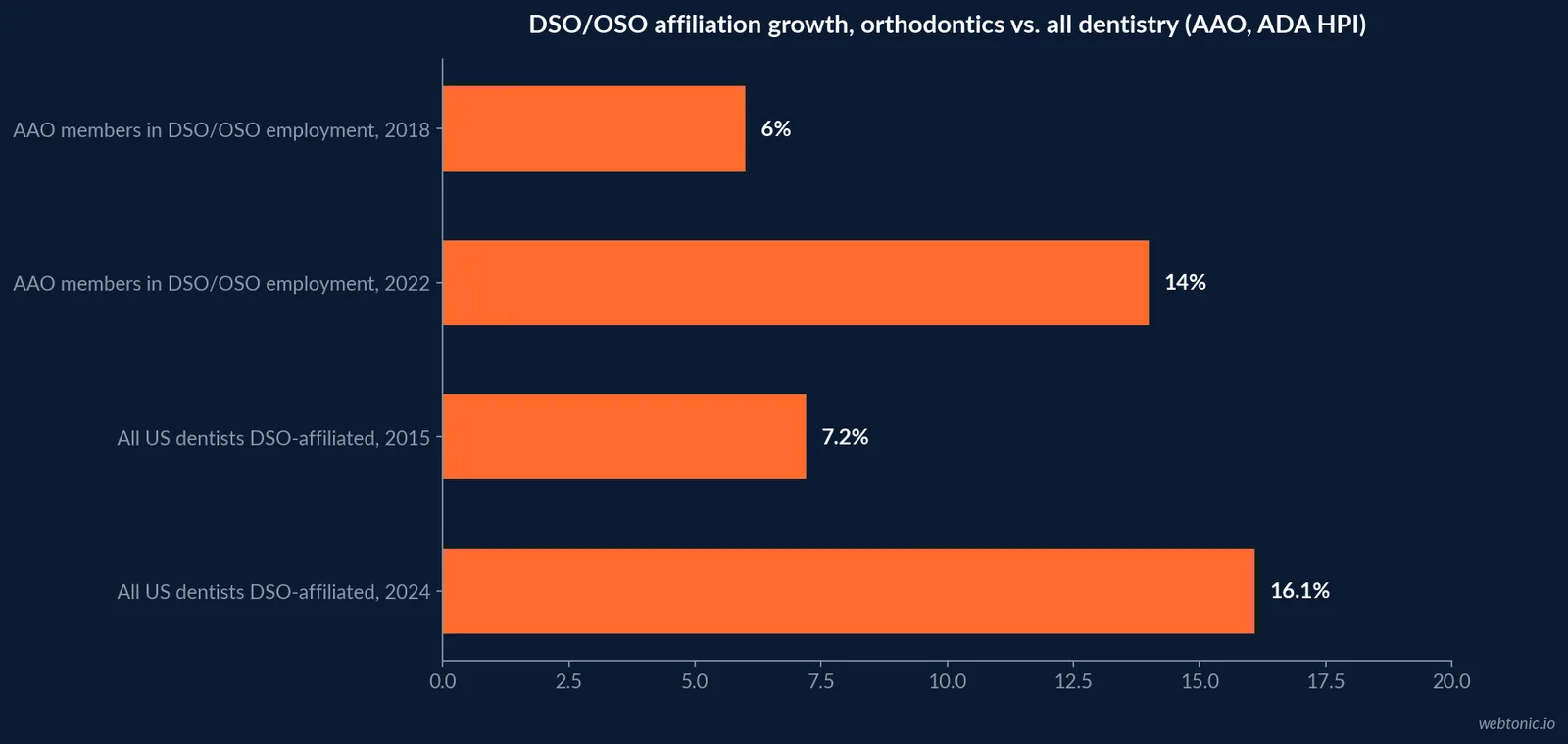
Recruiting and consolidation, not patient acquisition, is where LinkedIn spend in this vertical actually goes. The AAO's own 2023 survey found 14% of members now work in a Dental Support Organization or Orthodontic Support Organization modality, up from 6% in 2018, and that female respondents joined a DSO/OSO as their first career opportunity at 47%, against 20% of male respondents - with younger orthodontists far more likely to start there than older ones. Separately, the American Dental Association's Health Policy Institute found DSO affiliation across all of US dentistry more than doubled from 7.2% in 2015 to 16.1% in 2024, and the ADA's practice modality data shows early-career dentists driving that growth, with more than 1 in 4 dentists up to 10 years out of school already DSO-affiliated. Every one of those affiliations, acquisitions and recruiting searches runs through professional networks - LinkedIn chief among them - not a consumer feed.
| DSO/OSO metric | 2018 | 2024 or latest | Change |
|---|---|---|---|
| AAO members in DSO/OSO employment | 6% | 14% (2022 survey data) | +8 pts |
| Female orthodontists joining DSO/OSO first | n/a | 47% | vs. 20% for male orthodontists |
| US dentists (all) affiliated with a DSO | 7.2% (2015) | 16.1% (2024) | +8.9 pts since 2015 |
| Orthodontists reporting practice ownership | 80% | 68% | -12 pts |
What LinkedIn ad costs look like, without an ortho-specific number to cite
No study - not LinkedIn's own Marketing Solutions team, not WordStream, not LocaliQ - publishes a LinkedIn Ads cost benchmark broken out for orthodontics or dentistry the way Google and Facebook benchmarks exist for the industry. Third-party aggregator compilations of LinkedIn ad data (drawing on platforms like AdStage, Hootsuite and HubSpot) put cross-industry LinkedIn CPCs in roughly the $5 to $9 range and CPMs around $30 to $40 for 2026, spanning a broad B2B mix, not a dental-specific sample. None of those compilations state a methodology precise enough to be treated as authoritative here, so this page does not present a specific dollar figure as an orthodontics benchmark - a practice or DSO testing LinkedIn should treat its own first-campaign data as the real baseline, not a borrowed number.
Why the DSO buyer is only getting bigger
The scale behind the DSO/OSO recruiting case keeps growing. Mercer Capital's 2025 analysis of the dental service organization market puts total DSO market size at USD 453 billion in 2024, up from USD 412 billion in 2023, projecting a compound annual growth rate of 11.5% that could push the market past USD 700 billion by 2029. Mercer's analysis also found roughly 27% of general dental practices were DSO-affiliated in 2024, with that share projected to reach an estimated 39% by 2028. Every acquisition, every affiliation and every practice-integration hire behind those numbers needs a recruiting or partner-outreach campaign, and LinkedIn's own marketing solutions content is explicit that its targeting is built around job function, seniority and company attributes - the exact fields a DSO recruiting or M&A campaign needs, and fields a consumer-facing patient campaign simply does not use.
| Mercer Capital DSO market metric | 2023/2024 | Projected |
|---|---|---|
| Total DSO market size (USD) | 412B (2023) -> 453B (2024) | 700B+ by 2029 (11.5% CAGR) |
| General practices DSO-affiliated | 27% (2024) | 39% (2028 est.) |
None of this is orthodontics-only data - Mercer Capital's figures cover dental service organizations broadly, and orthodontic support organizations are a smaller, faster-growing slice of that same consolidation wave. But the direction is unambiguous: private equity-backed groups do not run recruiting searches or referral-partner development through the same channel a patient uses to book a consultation. They run it through LinkedIn, because that is where the operations directors, practice-integration leads and referring dentists they need to reach actually spend their professional attention. A LinkedIn budget aimed at patients in this vertical is aimed at the wrong audience entirely; a LinkedIn budget aimed at the people running that consolidation, or at the general dentists feeding the 41% referral share, is aimed at an audience that is provably there and provably growing.
Three ways to actually target a LinkedIn budget in this vertical
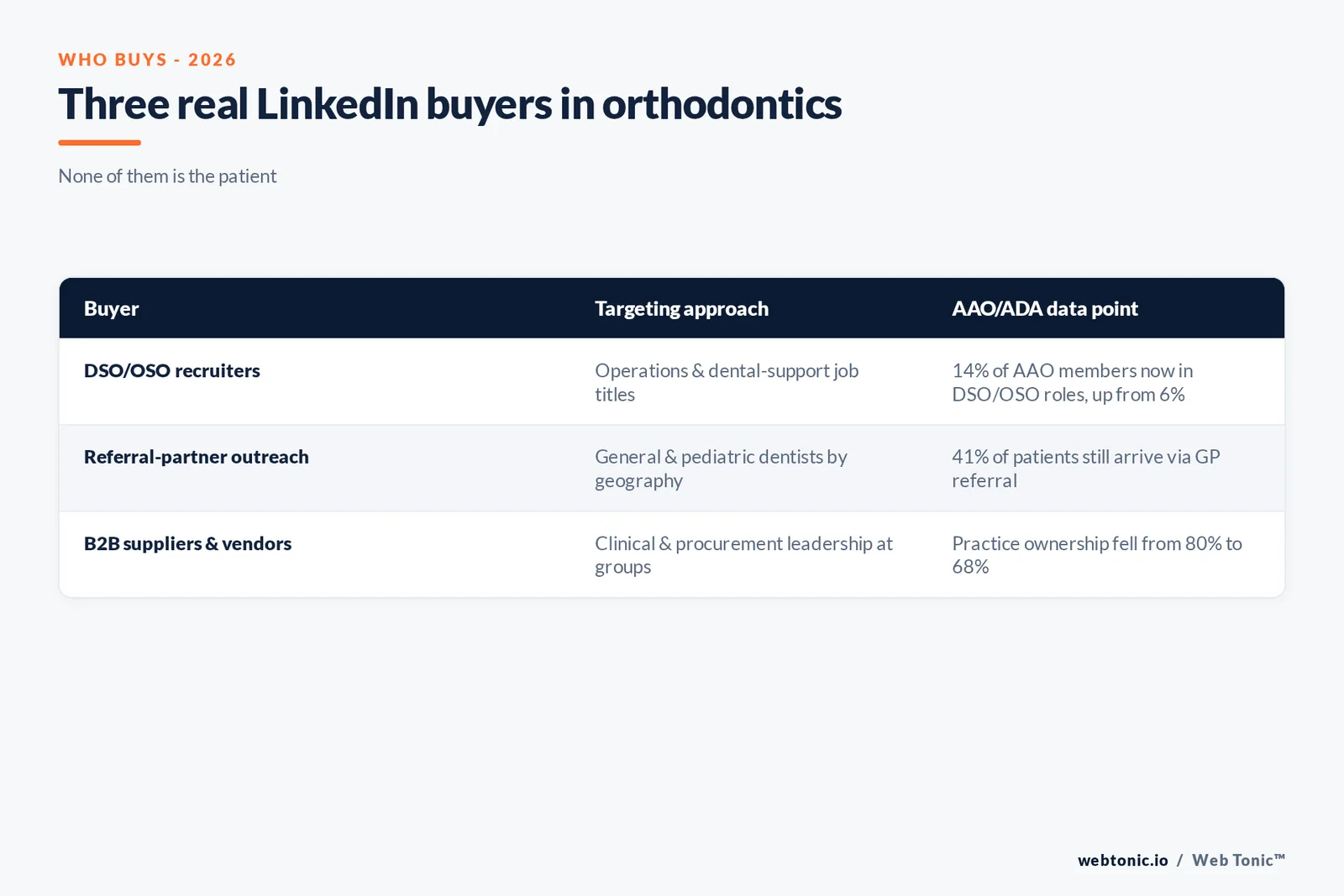
- DSO/OSO recruiting and M&A outreach - target operations and dental-support job titles, informed by the 14% AAO DSO/OSO employment share and the ADA's 16.1% national affiliation figure.
- Referral-partner development - target general and pediatric dentists by geography, informed by the 41% general-dentist referral share and the skill/complexity factors that drive referral decisions.
- Supplier and vendor outreach - target clinical and procurement leadership at multi-location groups, where the shrinking 68% practice-ownership share signals more buying decisions sitting with corporate, not solo-owner, roles.
Our growth marketing team builds B2B targeting like this for consolidating healthcare verticals, and our dental LinkedIn ads data is a useful adjacent-vertical read, since dentistry's own DSO trend is running several years ahead of orthodontics on the same curve. Talk to us before building a recruiting or referral-partner campaign from a patient-marketing playbook that was never built for this audience. The distinction is worth repeating because it is the single most common mistake agencies make when a client asks for "LinkedIn ads for our ortho practice": the request almost always turns out to be a recruiting, partnership or acquisition need wearing a patient-ads label, and campaigns built against the wrong audience definition waste budget regardless of how well the creative or targeting mechanics are executed.
Frequently Asked Questions
Do orthodontic patients see or respond to LinkedIn ads?
There is no published evidence they do in meaningful volume, and no association tracks it. LinkedIn's user base skews toward working professionals in a career-oriented mindset, not consumers researching a clear aligner treatment plan for themselves or a child. The real orthodontic LinkedIn audience is B2B: DSO/OSO recruiters, referral-partner outreach teams, and suppliers selling into practices.
Why would a DSO be the real LinkedIn ad buyer in orthodontics?
Because DSO/OSO affiliation is the fastest-growing employment path in the specialty. The AAO's 2023 survey found 14% of members worked in a DSO or OSO modality, up from 6% in 2018, and female respondents joined a DSO/OSO as their first career opportunity at 47%, against 20% for male respondents. Separately, the ADA's Health Policy Institute found DSO affiliation across all US dentistry more than doubled from 7.2% in 2015 to 16.1% in 2024. Recruiting and practice-acquisition outreach for that growth runs through LinkedIn far more than through consumer channels.
Is referral-partner outreach really a LinkedIn use case for orthodontics?
It fits the data. The AAO's 2023 survey found 41% of new patients still arrive via referral from a general dentist, essentially unchanged since 2018, and factors like the orthodontist's skill (cited by 66% of referring dentists in peer-reviewed research) and case complexity (41%) drive who a GP refers to. That referral relationship is a professional B2B connection - the kind LinkedIn's targeting (job title, practice type, location) is built to reach, unlike a consumer feed.
What does a LinkedIn ad actually cost, since no orthodontics-specific benchmark exists?
No published report breaks out LinkedIn Ads cost data by dental specialty. Cross-industry, aggregator compilations citing platforms like AdStage, Hootsuite and HubSpot put average LinkedIn CPCs in the roughly $5-$9 range and CPMs in the $30-$40 range across a broad mix of B2B industries as of 2026, but none of those sources publish a stated sample specific enough to treat as authoritative for a dental-adjacent vertical - treat any number circulating below this as directional at best.
What should an orthodontic-adjacent LinkedIn campaign actually target?
Job titles and practice types tied to the real buyer: 'Dental Support Manager,' 'Director of Operations' and similar roles at DSOs/OSOs for recruiting or M&A outreach; general and pediatric dentists by specialty and geography for referral-partner campaigns; and procurement or clinical leadership titles for supply and equipment vendors selling into ortho practices. None of these are the patient - which is the central distinction a LinkedIn budget for this vertical has to respect.
Sources
American Association of Orthodontists - 2023 Economics of Orthodontics Survey
American Association of Orthodontists - 2025 Economics of Orthodontics and Patient Census Survey
American Dental Association Health Policy Institute - U.S. Dentist Workforce, 2025 Update
American Dental Association Health Policy Institute - Practice Modalities Among U.S. Dentists
American Journal of Orthodontics and Dentofacial Orthopedics - Factors Impacting General Dentists' Referrals to Orthodontists
Mercer Capital - Dental Service Organizations market analysis, 2025
LinkedIn Marketing Solutions - Business Blog
Web Tonic - Growth Marketing
Web Tonic - Dental LinkedIn Ads Statistics