Table of contents

Dentists & Dental Services carries a $72.97 average cost per lead on Google Search in 2026, against a $66.69 cross-industry average, per WordStream. No benchmark study isolates orthodontics from general dentistry, so every figure here uses that broader category as the closest verified proxy - and states plainly where orthodontics-specific data does not exist.
Key Takeaways
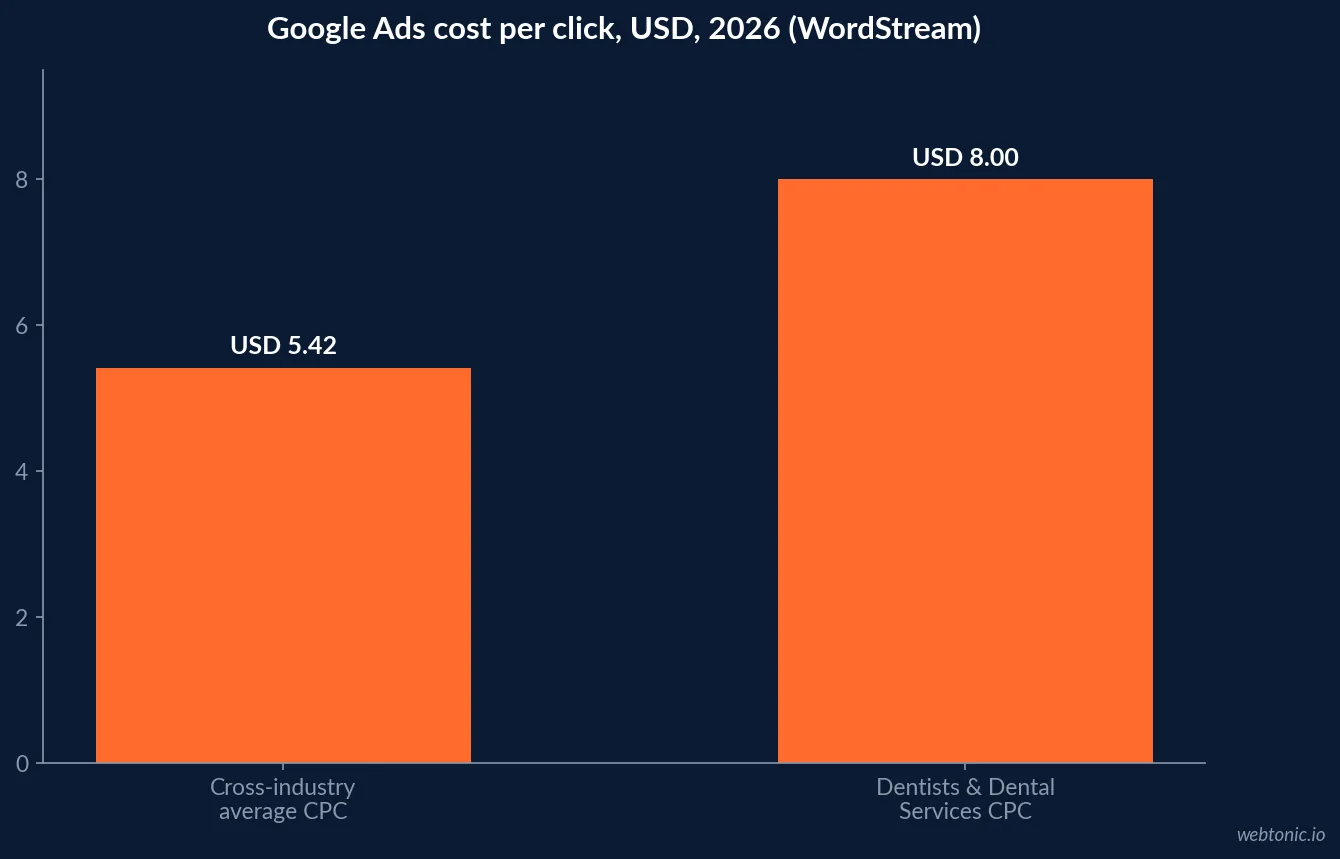
- Dentists & Dental Services averages an $8.00 cost per click on Google Search in 2026.
- That compares to a $5.42 cross-industry average CPC.
- Cost per lead for the category is $72.97, against a $66.69 overall average.
- Click-through rate is 5.66%, among the lowest of the 23 tracked industries.
- Conversion rate is 10.67%, above the overall average.
- WordStream's 2026 search data is drawn from 13,474 US campaigns across 23 industries.
- On Meta, the same category's CPC is $9.78 - the highest of any tracked industry.
- Meta CPL for the category is $76.71, also the highest tracked.
- Meta CTR is just 1.05%, the lowest of any tracked industry.
- Meta conversion rate is 6.38%, below the category's Search conversion rate.
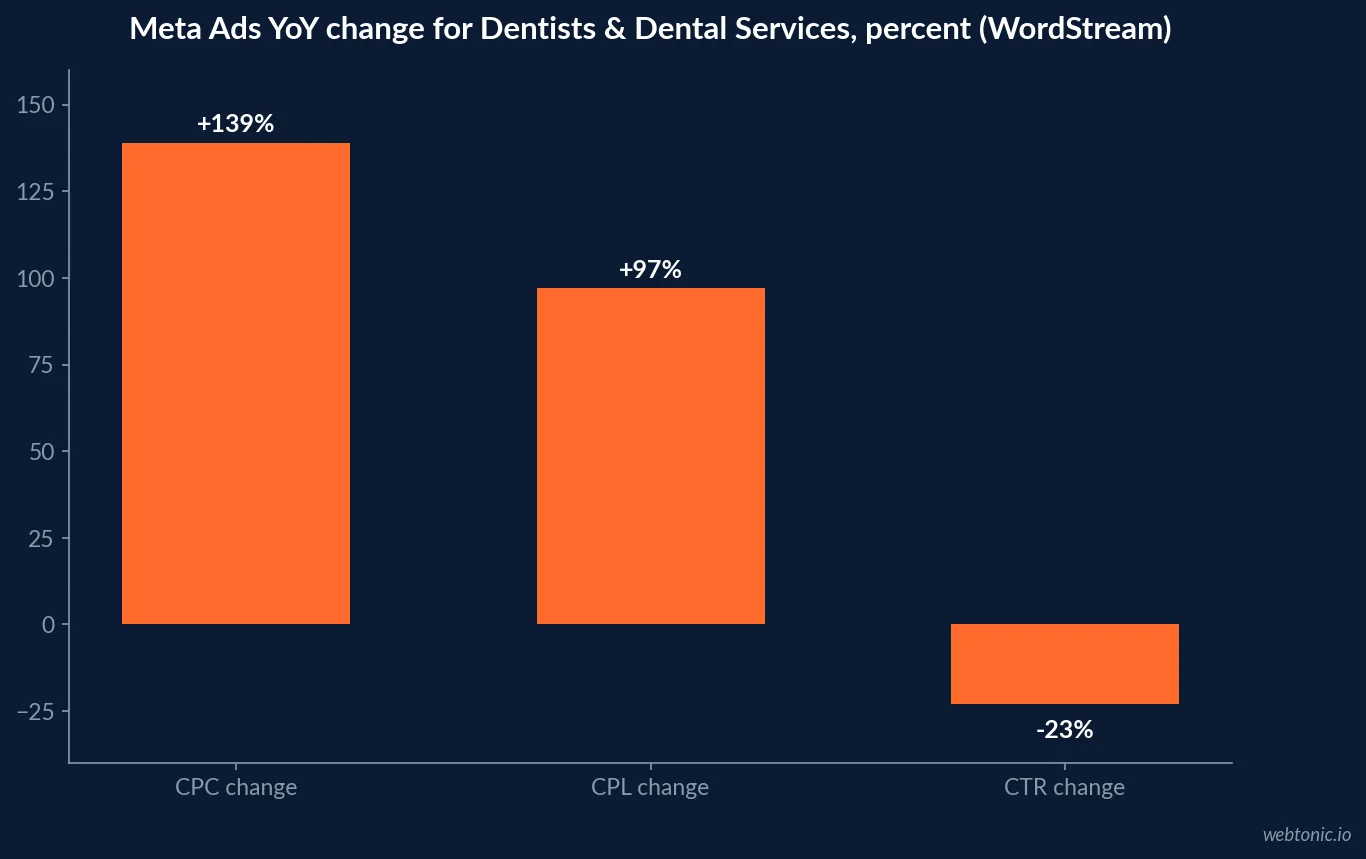
- Meta CPC for this category rose 139% year over year.
- Meta CPL rose 97% year over year for the same category.
- Meta CTR fell 23% year over year for the category.
- Attorneys & Legal Services, not dental, has the single highest Search CPL at $131.63 - useful context for scale.
- Google tightened Local Services Ads identity verification for providers in 2024.
- Align Technology reported Invisalign adult patients up 7.8% year-over-year in Q1 2026, a demand signal for ad targeting.
Where orthodontics sits in the Google Search benchmark
No vendor publishes a Google Ads benchmark for orthodontics as its own category. WordStream's 2026 Search Advertising Benchmarks - built from 13,474 US-based campaigns across 23 industries, running April 2025 through March 2026 - groups it inside Dentists & Dental Services, which covers general dentistry, orthodontics, and related specialties together. Inside that category, the average cost per click is $8.00 against a $5.42 cross-industry average, and the average cost per lead is $72.97 against a $66.69 overall average - both meaningfully above the norm, though nowhere near the category-leading $131.63 cost per lead in Attorneys & Legal Services.
| Metric (Google/Microsoft Search, 2026) | Dentists & Dental Services | Cross-industry average | Position |
|---|---|---|---|
| Average CPC | $8.00 | $5.42 | Above average |
| Average CTR | 5.66% | ~8.18% (overall) | Among the lowest tracked |
| Average CVR | 10.67% | ~8-9% range typical | Above average |
| Average CPL | $72.97 | $66.69 | Above average |
Meta tells almost the opposite cost story
WordStream's Facebook Ads Benchmarks report for the same category diverges sharply from the Search data. On Meta, Dentists & Dental Services has the highest cost per click of any tracked industry, at $9.78, and the highest cost per lead, at $76.71 - while carrying the lowest click-through rate tracked, at 1.05%. Conversion rate on Meta comes in at 6.38%, below the category's 10.67% Search conversion rate. The year-over-year direction is just as stark: Meta CPC for the category rose 139%, CPL rose 97%, and CTR fell 23% in the same period.
| Metric (Meta/Facebook Ads, 2025-2026) | Dentists & Dental Services | YoY change | Rank vs. other industries |
|---|---|---|---|
| Average CPC | $9.78 | Up 139% | Highest of all tracked industries |
| Average CTR | 1.05% | Down 23% | Lowest of all tracked industries |
| Average CVR | 6.38% | Not separately disclosed | Mid-range |
| Average CPL | $76.71 | Up 97% | Highest of all tracked industries |
Why the two channels diverge this much
The gap is consistent with what each channel is built to do. Google Search captures a person who has already typed "orthodontist near me" or a treatment-specific query - hence a respectable 10.67% conversion rate despite a below-average click-through rate. Meta interrupts a social feed with no expressed intent behind the impression, which explains the rock-bottom 1.05% CTR; the fact that cost per click and cost per lead both still rose sharply year over year suggests more dental and ortho advertisers are bidding for that same limited attention, not that the channel got less efficient on its own terms.
Practically, that argues for treating Meta as a brand-awareness and retargeting layer rather than a last-click acquisition channel competing head-to-head with Search on cost per lead.
| Channel role | Search (Google/Microsoft) | Meta (Facebook/Instagram) | Budget implication |
|---|---|---|---|
| Primary function | Capture expressed intent | Interrupt attention, build awareness | Protect Search budget for high-intent queries |
| Cost efficiency this category | $72.97 CPL, above average but stable | $76.71 CPL, above average and rising fast | Meta needs tighter creative/targeting discipline |
| Conversion rate | 10.67% | 6.38% | Search converts what it captures better |
| Best use in the funnel | Bottom-funnel, ready-to-book searches | Top-funnel awareness, retargeting warm audiences | Different KPIs per channel, not one shared CPL target |
What demand growth means for how far the budget should stretch
The cost pressure sits against real demand growth, not a flat market. The American Association of Orthodontists' own 2025 Economics Survey found per-member patient counts reaching an all-time high of 696 in 2024, and Align Technology's own Q1 2026 earnings call transcript shows Invisalign adult patients up 7.8% year-over-year in Q1 2026, outpacing teen and kid patient growth at 4.8% in the same quarter. An ad account allocating budget evenly across age segments, or defaulting creative toward teen/parent messaging, is under-serving the faster-growing adult segment exactly where Search's higher conversion rate could be put to work.
Why the category can absorb an above-average CPL
The cost premium is easier to justify against the category's own economics. The American Dental Association's Health Policy Institute reports national dental expenditure at $189 billion in 2024, up 3.6% from 2023, with consumer dental spending continuing to outpace general inflation through 2026. A single orthodontic case - often billed in the thousands of dollars and paid over a multi-month treatment plan - carries enough lifetime value to absorb a $72.97 cost per lead many times over before the acquisition channel becomes the constraint on profitability. That is the same dynamic WordStream's own report cites for why Attorneys & Legal Services tolerates an even higher CPL: acquisition cost scales with case value, not the other way around. Neither report claims to know an orthodontic practice's specific case value, but the arithmetic is directionally the same in both categories: acquisition cost that looks alarming in isolation is often reasonable measured against a multi-thousand-dollar case rather than a single transaction.
The verification layer Google applies to local providers
Beyond cost, orthodontic practices running Google Local Services Ads face a licensing and identity verification step most standard Search advertisers skip - Google requires business registration and license checks before a Local Services profile can serve ads, and added identity verification for business owners and featured professionals starting in 2024. Standard Google Search campaigns for a dental or orthodontic practice do not require the same verification, but Google's broader healthcare and medicines advertising policies still govern what claims and destination pages are eligible, particularly for anything touching prescription-adjacent products or unverified health claims.
| Verification or policy layer | Applies to | What it requires | Practical effect |
|---|---|---|---|
| Local Services Ads provider verification | Providers using Google Local Services | License number, business registration, background check | Delays before a Local Services profile can serve ads |
| Local Services identity verification (2024) | Business owners, featured professionals | Government ID confirmation | Additional setup step per named professional |
| Healthcare and medicines advertising policy | Any healthcare-adjacent claim or destination | Accurate, non-misleading claims; certain content restricted outright | Landing pages must avoid unverifiable outcome claims |
| Standard Search campaign policies | Regular Google Search ads (non-Local-Services) | General ad policy compliance | No special license verification required |
Reading the category's rank against the rest of the benchmark set
Context matters here because "above average" can still mean "mid-pack" depending on the metric. On Search, Dentists & Dental Services is not among the three highest-CPL industries WordStream tracks - that group is led by Attorneys & Legal Services at $131.63, followed by Furniture at $106.70 and Real Estate at $102.51 - but it sits well above the $66.69 overall average. On Meta, the category is not mid-pack at all: its $76.71 cost per lead and $9.78 cost per click are both the single highest of every industry WordStream tracks on that platform, which is a materially different competitive position than the Search side of the same business.
| Cost-per-lead ranking, 2026 | Search (Google/Microsoft) | Meta (Facebook/Instagram) |
|---|---|---|
| #1 highest CPL | Attorneys & Legal Services, $131.63 | Dentists & Dental Services, $76.71 |
| #2 highest CPL | Furniture, $106.70 | Health & Fitness, $52.98 |
| #3 highest CPL | Real Estate, $102.51 | Beauty & Personal Care, $51.42 |
| Where Dentists & Dental Services ranks | Above average, not top 3 | #1, highest of all tracked industries |
Building a defensible budget split
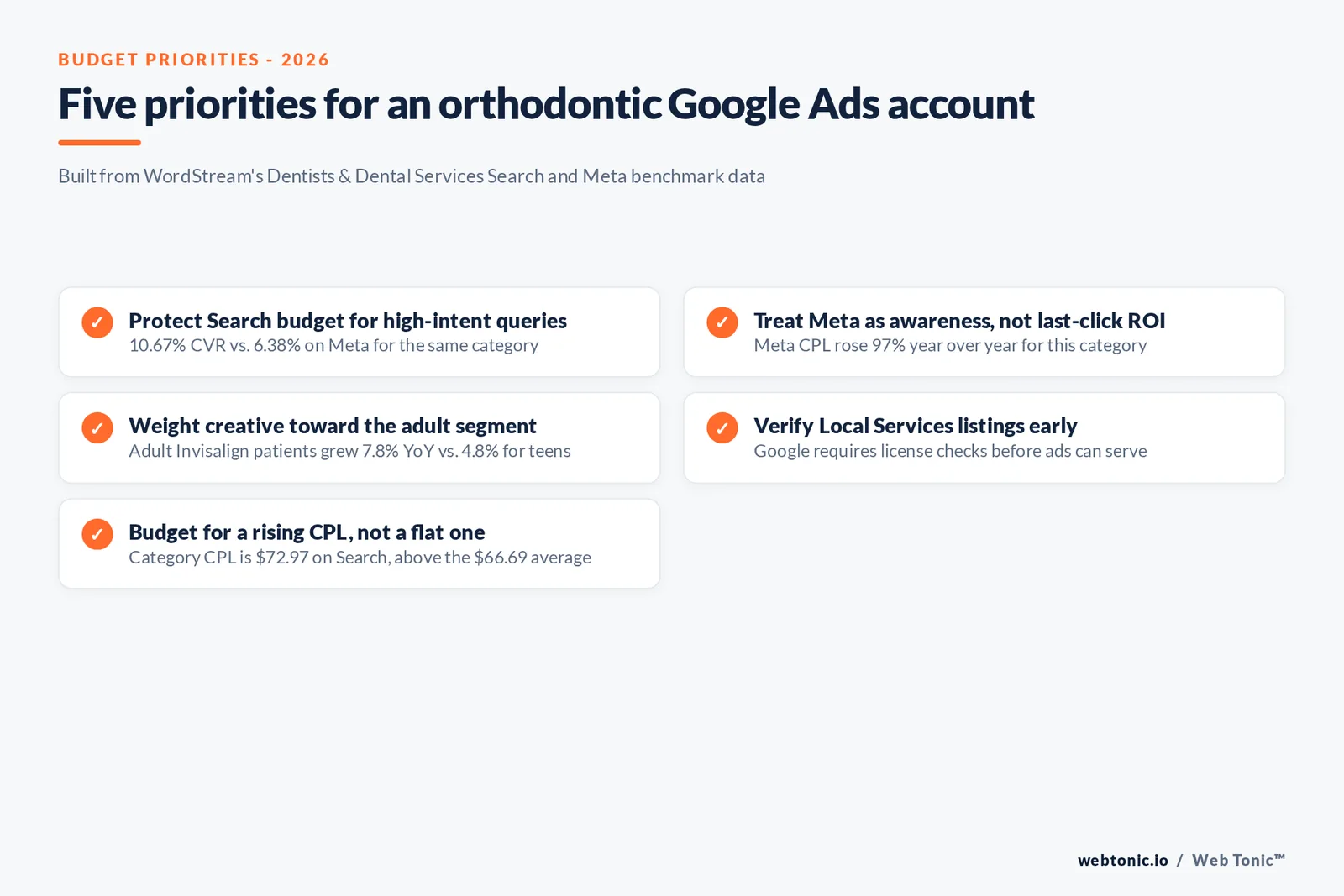
The category data supports a specific allocation logic rather than an even split: protect and grow Search budget where the $72.97 cost per lead is buying a 10.67% conversion rate on expressed intent, treat Meta spend as funding awareness and retargeting rather than a same-channel comparison on cost per lead, and weight creative and landing pages toward the adult segment growing faster than teen demand. A practical starting point is to size the Search budget first against expected case volume and the $72.97 category benchmark, then fund Meta separately against an awareness or retargeting goal rather than forcing it to hit the same cost-per-lead target Search is built to clear. None of this replaces a practice's own conversion data once campaigns are live, but it is a more defensible starting split than assuming dental-industry averages apply evenly across both channels. Our growth marketing team builds that kind of channel-specific budget model, and our guide to building a Google Ads strategy covers the account-structure side of the same problem. See our breakdown of what Google Ads actually costs across verticals, or talk to us about a channel-specific test plan.
Frequently Asked Questions
Is there a Google Ads benchmark specifically for orthodontists?
No. WordStream's benchmark reports track 23 broad industries, and the closest match is Dentists & Dental Services, which includes general dentistry alongside orthodontics. Every figure on this page should be read as that broader category's data, not an orthodontics-only number.
What does it cost to generate a lead for a dental or orthodontic practice on Google Ads?
WordStream's 2026 Google Ads benchmark puts Dentists & Dental Services at a $72.97 average cost per lead and an $8.00 average cost per click, both well above the roughly $5.42 and $66.69 cross-industry averages for CPC and CPL respectively.
Why does Meta cost so much more per lead than Google Search for this category?
WordStream's 2025 Facebook Ads Benchmarks report found Dentists & Dental Services carrying the highest cost per click ($9.78) and highest cost per lead ($76.71) of every tracked industry on Meta, with CPL up 97% year over year - while click-through rate was the lowest tracked, at 1.05%. Search captures people already looking for a provider; social has to interrupt a scroll and still pays a premium once auction demand rises.
Should an orthodontic practice shift budget from Meta to Google Search?
The cost data alone argues for protecting Search budget, since it converts at a much higher rate (10.67% vs. 6.38% on Meta) for a lower cost per click. But Meta's role is typically upper-funnel awareness rather than last-click conversion, so a straight cost comparison undercounts what paid social contributes earlier in a multi-touch patient journey.
Does an orthodontic practice need special verification to run Google ads?
If using Google's Local Services Ads product, yes - Google requires license and business verification for healthcare-adjacent local service providers, and tightened identity-check requirements in 2024. Standard Google Search campaigns do not require the same verification, but Google's healthcare and medicines advertising policies still apply to certain claims and destinations.
Sources
WordStream - 2026 Google Ads Benchmarks by industry
WordStream - Search Advertising Benchmarks by Industry, 2026 (PDF)
WordStream - Facebook Ads Benchmarks 2025 by industry
American Association of Orthodontists - 2025 Economics of Orthodontics and Patient Census Survey
Align Technology - Q1 2026 Earnings Call Transcript (StockAnalysis)
Google - Local Services platform policies
Google - Healthcare and medicines advertising policy
American Dental Association - Health Policy Institute, National Dental Expenditures