Table of contents
A nofollow link is a hyperlink carrying rel="nofollow", an attribute that tells search engines not to use the link when calculating rankings for the destination page. It signals that the link is not an endorsement, so no ranking credit — historically PageRank — is expected to pass through it.
Key Takeaways
- Google introduced the nofollow attribute in early 2005 to fight blog comment spam, and Yahoo and Bing adopted it too.
- Google now supports 3 link attributes —
sponsored,ugcandnofollow— and since 2019 treats them as hints rather than strict directives. - Paid links must be marked: Google prefers
rel="sponsored"for advertisements and paid placements, with nofollow still acceptable. - You can combine values in a space- or comma-separated list, for example
rel="ugc nofollow". - A nofollow link is not a blocked link: the destination page can still be crawled and indexed through sitemaps or other sites' links.
Nofollow sits at the intersection of SEO, publishing policy and advertising disclosure, which is why so much conflicting advice exists about it. This page separates what search engines document from what practitioners assume.
How the Nofollow Attribute Works
The attribute is a link relation placed inside the anchor tag, not on the page as a whole:
<a href=https://example.com/ rel="nofollow">Link text</a>
The rel attribute on an anchor element describes the relationship between the current document and the linked resource; nofollow is one of the registered values in the HTML specification for links, alongside values like noopener and canonical. It is valid HTML on any <a> element, and Google also supports nofollow as a robots meta tag that applies to every link on a page.
The original proposal came out of the blog-spam era. As documented in the history of the nofollow value, Google announced in early 2005 that links with rel="nofollow" would not influence the target's PageRank, and the specification was published under a royalty-free patent policy. In June 2009 Google changed the treatment again to stop advertisers from sculpting internal ranking flow: nofollowed links still consume a share of a page's outbound link equity, they simply do not pass it on.
The 3 Link Attributes Google Supports
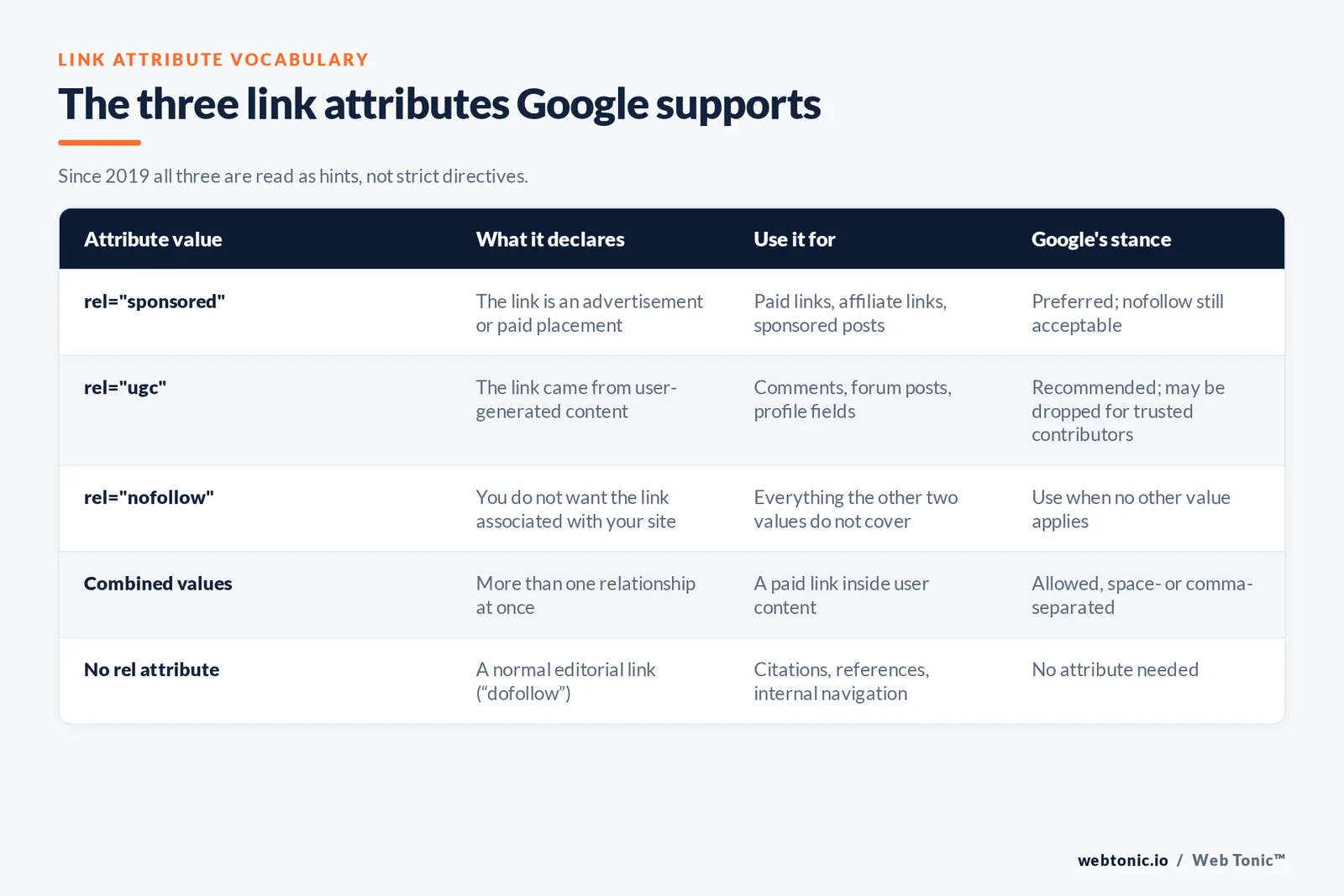
In 2019 Google replaced the single nofollow signal with a small vocabulary. All three values are documented in Google's guidance on how to qualify outbound links.
| Attribute value | What it declares | Use it for | Google's stance |
|---|---|---|---|
| rel="sponsored" | The link is an advertisement or paid placement | Paid links, affiliate links, sponsored posts | Preferred; nofollow still acceptable |
| rel="ugc" | The link came from user-generated content | Comments, forum posts, profile fields | Recommended; may be removed for trusted contributors |
| rel="nofollow" | You do not want the link associated with your site | Everything the other 2 values do not cover | Use when no other value applies |
| Combined values | More than one relationship at once | A paid link inside user content | Allowed as a space- or comma-separated list |
| No rel attribute | A normal editorial link, commonly called a dofollow link | Citations, references, internal navigation | No attribute needed |
Rule 1: there is no such thing as a rel="dofollow" attribute. "Dofollow" is practitioner shorthand for a link with no nofollow-family attribute at all. Adding rel="dofollow" to your HTML does nothing — it is not a registered value and search engines ignore it.
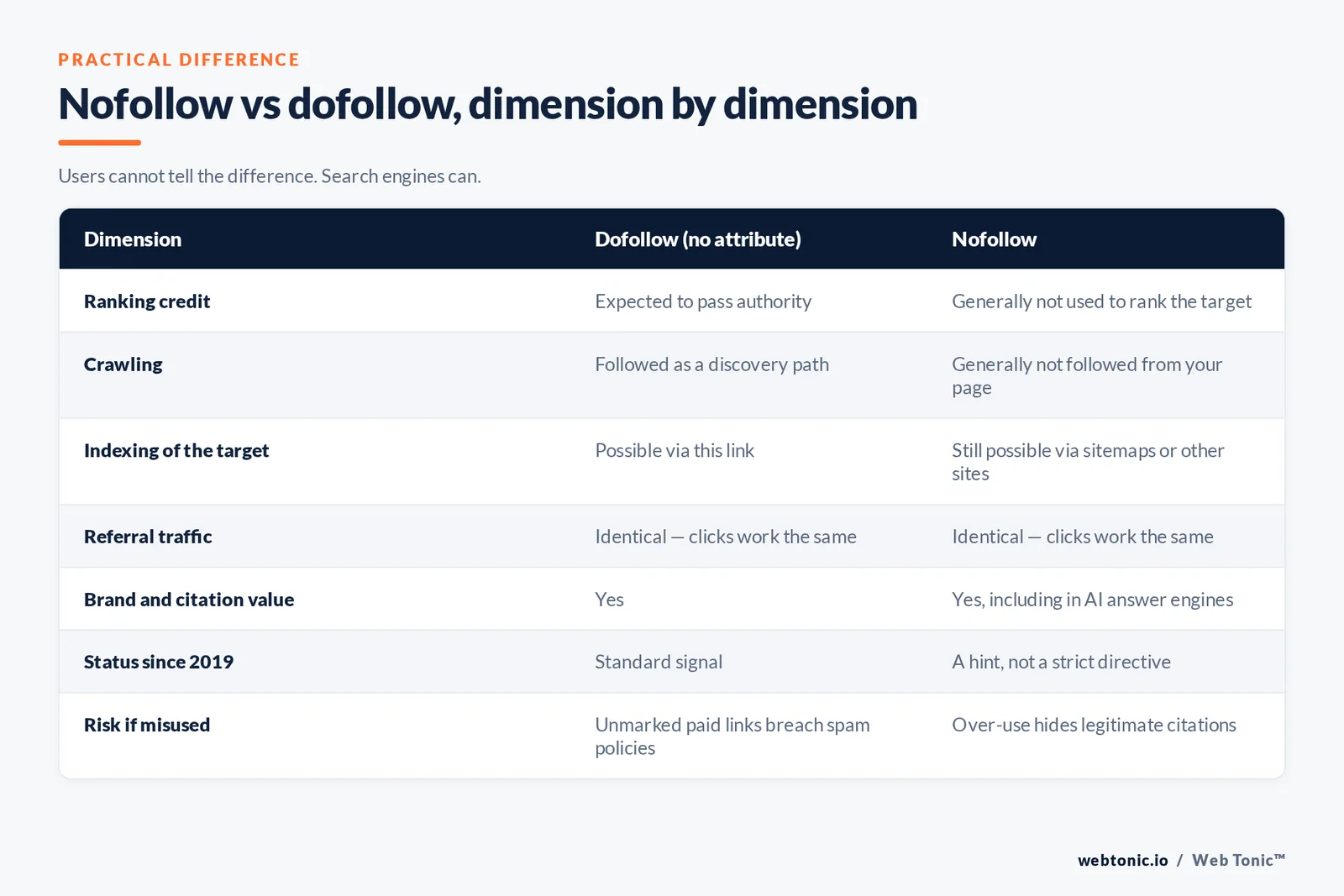
Nofollow vs Dofollow Links: The Practical Difference
| Dimension | Dofollow link (no attribute) | Nofollow link |
|---|---|---|
| Ranking credit | Expected to pass authority to the target | Generally not used for ranking the target |
| Crawling | Followed as a discovery path | Generally not followed from your page |
| Indexing of the target | Possible via this link | Still possible via sitemaps or other sites |
| Referral traffic | Identical — users cannot tell | Identical — clicks work the same |
| Brand and citation value | Yes | Yes, including in AI answer engines |
| Status since 2019 | Standard signal | Treated as a hint, not a strict directive |
| Risk if used wrongly | Paid links unmarked can breach spam policies | Over-use can hide legitimate citations |
Limit 2: nofollow is not a blocking mechanism. Google states plainly that pages linked with these attributes may still be found through other means, such as sitemaps or links from other sites, and so may still be crawled. To keep a URL out of the index you need a noindex robots rule; to stop crawling of your own URLs you need a robots.txt disallow rule.
When to Nofollow a Link — and When Not To
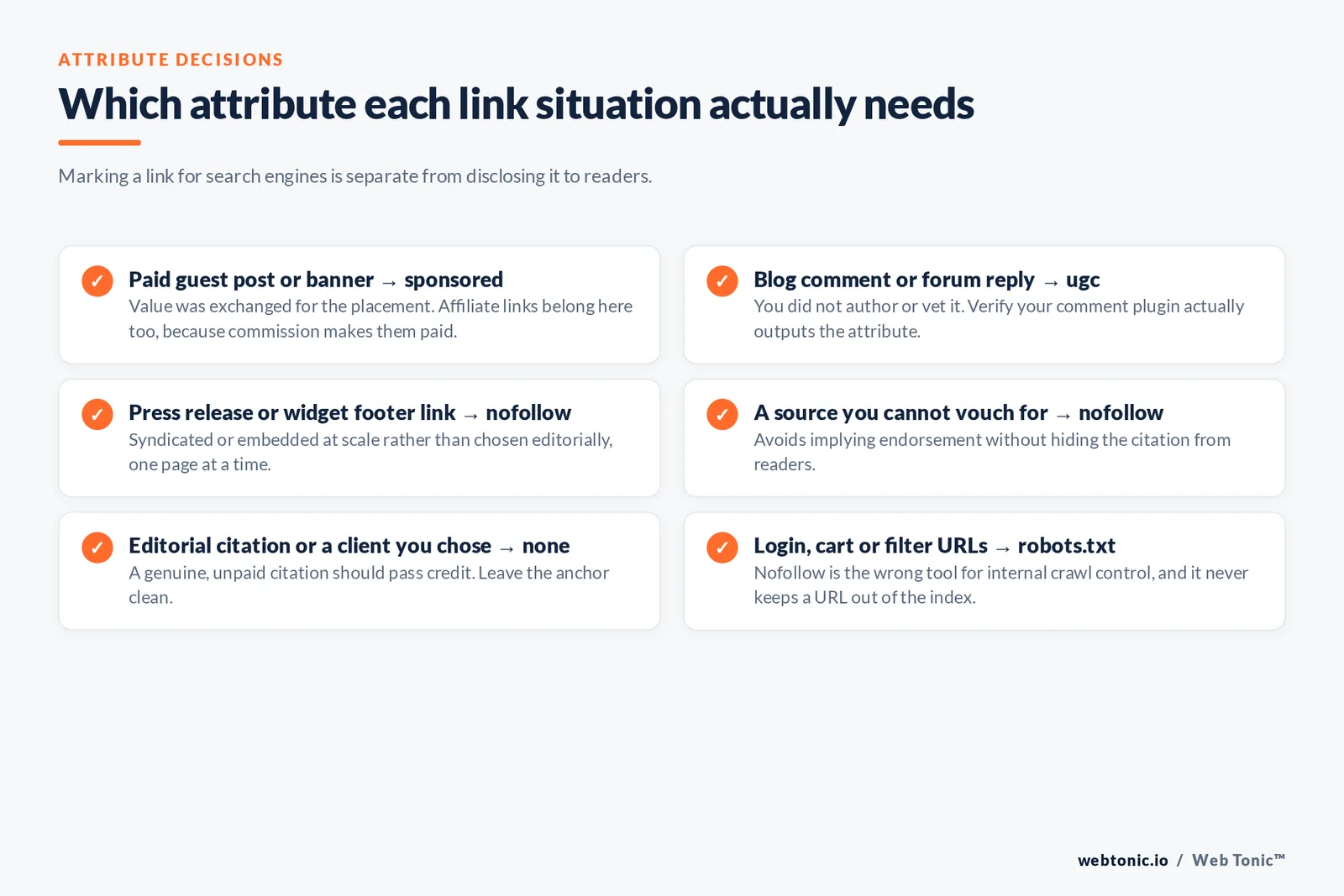
| Link situation | Recommended attribute | Reason |
|---|---|---|
| Paid guest post or banner | sponsored | Value was exchanged for the placement |
| Affiliate link | sponsored | Commission makes it a paid link |
| Blog comment or forum reply | ugc | You did not author or vet it |
| Press release distribution links | nofollow or sponsored | Syndicated at scale, not editorial |
| Link to a source you cannot vouch for | nofollow | Avoids implying endorsement |
| Login, cart or filter URLs on your own site | None — use robots.txt | Nofollow is the wrong tool for internal control |
| Editorial citation of research | None | A genuine citation should pass credit |
| Link to a client or partner you chose freely | None | Editorial and unpaid |
| Widget or embed footer link | nofollow | Distributed automatically, not chosen per page |
Disclosure obligations run in parallel with SEO ones. Marking an affiliate or sponsored link for search engines does nothing for consumers, and the FTC endorsement guidance expects a clear, visible disclosure in the content itself. Treat the attribute and the disclosure as two separate requirements.
Do Nofollow Links Still Have SEO Value?
Yes, but not the kind most link buyers imagine. A nofollow link from a high-traffic page delivers referral visits, brand exposure and a citation that AI answer engines can read. What it does not reliably do is move rankings the way an editorial link does. That distinction matters when pricing link building — the difference between a $500 sponsored placement and a $500 editorial mention is entirely in the attribute.
| Benefit | Nofollow delivers it? | Notes |
|---|---|---|
| Referral traffic | Fully | Clicks are unaffected by the attribute |
| Brand awareness | Fully | Readers never see the rel value |
| Citation in AI answers | Usually | Language models read the visible text |
| Ranking authority | No, by design | Hint status means no guarantee either way |
| Anchor text relevance | Uncertain | Not something to plan a strategy around |
| Profile diversity | Yes | A profile of 100% dofollow links looks unnatural |
Rule 3: a healthy backlink profile contains plenty of nofollow links. Real websites accumulate them naturally from Wikipedia, social platforms, forums and news comment sections. A profile with almost none is a signal that links were acquired rather than earned. Our growth marketing audits look at that ratio before anything else.
How to Add Nofollow in 6 Common Platforms
| Platform | How to apply the attribute | Gotcha |
|---|---|---|
| WordPress editor | Link settings panel, or the code editor for the raw tag | Visual editor may strip manual rel values on re-edit |
| Webflow | Link settings on the element, custom attribute rel | Rich-text links need a custom attribute per link |
| Shopify | Edit the HTML in the rich-text field | Theme templates can override rel on collections |
| Raw HTML | Add rel to the anchor tag directly | Combine with noopener when using target blank |
| Comment systems | Usually automatic ugc or nofollow | Verify — some plugins output dofollow links |
| Whole page at once | Robots meta tag with nofollow | Applies to every link, including internal ones |
WordPress documents the link workflow in its post editor documentation, and if you are building or migrating templates our web development team handles rel behaviour at theme level rather than per post.
How to Check Whether a Link Is Nofollow
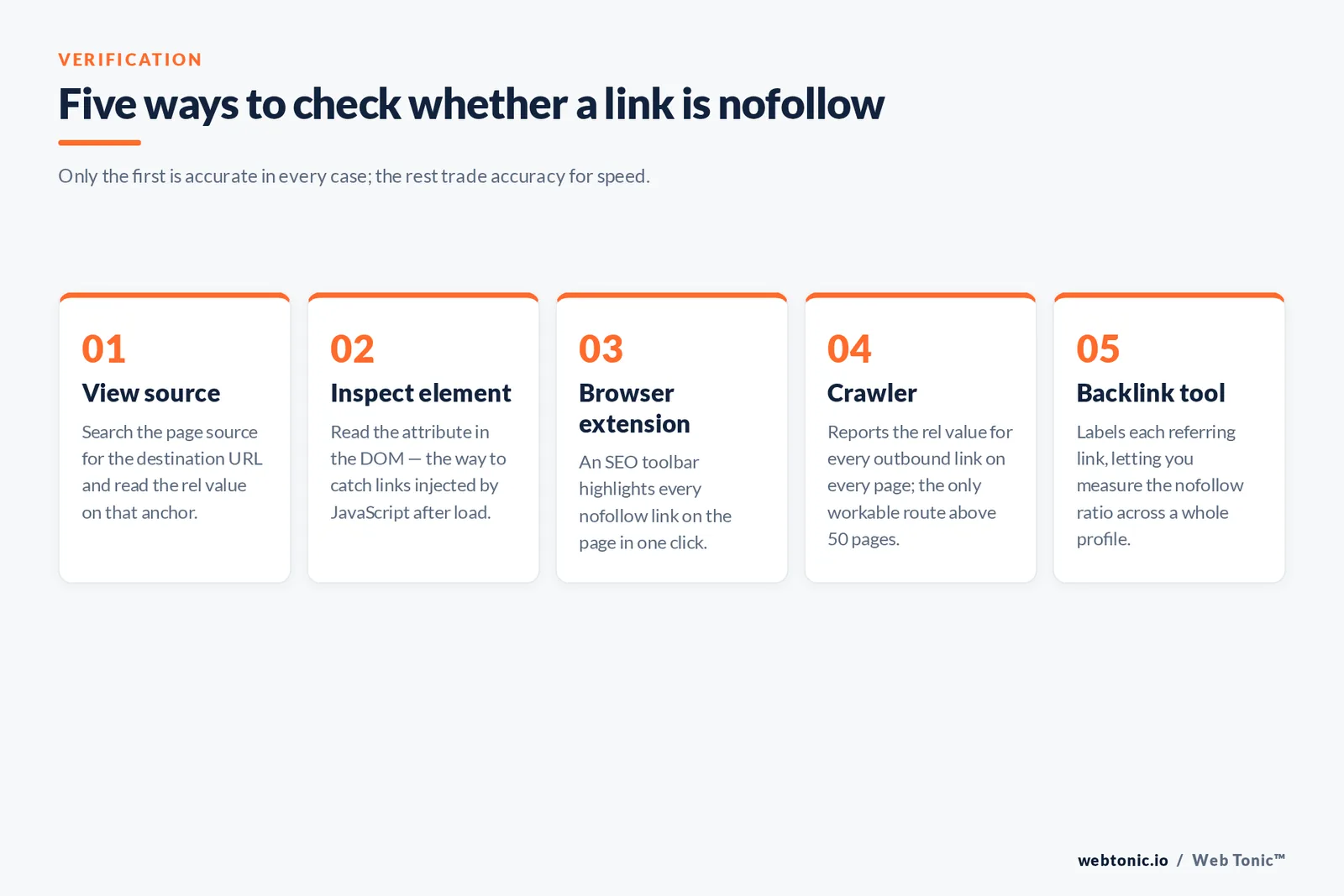
- Method 1 — View source. Open the page source and search for the destination URL; read the
relvalue on that anchor. This is the only method that is always accurate. - Method 2 — Inspect element. Right-click the link, inspect, and read the attribute in the DOM. Useful when links are injected by JavaScript after load.
- Method 3 — Browser extension. SEO toolbars highlight nofollow links visually across a page in 1 click, which is fastest for auditing a whole article.
- Method 4 — Crawler. A site crawler reports the rel value for every outbound link on every page, the only workable approach above 50 pages.
- Method 5 — Backlink tool. Backlink indexes label each referring link as nofollow or not, letting you measure the ratio across an entire profile.
Practitioner guides such as this walkthrough of nofollow links and this attribute explainer cover the tooling side in more detail; ongoing industry coverage tracks how the hint model has behaved since rollout.
How Other Search Engines and Platforms Treat the Attribute
Nofollow was never a Google-only convention. Yahoo and Bing announced support for the attribute in the same period, and large publishers standardised on it long before the 2019 vocabulary arrived. Wikipedia, one of the most linked-to domains on the web, applies nofollow to external links sitewide, which is why a Wikipedia citation drives traffic and trust rather than ranking authority.
| Engine or platform | Handling | What it means for you |
|---|---|---|
| Google Search | All 3 values read as hints since 2019 | Mark links accurately, do not expect absolute control |
| Bing | Respects the nofollow attribute value | Same markup covers both engines |
| AI answer engines | Read visible text and citations, not rel values | Nofollow placements can still be quoted |
| Wikipedia | Nofollows external links by policy | Chase it for referral traffic, not authority |
| Major social platforms | Nofollow or ugc on user links | Social profiles are visibility, not link equity |
| News comment sections | Typically ugc | Not worth buying at any price |
Limit 4: no attribute survives a redirect chain untouched. If a publisher wraps outbound links in a tracking redirect, the rel value on the visible anchor may not describe what search engines ultimately see. When you audit a paid placement, check the final destination as well as the anchor.
What Nofollow Means for Link Building Budgets
Once you accept that the attribute decides whether a placement moves rankings, link pricing becomes a simpler conversation. The question is no longer "how much does a link cost" but "what am I buying with this link".
| Placement type | Typical attribute | What you are really buying | Fair to pay for it? |
|---|---|---|---|
| Earned editorial mention | None | Ranking authority plus traffic | Cannot be bought, only earned |
| Paid guest post | sponsored | Audience exposure and referral clicks | Yes, priced as media |
| Directory listing | nofollow on most free tiers | Citation consistency for local search | Only where the audience is real |
| Press release syndication | nofollow | Announcement distribution | Sometimes, never as an SEO tactic |
| Sponsored newsletter | sponsored or tracked redirect | Qualified clicks from a warm list | Yes, judged on conversions |
| Link marketplace bulk deal | Advertised as dofollow | Risk under link spam policies | No |
Rule 5: budget nofollow placements out of the media line, not the SEO line. Judge them on referral sessions and assisted conversions within 30 days. If a $600 sponsored post sends 40 relevant visitors and 2 enquiries, it worked as media — and the attribute never mattered.
4 Myths Worth Retiring
- Myth 1 — "Nofollow links are worthless." They carry traffic, brand and citation value, and they make a profile look natural.
- Myth 2 — "Nofollow blocks indexing." It does not. Only a
noindexrule keeps a page out of results. - Myth 3 — "Nofollowing internal links sculpts PageRank." Google closed that loophole in 2009; the share is consumed either way.
- Myth 4 — "Hint status means the attribute is optional." Unmarked paid links can still breach link spam policies, so marking them is protective.
Internal nofollow use is where most damage happens. Blocking crawl paths to your own pages with nofollow instead of robots.txt creates orphaned URLs that are hard to diagnose later. Pages that should not be crawled belong behind a disallow rule; pages that should not rank belong behind noindex. For anything analytics-adjacent — measuring whether those referring links actually convert — see how we approach data intelligence.
FAQ
What does rel="nofollow" actually do?
It tells search engines not to use that link when ranking the destination page and, in most cases, not to follow it as a crawl path from your page. Since 2019 Google treats it as a hint rather than an absolute directive, meaning the search engine decides how much weight to give the signal.
Is nofollow or sponsored better for paid links?
Google prefers rel="sponsored" for advertisements and paid placements, while noting that nofollow remains an acceptable way to flag them. If your CMS only offers a nofollow checkbox, that is compliant; if you can set the value freely, use sponsored.
Do nofollow links help SEO at all?
Indirectly. They deliver referral visits, brand searches and citations that can lead to genuine editorial links later, and a natural mix of nofollow and dofollow links is what a real site looks like. They are not a substitute for earned editorial links.
Should internal links ever be nofollow?
Rarely. Google's own guidance points to a robots.txt disallow rule for links within your own site. Internal nofollow is a blunt tool that removes crawl paths without preventing indexing.
How do I find every nofollow link pointing at my site?
Use a backlink index and filter the referring links by attribute, then cross-check the top 20 manually in the page source, since indexes lag behind edits by days or weeks. Our blog covers the audit workflow, or get in touch for a review.
Sources: Google Search Central documentation on qualifying outbound links and the robots meta tag; WHATWG HTML specification, link types; Wikipedia, nofollow history; FTC endorsement guidance; WordPress documentation; Ahrefs; Semrush; Search Engine Journal.