



Table of contents
A networking email subject line has one job: make a busy stranger open a message that has no obvious value to them yet. The lines that work are short, specific and honest about why you are writing.
Key Takeaways
- Keep networking subject lines to 3–7 words and under 45 characters, because mobile inboxes truncate most lines past that point.
- Name the shared context — a mutual contact, an event, a published piece — in the subject itself; it is the single strongest open driver in one-to-one outreach.
- Brevo's 2026 benchmark puts average marketing email opens at 20.73% (33.87% once Apple privacy proxies are counted) and top-decile senders at 44.02%; one-to-one networking mail should clear those numbers comfortably.
- Average click rates sit near 2.27% for broadcast email, which is why reply rate — not open rate — is the metric that matters for networking.
- Inbox placement is not equal: Brevo measured 87.2% placement at Gmail versus 75.6% at Microsoft, so plain-text formatting and no tracking links help.
- Follow-up subject lines should change, not repeat — a second identical subject reads as automation.
- This page contains 42 usable subject lines across 7 scenarios, plus the templates and timing that go with them.
What Makes a Networking Subject Line Work
Networking email is not marketing email, and copying marketing tactics is why so much of it fails. There is no offer, no discount and no list — there is one person deciding in about a second whether a message from an unknown name is worth a tap. What earns that tap is recognisable context. A name they know, an event they attended, an article they wrote or a company they worked at all give the recipient a reason to place you before they open.
The second factor is proportionality. A subject line promising a "game-changing opportunity" from a stranger reads as sales; a subject line reading "Question about your ops role at Acme" reads as a person. Harvard Business Review's research library on professional networks is consistent on this point: weak-tie outreach succeeds when it is low-cost for the recipient to respond. Your subject line should telegraph exactly how small the ask is.
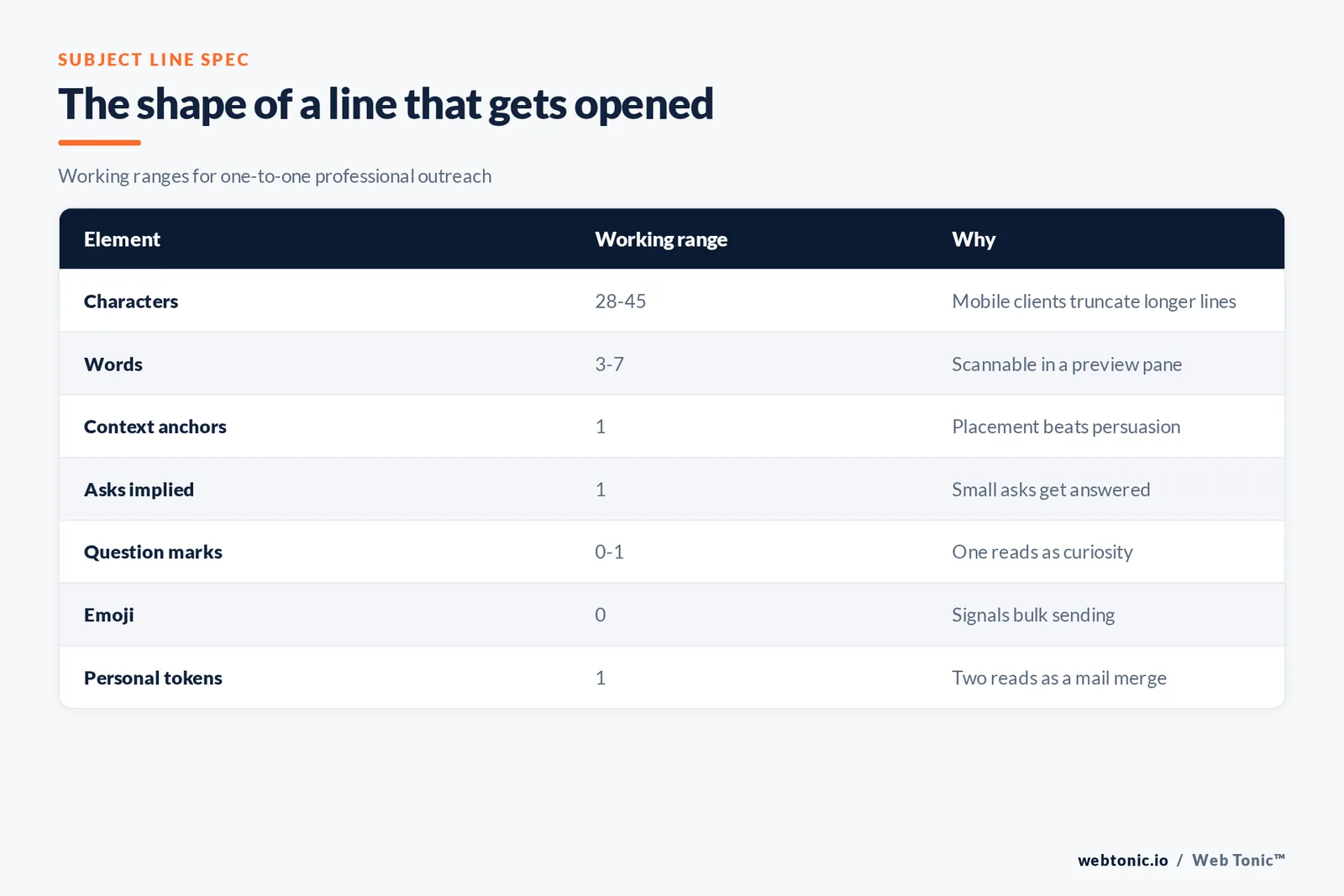
| Specification | Recommended range | Why | Fail state |
|---|---|---|---|
| Character count | 28–45 characters | Mobile clients truncate longer lines | A 70-character line cut mid-word |
| Word count | 3–7 words | Scannable in a preview pane | A full sentence with punctuation |
| Capitalisation | Sentence case | Reads as personal mail, not a campaign | Title Case Or ALL CAPS |
| Emoji | Zero in professional outreach | Signals bulk sending to most recipients | A rocket emoji on a cold ask |
| Context anchor | 1 per subject line | Placement beats persuasion | No shared reference at all |
| Ask size implied | 15 minutes or one question | Small asks get answered | "Partnership opportunity" |
| Personal tokens | 1 (name, company or event) | Two reads as a mail merge | Name, city and job title stacked |
| Question marks | 0 or 1 | One question reads as curiosity | Multiple punctuation marks |
42 Networking Email Subject Lines by Scenario
Use these as patterns rather than scripts — swap the bracketed tokens for genuine specifics before sending. Anything you cannot fill in truthfully should be cut rather than faked.
Cold outreach to someone you have never met
| Subject line | Why it works | Best used when |
|---|---|---|
| Quick question about [specific topic] | Names a small, answerable ask | You have one genuine question |
| Your talk on [topic] — one follow-up | Proves you consumed their work | They spoke publicly recently |
| Loved your piece on [subject] | Specific praise, no ask in the subject | You can quote a line from it |
| Fellow [university] grad in [city] | Instant shared-group placement | The affiliation is real and checkable |
| Two minutes on [their company]'s [process] | Bounded time, concrete subject | You are researching their function |
| [Their industry] question from a [your role] | Positions you honestly | Peer-to-peer outreach |
When you share a mutual connection
| Subject line | Why it works | Best used when |
|---|---|---|
| [Mutual contact] suggested I reach out | Borrowed trust in 5 words | They genuinely suggested it |
| Intro via [mutual contact] | Shortest possible framing | The name carries weight |
| [Mutual contact] and I were talking about [topic] | Explains the origin naturally | The conversation actually happened |
| Friend of [mutual contact] — quick hello | Warm and low-pressure | The relationship is informal |
| From [mutual contact]'s team at [company] | Adds an organisational anchor | You worked alongside them |
| [Mutual contact] said you'd know about [topic] | Flatters and specifies in one line | Expertise is the reason you write |
After meeting at an event
| Subject line | Why it works | Best used when |
|---|---|---|
| Great meeting you at [event name] | Direct memory trigger | Sent within 48 hours |
| Following up from [event] — [topic] we discussed | Two anchors, one purpose | You promised something |
| The [resource] I mentioned at [event] | Delivers value before asking | You owe them a link or file |
| [Event] hallway chat about [topic] | Specific enough to place instantly | The conversation was informal |
| Continuing our [event] conversation | Frames the email as a thread | There was real momentum |
| From your panel at [event] | Places you in the audience | They spoke and you did not meet properly |
Requesting an informational interview
| Subject line | Why it works | Best used when |
|---|---|---|
| 15 minutes on your path into [field]? | States the exact time cost | Career-change outreach |
| Advice request: moving into [role] | "Advice" outperforms "help" | You want guidance, not a job |
| Aspiring [role] — 3 questions if you have time | Quantifies the ask | Early-career outreach |
| Curious how [company] structures [function] | Flattering and concrete | Researching an operating model |
| Coffee or a call about [field]? | Offers two easy formats | You are geographically close |
| Your route from [role A] to [role B] | Shows you did the research | Their career path is public |
Following up on no reply
| Subject line | Why it works | Best used when |
|---|---|---|
| Re-sending in case this got buried | Assumes no bad intent | Follow-up 1, day 5–7 |
| One more try on [topic] | Honest and self-aware | Follow-up 2, day 14 |
| Should I close the loop on this? | Easy to answer either way | Final follow-up, day 21 |
| Still happy to work around your calendar | Removes the scheduling objection | A meeting was half-agreed |
| Adding one thing to my last note | Gives a new reason to open | You have genuinely new information |
| Closing this out — thanks either way | Graceful exit preserves the relationship | After 3 unanswered attempts |
Thank-you and post-meeting notes
| Subject line | Why it works | Best used when |
|---|---|---|
| Thank you for the [topic] advice | Names what you received | Within 24 hours of a call |
| Took your advice on [action] — an update | Proves you acted | 4–8 weeks later |
| Notes from our call, plus one link | Returns value immediately | You promised a summary |
| Introducing you to [contact], as promised | You are giving, not asking | You can make a real intro |
| That [resource] you asked about | Pure delivery, zero friction | A specific request was made |
| Grateful for the [company] intro | Short and warm | They opened a door for you |
Reconnecting after months or years
| Subject line | Why it works | Best used when |
|---|---|---|
| Long overdue hello from [shared context] | Names the gap honestly | 18+ months of silence |
| Still at [company]? Quick catch-up | Genuine curiosity, easy reply | Their role may have changed |
| Saw your news about [event] — congratulations | Occasion-led, no ask | They were promoted or launched |
| [Old project] came up this week | Shared memory as the hook | You worked together before |
| From your [old company] days | Places you across a job change | The overlap was years ago |
| Reconnecting, no agenda | Removes suspicion of a pitch | You genuinely want no favour |
Cold Outreach vs Follow-Up: The Rules Are Different
A first email and a third email are solving different problems. The first has to earn recognition; the follow-up has to avoid feeling like pressure. That means the subject line strategy inverts: cold subjects lean on shared context, while follow-up subjects lean on brevity and an easy exit. Never send an identical subject twice — most clients thread the conversation anyway, and a repeated line reads as an automated sequence.
Timing matters as much as wording. 2 to 3 touches spaced 5 to 14 days apart is the polite ceiling for networking outreach, and the third should openly offer to stop. Broadcast senders can afford to be ignored; you cannot, because the relationship is the asset.
| Dimension | Cold first email | Follow-up | Why they differ |
|---|---|---|---|
| Primary job | Establish who you are | Lower the cost of replying | Recognition already attempted |
| Subject anchor | Mutual contact, event or their work | The original topic, restated shorter | Context is already in the thread |
| Ideal length | 5–7 words | 3–5 words | Short reads as low-pressure |
| Body length | 90–130 words | 35–60 words | Nothing new to explain |
| Number of asks | 1 | 1, plus an exit | Exits protect the relationship |
| Spacing | Day 0 | Day 5–7, then day 14–21 | Inbox recovery takes a week |
| Total touches | 1 | 2 maximum | 3+ reads as a campaign |
Personalisation Tokens That Actually Change Behaviour
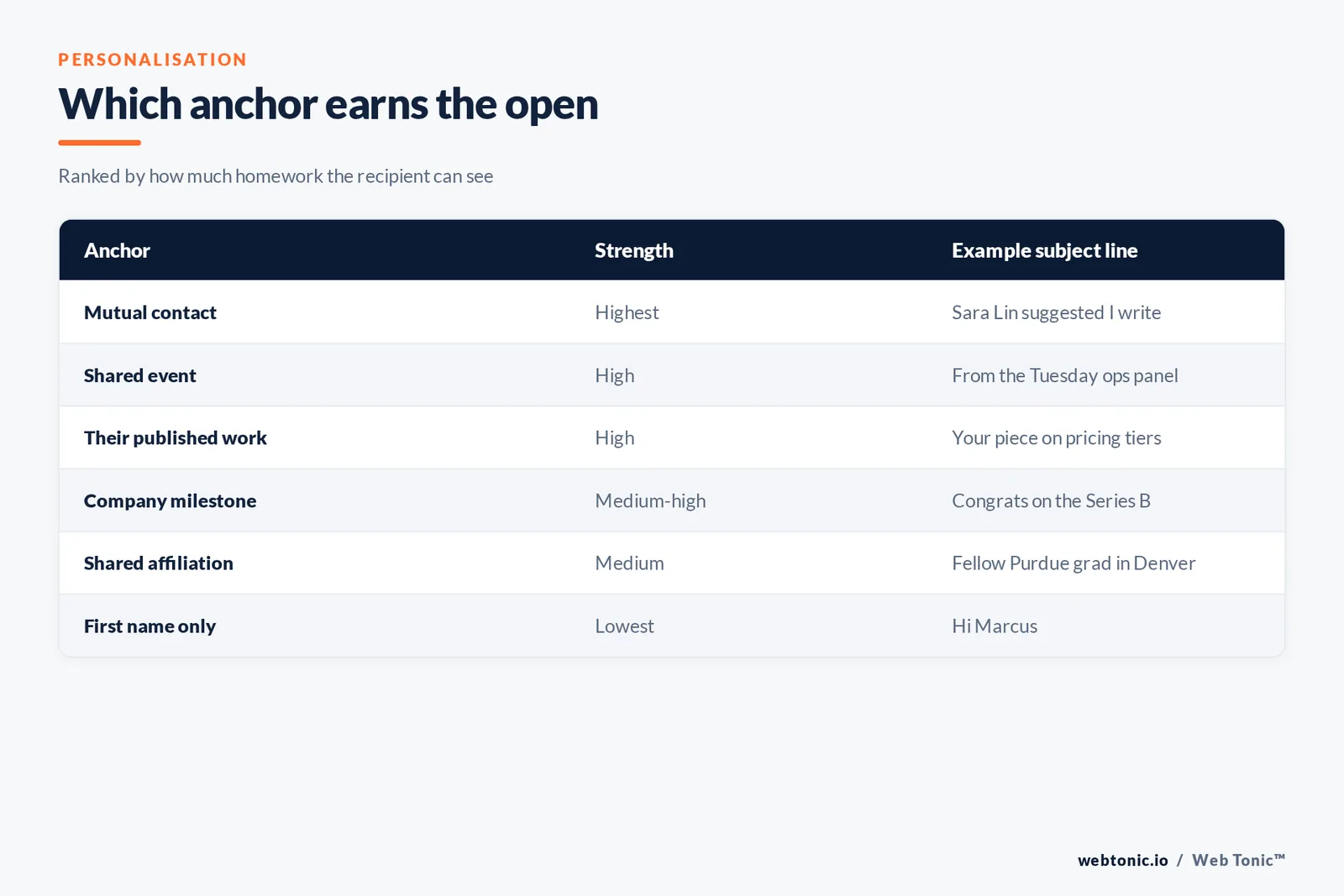
Personalisation is not the recipient's first name — that has been standard since the first mail merge. What moves a networking email is a detail only a human who did their homework would know. 1 strong token beats 3 generic ones, and the token should sit in the first 3 words of the subject where the preview pane will show it.
Do the research on public sources: their own writing, a recorded talk, a company announcement, a shared alumni group. LinkedIn's B2B Institute research library is a useful reminder that memorability, not novelty, drives response in professional contexts.
| Token | Example in a subject line | Strength | Where to source it |
|---|---|---|---|
| Mutual contact | "Sara Lin suggested I write" | Highest | The contact themselves |
| Shared event | "From the Tuesday ops panel" | High | Attendee list or programme |
| Their published work | "Your piece on pricing tiers" | High | Blog, newsletter, podcast |
| Company milestone | "Congrats on the Series B" | Medium-high | Press release or company page |
| Shared affiliation | "Fellow Purdue grad in Denver" | Medium | Alumni directory |
| Specific role detail | "Question on your RevOps stack" | Medium | Job posting or profile |
| Geography | "Also based in Lisbon" | Low-medium | Profile location |
| First name only | "Hi Marcus" | Lowest | Anywhere — and it shows |
Tone Calibrated to the Relationship
The same subject line can read as charming or presumptuous depending on the distance between you and the recipient. Calibrate deliberately: warmer language for people who already know you, plainer language for strangers and senior people. Humour is a poor bet in a first cold subject line because you have no read on the recipient's mood or culture.
| Relationship | Tone to use | Subject line example | What to avoid |
|---|---|---|---|
| Total stranger, senior | Plain and deferential | "One question about [topic]" | Familiarity or humour |
| Total stranger, peer | Direct and collegial | "[Industry] question, peer to peer" | Over-formal openers |
| Warm intro via a mutual | Warm, name-led | "[Name] connected us" | Burying the referral |
| Met once at an event | Friendly and specific | "Our [event] chat about [topic]" | Assuming they remember you |
| Dormant contact | Honest about the gap | "Long overdue hello" | Pretending no time passed |
| Current collaborator | Efficient | "Quick [project] question" | Unnecessary formality |
Six Mistakes That Kill Open Rates
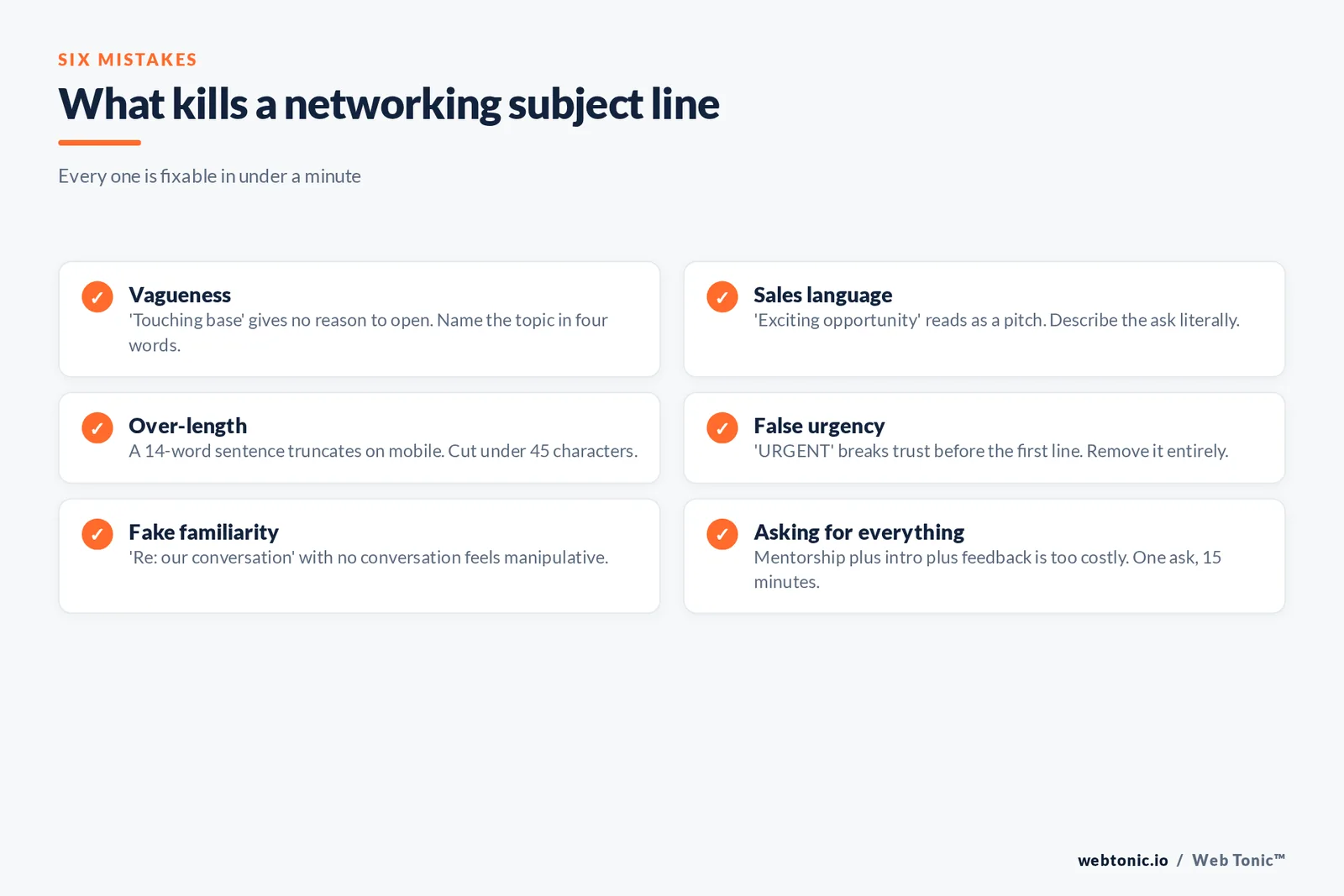
Most weak subject lines fail for the same handful of reasons, and every one of them is fixable in under a minute.
| Mistake | What it looks like | Why it fails | The fix |
|---|---|---|---|
| Mistake 1 — Vagueness | "Touching base" | Gives no reason to open | Name the topic in 4 words |
| Mistake 2 — Sales language | "Exciting opportunity for you" | Reads as a pitch, not a person | Describe the ask literally |
| Mistake 3 — Over-length | A 14-word summary sentence | Truncated on mobile | Cut to under 45 characters |
| Mistake 4 — False urgency | "URGENT: quick reply needed" | Breaks trust before you start | Remove urgency entirely |
| Mistake 5 — Fake familiarity | "Re: our conversation" with no conversation | Feels manipulative on open | Only reference what happened |
| Mistake 6 — Asking for everything | "Mentorship, intro and feedback?" | Too costly to answer | One ask, 15 minutes maximum |
Templates: Subject Line Plus the First Two Lines
A subject line only earns the open; the first two lines earn the reply, because most clients show them as preview text. Write them as one unit. These four templates cover the majority of real networking situations, and each keeps the ask to a single sentence.
| Scenario | Subject line | Opening two lines | The single ask |
|---|---|---|---|
| Referred introduction | "[Referrer] suggested I reach out" | "[Referrer] mentioned you led the migration at [company]. I am working through the same decision at [your company]." | "Would 15 minutes in the next two weeks be possible?" |
| Cold, admiring their work | "Your piece on [topic]" | "Your point about [specific argument] changed how I brief my team. One thing I could not resolve was [specific gap]." | "Is your take that [option A] or [option B]?" |
| Event follow-up | "Great meeting you at [event]" | "You mentioned you were rebuilding [process] — here is the [resource] I promised." | "Happy to compare notes in a month if useful." |
| Reconnecting | "Long overdue hello" | "We last spoke around [project] in [year]. I saw your move to [company] and wanted to say congratulations." | "Any interest in a 20-minute catch-up call?" |
Industry-Specific Angles
The pattern holds across fields, but the credible anchor changes. Match the anchor to what people in that field actually treat as proof of homework.
| Field | Strongest anchor | Subject line example | Anchor to avoid |
|---|---|---|---|
| Technology | A talk, repo or technical post | "Your talk on queue backpressure" | Generic company praise |
| Finance | A deal, filing or published note | "Question on your Q3 sector note" | Casual first-name openers |
| Healthcare | A paper, protocol or conference | "Your [conference] poster on triage" | Anything resembling a pitch |
| Creative and media | A specific piece of their work | "The [campaign] you art-directed" | Vague compliments |
| Academia | A citation of their research | "Citing your 2024 paper on [topic]" | Commercial framing |
| Trades and local business | A referral or a nearby job | "[Referrer] says you did their roof" | Corporate jargon |
Deliverability: Getting Into the Inbox at All
A brilliant subject line is worthless in a spam folder. One-to-one mail from a normal mailbox usually lands, but a few habits push it into filters. Brevo's benchmark data shows inbox placement is not uniform — roughly 87.2% at Gmail versus 75.6% at Microsoft for commercial senders — so the safest configuration for networking mail is a plain message with no tracking pixel, no bulk tool and no attachment on the first send. Gmail's own sender guidelines and Litmus's email client market share data are the two references worth knowing, and if you are sending anything remotely promotional the FTC's CAN-SPAM compliance guide defines the legal line.
| Habit | Effect on delivery | Do this instead |
|---|---|---|
| Tracking pixels on 1:1 mail | Raises filter suspicion | Send plain text from your mailbox |
| Attachment on first contact | Common spam signal | Link to a document instead |
| ALL CAPS or "!!!" | Classic filter trigger | Sentence case, one punctuation mark |
| Bulk tool for 40 people | Treated as a campaign | Send individually, 10 per day |
| Link shorteners | Frequently blocklisted | Use the full destination URL |
| Mismatched display name | Fails recipient recognition | Use your real full name |

What to Measure — and What to Ignore
Open rate is the metric everyone quotes and the least useful one here. Apple's privacy protections inflate and distort opens for anything sent through a marketing platform, which MailerLite's benchmark analysis and Mailchimp's industry benchmark data both note. For networking, reply rate and meetings booked are the only numbers that matter, and a spreadsheet of 40 rows is enough tooling.
Use broadcast benchmarks only as a floor. Brevo's 2026 email benchmark puts average marketing opens at 20.73% and clicks at 2.27%, while GetResponse's benchmark report and Campaign Monitor's guide land in similar territory. Genuine one-to-one outreach with a real anchor should sit far above those numbers; if it does not, your subject lines are not the problem — your targeting is. If you want this thinking applied to a commercial pipeline rather than a personal one, our growth marketing team and data intelligence team build the measurement, and the Web Tonic blog documents the patterns.
| Metric | Useful for networking? | Realistic target | Note |
|---|---|---|---|
| Reply rate | The primary metric | 15–35% with a real anchor | Referred intros run far higher |
| Meetings booked | The outcome metric | 1 in 5 replies | Track by anchor type |
| Open rate | Weak signal | Above the 20.73% broadcast average | Privacy proxies distort it |
| Click rate | Rarely relevant | n/a for 1:1 mail | Broadcast average is 2.27% |
| Bounce rate | Data hygiene check | Under 3% | High bounces mean stale sourcing |
| Follow-up conversion | Worth tracking | 20–30% of replies come from touch 2 | Justifies the second email |
FAQ
What is the best subject line for a networking email?
The best line names your shared context in under seven words — a mutual contact, an event or a piece of their work. "[Mutual contact] suggested I reach out" outperforms almost everything else because it borrows trust the recipient already has. There is no universally best line, only the most specific true one available to you.
How long should a networking email subject line be?
Three to seven words, or roughly 28 to 45 characters. Mobile clients truncate longer lines, and the front-loaded words are what the recipient actually reads in a crowded inbox. If your line only works at full length, it is carrying information that belongs in the body.
Should I use the person's name in the subject line?
Only if you have nothing stronger. A first name is the weakest form of personalisation because every mail merge does it. A mutual contact's name, an event name or the title of something they published is far more convincing evidence that a human wrote the message.
How many times should I follow up on a networking email?
Two follow-ups maximum, spaced roughly five to seven days and then fourteen to twenty-one days after the original. Change the subject line each time, keep each message shorter than the last, and make the final one an explicit offer to close the loop so the relationship survives the silence.
Do emoji help networking subject lines?
In professional one-to-one outreach, no. Emoji signal bulk sending to most recipients and can look careless to senior readers. They have a place in consumer marketing campaigns where you are testing at volume, but a networking email is a single message to a single person you want to impress.
Sources
Brevo 2026 email marketing benchmark report · Mailchimp email marketing benchmarks · MailerLite email marketing benchmarks · GetResponse email marketing benchmarks report · Campaign Monitor email marketing benchmarks guide · Litmus email client market share data · Gmail Help — bulk sender and spam guidelines · FTC — CAN-SPAM Act compliance guide for business · Harvard Business Review — professional networks research library · LinkedIn B2B Institute research library. All figures cited as published by the named source at the time of writing; benchmark figures describe broadcast marketing email and are used here as a floor for one-to-one outreach.


