Table of contents
Microsoft Advertising is the pay-per-click platform formerly called Bing Ads. It places text, display and video units across Bing, MSN, Yahoo, AOL and DuckDuckGo. It is the cheapest large-scale query inventory most advertisers never switch on.
This guide covers what the platform is, what it costs, how it stacks up against Google, and how to launch a first campaign the same afternoon.
Key Takeaways
- The network reaches buyers on Bing, MSN, Yahoo, AOL, DuckDuckGo and Ecosia from one account.
- Bing holds a single-digit share of global queries — roughly 4% of all queries — but a materially larger slice of US desktop volume.
- Practitioner benchmarks routinely put cost per click 20–40% below Google for the same keyword set.
- There is no minimum spend, and existing campaigns import in under 10 minutes.
- LinkedIn profile targeting — company, job function and industry — exists on no other search engine.
- Free certification takes roughly 2 hours and is worth it before you spend a dollar.
What the platform actually is
The platform is Microsoft's service for buying placements against query intent and browsing behaviour. It was branded Bing Ads until 2019, when the company renamed the product to reflect a reach that had grown well past a single search engine. The mechanics will feel instantly familiar to anyone who has run paid search elsewhere: you build campaigns, add ad groups, bid on keywords, write responsive search ads, and pay per click.
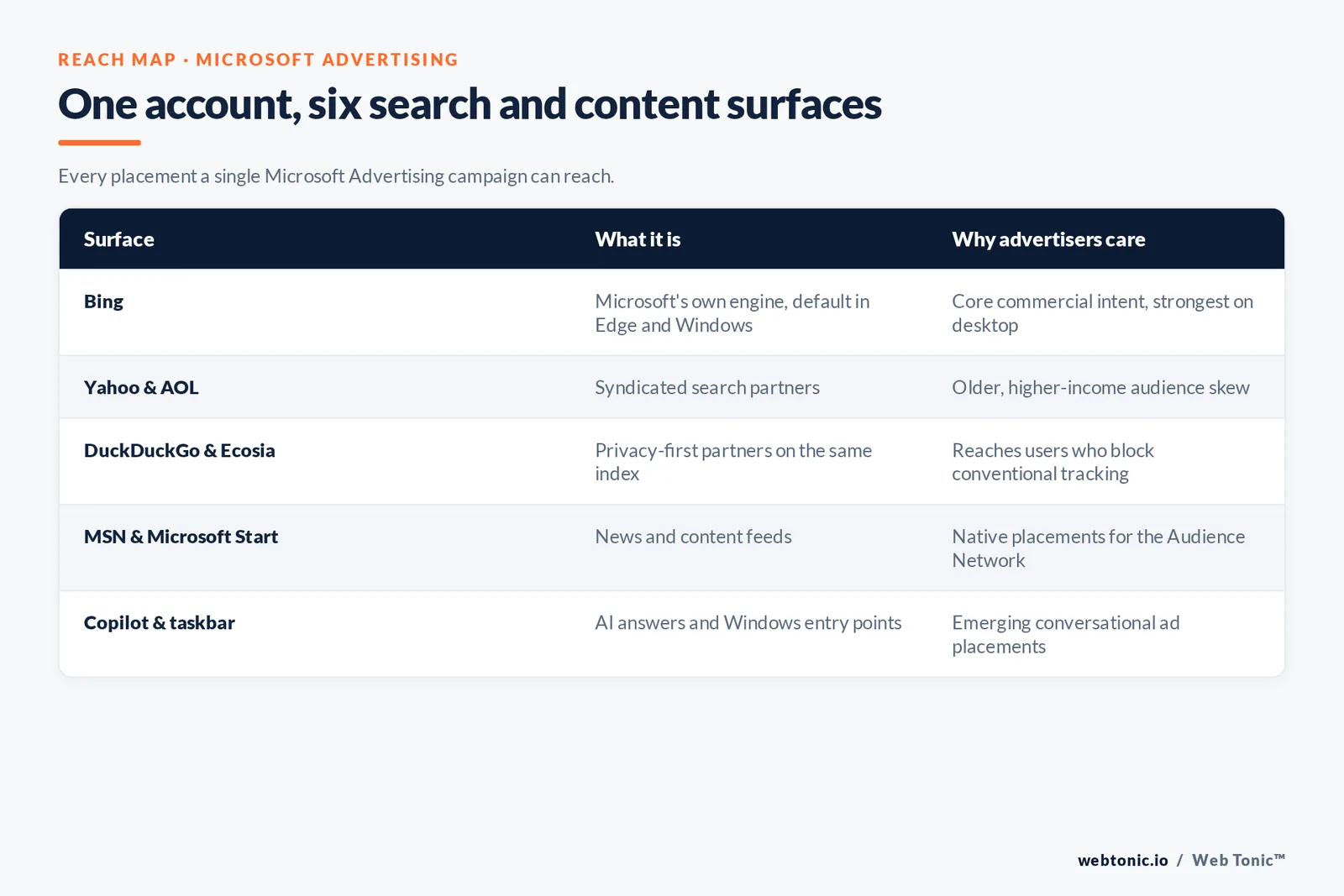
What differs is the inventory. A single account distributes your campaigns across the whole network — Bing itself, MSN, Microsoft Start, the Windows taskbar and Copilot surfaces — plus syndicated partners including Yahoo, AOL and DuckDuckGo. Yahoo has been monetised through this partnership for years, which is why its result pages carry these placements rather than their own. The platform's own solutions overview maps every placement, and the Microsoft Learn get-started guides document the structure in detail.
The other half of the offering is the Microsoft Audience Network, a native display network that renders in-feed on MSN, Outlook.com and Edge. It uses the same intent signals your search campaigns generate, so it behaves less like generic display and more like a retargeting layer with editorial polish.
How big is the reach, honestly
Query share is where most teams stop reading. Independent trackers put it at roughly 4% of worldwide queries, with the leader above 89%, according to StatCounter and corroborated by Statista. Those numbers are correct and also misleading, for three reasons.
First, they blend mobile — where Google is the default on Android and iOS — with desktop, where the Windows and Edge defaults give it a much stronger position. Second, they count the engine, not the network: partner traffic from Yahoo and DuckDuckGo does not appear in that line. Third, share of queries is not share of revenue. its search and news line has kept growing across recent quarters, as the quarterly earnings disclosures show, because higher-value commercial queries convert.
For a business, the practical read is simple. A small share of a market that runs to billions of daily queries still adds up to real volume, and the rivals competing for it are far fewer than on the leading engine.
| Surface | What it is | Why advertisers care |
|---|---|---|
| Bing | The company's own engine, default in Edge and Windows | Core commercial intent, strongest on desktop |
| Yahoo & AOL | Syndicated search partners | Older, higher-income audience skew |
| DuckDuckGo & Ecosia | Privacy-first partners using the same index | Reaches users who block conventional tracking |
| MSN & Microsoft Start | News and content feeds | Native placements for the audience network |
| Copilot & taskbar | AI answers and Windows entry points | Emerging conversational ad placements |
What ad formats you can run
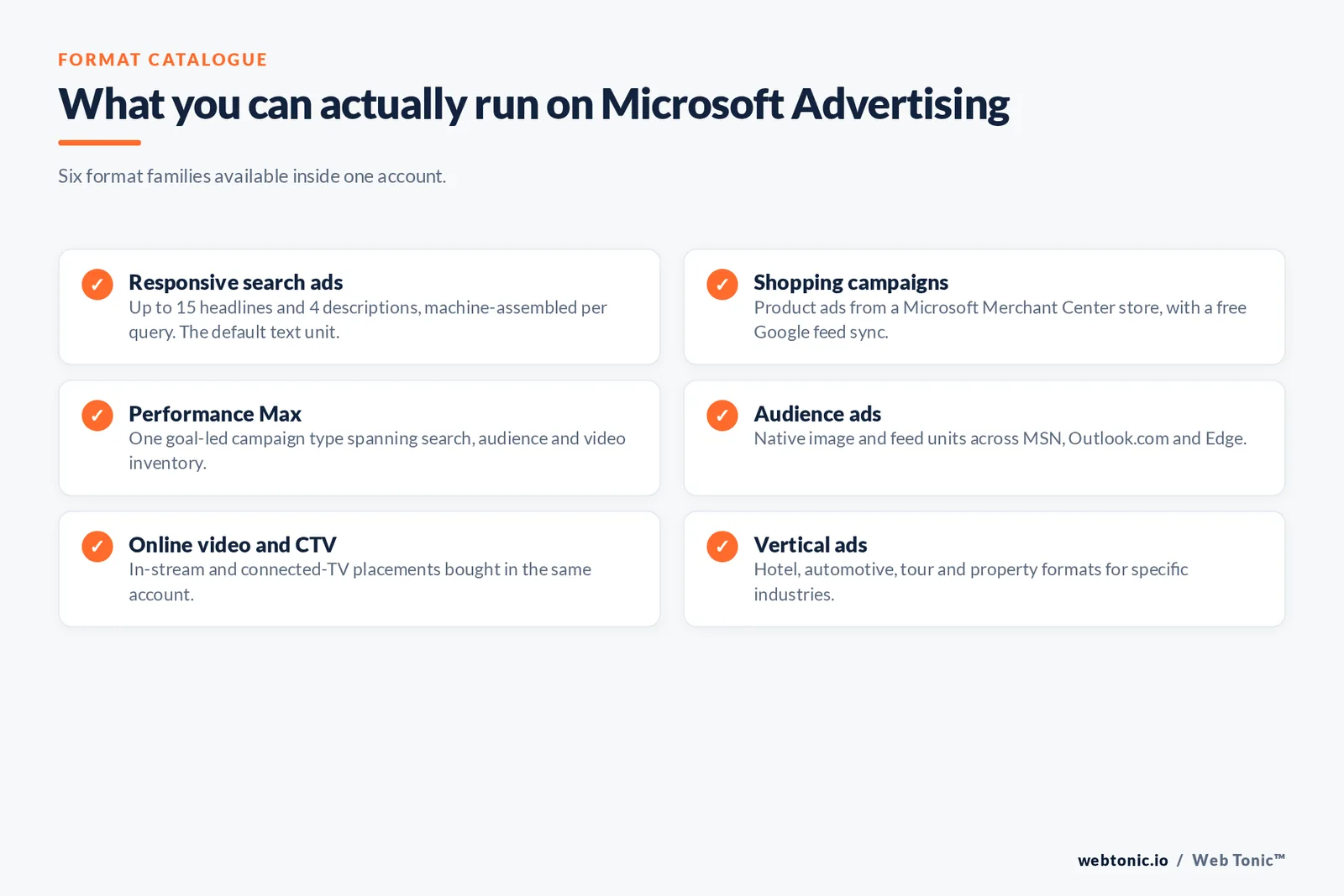
The format catalogue mirrors what any modern paid-media stack is expected to offer, with a few Microsoft-only twists.
- Responsive search ads — up to 15 headlines and 4 descriptions, machine-assembled per query. The default text unit.
- Shopping campaigns — product ads fed by a Microsoft Merchant Center store, with a free feed sync from Google Merchant Center.
- Performance Max — one goal-led campaign type that spans search, audience and video inventory.
- Audience ads — native image and feed units across MSN, Outlook and Edge.
- Online video and CTV ads — in-stream and connected-TV placements bought inside the same account.
- Vertical ads — hotel, automotive, tour and property formats for specific industries.
Second-channel maths: the honest comparison
Nobody should replace the market leader with this network. The realistic question is whether a second channel earns its keep, and for most teams with a working Google programme the answer is yes — the migration cost is close to zero because campaigns import directly.
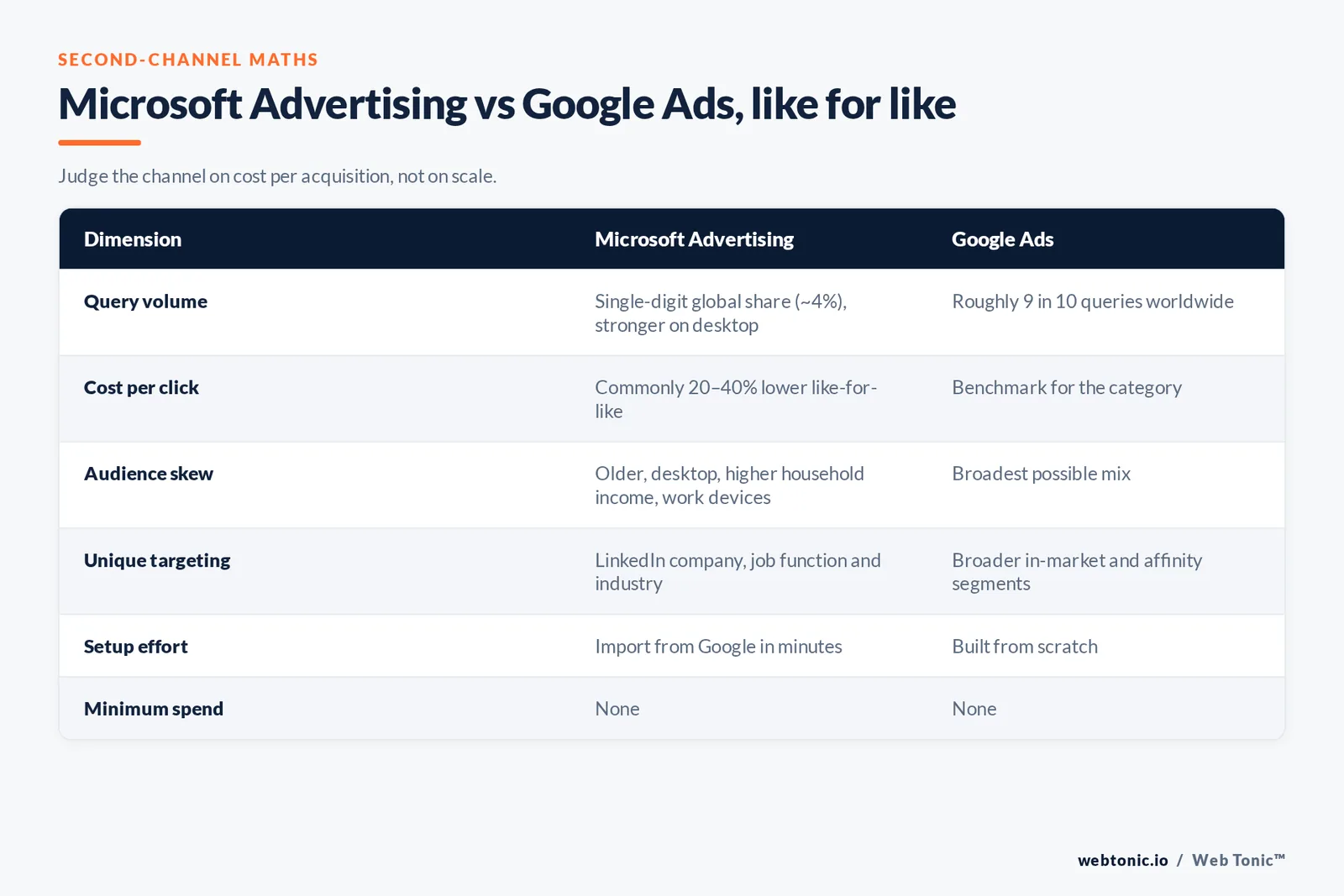
Cost is the headline. Because fewer buyers compete, auction pressure is lower and clicks land cheaper. Reported gaps vary by vertical, but analyses such as WordStream's benchmarks and coverage in Search Engine Land consistently show cheaper clicks and lower competition. Volume is the trade-off: expect a fraction of the impressions you see on Google, so judge it on cost per acquisition, not on scale.
| Dimension | Microsoft Advertising | Google Ads |
|---|---|---|
| Query volume | Single-digit global share, stronger on desktop | Roughly 9 in 10 queries worldwide |
| Cost per click | Commonly 20–40% lower like-for-like | Benchmark for the category |
| Audience skew | Older, desktop, higher household income, work devices | Broadest possible mix |
| Unique targeting | LinkedIn company, job function and industry | Broader in-market and affinity segments |
| Setup effort | Import from Google in minutes | Built from scratch |
| Minimum spend | None | None |
Two structural differences matter more than the cost gap. The LinkedIn integration lets a B2B buyer bid up for people who work at target companies — a layer no rival engine can copy. And the syndicated partners mean privacy-conscious DuckDuckGo users, invisible to conventional tracking, remain reachable through keyword intent. If your buyers sit in enterprise IT, finance, healthcare or manufacturing, this is where standard PPC economics bend in your favour.
How to set up your first campaign
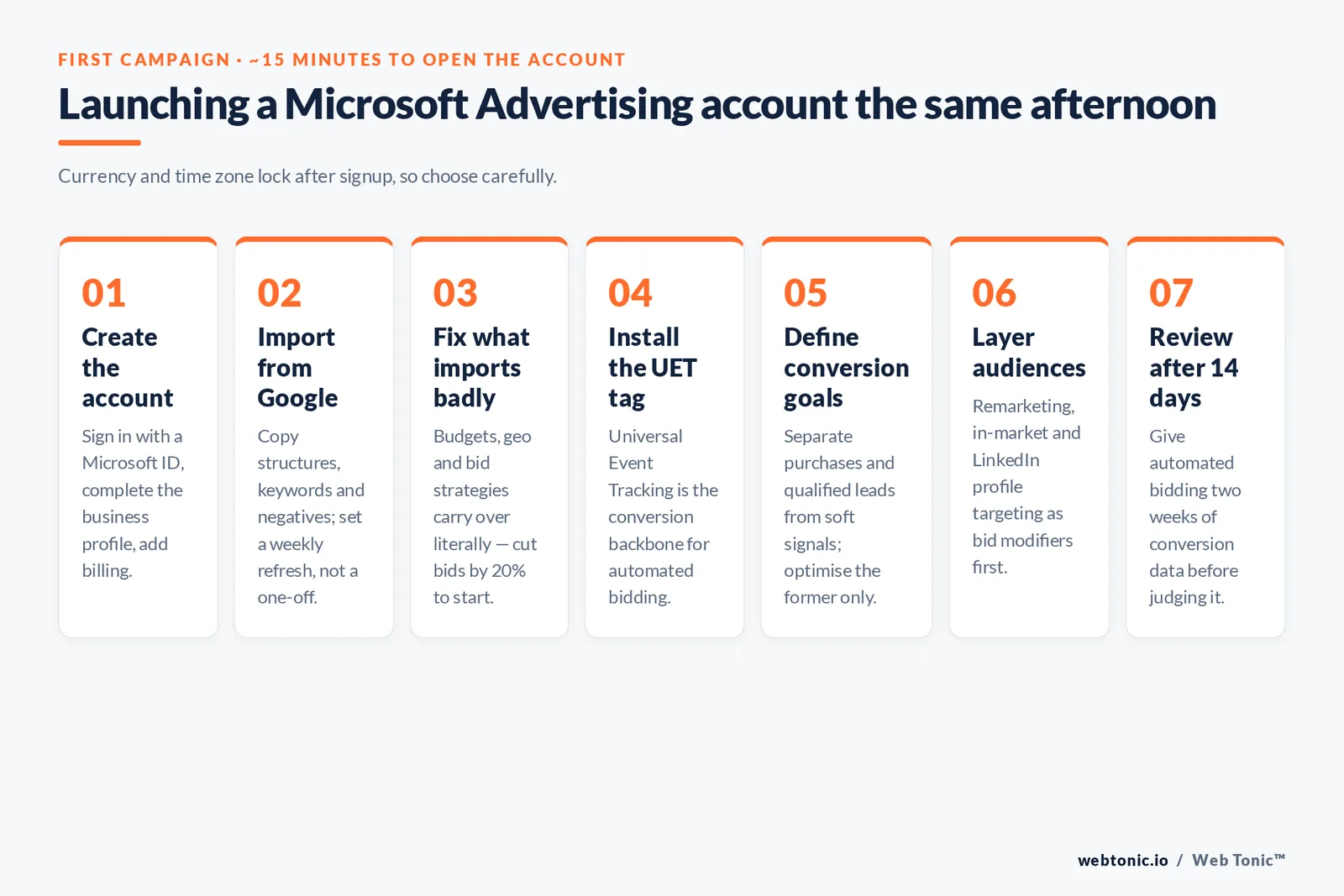
Opening an account takes about 15 minutes. You sign in with a Microsoft ID, confirm your company details, add a billing method and choose a currency and time zone — both of which are locked afterwards, so choose carefully.
- Create the account. Sign up at the platform's home page and complete the business profile.
- Import from Google. Use the built-in tool to copy structures, keywords and negatives. Set the schedule to a weekly refresh rather than a one-off if the larger engine remains your primary channel.
- Fix what imports badly. Budgets, geographic targeting and bid strategies carry over literally. Cut bids by 20% to start, since the auction is cheaper.
- Install the UET tag. Universal Event Tracking is the conversion backbone. Without it, automated bidding has nothing to learn from.
- Define conversion goals. Separate a purchase or qualified lead from a soft signal like a page view, and only optimise toward the former.
- Layer audiences. Add remarketing lists, in-market audiences and — for B2B — LinkedIn profile targeting as bid modifiers before you rely on them for standalone targeting.
- Review after 14 days. Give automated bidding two weeks of conversion data before judging performance.
Two tools save hours once you are live. The desktop bulk-editing application, Microsoft Advertising Editor, mirrors Google's own editor, and the free certification programme covers the interface properly in a couple of hours. Account and privacy settings, including how personalisation works on a personal Microsoft profile, are documented in Microsoft's help centre.
Measurement, privacy and account hygiene
Attribution on a secondary channel is where budgets get killed unfairly. A line item carrying 5–10% of your click volume will look weak in a last-click report and much healthier in a data-driven or position-based model. Set the attribution window and model deliberately before the first monthly review, the same discipline documented for conversion windows elsewhere.
Consent and privacy handling deserve equal care. UET supports consent mode, so if your site runs a European cookie banner, wire the consent signal through rather than blocking the tag outright. Verifying your site in Webmaster Tools also gives you the organic side of the same network for free — useful context when paid and organic queries overlap.
Three hygiene habits separate accounts that compound from accounts that drift: a shared negative keyword list applied to every campaign, a monthly search terms review, and one experiment running at all times. Our team applies the same cadence in growth marketing engagements, feeding results back through data intelligence reporting so the channel is judged on incremental revenue rather than raw click counts.
Who should switch it on, and who should not
It earns a place in the plan when your buyers sit at desktops at work, when costs per acquisition on the leading engine have plateaued, when you sell into enterprise, or when you already have exportable campaigns and simply want cheaper incremental volume. It is the wrong first channel when you have no conversion tracking, when your product skews heavily to mobile-first younger users, or when a budget under a few hundred dollars a month is already too thin for any bidding algorithm to learn from.
| Business type | Fit | Where to start |
|---|---|---|
| B2B software | Strong | Imported search plus LinkedIn profile bid boosts |
| Ecommerce retail | Good | Product feeds synced from Google Merchant Center |
| Local services | Moderate | Tight radius targeting on high-intent keywords |
| Consumer mobile apps | Weak | Test only after paid social saturates |
| Regulated finance | Strong | Desktop-weighted search with strict negatives |
A pragmatic test costs little: allocate 10% of your paid budget for 60 days, import your best performers, and compare cost per acquisition against your existing baseline. If the numbers hold, scale. If not, you have lost a rounding error and learned something. Teams that want the test designed and run properly can talk to us, or browse how we structure paid media inside our wider service lines and on the blog.
Frequently asked questions
Is Microsoft Advertising the same as Bing Ads?
Yes. Bing Ads was renamed Microsoft Advertising in 2019. The auction and the interface are the same product; the new name simply reflects that delivery now spans MSN, Yahoo, AOL, DuckDuckGo and the Audience Network rather than one engine alone.
How much does it cost to advertise on this platform?
There is no minimum spend and no platform fee — you pay per click in an auction. Cost per click varies enormously by industry, from well under a dollar in low-competition categories to double digits in legal and insurance, but clicks are typically 20–40% cheaper than the equivalent placement on Google.
Can I copy my existing campaigns across?
Yes, and you should. The import tool copies structures, keywords, negatives and creative text, and can run on a recurring schedule. Review budgets, bids and location settings after every import, because those transfer literally rather than being adapted to the cheaper auction.
What makes the targeting different?
LinkedIn profile targeting is the standout: you can adjust bids or restrict delivery based on a searcher's company, job function or industry. Add the syndicated privacy-first partners and the desktop, higher-income audience skew, and the platform reaches people your other campaigns often miss.
Does the platform work for small businesses?
It works well for small businesses with a clear commercial keyword set and functioning conversion tracking. Lower competition means a modest budget buys meaningful click volume. It works badly if the budget is so small that neither channel can gather enough conversion data to optimise.
Sources
StatCounter Global Stats — Search Engine Market Share · Statista — Worldwide search engine market share · Microsoft FY25 Q4 earnings release · Microsoft Advertising solutions and Audience Network documentation · Microsoft Learn — Microsoft Advertising get-started guides · Microsoft Advertising help centre · Microsoft Advertising training and certification · Search Engine Land — Microsoft Advertising library · WordStream — Microsoft Advertising benchmarks · HubSpot — PPC fundamentals · Google Ads Help — conversion windows · Bing Webmaster Tools. Figures current as of publication; platform features and market share change frequently.