Table of contents
A mental health clinic's "video marketing data" is really two unrelated data sets wearing one label. One is clinical: how many sessions now happen over video, where FAIR Health's tracker shows mental health is the single largest telehealth diagnostic category in the country. The other is promotional: whether a YouTube explainer or a social clip gets watched, and whether it moves someone toward booking. This page tracks both and keeps them separate.
Key Takeaways
- Mental health was the number-one telehealth diagnostic category nationally from July to December 2024.
- Mental health claim lines ran roughly 67% of telehealth activity nationally in July 2024, easing to 66.70% by December.
- 58.5% of January 2025 telehealth claims carried a mental health diagnosis, rising to 62.3% in February.
- 91% of businesses use video as a marketing tool in 2026, per Wyzowl, back to an all-time high.
- 93% of video marketers call video an important part of their strategy.
- 82% of video marketers report a good ROI, down from a 93% all-time high the year before.
- 85% of video marketers say video helped generate leads; 83% say it directly increased sales.
- 96% of people have watched an explainer video to learn about a product or service.
- 89% of consumers say video quality affects their trust in a brand.
- 84% of consumers want to see more brand video in 2026.
- "My doctor" is the most trusted voice on health truth at 82%, per Edelman.
- Friends and family are trusted on health at 72%, ahead of every institution.
- 69% of US adults needed more emotional support than they received in the past year, APA's 2025 survey found.
- Wistia analyzed 13 million-plus videos and 79 million-plus hours of viewing data for its 2026 report.
- A 60-plus minute video still holds a 52% play rate once someone starts watching.
- 17% of marketers who use video are not tracking spend at all.
The clinical number: video is now how mental health care is delivered
FAIR Health's Monthly Telehealth Regional Tracker found mental health conditions ranked as the number-one telehealth diagnostic category nationally and in every US census region from July through December 2024, falling only slightly from 67.01% to 66.70% of telehealth claim lines over that period. The January-March 2025 update shows the same pattern: 58.5% of telehealth claims in January carried a mental health diagnosis, rising to 62.3% in February before easing slightly to 61.6% in March, and a follow-up release found the share rose again in April.
None of this is marketing video. It is clinical delivery, measured through insurance claims. The reason it matters for a marketing plan is more basic: patients in this category are already comfortable choosing a screen over a waiting room, which changes what a marketing video is competing against - not a hesitation about video itself, but a decision about which practice to book with on a screen they already trust. That comfort has a demand-side root: SAMHSA's 2024 National Survey on Drug Use and Health found 22.9% of adults, or 60.1 million people, received mental health treatment in the past year - millions of them making that first contact through exactly the kind of screen a marketing video also lives on.
| Period | Mental health share of telehealth claim lines | Source |
|---|---|---|
| July 2024, national | 67.01% | FAIR Health Monthly Regional Tracker |
| December 2024, national | 66.70% | FAIR Health Monthly Regional Tracker |
| January 2025, national | 58.5% | FAIR Health, Jan-Mar 2025 update |
| February 2025, national | 62.3% | FAIR Health, Jan-Mar 2025 update |
| March 2025, national | 61.6% | FAIR Health, Jan-Mar 2025 update |

The marketing number: no clinic-specific study exists, so start from the cross-industry floor
No publisher breaks out video marketing performance for mental health practices specifically. Wyzowl's 2026 State of Video Marketing survey, based on 266 marketing professionals and consumers surveyed in late 2025, is the closest available benchmark, and it is explicitly cross-industry: 91% of businesses use video as a marketing tool, matching prior all-time highs after a dip in 2025, and 93% of video marketers call it an important part of their strategy.
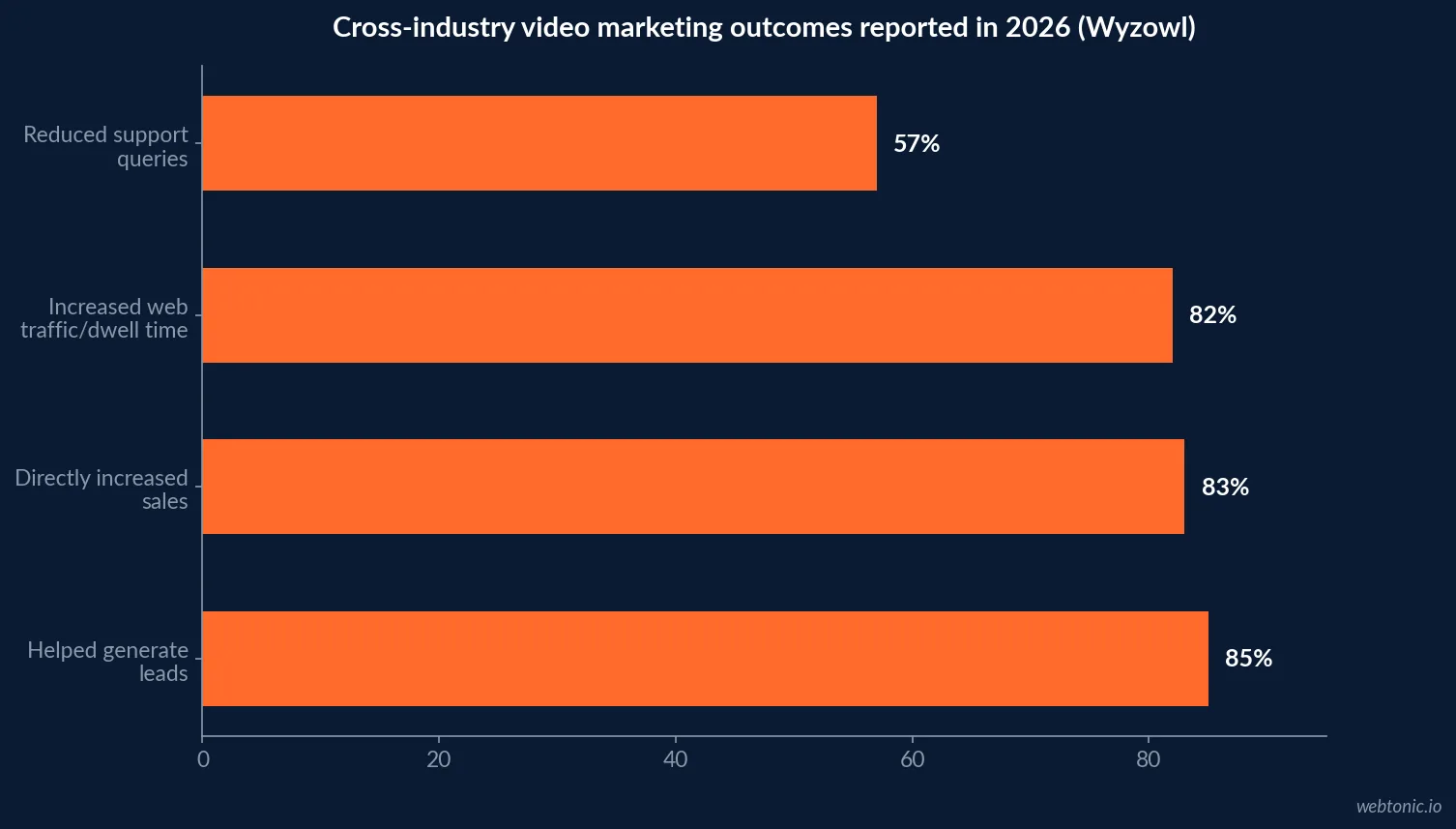
The ROI figures softened slightly year over year: 82% of video marketers report a good ROI, down from a 93% all-time high the year before, though still a dominant result. On outcomes, 85% say video has helped them generate leads, 83% say it directly increased sales, and 82% say it increased web traffic and kept visitors on the site longer.
| Outcome (Wyzowl 2026, cross-industry) | Share reporting it |
|---|---|
| Video gave a good ROI | 82% |
| Video increased brand awareness | 93% |
| Video helped generate leads | 85% |
| Video directly increased sales | 83% |
| Video increased website traffic / dwell time | 82% |
| Video reduced support queries | 57% |
Source: Wyzowl, 2026 State of Video Marketing survey (n=266). Cross-industry benchmark, not specific to healthcare or mental health.
Why trust is the variable that actually matters here
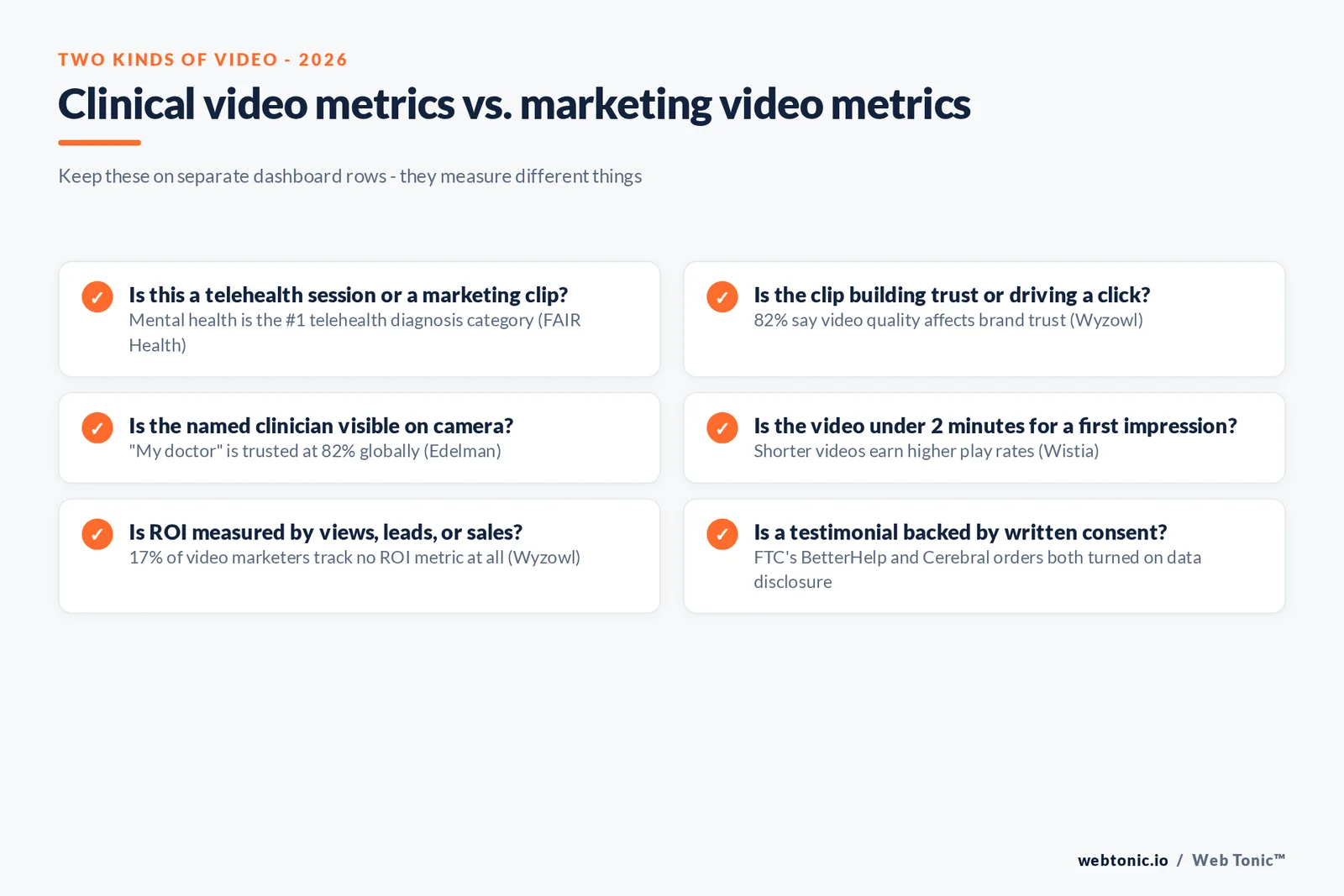
The reason cross-industry video-marketing numbers apply reasonably well to this category is that the underlying job of the video - building trust before a first contact - is unusually hard in mental health specifically. The 2025 Edelman Trust Barometer's special report on health found no institution studied - business, government, media or NGOs - is broadly trusted to address health needs, while "my doctor" remains the single most trusted voice on health truth globally at 82%, ahead of friends and family at 72%.
That gap is the whole argument for putting a named, visible clinician in front of the camera rather than producing a generic brand explainer: the video is borrowing credibility from a relationship, not from a logo. The APA's 2025 Stress in America survey, run by the Harris Poll among more than 3,000 US adults, adds the demand-side context - 69% of adults said they needed more emotional support in the past year than they received, up from 65% in 2024. People are looking for a reason to trust someone with that; a faceless brand video does not give them one.
Format and length: what the largest video dataset actually shows
Wistia's 2026 State of Video Report analyzed more than 13 million videos and 79 million hours of viewing data, plus a survey of 900-plus professionals. Its central finding is consistent across formats: shorter videos earn higher play rates. Even so, a video that clears the length bar and gets a click still performs - a 60-plus minute video holds a 52% play rate once someone commits to starting it, meaning length is a barrier to the first click, not to finishing once someone is invested.
For a mental health practice, that argues for two different assets rather than one: a short, direct clip (30-90 seconds) built for the first impression - a therapist introducing themselves, in plain language, on a landing page or ad - and a longer piece (a full session preview, a Q&A) for the visitor who has already decided to look closer.
| Video use case | Recommended length | What the data supports |
|---|---|---|
| First-impression clinician intro | 30-90 seconds | Shorter videos earn higher play rates (Wistia) |
| Landing page trust clip | Under 2 minutes | 96% have watched an explainer video to learn more (Wyzowl) |
| Deeper-dive Q&A or session preview | 10-20 minutes | Committed viewers still finish long content (Wistia) |
| Testimonial (with written consent only) | 60-90 seconds | 89% say video quality affects trust (Wyzowl) |
Where the video lives matters almost as much as its length. 82% of businesses upload their video to YouTube according to Wyzowl, making it the default hosting choice even for practices whose actual traffic comes from search and social. For a mental health practice, hosting the clinician-intro clip on YouTube has a second benefit beyond reach: it is searchable by name and condition, which gives a prospective patient a way to evaluate fit before ever filling out a form.
| Video hosting / distribution signal (Wyzowl 2026) | Figure |
|---|---|
| Businesses uploading video to YouTube | 82% |
| Marketers actively using YouTube for distribution | 70% |
| Marketers who find YouTube effective for their goals | 69% |
| Marketers who have created social media video | 69% |
| Marketers who have used AI tools to help create or edit video | 63% |
Source: Wyzowl, 2026 State of Video Marketing survey. Cross-industry benchmark.
Where marketers say the ROI comes from
Wyzowl's 2026 data also breaks down how video marketers actually measure return, which matters for setting up a clinic's own tracking before launching content. The most common measurement methods lean on views and engagement rather than bottom-line sales - which may explain why 17% of marketers using video are not tracking spend against outcomes at all. A practice that wants a defensible answer on whether its video budget worked should decide the metric before publishing, not after.
| How video marketers measure ROI (Wyzowl 2026) | Share using this method |
|---|---|
| Video views | 67% |
| Engagement (likes, shares, reposts) | 63% |
| Leads / clicks | 52% |
| Customer engagement and retention | 40% |
| Brand awareness / PR | 36% |
| Bottom-line sales | 32% |
Source: Wyzowl, 2026 State of Video Marketing survey. Cross-industry benchmark.
What to actually put on a dashboard
Keep the two data sets on separate rows. The clinical row tracks the share of sessions delivered by video, which FAIR Health's data suggests is now a majority-shaped part of the mental health caseload nationally - a scheduling and platform question, not a marketing one. The marketing row tracks views, watch-through, and downstream leads on the content built to earn a first contact, using Wyzowl's and Wistia's cross-industry figures as the honest floor until an industry-specific study exists.
Where the two rows do connect is trust: a practice that is comfortable enough on camera to explain its telehealth process is also the practice best positioned to make the marketing clip work, because the same comfort with the medium is what the video is selling. Our performance creative team builds that kind of short-form trust content, and our growth marketing practice can help decide where it belongs in the funnel. For the cost side of the channels this video usually supports, see our guide to what Facebook ads cost in 2026.
Frequently Asked Questions
Is telehealth demand the same thing as video marketing demand for a mental health practice?
No, and treating them as one number is the most common mistake in this category. FAIR Health's Monthly Telehealth Regional Tracker found mental health conditions were the number-one telehealth diagnostic category nationally and in every US region from July to December 2024, at roughly 67% of telehealth claim lines. That is clinical delivery - a video session that already replaced an in-person visit. Video marketing content (YouTube explainers, social clips, testimonials) is a completely separate funnel stage that happens before someone ever books a session, and none of the major clinical-utilization datasets measure it.
What is a realistic ROI expectation for a clinic's marketing video content?
Set expectations from the cross-industry data, not from a healthcare-specific study, because none exists at this granularity. Wyzowl's 2026 survey of 266 marketing professionals and consumers found 82% of video marketers report a good ROI, down from a 93% all-time high the year before, and 85% say video helped them generate leads. Those numbers describe businesses broadly, not clinics specifically, so use them as a floor for what is achievable rather than a guarantee.
How long should a mental health practice's marketing videos be?
Shorter, according to Wistia's 2026 State of Video Report, which analyzed more than 13 million videos and 79 million hours of viewing data: shorter videos consistently earn higher play rates, though a 60-plus minute video still holds a 52% play rate once someone commits to starting it. For an awareness or trust-building clip - the format most relevant to a first-time visitor deciding whether to reach out - the data favors a short, direct piece over a long-form explainer.
Should a mental health practice use patient testimonial videos?
Only with explicit, written consent and no re-use of the recording for ad targeting or lookalike audiences. The FTC's 2023 order against BetterHelp and 2024 order against Cerebral both turned on sensitive mental health information reaching ad platforms without proper disclosure. A testimonial video is not the same data flow as an intake form, but the same disclosure standard should apply: get it in writing, and do not let the footage double as ad-targeting fuel.
Why does trust matter more in mental health video content than in other health video content?
Because the 2025 Edelman Trust Barometer's health-specific report found no institution - business, government, media or NGOs - is broadly trusted to address health needs, while 'my doctor' remains the most trusted voice on health truth globally at 82%, ahead of friends and family at 72%. A video built around a visible, named clinician borrows against that 82% figure. A generic branded explainer with no identifiable clinician does not.
Sources
SAMHSA - 2024 National Survey on Drug Use and Health, highlights
FAIR Health - Mental health, top telehealth diagnostic category, July-December 2024
FAIR Health - Telehealth trends, January-March 2025
FAIR Health - Telehealth mental health claims, April update
Wyzowl - Video Marketing Statistics 2026
Wistia - State of Video Report, 2026
Edelman - 2025 Trust Barometer Special Report: Trust and Health
American Psychological Association - Stress in America 2025
Federal Trade Commission - BetterHelp order, 2023
Federal Trade Commission - Cerebral order, 2024