Table of contents
No published study scores mental health practices on tracking maturity, so this page builds the case from three adjacent data sets: how much treatment demand actually gets captured, how much bandwidth practices have left for anything beyond clinical work, and what happens when tracking is handed to an ad platform without controls. Read the claim in the headline as a synthesis, not a single cited percentage.
Key Takeaways
- 53.9% of adults with any mental illness received treatment in 2023, SAMHSA found.
- 46.1% of that same 58.7 million-person group received none.
- 23.8% of untreated adults with AMI still reported a perceived unmet need.
- 71.1% of adults with serious mental illness received treatment, the highest tier.
- 33.7% of adults with any mental illness used telehealth for treatment.
- 71% of psychologists had never used an AI tool in their practice, APA found.
- 53% of psychologists had no openings for new patients in 2024.
- 61% of psychologists had no waitlist at all; 17% had one over a month long.
- 34% of psychologists accepted no insurance of any kind.
- BetterHelp paid USD 7.8 million and was banned from health-data ad sharing (2023).
- Cerebral paid over USD 7 million and disclosed data on 3.2 million consumers (2024).
- HHS OCR's 2022 bulletin requires a business associate agreement before any tracking vendor touches PHI.
- SimplePractice's network logged 5.7 billion minutes of therapy in 2024.
- That same network scheduled 52.4 million insurance-covered sessions in 2024.
- 31.9% of adolescents aged 12-17 received mental health treatment in 2023.
- Mental health HPSA designations cover 137 million people, only 27.3% of need met.
Why "tracking maturity" has no benchmark study
Marketing analytics for clinical care sits in a regulatory grey zone that most survey vendors avoid. SAMHSA's National Survey on Drug Use and Health measures who received treatment, not how a practice found them. The American Psychological Association's 2024 Practitioner Pulse Survey measures capacity and burnout, not attribution setup. What exists instead is a paper trail of enforcement: two federal cases against companies that treated patient data like any other customer list when they wired it into ad platforms.
That gap is the story. A field this constrained on capacity, and this exposed on compliance, is a field where "we're not sure what our ads are actually doing" is the default answer, not the exception.
The demand side: what a funnel is supposed to capture
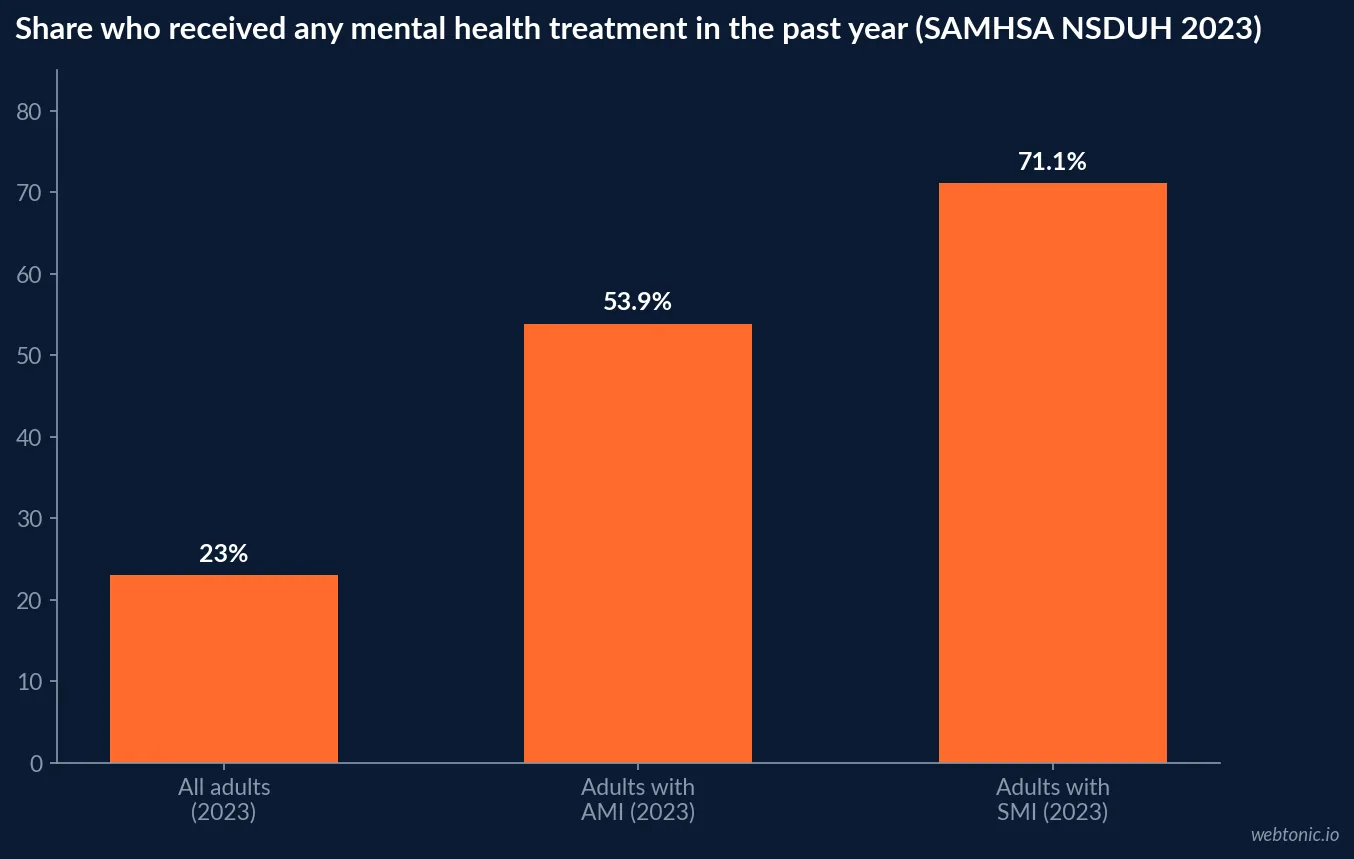
SAMHSA's 2023 NSDUH counted 58.7 million adults with any mental illness (AMI) in the past year. Of them, 53.9% (31.6 million) received treatment, and among the 46.1% who did not, 23.8% reported a perceived unmet need - highest among 18-to-25-year-olds at 36.7%. Among the 14.6 million adults with serious mental illness, 71.1% received treatment. Adolescents lagged behind at 31.9% of 8.3 million with any past-year mental health treatment.
A marketing dashboard built only on booked appointments never sees the unmet-need group. That group is exactly who paid search and content marketing are supposed to reach, and exactly who a pixel tuned only to "appointment confirmed" will never register.
| Population (2023, SAMHSA NSDUH) | Size | Received treatment | Detail |
|---|---|---|---|
| All adults 18+ | 58.7M with AMI | 53.9% | 31.6M people, 46.1% received none |
| Adults with serious mental illness | 14.6M | 71.1% | 10.4M people; 59.8% used medication |
| All adults, any treatment type | 241M total adults | 23.0% | 59.2M people; 12.1% via telehealth |
| Adolescents aged 12-17 | n/a (subset) | 31.9% | 8.3M people received treatment |
| Adults with AMI, untreated with unmet need | 27.1M untreated | 23.8% | 6.2M people still want care |
The capacity side: why tracking loses to triage
The APA's 2024 Practitioner Pulse Survey found 53% of psychologists had no openings for new patients and 61% had no waitlist at all - among those who did, 56% reported waits under a month while 17% reported waits over a month. Insurance participation stayed low: 66% accepted some form of insurance while 34% accepted none. On technology, 71% had never used an AI tool in their practice, only 11% used one monthly, and 27% worried AI could make part of their job obsolete.
Practices operating at or near capacity have limited incentive to instrument a marketing funnel they may not want to fill further. That is a rational response to demand, not a technology failure - but it does mean most tracking setups in this space are either absent or unmaintained.
| Capacity signal (APA 2024 Practitioner Pulse) | Share | What it implies for tracking |
|---|---|---|
| No openings for new patients | 53% | Little reason to instrument acquisition |
| No waitlist at all | 61% | Funnel demand isn't being queued or measured |
| Waitlist over one month | 17% of those with one | Overflow, not underperformance |
| Accept no insurance | 34% | Self-pay clients are harder to track by claim data |
| Never used an AI tool | 71% | Low general technology adoption in-practice |
| Worried AI could replace job duties | 27% | Caution extends to new marketing tooling too |
What happens when tracking is outsourced without controls
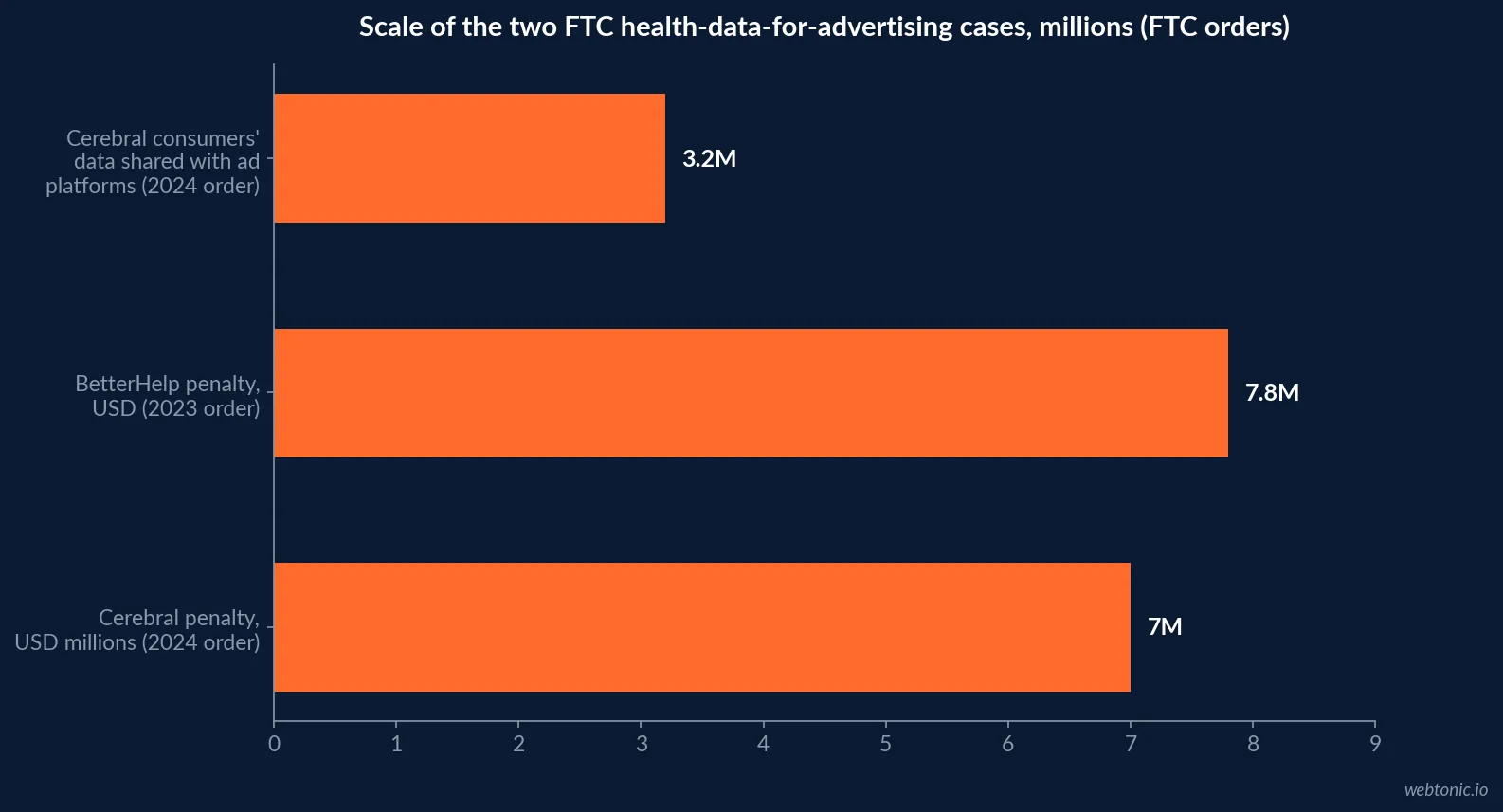
Two federal cases show the failure mode in detail. The FTC's March 2023 order against BetterHelp required a USD 7.8 million payment and banned the company from disclosing health information to Facebook, Snapchat, Pinterest and Criteo for advertising. The FTC's April 2024 order against Cerebral found the company disclosed sensitive data belonging to roughly 3.2 million consumers to third parties including LinkedIn and TikTok, and required a payment of more than USD 7 million plus a first-of-its-kind ban on using health information for most advertising.
Neither company was breached by an outside attacker. Both cases came from the companies' own marketing stack: standard conversion pixels and audience-matching tools configured to pass along more than a name and an email address.
| Case | Order date | Penalty | What was disclosed |
|---|---|---|---|
| BetterHelp | March 2023 | USD 7.8 million | Health info to Facebook, Snapchat, Pinterest, Criteo |
| Cerebral | April 2024 | Over USD 7 million | Data on ~3.2 million consumers to LinkedIn, TikTok, others |
What the HIPAA guidance actually requires
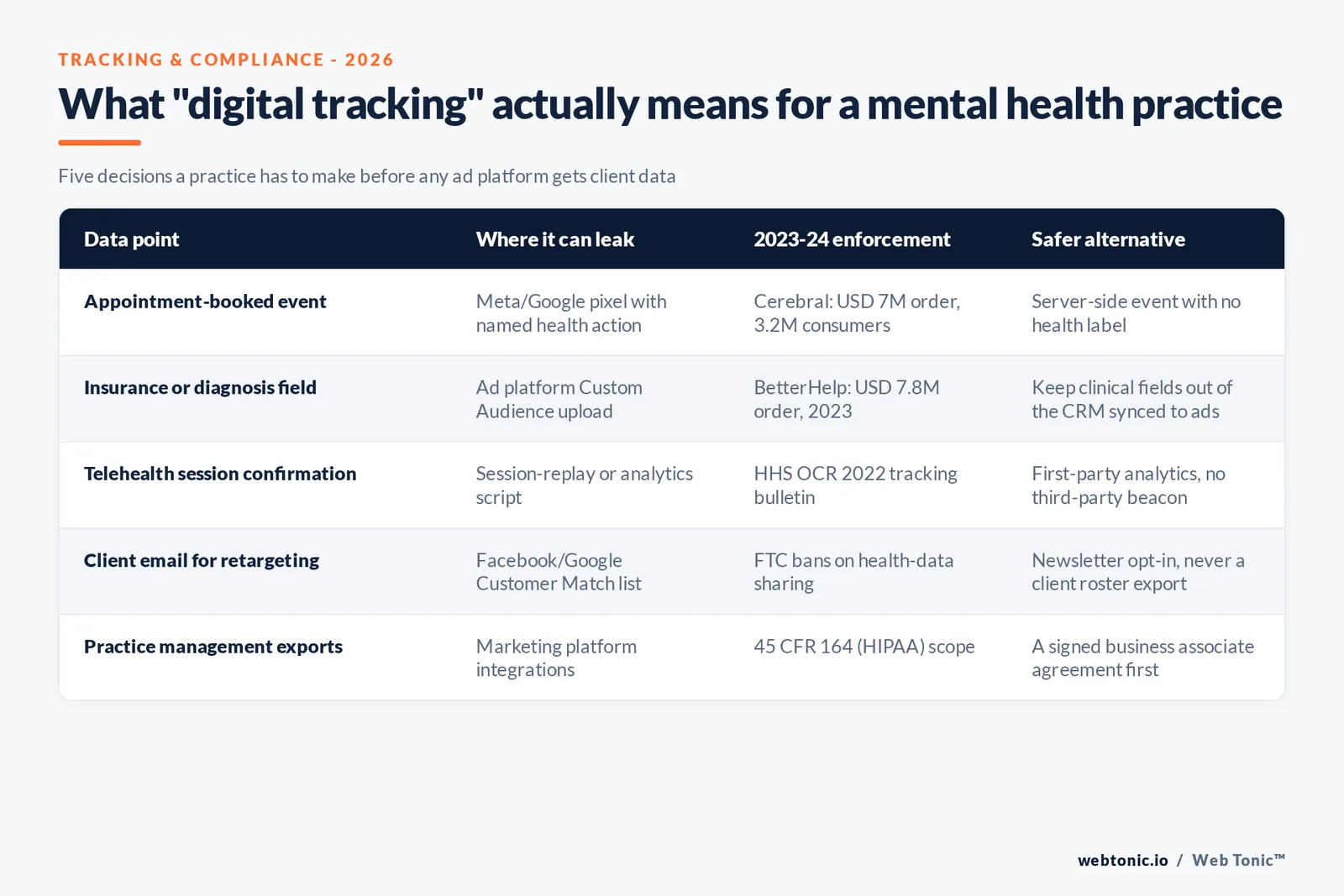
HHS's Office for Civil Rights bulletin on online tracking technologies states that a HIPAA-covered practice may not let a tracking vendor receive protected health information without a HIPAA- compliant patient authorization or a signed business associate agreement. The underlying scope of what counts as a covered entity and what counts as PHI sits in 45 CFR Part 164. A booking-confirmation pixel that fires alongside an insurance field or a diagnosis code is squarely inside that definition.
Our data and analytics practice treats a practice's appointment and diagnosis fields as data that never touches an ad platform directly - server-side events, stripped of clinical fields, are the safer default.
The digital-adoption baseline this is measured against
SAMHSA found 12.1% of all adults (31.3 million people) used telehealth for mental health treatment in 2023, rising to 33.7% among adults with any mental illness. SimplePractice's aggregated 2024 data across more than 245,000 clinicians recorded 5.7 billion minutes of therapy, 10 million clients met, 105 million appointments scheduled and 52.4 million insurance-covered sessions. The infrastructure to track outcomes exists at scale. What's missing is evidence that the marketing side of the same software is configured with the same care as the clinical side.
| Digital-adoption signal (2023-24) | Figure | Source |
|---|---|---|
| Adults using telehealth for mental health treatment | 12.1% (31.3M people) | SAMHSA NSDUH 2023 |
| Adults with AMI using telehealth specifically | 33.7% | SAMHSA NSDUH 2023 |
| Clinicians in SimplePractice's aggregated network | 245,000+ | SimplePractice 2025 report |
| Therapy minutes logged in 2024 | 5.7 billion | SimplePractice 2024 impact data |
| Insurance-covered sessions scheduled in 2024 | 52.4 million | SimplePractice 2024 impact data |
Where the shortage compounds the tracking gap
KFF's tracking of HRSA's mental health Health Professional Shortage Area data counted 6,807 designated shortage areas covering roughly 137.1 million people as of December 2025, with only 27.3% of need met nationally and 6,800 more practitioners needed to close every designation. In a market this short-staffed, a practice's marketing problem is rarely "not enough leads" - it's "too many leads for a team that can't safely track, triage or respond to them without breaking a privacy rule in the process."
| Shortage signal (HRSA/KFF, Dec 2025) | Figure |
|---|---|
| Total mental health HPSA designations | 6,807 |
| Population living in a designated shortage area | 137.1 million |
| Percent of mental health need currently met | 27.3% |
| Practitioners needed to remove all designations | 6,800 |
What the social-media pressure means for intake
Pew Research's 2025 survey of 1,391 US teens and parents found 48% of teens now say social media has a mostly negative effect on people their age (up from 32% in 2022), while 45% say they personally spend too much time on it (up from 36%). Teen girls report worse effects than boys on mental health (25% vs. 14%), confidence (20% vs. 10%) and sleep (50% vs. 40%). That is more demand arriving through a channel -paid and organic social- that the same practices are least equipped to track responsibly.
What a defensible tracking setup looks like
Keep insurance status, diagnosis and appointment-type fields out of any system that syncs to an ad platform. Use server-side conversion events stripped of clinical detail rather than client-side pixels. Sign a business associate agreement with any analytics or ad vendor before PHI could ever reach them. And measure the unmet-need population, not just booked appointments, so the funnel reflects the 46.1% who never got treatment in the first place. If you want a second read on what your current stack actually sends to Meta or Google, talk to us, or see how our growth marketing practice structures healthcare-adjacent accounts around compliant events instead of raw conversions.
Frequently Asked Questions
Do most mental health practices actually struggle with digital tracking?
No single study measures that directly, so the honest answer is inferred from three data points. The American Psychological Association's 2024 Practitioner Pulse survey found 71% of psychologists had never used an AI tool in their practice and 53% had no openings for new patients, which leaves little bandwidth for marketing analytics work. The FTC's BetterHelp and Cerebral orders show what happens when tracking is outsourced to an ad platform without controls: both companies disclosed sensitive health data to Meta, Snapchat, Pinterest, Criteo, TikTok and LinkedIn for advertising. Between low tool adoption and two major enforcement cases, the data supports the claim without needing a single survey that asks the question directly.
What did the FTC actually find in the BetterHelp and Cerebral cases?
In March 2023 the FTC ordered BetterHelp to pay USD 7.8 million and banned it from sharing consumers' health information with Facebook, Snapchat, Pinterest and Criteo for advertising purposes. In April 2024 the FTC ordered Cerebral to pay more than USD 7 million and to stop using health information for most advertising, after finding it had disclosed the sensitive data of roughly 3.2 million consumers to third parties including LinkedIn and TikTok. Both cases involved standard pixel and conversion-API integrations, not a data breach.
What does HIPAA say about tracking pixels on a practice website?
HHS's Office for Civil Rights issued a 2022 bulletin stating that HIPAA-covered entities may not use tracking technologies in a way that discloses protected health information to a vendor without a HIPAA-compliant authorization, and that a business associate agreement is required before any analytics or ad vendor receives that data. The Privacy, Security and Breach Notification Rules referenced in that bulletin sit in 45 CFR Part 164. A booking-confirmation pixel that fires with a diagnosis code or insurance status attached is the exact scenario the bulletin addresses.
How much of the demand a practice is trying to track even gets seen?
SAMHSA's 2023 National Survey on Drug Use and Health found that of the 58.7 million adults with any mental illness that year, 53.9% (31.6 million) received some form of treatment and 46.1% did not. Among the 27.1 million who received no treatment, 23.8% still reported a perceived unmet need. Tracking a funnel that only captures the half who already converted misses the larger group a practice's marketing could still reach.
Is telehealth adoption itself a form of digital tracking maturity?
It's a proxy, not a direct measure. SAMHSA found that 33.7% of adults with any mental illness used telehealth for treatment in 2023, and SimplePractice's aggregated data across more than 245,000 clinicians shows 5.7 billion minutes of therapy delivered and 52.4 million insurance-covered sessions scheduled in 2024 alone. That volume runs through practice-management software that could support real analytics, but adoption of the software is not the same as a practice actually using it to measure where clients come from.
Sources
SAMHSA - 2023 National Survey on Drug Use and Health, National Report
American Psychological Association - 2024 Practitioner Pulse Survey
Federal Trade Commission - BetterHelp order, March 2023
Federal Trade Commission - Cerebral order, April 2024
HHS Office for Civil Rights - Bulletin on use of online tracking technologies
eCFR - Title 45, Part 164 (HIPAA Privacy, Security and Breach Notification Rules)
SimplePractice - Annual State of Private Practice Report
KFF - Mental Health Care Health Professional Shortage Areas (HRSA data)
Pew Research Center - Social Media and Teens' Mental Health, 2025