Table of contents

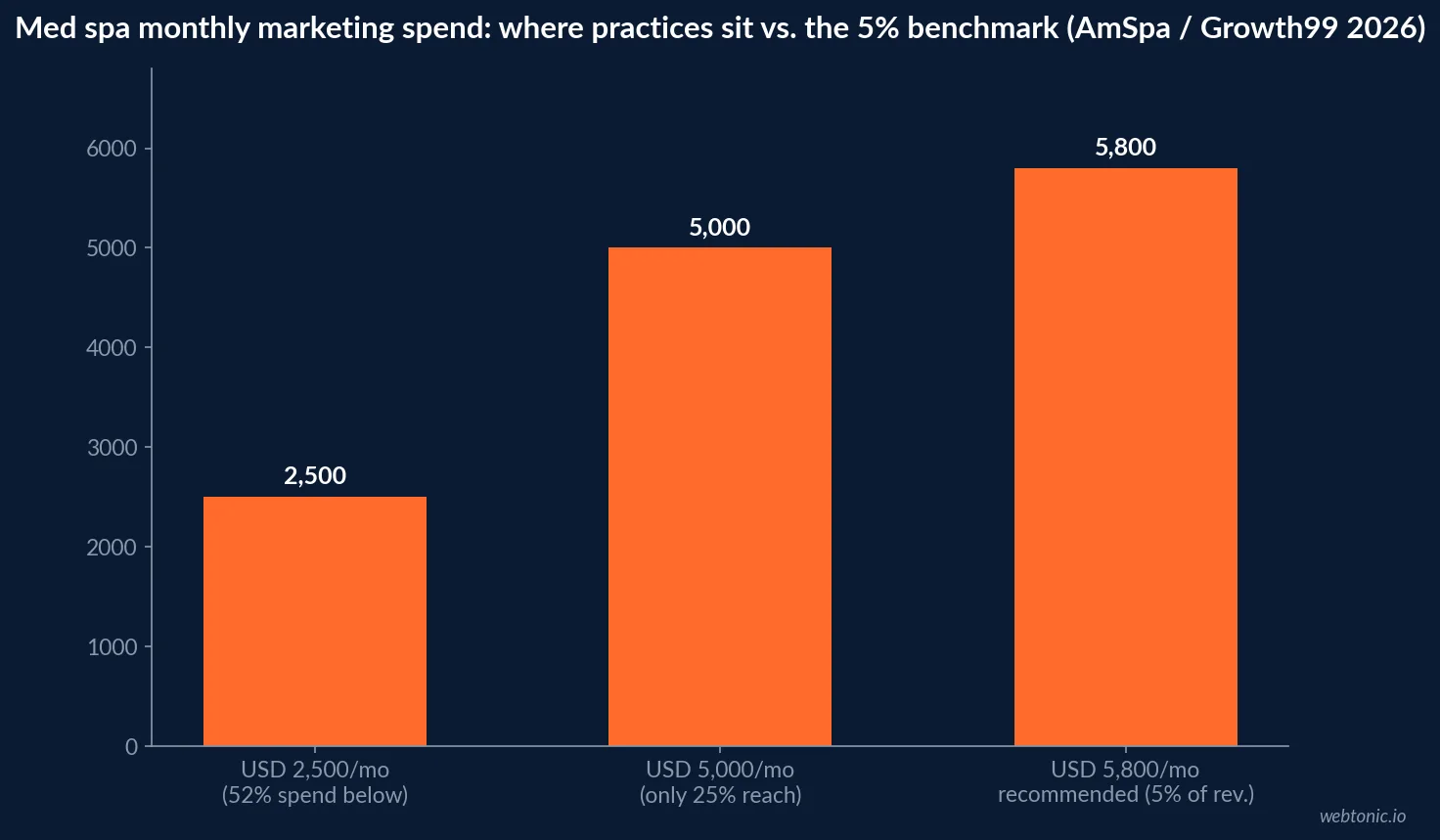
No vendor publishes a public list price for med spa review-management software, so this budget has to be built from the industry's own marketing-investment research rather than a quote. AmSpa and Growth99's 2026 data puts the marketing budget for an average practice at roughly USD 5,800 a month at the recommended 5% of revenue - and finds only a quarter of practices spend anywhere near that.
Key Takeaways
- U.S. med spa industry revenue has passed USD 17 billion, growing over USD 1 billion a year.
- Average med spa revenue is USD 1.39 million a year (AmSpa data).
- Industry guidance recommends 5% of revenue toward marketing.
- For the average practice that is roughly USD 5,800 a month.
- 52% of practices spend under USD 2,500 a month.
- Only 25% meet or exceed the USD 5,000 monthly threshold.
- 77% of practices report struggling to differentiate from competitors.
- Average cost per lead is USD 39; new-patient acquisition cost is USD 132.
- Average visit value is USD 527.
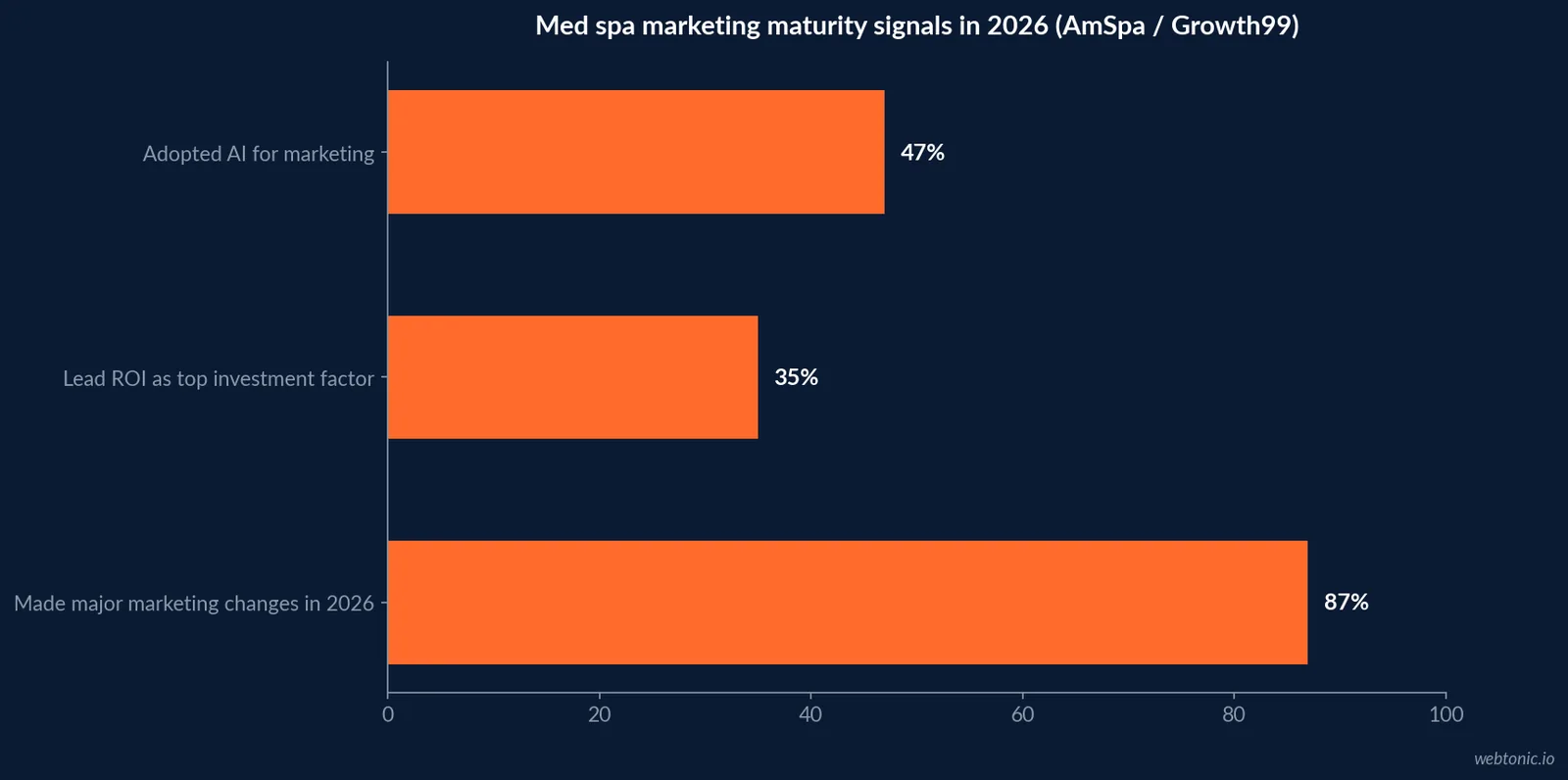
- 87% of practices made significant marketing changes in 2026, up from 54% the year before.
- 47% of practices have adopted AI for marketing tasks; 53% have not.
- Podium and Birdeye both publish quote-only pricing pages - no public list price exists for either.
- Cross-industry, 31% of consumers only use businesses rated 4.5 stars or higher.
- 89% of consumers expect any business to reply to their review.
- A HIPAA-safe reply never confirms or denies that the reviewer was a patient (45 CFR Part 164).
The budget model, built from published data, not a quote
Med spa review-management pricing is not published anywhere as a line-item product. Podium's own pricing page and Birdeye's own pricing page are both custom-quote intake forms with no dollar figures published as of this writing - the honest starting point for a budget conversation is what the industry itself says marketing as a whole should cost, then sizing the review-management slice inside it.
Growth99's 2026 State of Aesthetic & Elective Wellness Marketing Report, published via the American Med Spa Association (AmSpa), puts average med spa revenue at USD 1.39 million and recommends the industry-standard 5% of revenue for marketing - about USD 5,800 a month, or USD 69,600 a year, across every channel combined.
| Line | Published figure | Source |
|---|---|---|
| Average med spa annual revenue | USD 1.39 million | AmSpa / Growth99 2026 |
| Recommended marketing share of revenue | 5% | Growth99 2026 benchmark |
| Recommended monthly marketing budget | ~USD 5,800 | Growth99 2026 (5% of USD 1.39M) |
| Practices spending under USD 2,500/mo | 52% | Growth99 2026 |
| Practices meeting/exceeding USD 5,000/mo | 25% | Growth99 2026 |
| Average cost per lead | USD 39 | AmSpa / Growth99 2026 |
| Average new-patient acquisition cost | USD 132 | AmSpa / Growth99 2026 |
| Average visit value | USD 527 | AmSpa / Growth99 2026 |
Why the review line specifically deserves a bigger share
Growth99's research found 77% of med spa practices struggle to differentiate from competitors in their market - a treatment menu, price point, and provider credentials all look similar across nearby practices. A verifiable, current star rating is one of the few signals a prospective patient can compare in thirty seconds before booking a consultation, which is exactly the decision point BrightLocal's cross-industry 2026 Local Consumer Review Survey describes: 31% of consumers will only use a business rated 4.5 stars or higher, up from 17% a year earlier, and 74% only weigh reviews from the last three months. A stale rating built on old volume is a differentiator competitors can pass with a handful of fresh reviews.
Where the budget gap actually shows up
The practices closing that gap moved fast: 87% made significant marketing changes in 2026, up from 54% a year earlier, and 35% now cite ROI and performance as their leading investment criterion - a shift away from treating marketing spend as a cost to minimize. AI adoption splits the field almost evenly: 47% of practices have adopted it for content, patient communication, analytics, or targeting, while 53% have not, which Growth99 frames as a widening capability gap rather than a stable split.
| Practice behavior | Share in 2026 | Trend | Source |
|---|---|---|---|
| Spend under USD 2,500/month on marketing | 52% | Flat vs. prior years | Growth99 2026 |
| Meet/exceed USD 5,000/month benchmark | 25% | Below the 5% target | Growth99 2026 |
| Made significant marketing changes this year | 87% | Up from 54% | Growth99 2026 |
| Cite ROI/performance as top investment factor | 35% | Leading factor, up sharply | Growth99 2026 |
| Adopted AI for marketing tasks | 47% | Widening vs. non-adopters | Growth99 2026 |
The HIPAA layer no other industry in this series has to plan for
Med spas are covered entities or business associates under HIPAA, which changes how a negative review can be handled. Legal guidance consistent with 45 CFR Part 164 holds that a provider can respond to an online review without violating HIPAA, but the response must not confirm or deny that the reviewer was ever a patient, and it must not disclose any protected health information - even in the practice's own defense. That rules out the single most tempting reply a practice manager wants to write ("that's not what happened, our records show...") because the act of confirming a treatment record exists is itself a disclosure. The compliant pattern is short: thank the reviewer, note the practice takes feedback seriously, and invite a direct, private conversation.
| Reply element | HIPAA-safe? | Why |
|---|---|---|
| Thanking the reviewer for feedback | Yes | No PHI referenced |
| Inviting a private phone call or email | Yes | Moves the conversation off the public record |
| "We have no record of you as a patient" | No | Confirms/denies patient status, itself a disclosure |
| Describing what treatment the reviewer received | No | Discloses protected health information |
| General statement of the practice's process | Yes | Describes policy, not the individual's record |
A pricing framework to take into a vendor conversation
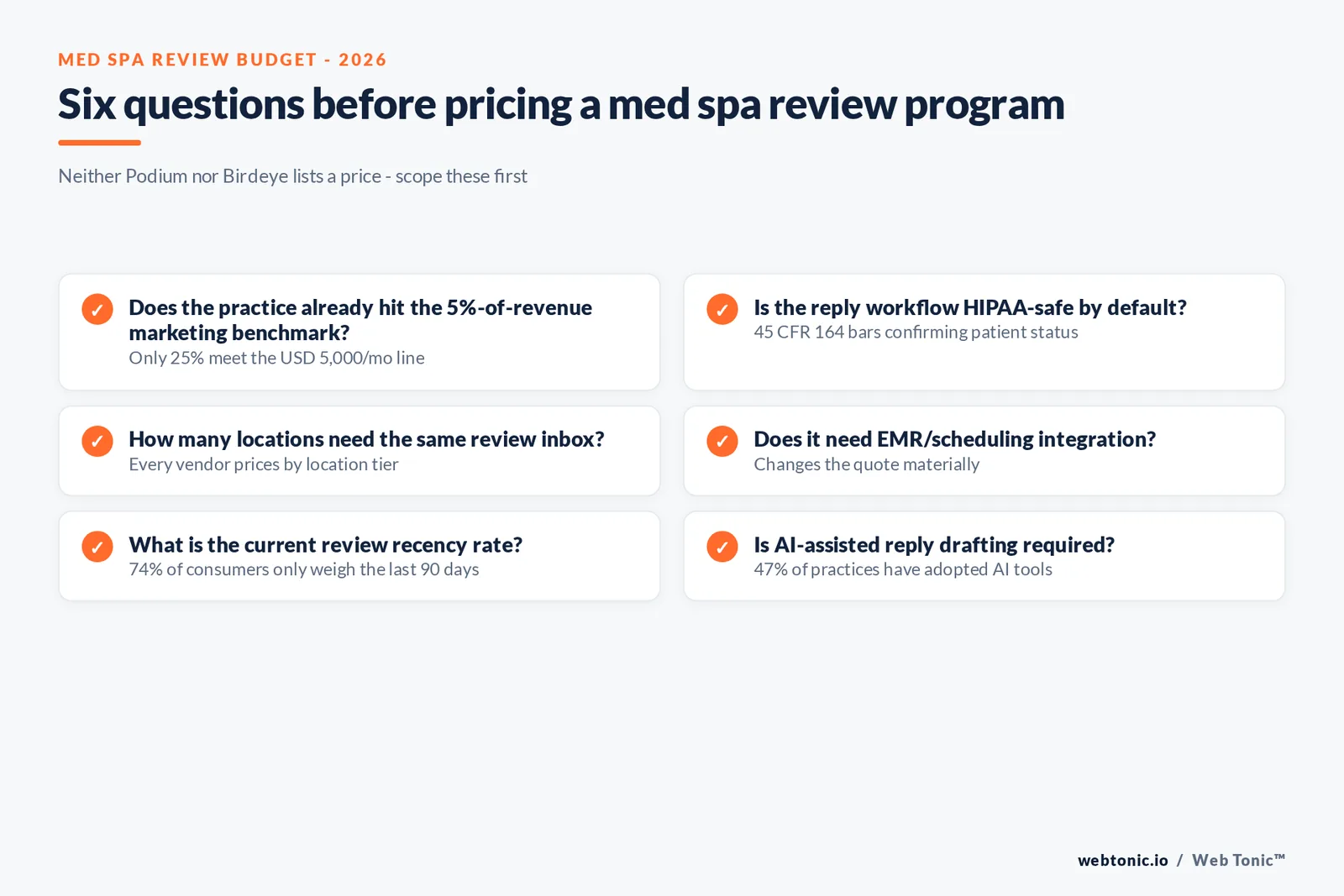
Because neither Podium nor Birdeye lists a price, the useful preparation is a scope document, not a target number: how many locations, how many monthly review volume you already generate, whether HIPAA-safe reply templates are required out of the box, and whether the tool needs to integrate with an EMR/scheduling system already in place. Vendors price multi-location and healthcare-compliant configurations differently, and a like-for-like comparison needs that scope fixed before a quote is requested from more than one vendor.
What the review-request timing should look like
BrightLocal's 2026 data shows reply-speed expectations compressing across every category: 19% of consumers now expect a same-day reply (up from 6%), and 89% expect a reply at all. For a med spa specifically, the review-request moment should sit right after the post-treatment follow-up call, not at the next appointment weeks later - by then the patient's recall of the experience, and their motivation to write a detailed review, has faded.
What the FTC and Google add on top of the HIPAA layer
The FTC's 16 CFR Part 465 rule, finalized in August 2024, prohibits a med spa from creating, buying, or disseminating reviews that misrepresent a real patient's experience, and bars conditioning any incentive on a review being positive - a real risk in a category that often runs loyalty-point or referral programs alongside review requests. On the platform side, Google's own Prohibited and Restricted Content policies apply to every review on a practice's Business Profile, and a policy violation there can lead to a temporary review pause or profile restriction regardless of what the practice intended. Building the review-request workflow around the FTC's disclosure requirement from day one avoids both problems at once.
Sizing the budget by practice revenue, not a flat number
Because the 5%-of-revenue guideline scales with the practice, the dollar figure that actually belongs in a budget conversation depends on where a given med spa sits against the USD 1.39 million average. A newer, single-injector practice generating a few hundred thousand dollars a year has a very different review-management budget than a multi-provider practice doing several million - the percentage stays constant even when the dollar figure does not.
| Practice annual revenue (illustrative) | 5% marketing budget | Monthly equivalent |
|---|---|---|
| USD 500,000 | USD 25,000/year | ~USD 2,083/month |
| USD 1,000,000 | USD 50,000/year | ~USD 4,167/month |
| USD 1,390,000 (AmSpa average) | USD 69,600/year | ~USD 5,800/month |
| USD 2,500,000 | USD 125,000/year | ~USD 10,417/month |
| USD 5,000,000 | USD 250,000/year | ~USD 20,833/month |
Review management is normally one line inside that total marketing budget alongside paid media, content, and the practice website - not the whole figure - but a practice spending nothing close to the 5% guideline overall is very unlikely to be funding review management adequately either, which is the pattern Growth99's 52% under USD 2,500/month figure points to.
Internal resources worth reading alongside this one
For the visibility side of the same local-search fight, see Web Tonic's cross-industry reputation management statistics page. Practices comparing what a broader growth-marketing partner covers beyond reviews can start from our growth marketing services page, review our agency background, or reach out directly to scope a review-management budget against the practice's own numbers.
Frequently Asked Questions
What does review management software cost for a med spa?
There is no public list price to quote. Podium's own pricing page and Birdeye's own pricing page are both request-a-quote forms with no published dollar figures, and neither vendor discloses list pricing publicly as of this writing. What is publicly modelable instead is the budget line it should sit inside: Growth99's 2026 State of Aesthetic & Elective Wellness Marketing Report, published via AmSpa, recommends 5% of revenue toward marketing, which for the average USD 1.39 million-revenue med spa (AmSpa data) works out to roughly USD 5,800 a month across all marketing, not review management alone.
How many med spas actually meet that marketing budget benchmark?
A minority. Growth99's research found 52% of med spa practices still invest less than USD 2,500 a month in marketing, and only 25% meet or exceed the USD 5,000 monthly threshold close to the 5%-of-revenue benchmark. That leaves review management - normally a smaller line inside the broader marketing budget - underfunded at the majority of practices even before it competes with paid media and content.
Can a med spa reply to a negative Google review without violating HIPAA?
Yes, but the reply has to stay generic. Legal guidance on responding to online patient reviews - consistent with 45 CFR Part 164 - states a covered entity can respond to a review without violating HIPAA as long as the reply does not confirm or deny that the reviewer was a patient and does not disclose any protected health information, even to correct the reviewer's account of what happened. The safe reply thanks the reviewer for their feedback and invites them to contact the practice directly, and stops there.
Is the med spa industry big enough to justify a dedicated review strategy?
AmSpa's State of the Industry Report puts U.S. medical aesthetics revenue at more than USD 17 billion, growing by more than USD 1 billion a year. Growth99's companion research found 77% of practices report struggling to differentiate from competitors - in a high-growth, hard-to-differentiate category, a verifiable, consistently updated star rating is one of the few differentiators a consumer can compare before booking a consultation.
What is the ROI case for spending more on review management specifically?
AmSpa/Growth99 report an average med spa cost per lead of USD 39 and new-patient acquisition cost of USD 132, against an average visit value of USD 527 - a roughly 4:1 return on the acquisition spend alone, before repeat visits are counted. Practices that made significant marketing changes in 2026 rose to 87% from 54% a year earlier, and 35% now cite ROI and performance as their leading investment criterion, up sharply from prior years - a sign that budget-holders are already re-pricing marketing as a return-generating line rather than a fixed cost, which is the same lens a review program should be priced under.
Sources
American Med Spa Association - Medical Spa State of the Industry Report
AmSpa / Growth99 - The Marketing Investment Gap, 2026
BrightLocal - Local Consumer Review Survey 2026
Podium - Official Pricing Page (quote-only, checked 2026)
Birdeye - Official Pricing Page (quote-only, checked 2026)
eCFR - 45 CFR Part 164 (HIPAA Privacy and Security)