Table of contents
Med spas do not cold email patients, and this page does not pretend they do. The honest unit of analysis is the B2B outbound channel a med spa's growth team runs on the side - corporate wellness accounts, referring physicians, franchise development targets and supplier relationships - benchmarked against the reply-rate data vendors publish from their own client datasets in 2025 and 2026.
Key Takeaways
- Belkins' 2026 study reports a 0.45% average reply rate across 7.5 million cold emails sent in 2025.
- Woodpecker's platform data shows a 1.5% median reply rate across 56,614 tracked campaigns.
- Instantly's 2026 benchmark reports a 3.43% average reply rate, with top performers exceeding 10%.
- 58% of Instantly's replies come from the first email in a sequence, not a follow-up.
- Founders and owners reply at 0.57% in Belkins' data, outperforming C-level executives at 0.42%.
- Companies with 11-50 staff reply at 0.49% against 0.22% for 10,000-plus employee enterprises - the range a med spa's B2B targets sit inside.
- Woodpecker's median open rate is 26% across 37,000 campaigns.
- Morning sends drove a 0.54% reply rate in Belkins' 2026 data, the strongest window measured.
- Google requires SPF, DKIM and DMARC from any sender pushing 5,000-plus daily messages to Gmail addresses since February 2024.
- Google caps the spam-complaint rate at 0.3% in Postmaster Tools for bulk senders.
- Yahoo enforces the same 2024 authentication bar plus a mandatory one-click unsubscribe on promotional mail.
- InMails are accepted 6 times more often than cold email, per LinkedIn's own 2022 Sales Navigator analysis.
- InMails beat cold calls by 3 times on acceptance in the same LinkedIn dataset.
- A complete LinkedIn profile lifts InMail acceptance 87%, LinkedIn reports.
- CAN-SPAM requires opt-outs honored within 10 business days, per 16 CFR Part 316.
- HIPAA's Privacy and Security Rule (45 CFR Part 164) governs any patient data a practice might be tempted to fold into outbound - and rules it out.
- The 2025 second half saw a 20% reply-rate decline from the first half in Belkins' monthly trend.
- December 2025 hit a 0.35% reply-rate floor, the lowest month in Belkins' data.
What "cold email" means for a med spa, honestly
A med spa's revenue comes from patients who book through search, referrals, social proof and walk-in visibility - not from an inbox. Cold email outbound only makes sense pointed at business accounts: corporate wellness buyers evaluating an employee benefit, dermatologists and plastic surgeons who refer overflow cases, multi-location franchise groups scouting new territory, and injectable, device or supply vendors negotiating volume pricing. Anyone selling a med spa a consumer cold-email "patient list" is selling a compliance problem, not a channel.
Every reply-rate figure below comes from B2B outbound platforms' own labelled datasets. None of them are med spa-specific studies - no vendor has published one - so use them as the honest floor a tightly built account list should beat.
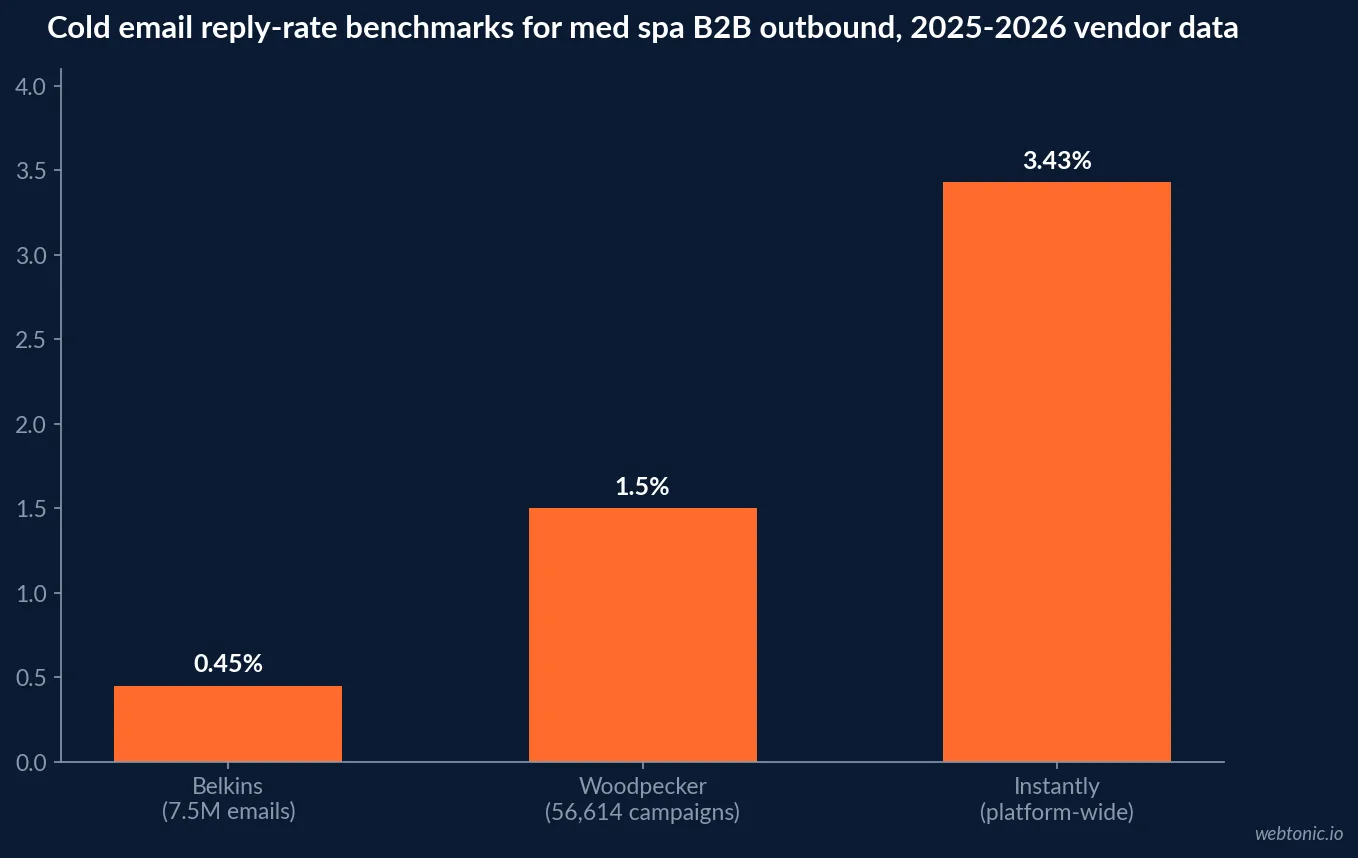
The three benchmarks a med spa's outbound plan should start from
Instantly's 2026 report, drawn from billions of cold email interactions across its platform, puts the overall average reply rate at 3.43%, with top-performing senders exceeding 10% - 2 to 4 times the average. Woodpecker reports a median reply rate of 1.5% across 56,614 campaigns and a median open rate of 26% across 37,000 campaigns, both drawn from actual platform data rather than a survey. Belkins' 2026 study, analyzing 7.5 million cold emails sent across its client campaigns in 2025, reports an average reply rate of 0.45% measured strictly against total sends, not against openers - a stricter, more conservative denominator than most vendors use.
| Vendor (2025-2026 data) | Sample | Reply-rate figure | What it measures |
|---|---|---|---|
| Instantly | Billions of emails, platform-wide | 3.43% average, 10%+ top performers | Replies / total sent |
| Woodpecker | 56,614 campaigns | 1.5% median | Replies / total sent |
| Belkins | 7.5 million emails, 2025 | 0.45% average | Replies / total sent (strict) |
| Woodpecker (open rate) | 37,000 campaigns | 26% median | Opens / total sent |
| Instantly (sequence split) | Platform-wide | 58% of replies from email 1 | Where replies originate |
Who actually replies: seniority and company size
Belkins' 2026 breakdown is the most useful cut for a med spa's B2B list, because most of its realistic targets - independent dermatology practices, boutique wellness accounts, regional franchise groups - sit in the small-to-midsize band the data favors. Founders and owners reply at 0.57%, beating C-level executives at 0.42% by 35% and VPs by nearly 80%. By company size, 11-50 employee companies reply at 0.49% against just 0.22% for enterprises of 10,000-plus - almost exactly the difference between a single-location wellness studio and a national employer's HR department.
The practical read: a med spa's outbound list should skew toward the owner of a small practice or wellness account, not a benefits director buried inside a large enterprise.
| Recipient segment (Belkins 2026) | Reply rate | Lift or gap vs. average | Fit for med spa outbound |
|---|---|---|---|
| Founders / owners | 0.57% | +27% vs. 0.45% average | Independent practices, boutique wellness accounts |
| C-level executives | 0.42% | -7% vs. average | Larger referral networks, device vendors |
| 11-50 employees | 0.49% | +9% vs. average | Regional franchise groups, small clinics |
| 10,000+ employees | 0.22% | -51% vs. average | National corporate wellness programs |
| Morning sends, 8am-12pm | 0.54% | +20% vs. average | Highest-performing send window measured |
The 2024 Google and Yahoo rules a clinical domain cannot ignore
Since February 1, 2024, Google's sender guidelines require SPF or DKIM from every sender to Gmail addresses, and senders pushing 5,000 or more messages a day must add SPF, DKIM and DMARC, hold the spam-complaint rate reported in Postmaster Tools under 0.3%, and support one-click unsubscribe. Yahoo's Sender Hub enforces the equivalent bar and confirms enforcement began in February 2024, with one-click unsubscribe enforcement following in June 2024.
A med spa outbound program built on the practice's main clinical domain risks that domain's standing for every appointment reminder and confirmation it also sends. The safer build is a dedicated subdomain, warmed up separately, so a B2B outbound misstep never touches patient communication.
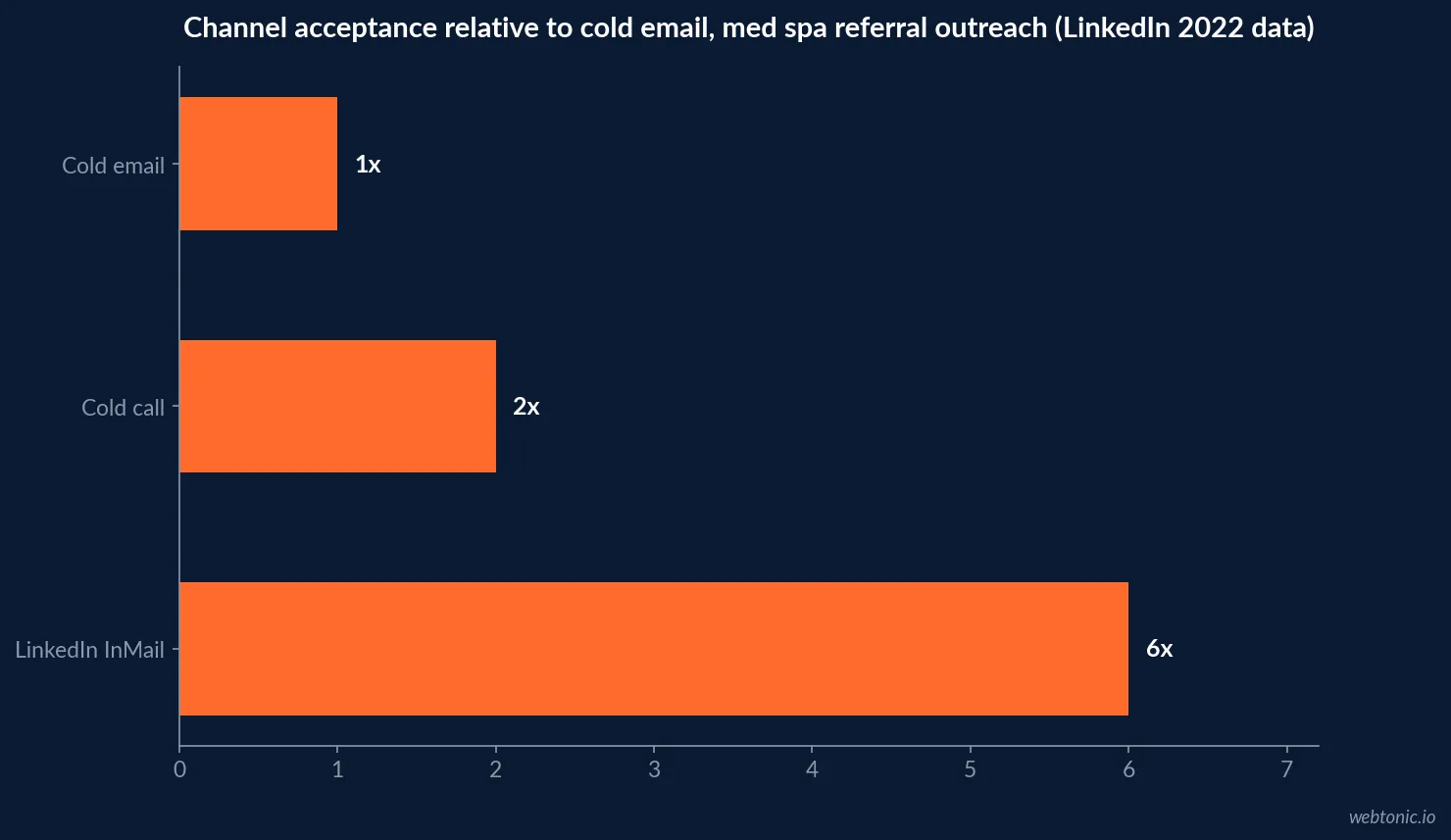
Cold email vs. cold call vs. LinkedIn for referral outreach
LinkedIn's own analysis of every Sales Navigator InMail sent in 2022 found InMails are 3 times more likely to be accepted than a cold call and 6 times more likely than a cold email, and that a complete profile lifts acceptance by 87%. For a med spa chasing a short list of high-value referral sources - dermatologists, plastic surgeons, med spa franchise scouts - that channel advantage can outweigh email's lower cost per contact. For volume outreach to dozens of corporate wellness accounts, email still wins on unit economics and on the paper trail CAN-SPAM expects a business to keep.
| Channel | Relative acceptance (LinkedIn 2022 data) | Best use for a med spa | Cost per contact |
|---|---|---|---|
| Cold email | 1x (baseline) | Volume outreach to wellness accounts and vendors | Lowest |
| Cold call | ~2x cold email | Warm follow-up after a referral introduction | Medium |
| LinkedIn InMail | 6x cold email, 3x cold call | A short list of high-value referring physicians | Highest per contact, lowest per accepted reply |
CAN-SPAM and HIPAA: the two rule sets that actually bind a med spa
The FTC's CAN-SPAM compliance guide and 16 CFR Part 316 require accurate headers, a working postal address, clear identification as an advertisement where the primary purpose is commercial, and an opt-out honored within 10 business days at no cost to the recipient - full stop, whether the recipient is a business or a consumer.
Separately, 45 CFR Part 164, HIPAA's Privacy and Security Rule, governs protected health information. It does not ban B2B cold email - it bans putting a patient's name, condition or treatment history anywhere near an outbound list. The two rule sets are not in tension as long as the outbound list is built from public business data, not the practice management system.
| Rule | Source | What it requires | Consequence for med spa outbound |
|---|---|---|---|
| CAN-SPAM | FTC / 16 CFR Part 316 | Accurate headers, postal address, 10-day opt-out | Applies to every B2B email sent |
| Google bulk sender rules | support.google.com/mail (2024) | SPF+DKIM+DMARC, spam under 0.3% | Applies once sending 5,000+/day |
| Yahoo bulk sender rules | senders.yahooinc.com (2024) | Equivalent authentication, one-click unsubscribe | Applies to any Yahoo/AOL recipients |
| HIPAA Privacy/Security Rule | 45 CFR Part 164 | PHI cannot be used for outreach without authorization | Bars patient data from any list, not the channel itself |
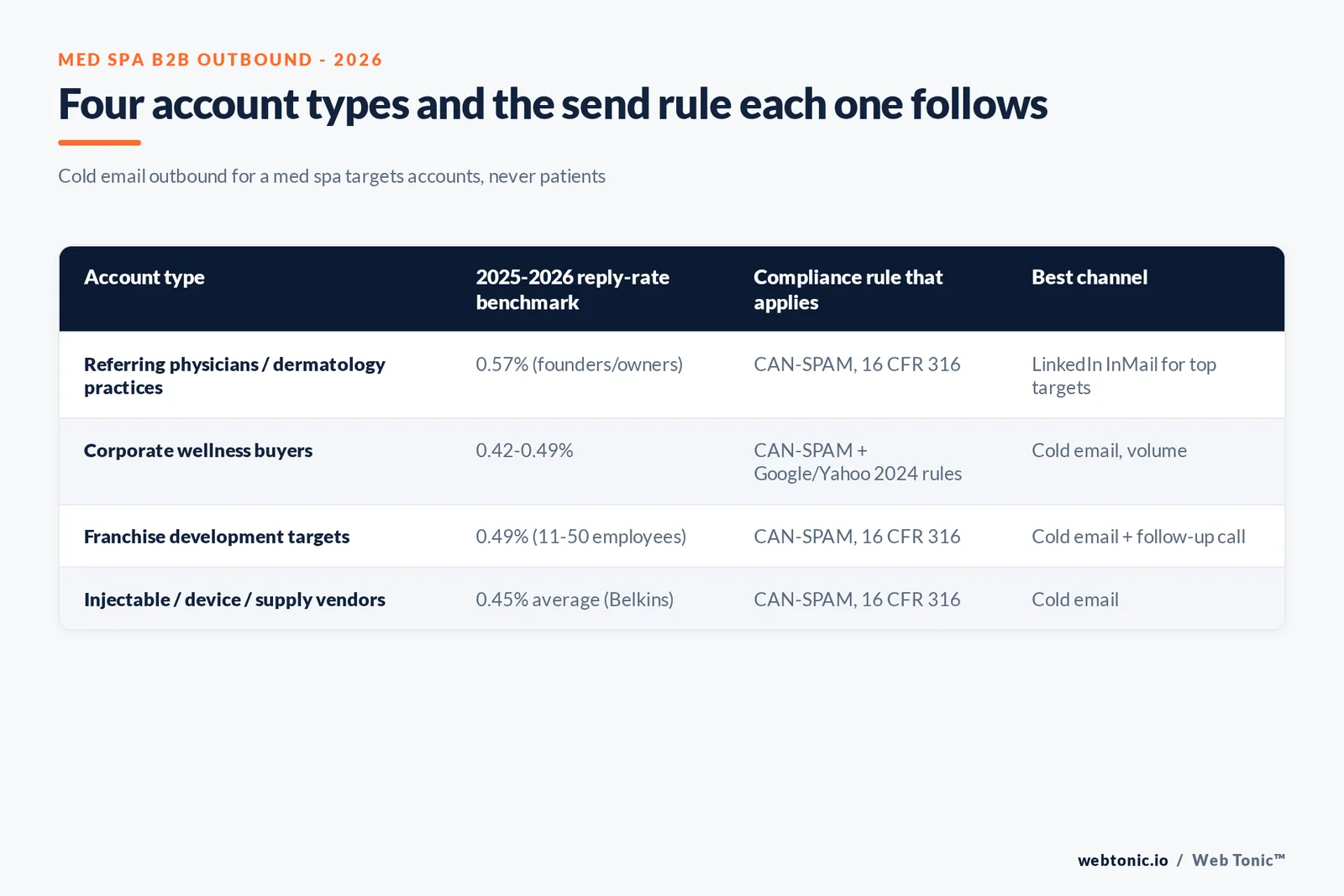
Building the list without touching patient data
The safest and, based on the seniority data above, best-performing list for a med spa's outbound program is built from public business sources: state licensing boards for referring physicians, franchise disclosure filings for expansion targets, and corporate wellness or HR association directories for employer buyers. None of that requires touching the practice management system, and all of it keeps the outbound program inside CAN-SPAM without ever brushing against HIPAA.
Our growth marketing practice builds these B2B lists alongside a med spa's consumer acquisition plan so the two channels never cross wires - and if email consistently underperforms a given segment, talk to us about testing LinkedIn or phone against the same list before scaling either one.
What "good" looks like before scaling volume
Given the spread between Belkins' strict 0.45% and Instantly's 3.43% platform average, the honest target for a new med spa outbound program is the middle of that range on a well-built list - roughly 1% to 2% - climbing toward the top-performer band only after several sequences of testing subject lines, send windows and segment targeting. Chasing Instantly's reported 10%+ top-performer band on the first campaign is the surest way to burn a domain's sending reputation before the program has proven anything.
Sequence length and the follow-up math
Instantly's 2026 data breaks down where replies actually come from inside a sequence: 58% from the first email, and the remaining 42% spread across follow-ups. For a med spa's B2B list, that argues against a single-touch outreach plan aimed at a referring physician or wellness buyer - most of the reply volume a program eventually earns is still ahead of it after the first send goes unanswered. A three-to-four email sequence spaced a few business days apart, not a one-off pitch, is what the vendor data actually supports.
| Sequence position | Share of total replies (Instantly 2026) | Practical read for med spa outbound |
|---|---|---|
| Email 1 (initial send) | 58% | Still the single highest-value touch |
| Follow-up emails (2 through 4+) | 42% | Worth building, not worth skipping |
| Reply window, best month (Belkins 2026) | 0.54% (Feb 2025) | Seasonal timing matters as much as copy |
| Reply window, weakest month (Belkins 2026) | 0.35% (Dec 2025) | Avoid launching a first campaign in December |
Where our team fits in
Building a compliant med spa B2B list, warming a dedicated sending domain and running the sequence math above is exactly the kind of measurable work our data and analytics practice instruments alongside a practice's consumer acquisition funnel, so the two channels report against the same dashboard instead of two disconnected spreadsheets.
Frequently Asked Questions
Do med spas cold email their patients?
No, and doing so would be reckless. Patient contact information is protected health information, and the eCFR's HIPAA Privacy and Security Rule (45 CFR Part 164) governs how a covered practice may use it. Cold email outbound for a med spa is a B2B channel aimed at corporate wellness buyers, referring physicians and dermatology practices, franchise development targets and equipment or injectable suppliers - never a list of patients or prospects pulled from a scraped consumer database.
What reply rate should a med spa's outbound team expect?
Vendor-reported 2025-2026 averages run from 0.45% to 3.43% depending on how the denominator is built. Belkins reports 0.45% across 7.5 million emails measured against total sends. Woodpecker reports a 1.5% median across 56,614 campaigns. Instantly reports a 3.43% average with top performers exceeding 10%. All three are B2B-wide benchmarks, not med spa-specific studies, so treat them as a floor to beat with a tightly built account list, not a target.
What do the 2024 Google and Yahoo rules change for a med spa's outbound domain?
Since February 2024, Google requires SPF or DKIM from every sender and SPF, DKIM and DMARC plus a spam rate held under 0.3% in Postmaster Tools from anyone sending 5,000 or more messages a day to Gmail addresses, per Google's own sender guidelines. Yahoo enforces equivalent authentication and a one-click unsubscribe on promotional mail, per its Sender Hub FAQ. A med spa running outbound from its main clinical domain risks that domain's deliverability for every appointment-confirmation email it sends.
Is cold calling or LinkedIn a better fit than email for referral outreach?
LinkedIn's own 2022 Sales Navigator analysis found InMails are 3 times more likely to be accepted than a cold call and 6 times more likely than a cold email. For the highest-value target - a small list of referring physicians or corporate benefits leads - that channel edge can matter more than volume. Email still wins on cost per contact and on the CAN-SPAM paper trail a compliance-conscious practice wants.
What does CAN-SPAM actually require of a med spa's B2B emails?
The FTC's compliance guide and 16 CFR Part 316 require accurate header and subject information, clear identification of the message as an advertisement where applicable, a valid physical postal address, and a working opt-out honored within 10 business days - not to a paid service. None of that is optional because the recipient is a business rather than a consumer; CAN-SPAM covers commercial email to both.
Sources
Instantly - Cold Email Benchmark Report 2026
Woodpecker - Cold Email Benchmarks (platform data)
Belkins - B2B Cold Email Response Rates, 2026 study
Google - Email sender guidelines
Yahoo - Sender Hub FAQs, 2024 requirements
Federal Trade Commission - CAN-SPAM Act Compliance Guide
eCFR - 16 CFR Part 316, CAN-SPAM Rule
eCFR - 45 CFR Part 164, HIPAA Security and Privacy
LinkedIn Sales Solutions - 2022 InMail acceptance analysis