Table of contents
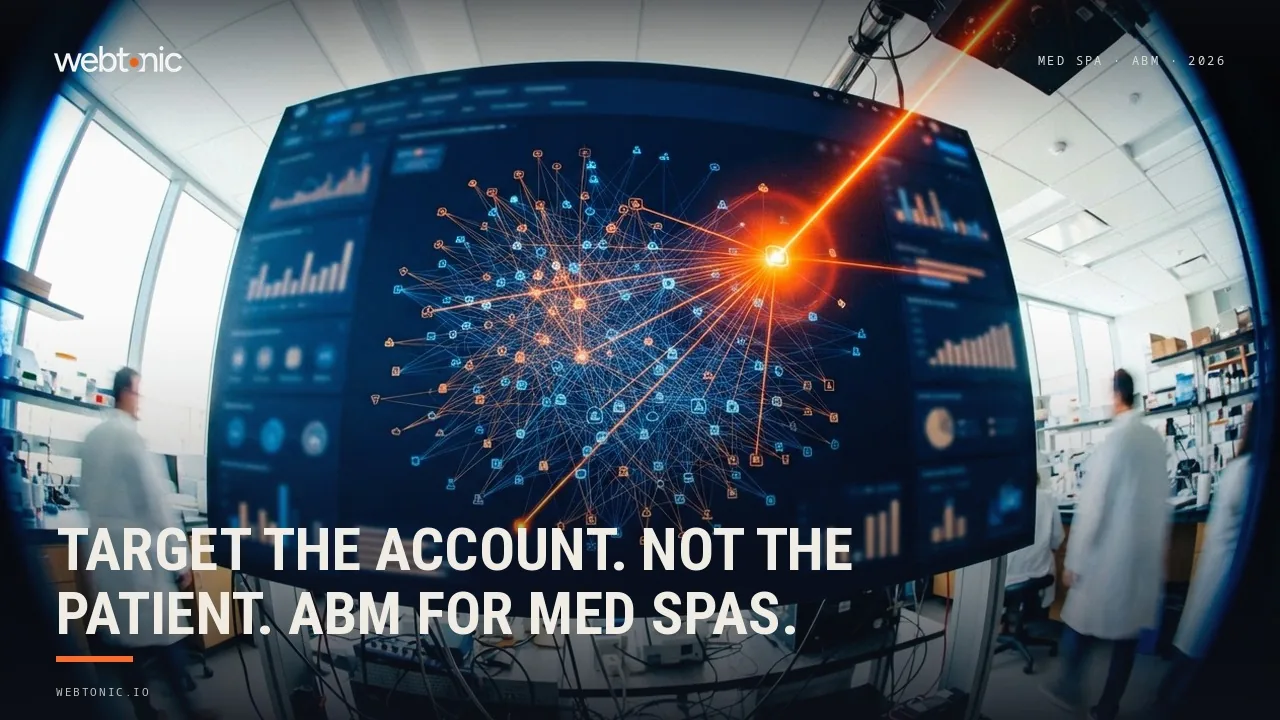
Account-based marketing for a med spa is not a patient-acquisition tactic - it is how a practice targets a short list of named commercial accounts. The figures below come from cross-industry B2B ABM research; none were built on aesthetics practices, so this page pairs them with the med spa market data that sizes the actual opportunity and states every assumption.
Key Takeaways
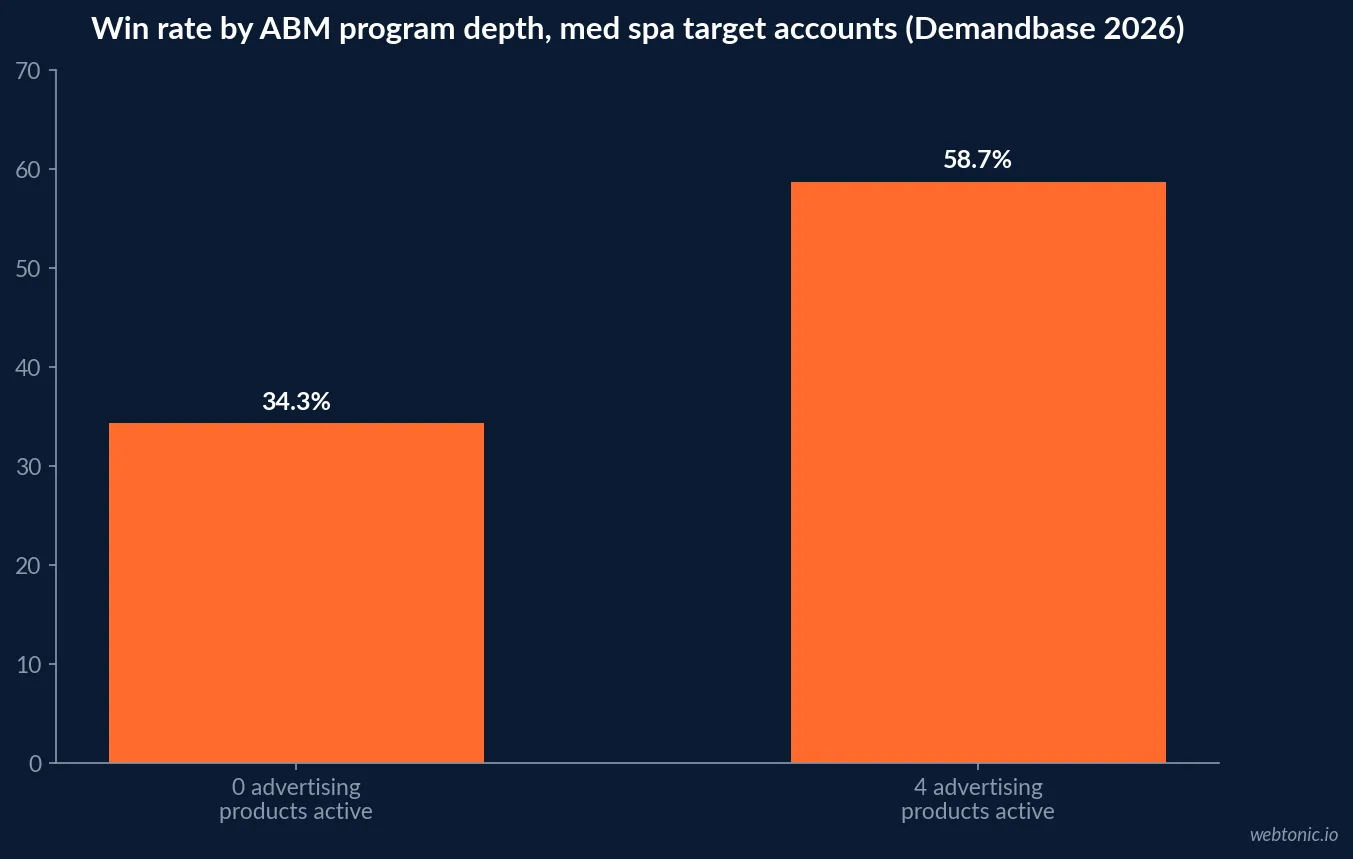
- Demandbase's 2026 platform data reports a 58.7% win rate for accounts run with four advertising products.
- That is a 71% lift over accounts run with none, in the same 1,452-tenant dataset.
- Companies tracking 3-4 buying groups see a 48.5% higher win rate than those taking a broader, less structured approach.
- A typical B2B buying group includes 13 to 17 stakeholders, per Demandbase's 2026 platform data.
- 22%-plus of marketing-qualified accounts convert to pipeline with a fully integrated CRM, MAP and predictive stack.
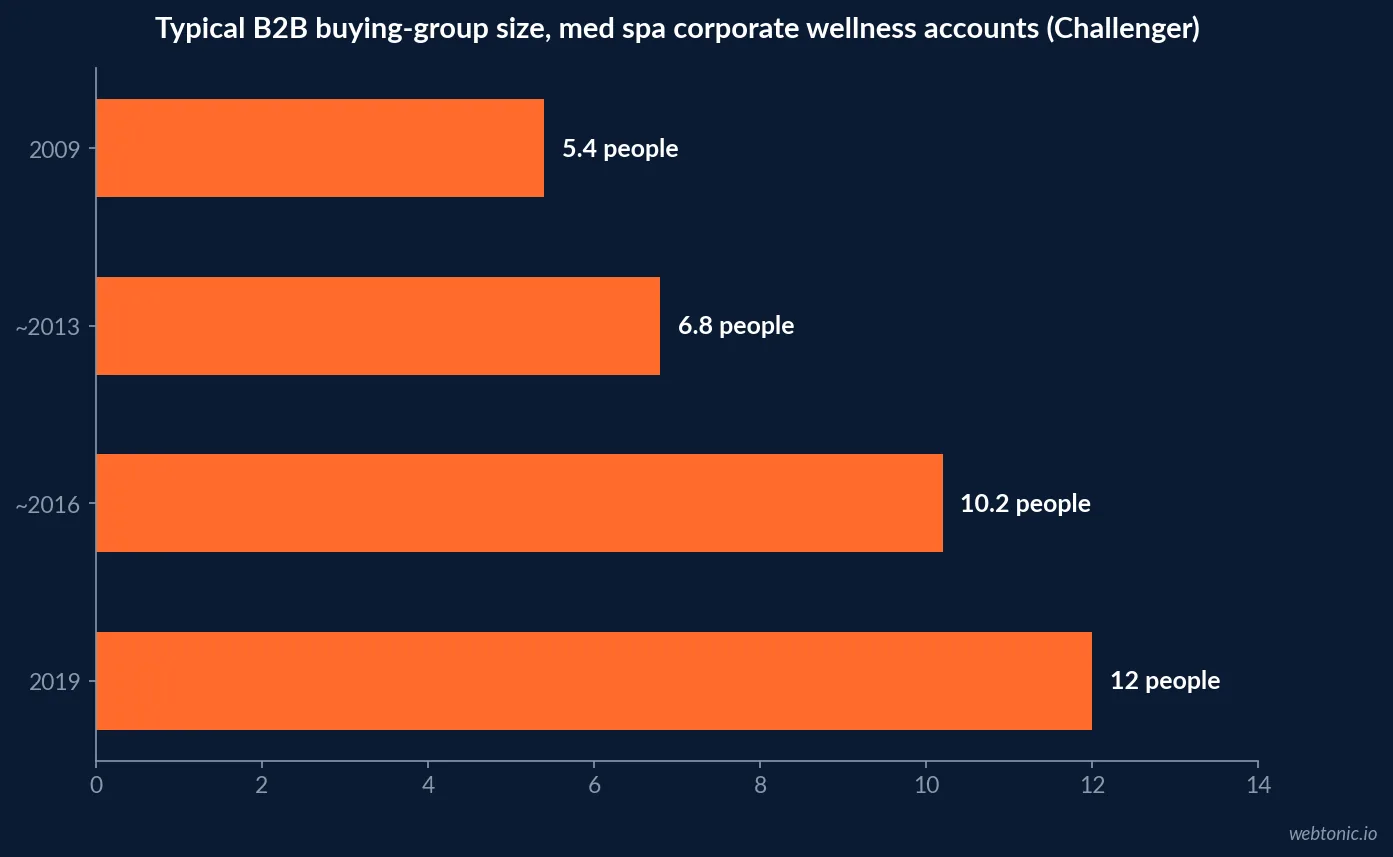
- The typical B2B buying group grew from 5.4 people in 2009 to roughly 12 by 2019, per Challenger.
- Deal completion drops from 53% to 31% once a buying group passes five people.
- 38% of B2B purchase attempts end in "no decision," Challenger's research found.
- Only 26% of ABM programs call themselves successful, N.Rich's 2025 survey of 107 B2B leaders reports.
- 67% treat ABM as a core go-to-market motion in the same survey.
- Just 22% run ABM on a dedicated platform - most still use a CRM and spreadsheets.
- ITSMA's benchmark study surveyed more than 200 ABM leaders for its 7th annual report.
- The U.S. med spa market reached $21.31 billion in 2025, growing at a 14% CAGR toward 2030.
- A complete LinkedIn profile lifts InMail acceptance 87%, relevant to any account-based outreach into a buying committee.
- Roughly half of B2B deals dissolve on lack of buying-group consensus, per LinkedIn's Hidden Buyer Gap research with Bain and NewtonX.
What ABM targets when the customer is a patient, not an account
A med spa's consumer demand comes from search, social proof and referrals - none of that is ABM. Account-based marketing earns its name inside a med spa's B2B relationships: the dermatology and plastic surgery practices that refer overflow cases, the corporate wellness buyers evaluating injectable or recovery benefits for employees, the private-equity-backed franchise groups scouting acquisition or license targets, and the injectable, device and supply vendors negotiating volume pricing. Every one of those is a named account with a buying committee, which is exactly what ABM is built to run against.
The outcome data: what a disciplined program actually returns
The most credible 2026 ABM outcome figures come from Demandbase's inaugural State of ABM 2026 report, built from its own platform data across 1,452 tenants, 429,634 advertising campaigns, 38 million marketing activities and 9.7 million sales interactions. It reports a 58.7% win rate for accounts run with four advertising products working together, a 71% lift over accounts run with none, and companies tracking 3-4 buying groups saw a 48.5% higher win rate than those taking a broader, less structured approach. Programs with a fully integrated CRM, marketing-automation and predictive-model stack converted 22% or more of marketing-qualified accounts to pipeline.
| Demandbase 2026 metric | Figure | Comparison point | Sample |
|---|---|---|---|
| Win rate, 4 ad products active | 58.7% | 71% lift over 0 products | 1,452 tenants |
| Win-rate lift, 3-4 buying groups tracked | +48.5% | vs. a broader, less structured approach | 429,634 campaigns |
| Typical buying group size | 13-17 stakeholders | Cross-industry benchmark, not a win-rate peak | 9.7M sales interactions |
| MQA-to-pipeline conversion, integrated stack | 22%+ | vs. lower with fragmented tools | 38M marketing activities |
Why the buying group size is the real target, not the account name
Challenger's long-running research tracked the typical B2B buying group growing from 5.4 people in 2009 to 6.8, then 10.2, then just under a dozen by 2019 - and found that once a group passes five people, the odds of completing a purchase fall from 53% to 31%. Separately, its research on customer indecision found 38% of purchase attempts end in "no decision" rather than a loss to a competitor. A corporate wellness buying committee - benefits, HR, finance and facilities all weighing in on a new employee perk - reaches that size easily. Demandbase's data separately puts the typical buying group at 13 to 17 stakeholders, while win rates peak when a program tracks 2 to 3 buying groups per product.
| Year (Challenger data) | Typical buying group size | Deal completion once group > 5 |
|---|---|---|
| 2009 | 5.4 people | 53% (small group baseline) |
| ~2013 | 6.8 people | Declining as group grows |
| ~2016 | 10.2 people | Declining as group grows |
| 2019 | ~12 people | 31% (group > 5 threshold) |
How mature the field actually is - useful context before buying tooling
N.Rich's 2025 State of ABM report, surveying 107 B2B go-to-market leaders, found 67% now treat ABM as a core go-to-market motion rather than a campaign tactic - yet only 26% describe their program as successful and just 22% run it on a dedicated ABM platform, with most still working from LinkedIn, a CRM and spreadsheets. ITSMA and the ABM Leadership Alliance's 7th annual benchmark study, based on an international survey of more than 200 ABM leaders and practitioners, documents the same pattern year over year: strategy and budget commitment outrun execution maturity.
For a med spa entering ABM for the first time, that is good news. The field is not a mature discipline to catch up to - it is a discipline where three-quarters of programs still call themselves unsuccessful, which means a tightly scoped list of a few dozen accounts, run manually through a CRM, is not behind the curve.
| ABM maturity signal (2025-2026) | Figure | Source | Sample |
|---|---|---|---|
| Treat ABM as core GTM motion | 67% | N.Rich 2025 | 107 B2B leaders |
| Describe program as successful | 26% | N.Rich 2025 | 107 B2B leaders |
| Run ABM on a dedicated platform | 22% | N.Rich 2025 | 107 B2B leaders |
| Surveyed for the 7th annual ABM benchmark | 200+ leaders | ITSMA / ABM Leadership Alliance | International survey |
The four account types worth an ABM list
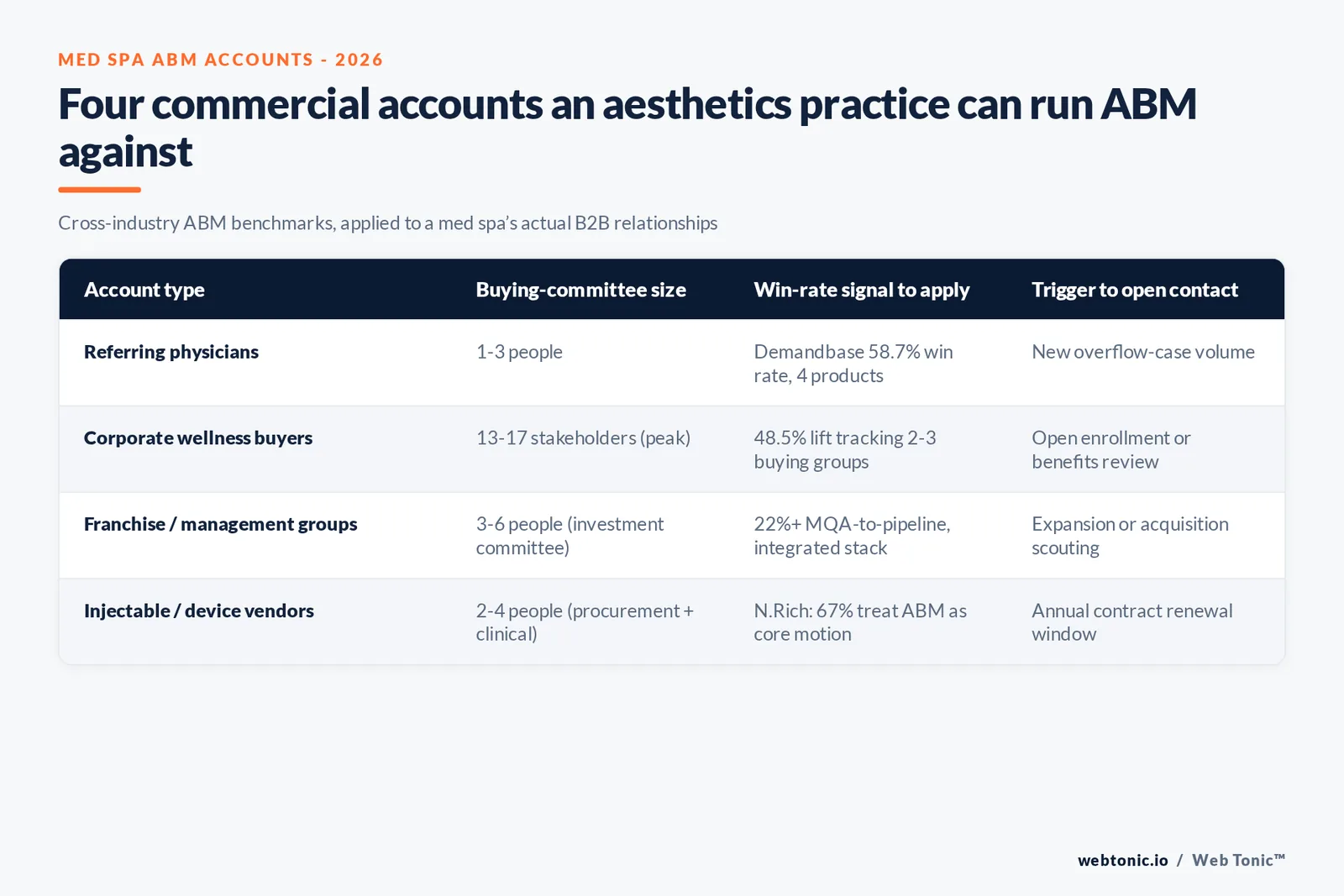
Translating the research into a med spa-specific target list: referring physicians and dermatology or plastic surgery practices (a buying group of one to three, low friction, relationship- led); corporate wellness buyers evaluating an injectable, recovery or aesthetics benefit (a committee of benefits, HR and finance, matching the higher end of Demandbase's 13-17 stakeholder band); multi-location franchise or management groups scouting expansion (an investment committee, typically three to six people); and injectable, device or supply vendors negotiating annual terms (procurement plus clinical leadership, two to four people). Each needs a different message and a different buying-committee map, which is the actual work ABM describes.
Sizing the opportunity: the med spa market itself
The Business Research Company's 2026 market report puts the global medical spa market at $21.31 billion in 2025, growing to $41.21 billion by 2030 at a 14% compound annual growth rate. That growth is the reason corporate wellness buyers and franchise groups are increasingly worth a dedicated account-based motion rather than an afterthought inside consumer marketing - the supply side of the market is consolidating fast enough that named-account relationships compound.
Where to start without buying an ABM platform
Given that 78% of surveyed B2B teams in N.Rich's data still run ABM manually, a med spa does not need Demandbase, 6sense or Terminus-grade tooling to start. A CRM with account records, a shared buying-committee map per target, and a LinkedIn Sales Navigator seat for outreach into that committee covers the first dozen accounts. Our growth marketing practice builds that account map alongside a practice's consumer funnel, and a conversation with us is the right next step before any platform purchase.
The messaging gap: why a broad pitch fails a buying committee
LinkedIn's own Hidden Buyer Gap research, conducted with Bain & Company and NewtonX, found that "Hidden Buyers" - stakeholders with almost equal decision-making influence to the named economic buyer but no visible activity - carry roughly 49% of a buying group's influence against 51% for the recognized target buyer. A pitch aimed only at the benefits director a med spa's sales rep has met misses roughly half the influence sitting inside the same account, which is the mechanism behind Challenger's finding that larger buying groups complete purchases less often - not indecision, but an unaddressed second half of the room.
| Buying-group role | Share of decision influence (LinkedIn/Bain/NewtonX) | Visible activity | What ABM has to reach |
|---|---|---|---|
| Target buyer (economic buyer) | 51% | High - meetings, emails, calls logged | Already covered by most outreach |
| Hidden Buyer | 49% | Low - little to no visible activity | The gap ABM content has to close |
Measuring the program without enterprise tooling
Demandbase's 2026 platform data ties its 22%+ marketing-qualified-account-to- pipeline conversion figure to a fully integrated CRM, marketing-automation and predictive stack - but the underlying metric it is measuring is simple enough to track by hand on a shorter list: how many of a target account's mapped buying-committee members have actually been reached, and at what pipeline stage the account sits. A med spa running its first program on a CRM instead of a dedicated platform can track that same shape of metric manually, account by account, before ever evaluating a platform contract. Our data and analytics practice sets up that tracking layer so it survives the eventual move to a dedicated ABM tool.
Frequently Asked Questions
What does account-based marketing mean for a med spa?
It means targeting named commercial accounts, not patients: referring dermatologists and plastic surgeons, corporate wellness buyers evaluating an employee benefit, multi-location franchise or management groups, and injectable, device or supply vendors negotiating terms. None of the ABM benchmark studies cited on this page were built on aesthetics practices - they are cross-industry B2B research - so read every figure as a directional benchmark, not a med spa-specific result.
How many accounts should a med spa's ABM list target?
The B2B-wide research argues for fewer, better-resourced accounts. ITSMA and the ABM Leadership Alliance's 7th annual benchmark study, based on a survey of more than 200 ABM leaders and practitioners, has repeatedly found that programs narrowing account counts and adding resource per account outperform broad-list approaches. For most aesthetics practices that means a list in the dozens - regional referral sources and a handful of corporate accounts - not hundreds.
How big is the buying group at a typical target account?
Bigger than most practices assume, and growing. Challenger's tracking shows the typical B2B buying group grew from 5.4 people in 2009 to roughly 12 by 2019, and found that once a group passes five people, the odds of completing a purchase fall from 53% to 31%. Demandbase's 2026 platform data, drawn from 1,452 tenants, finds a typical buying group runs 13 to 17 stakeholders per account, while win rates peak when a program tracks 2 to 3 buying groups per product - a corporate wellness buying committee, for instance, easily reaches that stakeholder size once benefits, HR, finance and facilities all have a vote.
Does ABM actually lift win rates, or is that a vendor claim?
Demandbase's inaugural State of ABM 2026 report, built from 1,452 of its own tenants, 429,634 advertising campaigns and 9.7 million sales interactions, reports a 58.7% win rate for accounts run with four advertising products working together - a 71% lift over accounts run with none. That is platform data, not a survey, which makes it one of the more credible ABM outcome figures published in 2026, though it still describes Demandbase's own customer base rather than aesthetics specifically.
Is ABM even mature enough in most companies to copy?
No, and that is useful context before overinvesting in tooling. N.Rich's 2025 State of ABM report, surveying 107 B2B go-to-market leaders, found 67% now treat ABM as a core go-to-market motion, yet only 26% call their program successful and just 22% run it on a dedicated ABM platform - most still work from LinkedIn, a CRM and spreadsheets. A med spa entering ABM for the first time is not behind a mature field; it is entering a field where most programs still describe themselves as unsuccessful.
Sources
Demandbase - The state of ABM in 2026 (1,452 companies)
N.Rich - State of ABM Report 2025
Challenger - Growing B2B Buying Groups Are Driving Purchasing Gridlock
ABM Leadership Alliance / ITSMA - Research Reports
ITSMA / ABM Leadership Alliance - Rethinking ABM, 7th Annual Benchmark Study
The Business Research Company - Medical Spa Global Market Report 2026
LinkedIn Marketing Collective - The Hidden Buyer Gap (with Bain & NewtonX)
LinkedIn Sales Solutions - 2022 InMail acceptance analysis