Table of contents
Companies say they build capability 59.5% of the time - and still run a third of their digital marketing externally. The 2026 data explains that contradiction sector by sector, and it changes who should own your strategy work.
Key Takeaways
- Capability emphasis: 59.5% build, 38.5% partner, 1.9% buy.
- Agencies take 15.5% of partnering emphasis, consultancies 12.7%.
- 33.6% of digital marketing activity is performed externally.
- B2C product companies outsource 48%, B2B services just 25%.
- Retail outsources 57% and consumer packaged goods 55%.
- Education is the most internal category at 3% external delivery.
- 83.0% of education firms lead with building capability.
- Firms under USD 10M in revenue emphasise building at 64.1%.
- 66% of client firms keep at least 26% of work in-house, down from 92%.
- 60% now report in-house agency capability, against 40% a year earlier.
- Average S&P 500 CMO tenure is 4.1 years; 31% have no CMO.
- Bandwidth at 22% and speed at 18% drive most B2B outsourcing.
The build bias is real, and it barely moves
The CMO Survey's 2026 report shows capability emphasis split 59.5% building, 38.5% partnering and 1.9% buying, with partnering broken into agencies at 15.5%, consultancies at 12.7% and other companies at 10.4%. The 2020 reading was 57.9% building - a pandemic, a privacy reset and a generative AI wave moved the number by 1.6 points.
Smaller organisations lean hardest on building: firms under USD 10 million in revenue report 64.1% build emphasis, which is usually less a philosophy than a budget. The useful reading is that stated intent and actual delivery diverge, and the delivery numbers are the honest ones.
| Capability route | Share of emphasis | Direction since 2020 |
|---|---|---|
| Build through hiring and training | 59.5% | 57.9% in 2020, effectively flat |
| Partner with agencies | 15.5% | Largest single partnering channel |
| Partner with consultancies | 12.7% | Second partnering channel |
| Partner with other companies | 10.4% | Alliances and co-marketing |
| Buy companies outright | 1.9% | Marginal for marketing capability |
Where the work actually happens
Stated build emphasis coexists with 33.6% of digital marketing activity performed by external partners, up from 31.6% in 2022 and projected at 34.3% within two years. The sector detail is where the decision gets made: 48% external for B2C product companies and 44% for B2C services, against 28% for B2B product and 25% for B2B services. By industry, retail runs 57% externally and consumer packaged goods 55%, while education sits at 3%, media at 10% and technology at 28%.
Consumer categories buy volume, velocity and creative range; B2B categories buy judgement in narrower slices. That is why a B2B services firm outsourcing its entire strategy function looks unusual - and why outsourcing the diagnosis while keeping the ownership is the common middle path.
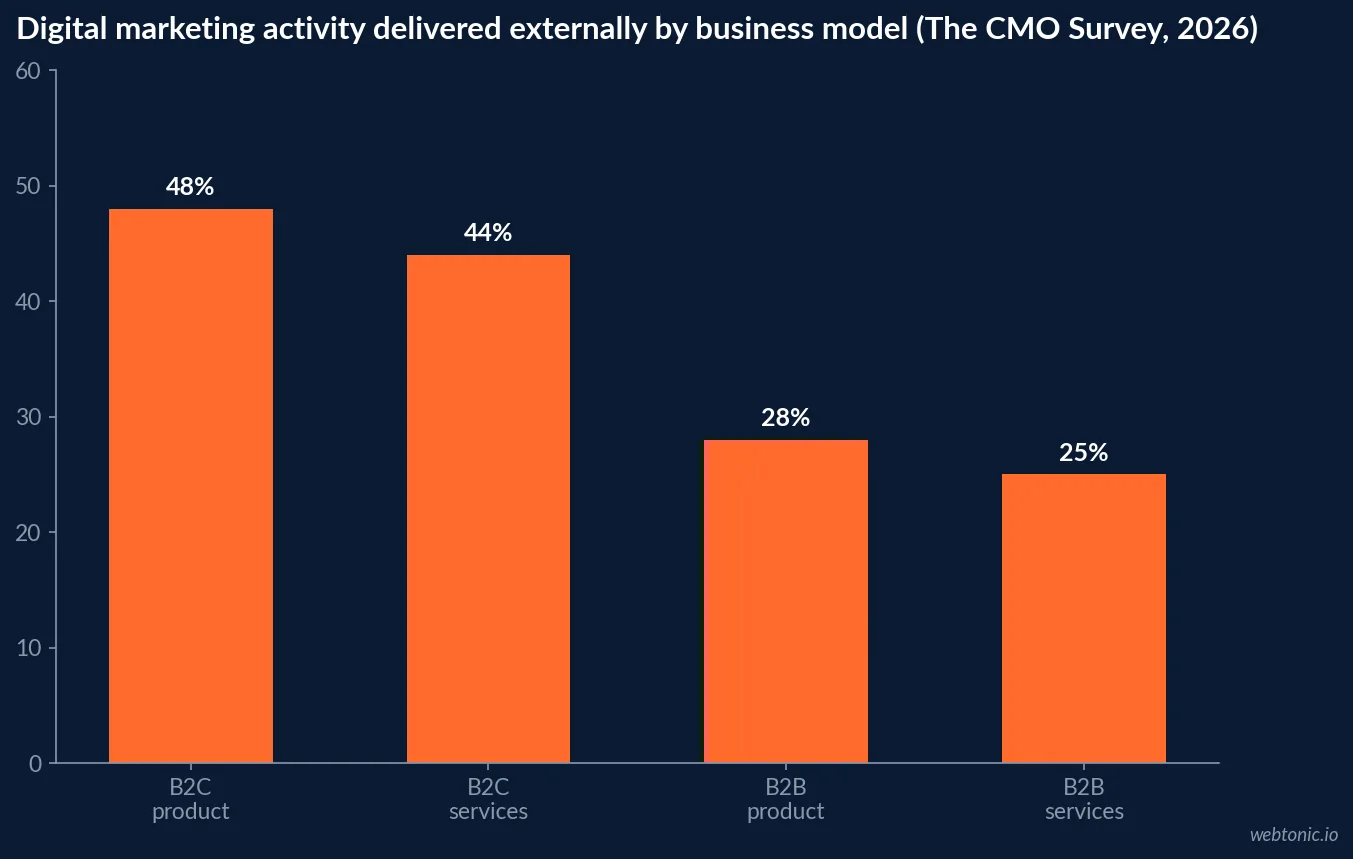
| Segment | Digital work delivered externally | Reading |
|---|---|---|
| B2C product | 48% | Volume and creative range bought outside |
| B2C services | 44% | Similar pattern, slightly more internal |
| Retail | 57% | Highest outsourcing category |
| Consumer packaged goods | 55% | Close second |
| Technology | 28% | Specialist slices only |
| B2B product | 28% | Judgement kept inside |
| B2B services | 25% | Most internal of the four models |
| Education | 3% | Effectively never outsourced |
Which categories insist on building
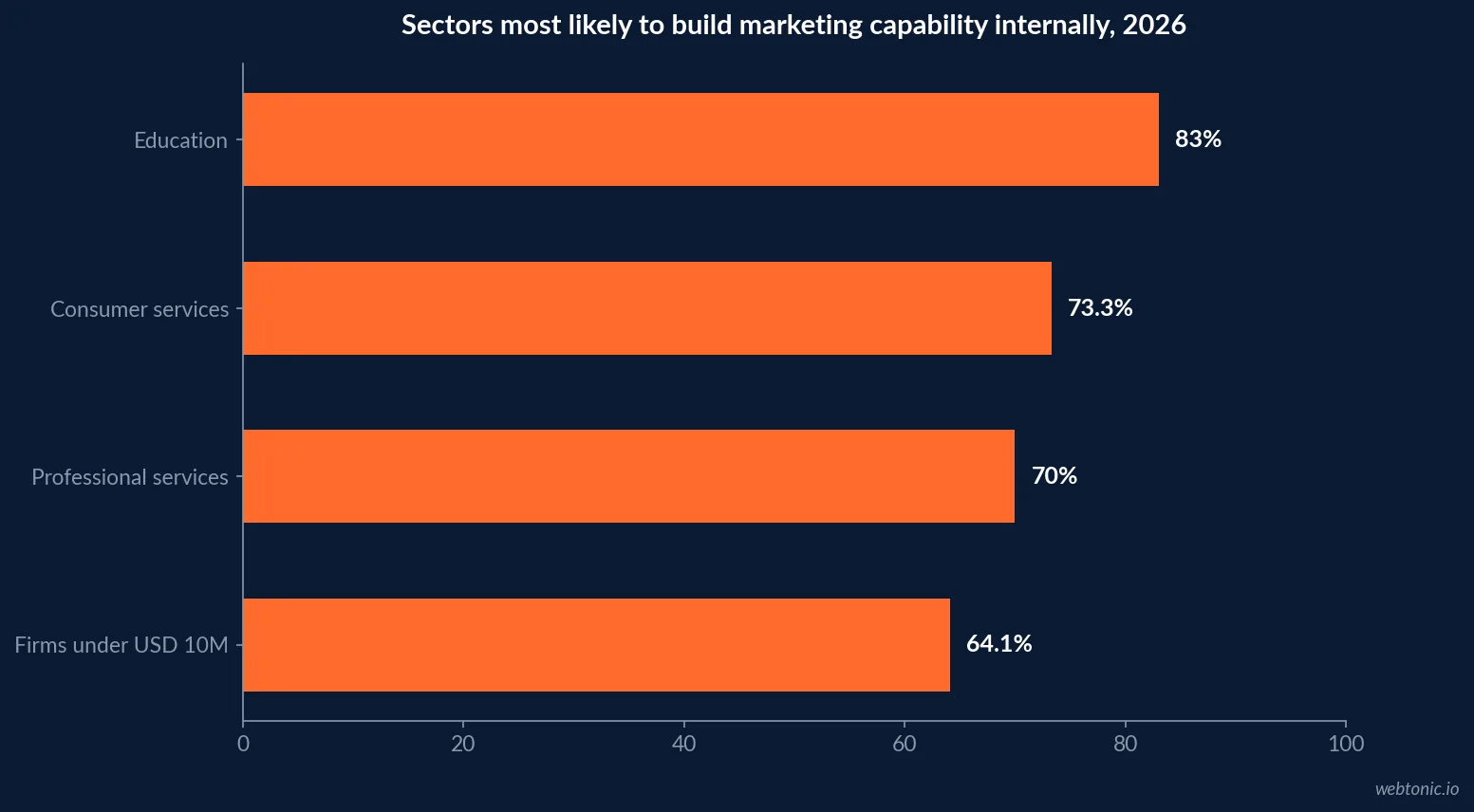
The same survey ranks build emphasis by sector: education at 83.0%, consumer services at 73.3% and professional services at 70.0% lead the field. Those are all categories where the product is the expertise of the people, so building marketing capability internally is consistent with how the business already thinks about talent.
If you sit in one of those categories, the honest framing of a strategy engagement is not "outsource marketing". It is buying a diagnosis and a plan that your own team then owns - the shape that survives the tenure problem discussed below.
In-house capability is growing, with a tooling gap
RSW/US's 2026 New Year Outlook found 66% of client-side firms keeping at least 26% of work in-house, down from 92% in 2024, and 60% reporting some in-house agency capability against 40% a year earlier. Read carefully, those two movements point in opposite directions: more firms have an internal team, but fewer are loading it with the majority of the work.
The same report notes roughly 61% of external agencies used generative AI in 2025 against 17% of in-house agencies. Internalising work can mean inheriting a slower production stack, which is a real cost that rarely appears in the business case. Our data and analytics team sees the same gap in measurement tooling.
| In-house shift indicator | 2026 | Prior reading |
|---|---|---|
| Firms keeping 26%+ of work in-house | 66% | 92% in 2024 |
| Firms with in-house agency capability | 60% | 40% a year earlier |
| External agencies using generative AI | About 61% | 2025 measurement |
| In-house agencies using generative AI | 17% | 2025 measurement |
The tenure problem nobody prices in
Spencer Stuart's 2026 CMO tenure snapshot puts average tenure at 4.1 years at S&P 500 companies against 5.0 years for the C-suite overall, with 31% of those companies having no CMO and 77% of departing CMOs landing a new company role within six months. Hiring a leader is therefore a four-year bet on continuity of strategy - and the strategy usually needs to outlive the bet.
Add the failure case: 2026 mis-hire research cites a floor of 30% of first-year earnings per US Department of Labor guidance, senior mis-hire costs up to 213% of salary and retained search fees of 25% to 35%. The cheapest risk control is a documented plan and scorecard that is not stored in one person's head.
| Continuity risk | 2026 figure | Mitigation |
|---|---|---|
| Average CMO tenure | 4.1 years | Document the plan independently |
| C-suite average tenure | 5.0 years | Longer horizon than marketing |
| Companies with no CMO | 31% | Interim or fractional ownership |
| Departing CMOs re-hired within 6 months | 77% | Expect short notice |
| Senior mis-hire cost ceiling | 213% of salary | Define the role before hiring |
Why B2B firms outsource, in their own words
Sagefrog's 2026 B2B Marketing Mix Report ranks the drivers: limited internal bandwidth at 22%, faster execution at 18%, lack of in-house expertise at 15%, cost efficiency at 13%, a rebrand at 11%, fresh ideas at 11%, a launch at 8% and a transition at 2%. Bandwidth and speed together make up 40% - capacity, not competence.
Structurally, the same report shows hybrid arrangements at 35%, project work at 28%, retainers at 24% and freelancers at 12%. Hybrid leading the field is the practical answer to this whole debate: an internal owner with external capacity attached.
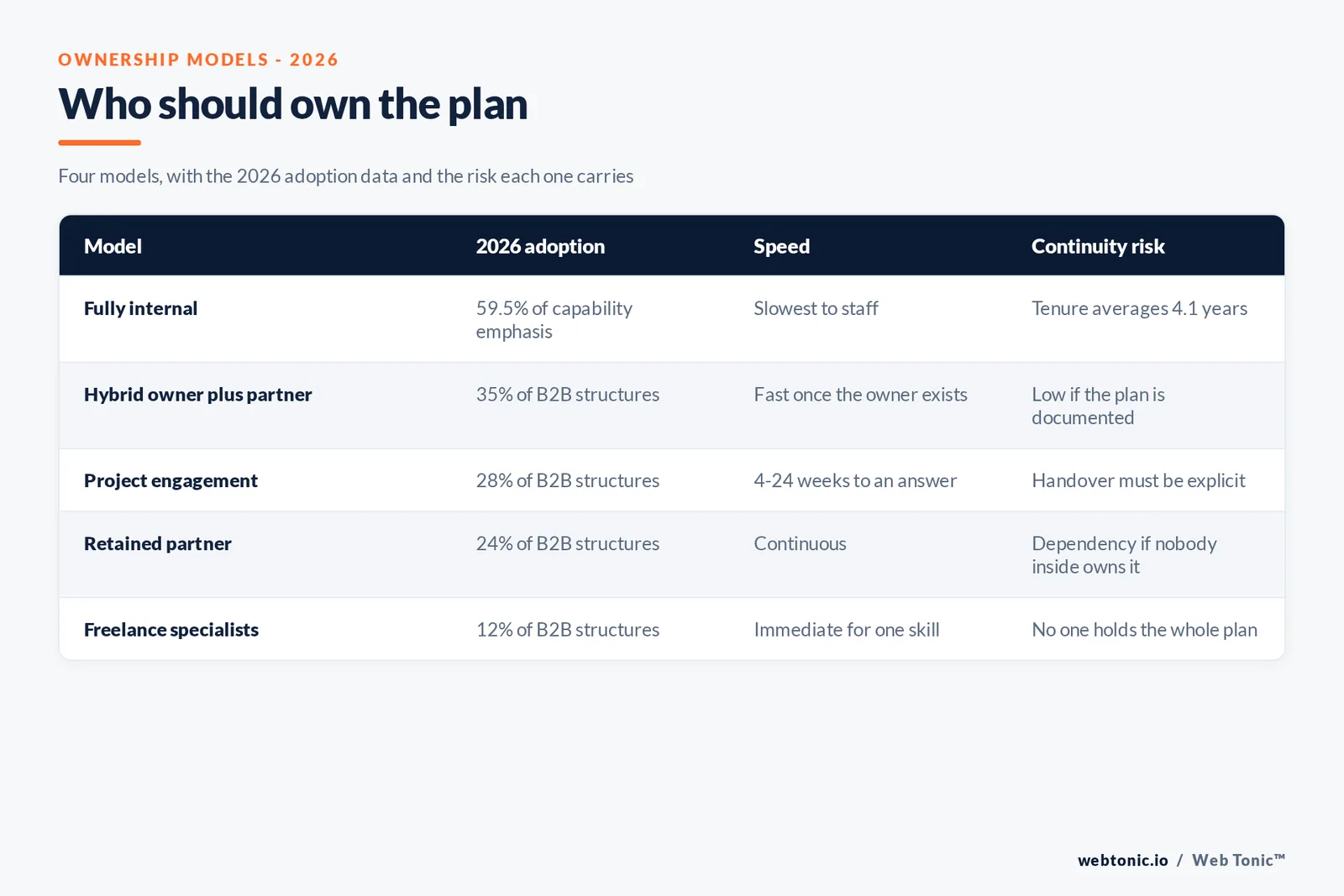
| Outsourcing structure | Share of B2B firms | Best-fit situation |
|---|---|---|
| Hybrid internal plus external | 35% | Owner inside, capacity outside |
| Project-based | 28% | Diagnosis, rebrand or launch |
| Monthly retainer | 24% | Continuous programme management |
| Freelancers | 12% | Single-skill gaps |
A decision rule that fits the data
Three tests settle most of these arguments. First, is the gap capacity or capability? 40% of outsourcing is driven by bandwidth and speed, and capacity gaps are cheaper to rent than to hire. Second, does your category keep this work inside? B2B services outsource 25% of digital activity, B2C product 48% - being an outlier needs a reason. Third, who owns the plan when the person leaves? With 4.1-year average tenure, ownership has to sit in a document and a scorecard, not a job title.
Applied honestly, those tests usually land on the hybrid shape the data already shows leading at 35%: an internal owner accountable for the plan, external senior judgement for the diagnosis and the quarterly reset, and specialist execution attached where speed matters. That is how we structure paid channel programmes too, and you can talk through which shape fits before committing to a headcount.
The fractional middle ground, and how fast it grew
Between hiring and outsourcing sits a third option that barely existed as a category five years ago. The Fractional Work Report puts demand growth at 149% year over year with roughly 150,000 US practitioners, marketing accounting for about 20% of demand, 87% of practitioners holding 11 or more years of experience, 64% working with multiple clients and 90% saying they would not return to full-time employment.
That last figure is the strategic point. The senior operators most likely to fix a positioning problem are increasingly unavailable as employees at any price, which changes the hiring-versus- outsourcing question from a preference into an availability constraint. Vendux, citing Gartner, reports an expectation that more than 30% of midsize companies will use fractional executives by 2027. We describe how we structure that shared ownership on our team page.
| Fractional market indicator | 2026 reading | Consequence for buyers |
|---|---|---|
| Year-over-year demand growth | 149% | Availability tightens, not loosens |
| US practitioners | About 150,000 | A real labour pool, not a niche |
| Marketing share of demand | About 20% | Marketing is a core use case |
| Practitioners with 11+ years | 87% | Seniority is the product |
| Working with multiple clients | 64% | Expect shared attention by design |
| Would not return to full-time | 90% | Some talent is unhireable at any salary |
Related reading
- Marketing Operations Consulting Statistics: Hiring vs Outsourcing
- Marketing Strategy Consulting: vs hiring in-house
- Marketing Audit Statistics: Hiring Versus Outsourcing
- Marketing Strategy Consulting services at Web Tonic
Frequently Asked Questions
Do companies build or buy marketing capability in 2026?
Overwhelmingly they say build. The CMO Survey's 2026 report shows companies placing 59.5% of their capability emphasis on building through hiring and training, 38.5% on partnering and only 1.9% on buying companies outright. Inside the partnering share, agencies take 15.5%, consultancies 12.7% and other companies 10.4%. The striking part is the stability: the build figure was 57.9% in 2020, so six years of disruption moved it by less than two points.
Which sectors keep strategy in-house and which outsource it?
The split is sharp. External delivery of digital marketing activity averages 33.6% overall, but it is 48% for B2C product companies and 44% for B2C services against 28% for B2B product firms and 25% for B2B services. By industry, retail outsources 57% and consumer packaged goods 55%, while education sits at 3% and media at 10%. If your category is on the low side, an outsourced strategy function will feel unusual to your peers - which is not an argument against it, but it is an argument for being explicit about ownership.
Is in-house capability actually growing?
Yes, and quickly. RSW/US's 2026 New Year Outlook found 66% of client-side firms keeping at least 26% of their marketing work in-house, against 92% in 2024, and 60% reporting some in-house agency capability against 40% a year earlier. The counterweight is capability quality: roughly 61% of external agencies used generative AI in 2025 against 17% of in-house agencies, so bringing work inside can mean bringing in a slower toolset with it.
How long does a hired marketing leader stay?
Spencer Stuart's 2026 tenure work puts average CMO tenure at S&P 500 companies at 4.1 years against 5.0 years for the C-suite overall, with 31% of those companies having no CMO at all and 77% of departing CMOs landing a new company role within six months. A four-year average means the strategy you hire for is likely to outlast the person who owns it, which is the practical case for documenting the plan and the scorecard independently of any individual.
Why do B2B companies outsource marketing work?
Sagefrog's 2026 B2B Marketing Mix Report ranks the reasons: limited internal bandwidth at 22%, faster execution or go-to-market at 18%, lack of in-house expertise at 15%, cost efficiency at 13%, a rebrand at 11%, fresh ideas at 11%, a launch at 8% and a transition at 2%. Bandwidth and speed together account for 40% - most outsourcing decisions are capacity decisions, not competence decisions.
Sources
The CMO Survey - Highlights and Insights Report 2026
RSW/US - 2026 New Year Outlook Report
Sagefrog - 2026 B2B Marketing Mix Report
Spencer Stuart - CMO Tenure 2026 Snapshot
Talentfoot - The Cost of a Leadership Mis-hire, 2026 Data
Fractional Jobs - The Fractional Work Report
Hinge Research Institute - High Growth Study 2026