



Table of contents

Marketing teams rate every one of their technology capabilities below 5 out of 7 - and none of those scores improved since 2024. That is the real reason strategies stall at adoption, and the 2026 data says which capability to fix first.
Key Takeaways
- No martech capability scores above 4.9 out of 7, and none improved since 2024.
- Hiring for martech is the weakest capability at 3.7 out of 7.
- Training scores 3.9 and demonstrating technology ROI 4.2.
- Martech is 19.4% of marketing budget, a five-year low from 26.6% in 2021.
- 62% of leaders still say they will invest more in technology.
- 56% shifted toward consumption-based pricing against 9% cutting it.
- 41% now run real-time usage controls and 24% are overhauling systems.
- AI runs 24.2% of marketing activities, up from 13.1% in 2024.
- Generative AI rose from 7.0% to 22.4%, a 220% increase.
- Content creation leads AI use at 73.9%, personalisation at 65.4%.
- Only 9% call themselves fully AI-optimised; 21% are mature.
- Training budgets are 3.8% of marketing spend, down from 5.8%.
The capability scores that predict adoption failure
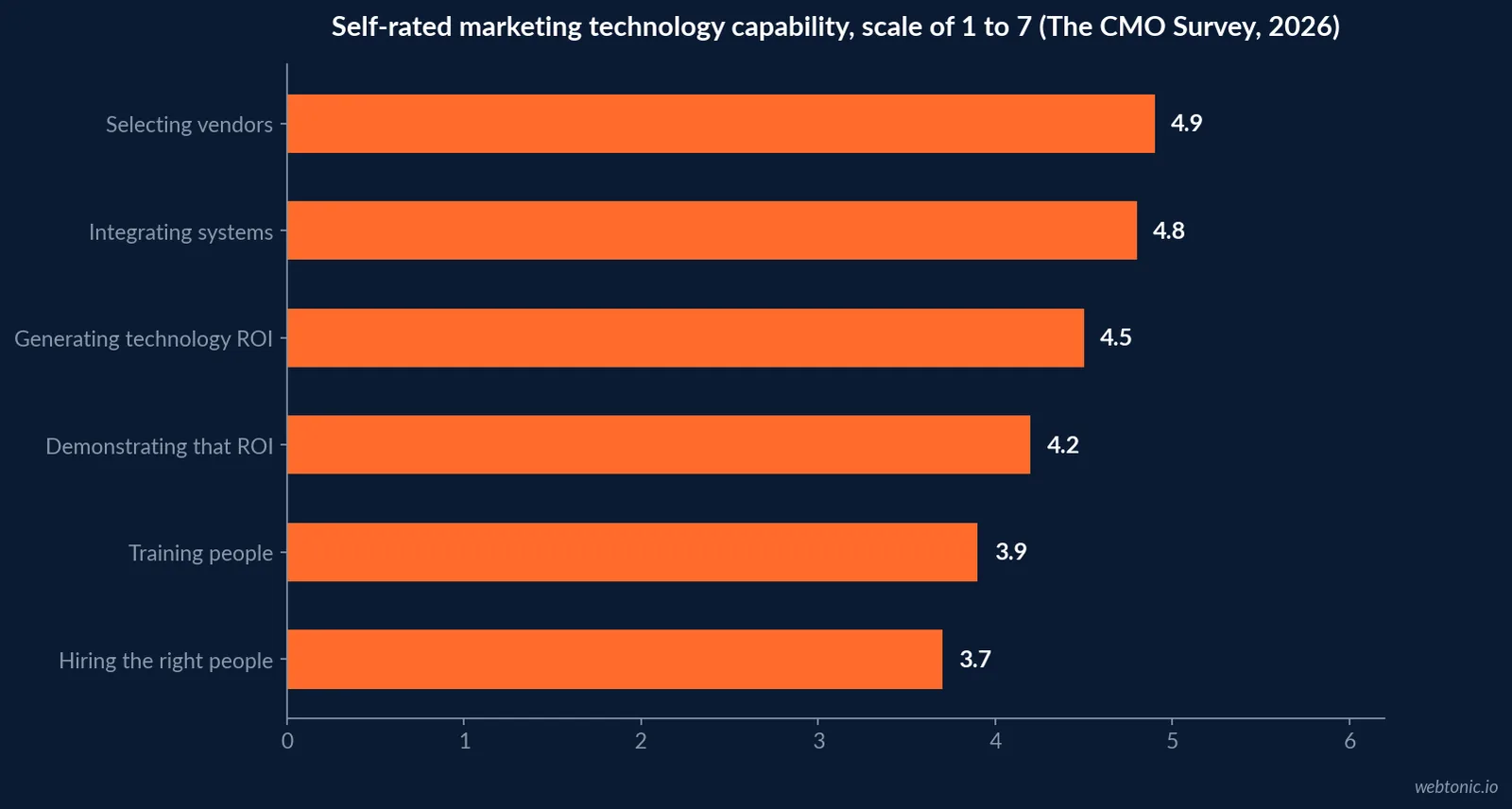
The CMO Survey's 2026 report asks marketers to rate their marketing technology activities on a seven-point scale. Selecting vendors scores 4.9, making marketing mix decisions 4.8, integrating systems 4.8 and using data tactically 4.8, then it drops: generating ROI from technology 4.5, demonstrating that ROI 4.2, training people 3.9 and hiring the right people 3.7. Nothing clears 5, and the pattern is flat against 2024.
The shape of that curve is the whole story. Teams are relatively confident at buying and connecting tools, and weakest at staffing and proving them. An adoption plan built on the assumption that selection is the hard part is solving the problem the team is already best at.
| Martech capability | Self-rating (out of 7) | Implication for adoption |
|---|---|---|
| Selecting the right vendors | 4.9 | Strongest link - not the constraint |
| Making marketing mix decisions | 4.8 | Adequate for planning |
| Integrating systems | 4.8 | Adequate for planning |
| Using data for tactical decisions | 4.8 | Adequate for planning |
| Generating ROI from technology | 4.5 | Where value starts leaking |
| Demonstrating that ROI | 4.2 | Renewal conversations get hard here |
| Training people on the tools | 3.9 | Underfunded at 3.8% of spend |
| Hiring the right people | 3.7 | The binding constraint |
Budgets fell while usage rose
Gartner's 2026 CMO Spend Survey puts martech at 19.4% of marketing budget, a five-year low against 26.6% in 2021, while 62% of leaders plan to invest more. The reconciliation is the pricing model: 56% shifted budget toward consumption-based billing against 9% reducing it, 41% introduced real-time usage controls and 24% are overhauling their systems.
For anyone writing a strategy, that changes the budget line from a fixed licence to a variable operating cost. Consumption pricing rewards teams that know which workflows actually run and punishes teams that buy capacity speculatively - which is a governance question, not a procurement one.
| Tooling spend signal | 2026 reading | What it changes |
|---|---|---|
| Martech share of budget | 19.4% | Five-year low, from 26.6% in 2021 |
| Leaders investing more | 62% | Intent has not fallen with the budget |
| Moved to consumption pricing | 56% | Licence becomes an operating cost |
| Reduced consumption pricing | 9% | Small counter-current |
| Running real-time usage controls | 41% | Governance replaces procurement |
| Overhauling systems | 24% | Migration risk inside the plan window |
AI adoption ran ahead of the operating model
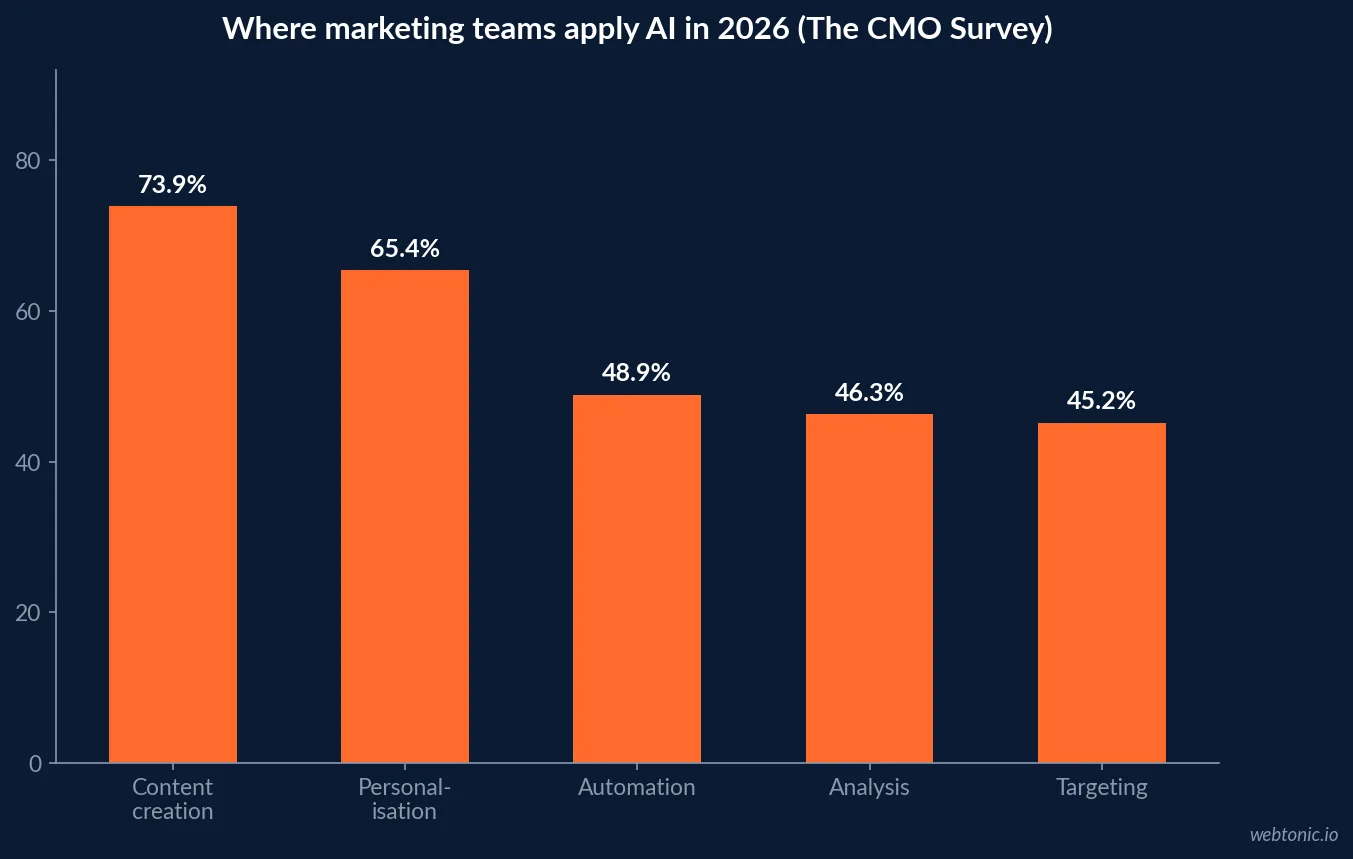
The same survey shows AI performing 24.2% of marketing activities against 13.1% in 2024, with generative AI at 22.4% against 7.0%, a 220% rise, and marketers projecting 55.9% within three years. Adoption is concentrated in content creation at 73.9%, personalisation at 65.4%, automation at 48.9%, analysis at 46.3% and targeting at 45.2%, while 41.5% report working on generative engine optimisation.
HubSpot's 2026 State of Marketing reports 61% of marketers calling this the biggest disruption in twenty years, with 80% using AI for content creation and 75% for media production. Against that, Gartner's data shows only 9% describing themselves as fully AI-optimised and 21% as mature - adoption is broad and shallow.
| AI application | Share of marketers using it | Maturity note |
|---|---|---|
| Content creation | 73.9% | Highest volume, lowest differentiation |
| Personalisation | 65.4% | Depends on data quality |
| Automation of workflows | 48.9% | Needs process documentation first |
| Analysis and insight | 46.3% | Constrained by measurement baseline |
| Targeting | 45.2% | Privacy and consent dependent |
| Generative engine optimisation | 41.5% | New discipline, thin benchmarks |
The barriers are people, not platforms
Named obstacles in the 2026 data are inadequate resourcing at 22.3%, systems architecture at 19.1%, bandwidth at 14.1% and talent management at 13.1%, with AI-specific capability gaps accounting for a combined 35.7%. Behind them sit two structural numbers: training at 3.8% of marketing spend against a pre-pandemic 5.8%, and headcount growth down more than 50% year over year.
There is a partner dimension too. RSW/US's 2026 outlook found roughly 61% of external agencies using generative AI in 2025 against 17% of in-house agencies. Where the capability gap is a tooling gap, borrowing the capability is faster than building it - which is how our creative production team is usually engaged.
The adoption sequence that survives the data
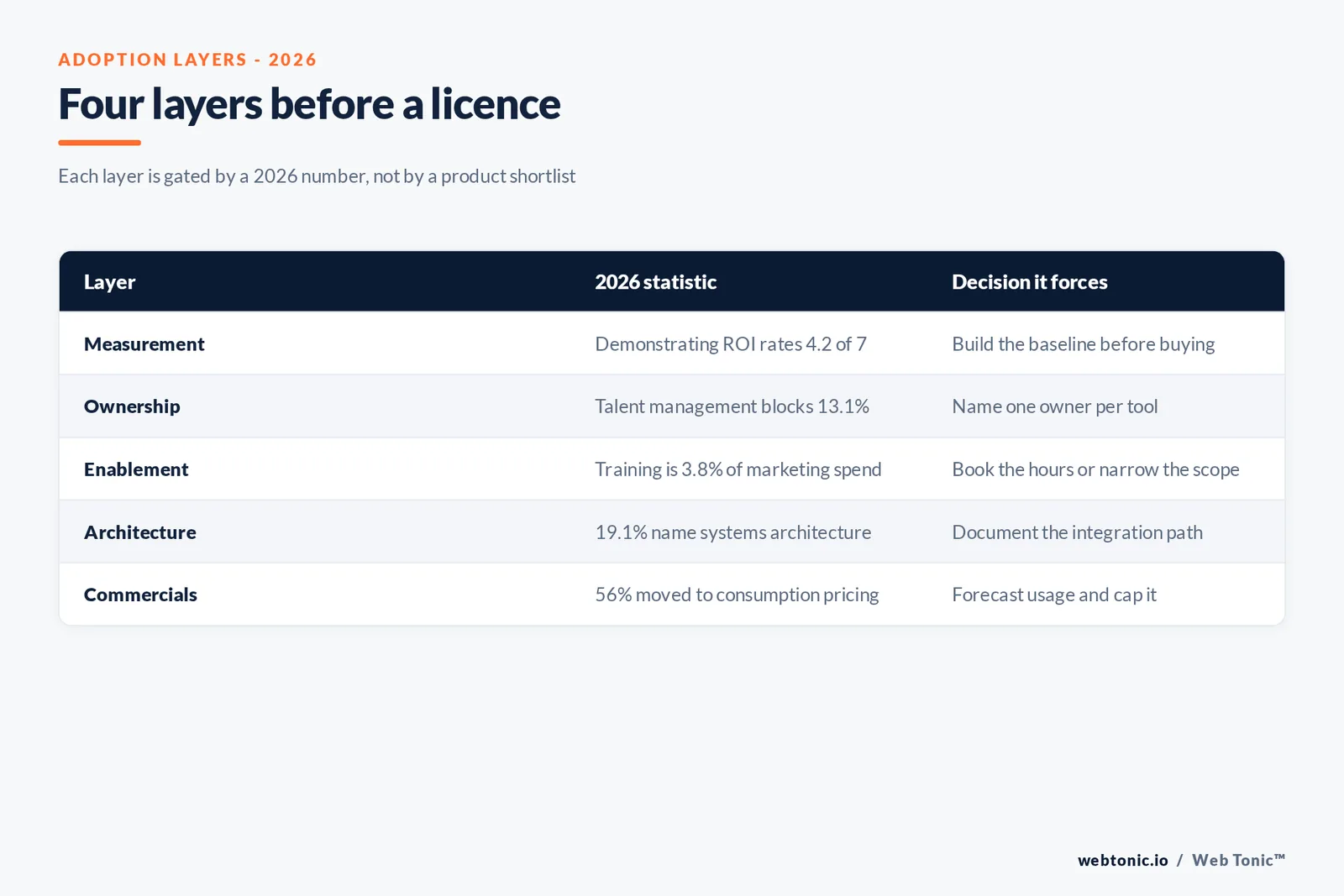
Given those numbers, the order matters more than the shortlist. Baseline the measurement before buying, because demonstrating technology ROI scores 4.2 out of 7. Name a single owner per tool, because talent management blocks 13.1% of leaders. Fund the training explicitly, because the category average is 3.8% of spend. Check the architecture, because 19.1% name it as the blocker. Then negotiate the pricing model, since 56% have already moved to consumption and 41% run usage controls.
| Gate | Statistic that justifies it | Pass condition |
|---|---|---|
| Measurement baseline exists | ROI proof rated 4.2 of 7 | Named metric with 12 months of history |
| Single named owner | Talent gaps block 13.1% | One person, not a committee |
| Training funded | 3.8% of marketing spend | Hours booked before go-live |
| Architecture checked | 19.1% cite systems architecture | Integration path documented |
| Pricing model chosen | 56% moved to consumption | Usage forecast and cap agreed |
What this means for a strategy engagement
Content and campaign work is where teams say they struggle most: CMI's 2026 B2B research puts resource constraints at 39% and measuring effectiveness at 33% among the top three challenges, with producing enough quality content at 28%. Tooling addresses volume. It does not address either of the first two, which are staffing and measurement problems.
So a credible adoption section in a marketing plan is short, sequenced and conditional: it names the measurement baseline, the owner, the training hours and the usage cap before it names a product. If you want a second read on the stack you already own before adding to it, get in touch - and our channel strategy guide covers the same discipline at the campaign level.
What the outsourcing structure data says about adoption
Adoption capacity is also a staffing structure question. Sagefrog's 2026 B2B Marketing Mix Report shows B2B firms working through hybrid arrangements at 35%, project engagements at 28%, retainers at 24% and freelancers at 12%, with outsourcing driven by limited bandwidth at 22% and faster execution at 18%. Those are the same constraints that stall tool rollouts.
The pattern worth copying is hybrid: an internal owner accountable for the workflow, with external capacity attached for the build. It keeps the institutional knowledge inside - which matters, because Hinge's 2026 study found SEO and keyword research falling from 33.5% to 27.0% of firms even as AI-driven discovery grows, a capability drift no software purchase corrects. Our growth marketing engagements assume that split by default.
| Delivery structure | Share of B2B firms | Effect on tool adoption |
|---|---|---|
| Hybrid internal plus external | 35% | Owner inside, build capacity outside |
| Project engagement | 28% | Good for migrations, weak for upkeep |
| Monthly retainer | 24% | Continuity, at a higher run rate |
| Freelancers | 12% | Single-skill gaps only |
| Reason: limited bandwidth | 22% | Adoption fails on hours, not licences |
| Reason: faster execution | 18% | Speed is bought, not installed |
Related reading
- Marketing Strategy Consulting: Tooling and Template Checklist
- Marketing Operations Consulting Statistics: Adoption and Tooling
- Marketing Strategy Consulting Statistics: ROI and Payback
- Marketing Strategy Consulting services at Web Tonic
Frequently Asked Questions
Why do marketing strategies stall at the tooling stage?
Because capability, not software, is the binding constraint. The CMO Survey's 2026 report asks marketers to rate their martech capabilities on a seven-point scale: vendor selection scores 4.9, marketing mix decisions 4.8, integration 4.8 and tactical data use 4.8, while generating ROI from technology scores 4.5, demonstrating that ROI 4.2, training 3.9 and hiring 3.7. Not one capability reaches 5 out of 7, and the set is essentially unchanged since 2024. A strategy that assumes competent tool adoption is assuming the weakest link in the chain.
How much of the marketing budget goes to technology in 2026?
Less than it did. Gartner's 2026 CMO Spend Survey puts martech at a mean 19.4% of marketing budget - a five-year low, down from 26.6% in 2021 - even though 62% of leaders say they will invest more in technology. The gap is explained by pricing structure: 56% shifted budget toward consumption-based billing against 9% cutting it, 41% now run real-time usage controls and 24% are overhauling their systems. Spending less on licences is not the same as using less technology.
How far has AI actually been adopted in marketing work?
Further than most stacks are ready for. The CMO Survey shows AI running 24.2% of marketing activities in 2026 against 13.1% in 2024, with generative AI specifically at 22.4% against 7.0% - a 220% rise - and marketers projecting 55.9% within three years. Use is concentrated in content creation at 73.9%, personalisation at 65.4%, automation at 48.9%, analysis at 46.3% and targeting at 45.2%. Meanwhile only 9% of organisations describe themselves as fully AI-optimised, with 21% classed as mature.
What blocks adoption in practice?
Named barriers in the 2026 data are inadequate resourcing at 22.3%, systems architecture at 19.1%, bandwidth at 14.1% and talent management at 13.1%, with AI-specific capability gaps accounting for a combined 35.7%. Training budgets sit at 3.8% of marketing spend, down from a pre-pandemic 5.8%, and headcount growth has slowed by more than 50% year over year. Those four numbers are why adoption plans that add tools without adding owners fail.
Should a strategy engagement recommend new tooling at all?
Only after the measurement baseline exists. Demonstrating ROI from technology is the second-weakest self-rated capability at 4.2 out of 7, and 33% of B2B marketers name measuring content effectiveness as a top-three challenge. Adding a tool to an unmeasured process produces an unmeasured process with a licence fee. The defensible sequence is baseline, owner, training budget, then purchase.
Sources
The CMO Survey - Highlights and Insights Report 2026
Chief Marketer - Gartner 2026 CMO Spend Survey coverage
HubSpot - 2026 State of Marketing
RSW/US - 2026 New Year Outlook Report
Content Marketing Institute - B2B Content and Marketing Trends 2026
Sagefrog - 2026 B2B Marketing Mix Report
Hinge Research Institute - High Growth Study 2026


