Table of contents
No published study prices marketing scorecard advisory as a product. So this page builds the budget from consulting-wide rate bases that are published, and states which band each number comes from.
Key Takeaways
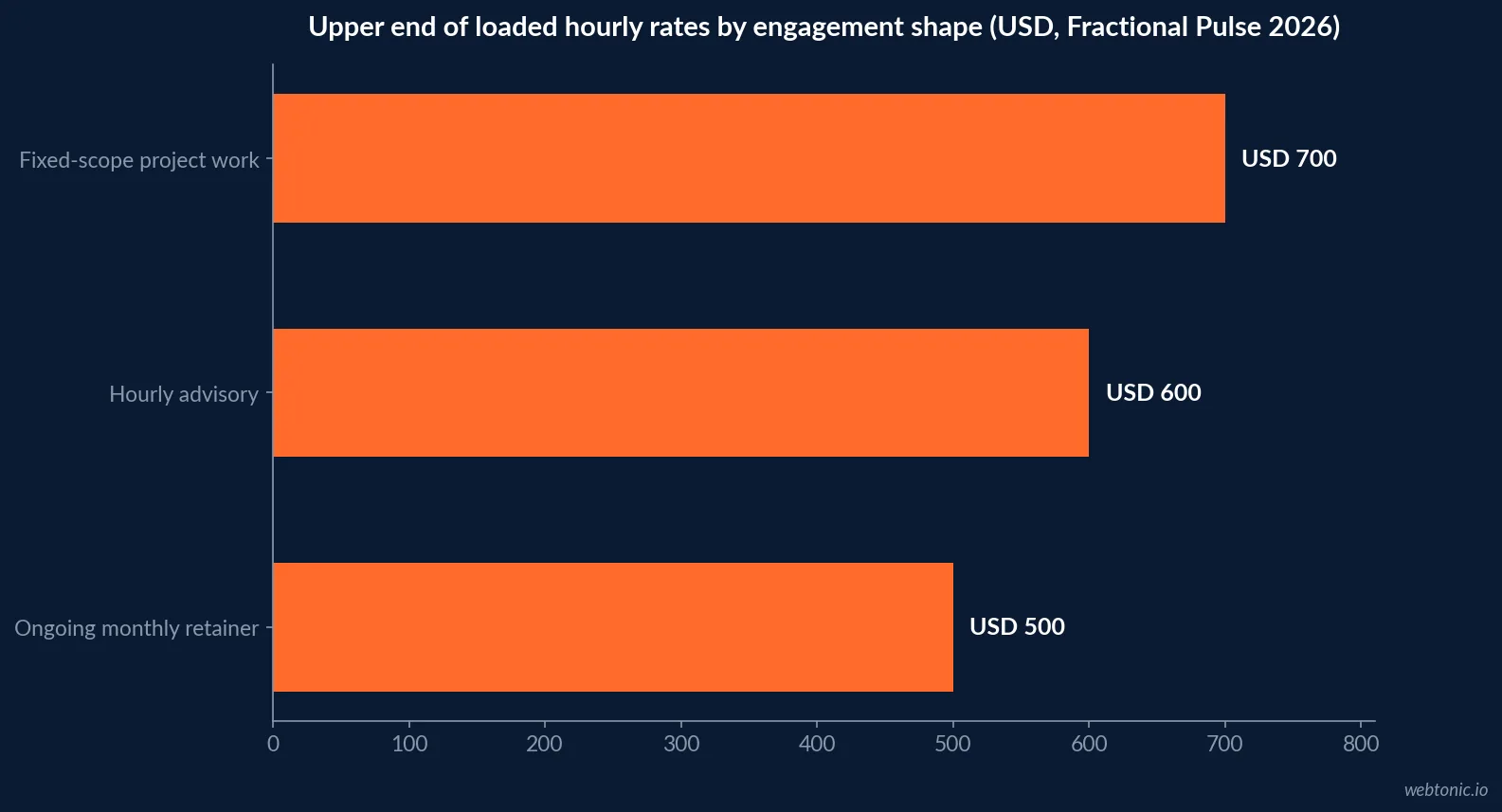
- Loaded project rates run USD 300 to 700 an hour.
- Hourly advisory runs USD 200 to 600 an hour.
- Work delivered inside a retainer runs USD 200 to 500 an hour.
- Retainers themselves run USD 5,000 to 25,000 a month.
- Buying project work through a retainer costs 4 to 5 times more.
- Fractional marketing leadership averages USD 180 an hour, median USD 175.
- The quartile range is USD 130 to 220 an hour.
- A permanent CMO costs USD 293,575 in total cash.
- A bad hire starts at 30% of first-year earnings.
- Senior mis-hires can reach 213% of salary.
- Retained search adds 25% to 35%.
- Consultants price 30% by project, 29% hourly, 16% by retainer.
- 79% of consultants want to raise their fees.
- Marketing budgets sit at 9.0% of revenue with 1.7% spend growth.
- Martech has fallen to 19.4% of marketing budget, a five-year low.
Why there is no price list
Scorecard and KPI advisory is sold as part of something larger - a fractional engagement, a reporting project, an operating-system rollout - so no benchmark study isolates its price. What is published is the rate base underneath it. Fractional Pulse's 2026 engagement comparison puts loaded hourly rates at USD 300 to 700 for project work, USD 200 to 600 for hourly advisory and USD 200 to 500 inside a retainer, with retainers at USD 5,000 to 25,000 a month on six to twelve month terms with 30 days' notice.
Treat every figure below as consulting-wide, not scorecard-specific. That is the honest framing, and it is still enough to sanity-check a quote.
| Engagement shape | Published 2026 loaded rate | Typical duration | Fits when |
|---|---|---|---|
| Fixed-scope project | USD 300-700 an hour | 4-24 weeks | The board has to be built once |
| Hourly advisory | USD 200-600 an hour | Open-ended | Definitions need a second opinion |
| Monthly retainer | USD 200-500 an hour effective | 6-12 months | Someone owns the cadence |
| Retainer fee itself | USD 5,000-25,000 a month | 6-12 months | Continuous change, not a build |
| Fractional at market rate | USD 130-220 an hour | 6-12 months | Weekly ownership without a hire |
The most expensive mistake is the wrong shape
Fractional Pulse's sharpest finding is not a rate, it is a mismatch: buying project-shaped work through a retainer costs four to five times more, illustrated as USD 180,000 against USD 40,000 for the same scope. A scorecard build is project-shaped. The cadence that follows it is retainer-shaped.
Splitting the two is the single biggest lever on the invoice, and it costs nothing to ask for. If a proposal prices a twelve-week build as a twelve-month retainer, that is a scope question, not a rate question.
What the rate itself is doing
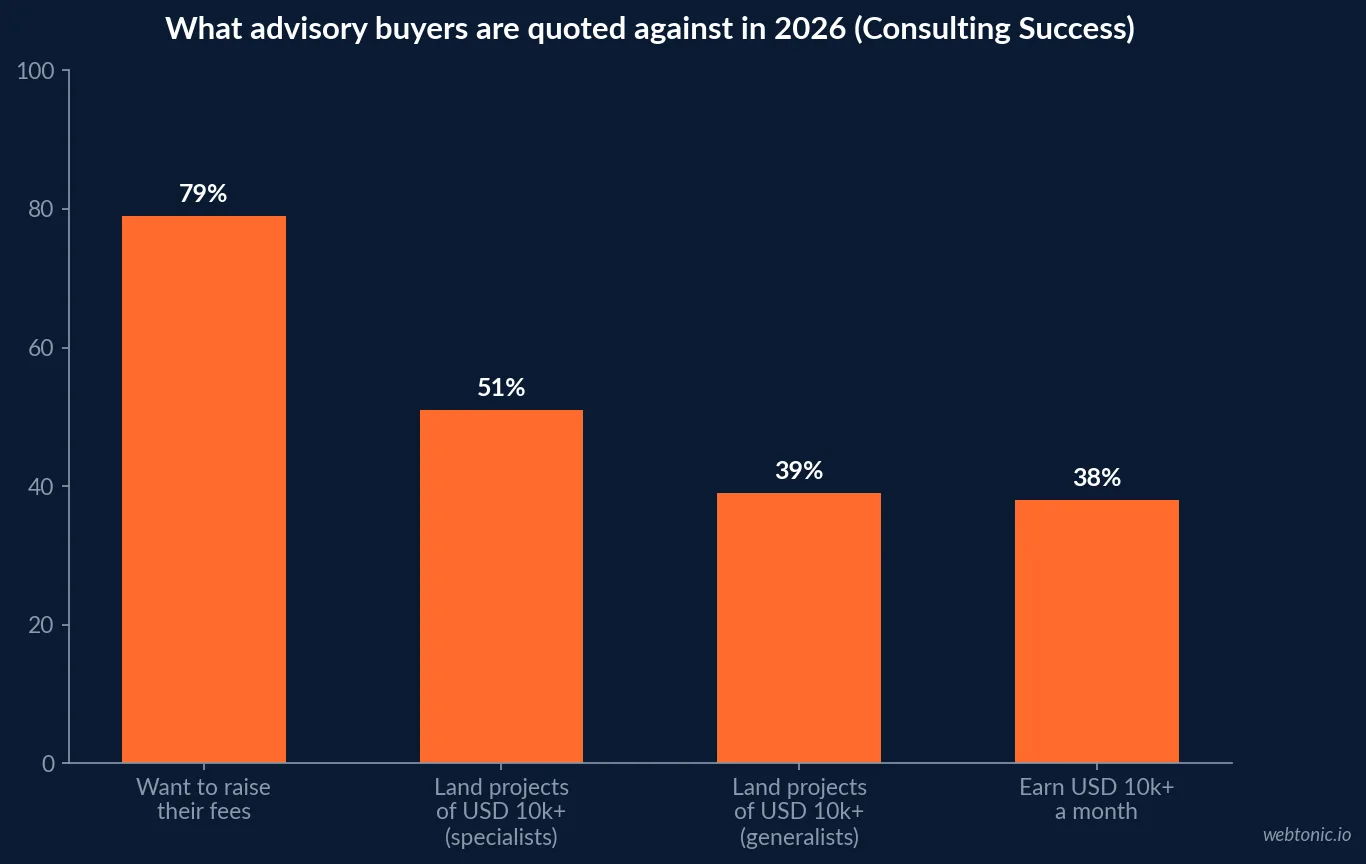
Consulting Success surveyed roughly 1,000 consultants and found pricing split project 30%, hourly 29%, monthly retainer 16%, value-based 15% and daily 10%. Some 79% want to raise their fees, 38% earn USD 10,000 or more a month, and specialists land projects worth USD 10,000 or more at 51% against 39% for generalists.
Two practical consequences. Quotes will arrive in project or hourly shape, and the direction of travel on rates is up, so a rate held for a second year is a concession worth asking for explicitly.
| Pricing model | Share of consultants | What it means for a scorecard scope |
|---|---|---|
| Project based | 30% | The natural fit for a definition-and-build phase |
| Hourly | 29% | Fine for review sessions, risky for an open build |
| Monthly retainer | 16% | Right for cadence, wrong for a one-time build |
| Value based | 15% | Needs an agreed baseline metric first |
| Daily rate | 10% | Useful for workshops and offsites |
Fractional pricing is the closest published proxy
Go Fractional reports an average marketing leadership rate of USD 180 an hour, a median of USD 175, a quartile range of USD 130 to 220 and typical engagements of about 9 hours a week, roughly 468 hours a year.
At that intensity, a year of part-time senior ownership sits well below a permanent package. That is the comparison a finance team actually wants, and it is the reason scorecard work so often lands inside a fractional arrangement rather than a standalone line item.
The permanent-hire comparison
Built In's 2026 US salary data puts chief marketing officer pay at USD 225,908 base plus USD 67,667 additional, or USD 293,575 total cash. Talentfoot adds the risk side: a bad hire costs at least 30% of first-year earnings under US Department of Labor guidance, senior mis-hires reach 213% of salary, and retained search adds 25% to 35%.
A hire is the cheapest option only when the scope is settled and funded. Where the scope is still being discovered - which is the normal state before a scorecard exists - the risk-adjusted cost favours renting the capability for two or three quarters.
| Cost line | Published 2026 figure | Source basis |
|---|---|---|
| CMO base salary | USD 225,908 | Built In US salary data |
| Additional cash | USD 67,667 | Built In US salary data |
| Total cash | USD 293,575 | Built In US salary data |
| Retained search fee | 25-35% of package | Talentfoot |
| Bad-hire floor | 30% of first-year earnings | US Department of Labor via Talentfoot |
| Senior mis-hire ceiling | 213% of salary | Talentfoot |
Where the money has to come from
The CMO Survey 2026 puts budgets at 9.0% of revenue and 9.6% of firm budgets with spend growth of 1.7% and headcount growth down 50% year on year. Training has fallen to 3.8% of marketing spend from 5.8%.
Meanwhile Gartner's 2026 CMO Spend Survey has martech at 19.4% of budget, a five-year low against 26.6% in 2021, with 62% planning to invest more and 41% adding usage controls. A scorecard programme funded from a licence nobody uses is a far easier approval than one funded from new money.
Budgeting the phases separately
Price the diagnosis, the build and the cadence as three lines. The diagnosis is short and hourly. The build is fixed-scope at the USD 300 to 700 project band. The cadence is either a retainer at USD 5,000 to 25,000 a month or fractional hours at USD 130 to 220.
Three lines also make cancellation cheap. If the build lands and the cadence holds internally, you stop after phase two, which is the outcome an honest adviser should be willing to write down. Our data intelligence team scopes it that way by default.
| Phase | Shape to buy | Published rate basis | Exit test |
|---|---|---|---|
| Diagnosis | Hourly advisory | USD 200-600 an hour | Definitions agreed in writing |
| Build | Fixed-scope project | USD 300-700 an hour | Board runs without the adviser |
| Cadence | Retainer or fractional | USD 5,000-25,000 a month | Owners defend their own lines |
| Steady state | Internal | No external fee | Two clean quarters unaided |

The market context behind the quote
Demand is not soft. Fractional Jobs reports 149% year-on-year growth in demand, roughly 150,000 US practitioners, marketing at 20% of demand, 87% with eleven or more years of experience, 64% working with multiple clients and 90% saying they will not return to full-time work.
A supply pool that experienced and that committed will not discount heavily. The saving comes from shaping the scope, not from squeezing the rate - the same logic behind how media budgets should be framed.
What a defensible quote looks like
Phases priced separately, a stated rate basis, a fixed scope on the build, a cadence you can cancel with 30 days' notice, and no retainer wrapped around project work at four to five times the cost. Anything else is a pricing preference dressed as a methodology.
If you want the same numbers applied to your own reporting stack, our growth team will scope it in phases, or send us your current reporting pack and we will tell you which phase you actually need.
The market you are buying in
The Business Research Company sizes global management consulting services at USD 1,063.77 billion in 2025, USD 1,111.35 billion in 2026 and USD 1,407.09 billion by 2030. A growing market with a shortage of senior operators is not a market that discounts.
The implication for a scorecard budget is simple. Expect the quoted rate to hold or rise, and take your savings from scope discipline: a narrow diagnosis, a fixed build and a cadence you can end.
| Market measure | Published figure | Year |
|---|---|---|
| Global management consulting services | USD 1,063.77 billion | 2025 |
| Global management consulting services | USD 1,111.35 billion | 2026 |
| Global management consulting services | USD 1,407.09 billion | 2030 forecast |
| Fractional demand growth | 149% year on year | 2026 |
| US fractional practitioners | About 150,000 | 2026 |
Three worked budget shapes
These are arithmetic on published rate bands, not quotes, and they assume the phases stay separate. A short diagnosis at the USD 200 to 600 hourly band, a build at the USD 300 to 700 project band, and a cadence at either USD 5,000 to 25,000 a month or fractional hours at USD 130 to 220.
Any of the three can be stopped after the build. That is the test of whether an adviser is selling a scorecard or selling a subscription, and it is worth asking before the first invoice.
| Buyer shape | Diagnosis | Build | Cadence |
|---|---|---|---|
| Owner-led firm | Hourly, few sessions | Fixed scope, short | Internal after handover |
| Scaling company | Hourly, structured | Fixed scope, 6-12 weeks | Fractional hours, 6 months |
| Multi-brand group | Hourly plus workshops | Fixed scope per brand | Retainer, 6-12 months |
Related reading
- AI Marketing Advisory Statistics: Cost and Pricing
- Marketing Operations Consulting Statistics: Cost and Pricing
- Fractional CMO Statistics: Cost and Pricing
- Marketing Strategy Consulting services at Web Tonic
Frequently Asked Questions
How much does it cost to build a marketing KPI scorecard?
There is no published price for scorecard advisory as a product, so the honest answer is built from consulting-wide rate bases. Fractional Pulse's 2026 comparison puts loaded hourly rates at USD 300 to 700 for project work, USD 200 to 600 for hourly advisory and USD 200 to 500 inside a retainer, with retainers themselves at USD 5,000 to 25,000 a month. A definition-and-build engagement of four to twenty-four weeks prices off the project band.
Is a retainer or a project cheaper for scorecard work?
For a bounded build, a project. Fractional Pulse reports that buying project-shaped work through a retainer costs four to five times more, illustrated as USD 180,000 against USD 40,000 for the same scope. Retainers earn their price when the work is continuous stewardship rather than a one-time build, and they usually carry a six to twelve month term with 30 days' notice.
What does a permanent reporting hire cost instead?
Built In's 2026 US data puts chief marketing officer pay at USD 225,908 base plus USD 67,667 additional, or USD 293,575 in total cash. Talentfoot notes that US Department of Labor guidance places the floor cost of a bad hire at 30% of first-year earnings, with senior mis-hires reaching 213% of salary, and retained search adds 25% to 35%. Those are the numbers a build-versus-buy case has to clear.
What share of a marketing budget should reporting take?
The CMO Survey 2026 reports marketing budgets at 9.0% of revenue and 9.6% of firm budgets, with spend growth of just 1.7%, while martech has fallen to 19.4% of budget per Gartner's 2026 CMO Spend Survey. Reporting competes inside that martech share, so a scorecard programme funded by cutting an unused licence is usually easier to approve than one funded by new money.
How do consultants price advisory work in 2026?
Consulting Success surveyed roughly 1,000 consultants and found project pricing at 30%, hourly at 29%, monthly retainers at 16%, value-based at 15% and daily rates at 10%, with 79% saying they want to raise fees. Around 38% earn USD 10,000 or more a month. Expect a quote in project or hourly shape and expect upward pressure on the rate.
Sources
Fractional Pulse - Fractional executive engagement comparison 2026
Consulting Success - Consulting fees and pricing study
Go Fractional - Fractional CMO rates 2026
Built In - Chief marketing officer salary data
Talentfoot - The cost of a leadership mis-hire, 2026 data
The CMO Survey - Highlights and Insights Report 2026
Gartner 2026 CMO Spend Survey via Chief Marketer
Fractional Jobs - The Fractional Work Report
The Business Research Company - Management Consulting Services Global Market Report