



Table of contents

Hybrid structures lead B2B at 35%, and 66% of client firms keep at least a quarter of the work in-house. Marketing operations splits badly along the usual hire-or-outsource line, because owning a system and building one are different jobs. Here is what the 2026 data supports.
Key Takeaways
- Hybrid structures lead B2B at 35%, ahead of projects 28% and retainers 24%.
- Freelancers account for 12% of B2B marketing structures.
- Bandwidth drives 22% of outsourcing decisions, speed 18% and expertise 15%.
- Capability emphasis runs 59.5% build, 38.5% partner and 1.9% buy.
- 33.6% of digital marketing activity is delivered externally.
- 66% of client firms keep at least 26% of their work in-house.
- 60% have in-house agency capability, up from 40% a year earlier.
- 61% of external agencies used generative AI against 17% of in-house teams.
- Senior mis-hires reach 213% of salary; the floor is 30% of first-year earnings.
- Average CMO tenure is 4.1 years against 5.0 across the C-suite.
- 31% of companies have no CMO at all.
- Fractional demand grew 149% year on year.
- 90% of fractional practitioners will not return to full-time work.
- Gartner projects 30%+ of midsize companies using fractional executives by 2027.
- Marketing headcount growth fell 50% year on year.
The default answer is hybrid
Sagefrog's 2026 B2B Marketing Mix Report finds hybrid structures at 35%, project-based engagements at 28%, retainers at 24% and freelancers at 12%. No single model holds a majority, which tells you the question is not which model is correct but which capability sits where.
Operations makes that sharper than most functions. The work divides cleanly into building systems, which is finite, and owning them, which is not - and the two halves have different failure modes.
| Structure | Share of B2B firms | Fits which half of operations |
|---|---|---|
| Hybrid internal and external | 35% | Internal ownership, external build |
| Project-based | 28% | Migrations and integrations |
| Retainer | 24% | Continuous stewardship |
| Freelancers | 12% | Specialist platform tasks |
Why teams go external
Sagefrog ranks the reasons as bandwidth 22%, speed 18%, expertise 15%, cost efficiency 13%, a rebrand 11%, fresh ideas 11%, a launch 8% and a transition 2%. Three of the top four are capacity and timing, not capability - which is worth noticing, because capacity problems are temporary and hiring is not.
Where the reason is genuinely expertise, at 15%, the case for renting is strongest and the case for renting permanently is weakest: the point of buying expertise is to leave documented practice behind.

| Reason for outsourcing | Share | Hire instead when |
|---|---|---|
| Bandwidth | 22% | The overload lasts more than four quarters |
| Speed | 18% | Speed is needed every quarter, not once |
| Expertise | 15% | The expertise is core to the product |
| Cost efficiency | 13% | Internal utilisation would exceed 80% |
| Rebrand | 11% | Never - this is finite by definition |
| Launch | 8% | Never - this is finite by definition |
In-house capability is growing, not shrinking
RSW/US's 2026 New Year Outlook reports that 66% of client firms keep at least 26% of their work in-house and that 60% now have some in-house agency capability, up from 40% a year earlier. It also finds 61% of external agencies used generative AI in 2025 against 17% of in-house agencies.
Those two findings pull in opposite directions, and the tension is the interesting part: companies are internalising more work at the same time as external partners are adopting new tooling faster. For operations, that argues for internal ownership of the process and external help with whatever the internal team has not yet learned to run.
What the CMO Survey says about the split
The CMO Survey 2026 puts capability emphasis at 59.5% build, 38.5% partner and 1.9% buy, with 33.6% of digital marketing activity delivered externally - up from 31.6% in 2022 and projected at 34.3% within two years. The split is uneven by model: B2B product 28%, B2B services 25%, B2C product 48% and B2C services 44%.
Sector spread is wider still: retail 57%, consumer packaged goods 55%, technology 28%, media 10% and education 3%. If your sector sits at the low end, an outsourced operations function will feel unusual internally even when the arithmetic supports it.
| Segment | Share of digital delivered externally | Reading for operations |
|---|---|---|
| B2C product | 48% | External delivery is the norm |
| B2C services | 44% | External delivery is the norm |
| B2B product | 28% | Hybrid with internal ownership |
| B2B services | 25% | Hybrid with internal ownership |
| Technology | 28% | Build-heavy, buys specialist help |
| Education | 3% | Almost entirely internal |
The downside of hiring into an undefined scope
Talentfoot cites a US Department of Labor floor of at least 30% of first-year earnings for a bad hire, senior mis-hires reaching 213% of salary, and retained search at 25-35% of first-year compensation. The CMO Survey adds the context that headcount growth fell 50% year on year while spend growth was 1.7%.
The practical test is whether the scope has stopped moving. Hiring a permanent operations lead to discover what the operations problem is inverts the order, and it is expensive in exactly the way the mis-hire data describes.
Leadership churn outlasts the systems
Spencer Stuart's 2026 CMO tenure snapshot puts average tenure at 4.1 years in the S&P 500 against 5.0 years across the C-suite, with 31% of companies having no CMO and 77% of vacancies filled within six months.
A CRM, an attribution model and a lead-routing ruleset all outlive that. Whoever builds them, the documentation and the definitions have to belong to the company - the principle behind how our data intelligence practice hands work over.
The rented market is maturing
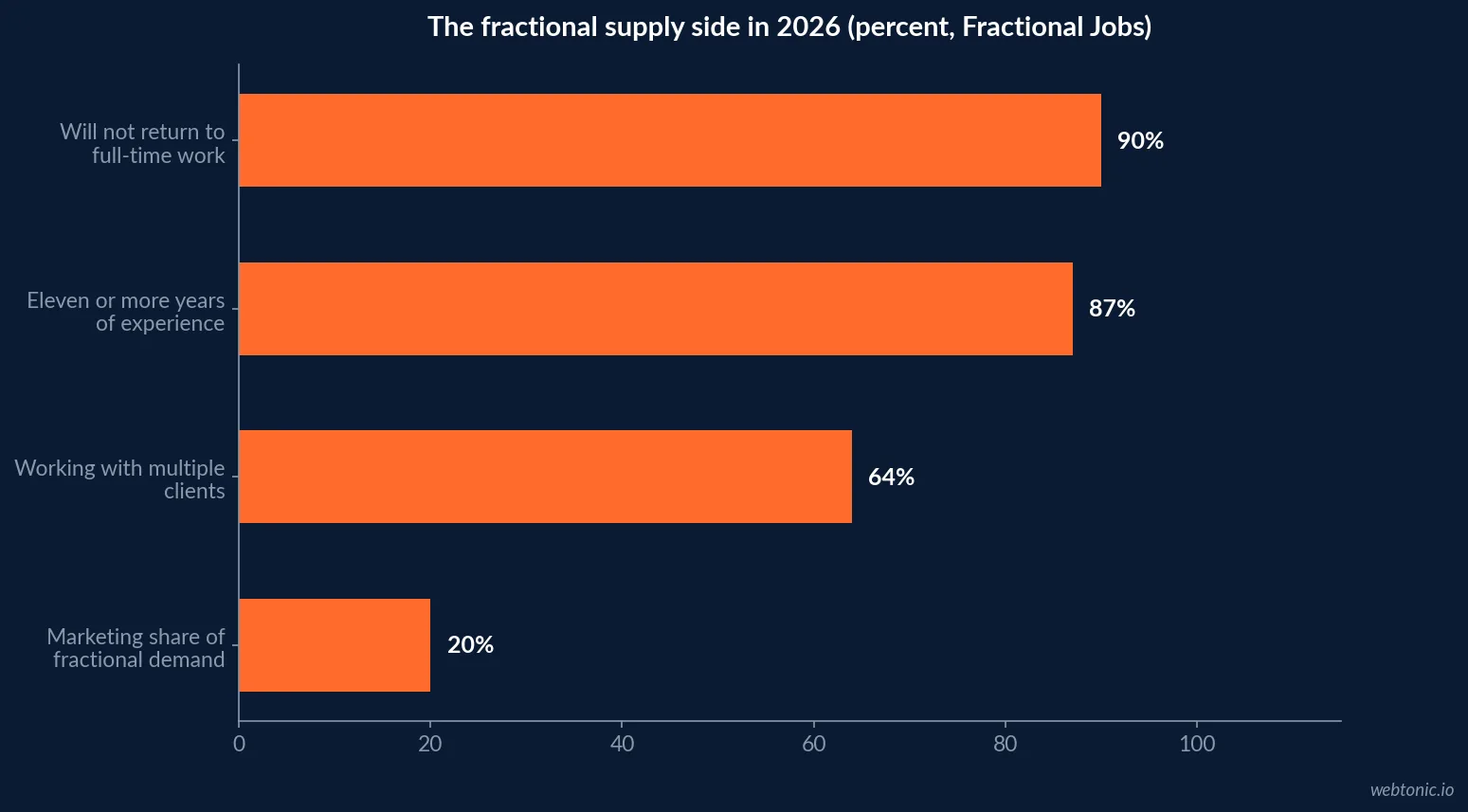
The Fractional Work Report records 149% year-on-year demand growth, roughly 150,000 US practitioners, marketing at 20% of demand, 87% with eleven or more years of experience, 64% working with multiple clients and 90% who will not return to full-time work. Vendux cites a Gartner projection that more than 30% of midsize companies will use fractional executives by 2027.
Supply that experienced changes the calculation. Renting senior operations judgement is no longer a stopgap for firms that cannot hire; it is a normal way to buy a capability whose scope is still moving.
| Operations responsibility | Own or rent | Published anchor |
|---|---|---|
| Metric definitions and governance | Own | 4.1-year average leadership tenure |
| CRM or platform migration | Rent as a project | 28% run project-based engagements |
| Attribution and reporting build | Rent, then own | 33.6% of digital delivered externally |
| Day-to-day automation upkeep | Own | 66% keep 26%+ of work in-house |
| New tooling the team cannot run | Rent | 61% vs 17% generative AI adoption |
| Vendor and contract management | Own | Headcount growth down 50% YoY |
Six tests before you open a requisition
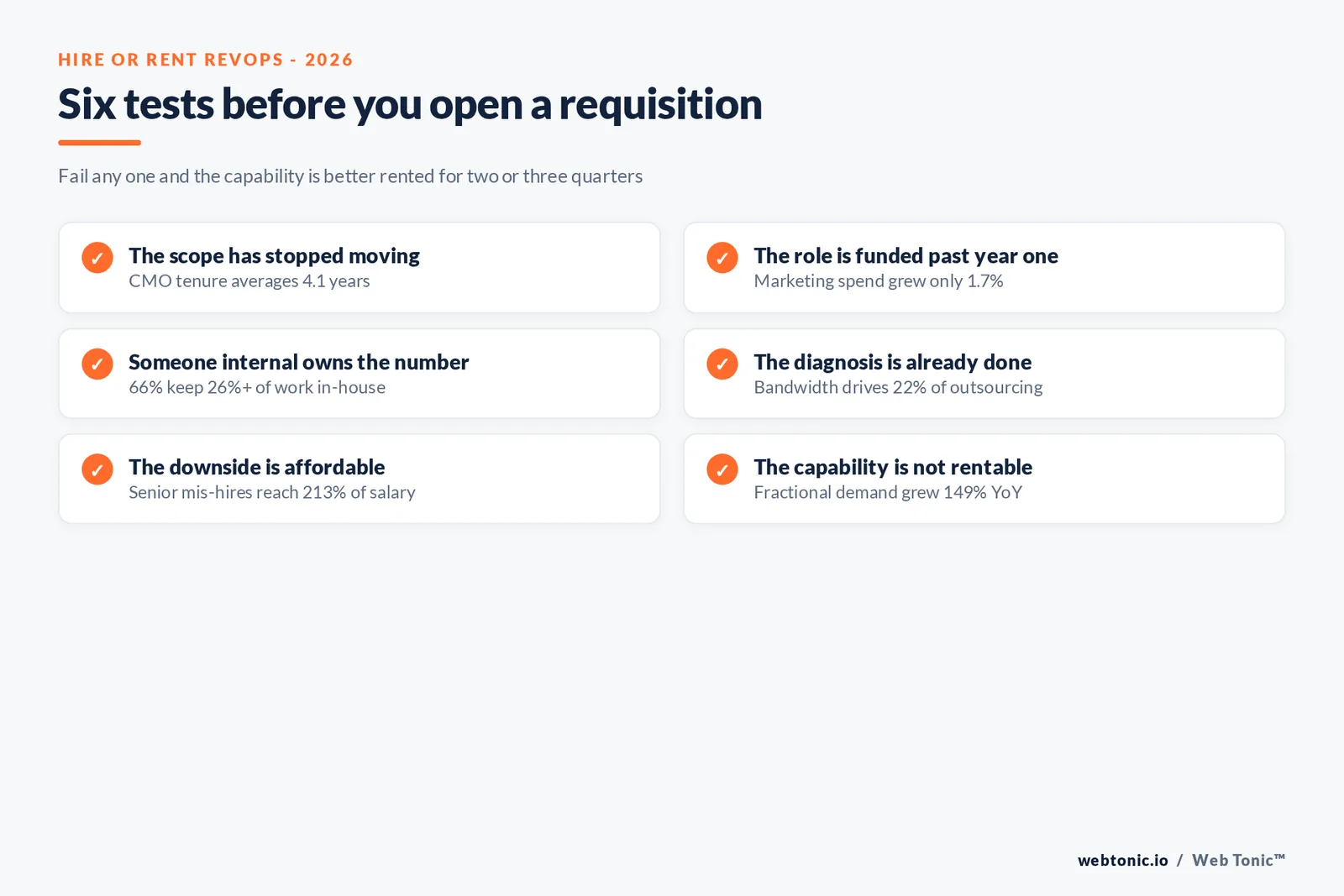
Has the scope stopped moving? Is the role funded past year one against 1.7% spend growth? Does someone internal already own the number? Is the diagnosis already done? Is the downside affordable against a 213% worst case? And is the capability genuinely un-rentable given 149% demand growth in the fractional market?
Fail any one and the capability is better rented for two or three quarters. Pass all six and the requisition is defensible. Our growth team runs that test with clients before either option is priced - tell us where your operations gap is and we will walk through it.
What breaks at the handoff
Most operations failures are not build failures; they are handoff failures. An external team builds a lead-scoring model, the internal owner changes roles inside the 4.1-year tenure window, and six months later nobody can say why a record is scored the way it is. The build was fine. The transfer was never specified.
The fix is contractual rather than technical: name the receiving owner before the work starts, require a written definition set as a deliverable, and schedule one review after the partner has left. That is cheap against a mis-hire floor of 30% of first-year earnings and a ceiling of 213%.
| Handoff artefact | Who owns it after | Why it matters |
|---|---|---|
| Metric and object definitions | Internal owner | Survives 4.1-year leadership tenure |
| Field and automation inventory | Internal owner | Prevents duplicate builds |
| Runbook for failures | Internal owner | Removes escalation-only dependency |
| Vendor and contract list | Internal owner | 56% of contracts now consumption-priced |
| Open backlog with estimates | Shared | Makes the next project scopeable |
How to phase the decision
Quarter one: rent a diagnostic and name an internal owner, even a part-time one. Quarter two: rent the build as a fixed project, with the handoff artefacts above as deliverables. Quarter three: measure whether the remaining work is continuous or finite. Only then decide between a retainer and a requisition against 1.7% spend growth and headcount growth down 50%.
Phased that way, the expensive decision is made last and with evidence, which is exactly what the 35% of firms running hybrid structures have effectively arrived at by trial.
How the hybrid actually gets structured
In practice the working version looks like this: one internal owner accountable for definitions and for the reporting the board sees, an external project team for finite builds, and a small retainer for escalation and hygiene. That maps to the 35% hybrid share Sagefrog measures rather than to either pure model.
It also survives the churn that 4.1-year tenure implies, because the accountable owner is a role rather than a person, and the build partner can change without the definitions changing with it. More on how we work that way is on our about page.
Related reading
- Marketing Strategy Consulting Statistics: Hiring vs Outsourcing
- Marketing Strategy Consulting: vs hiring in-house
- Marketing Audit Statistics: Hiring Versus Outsourcing
- Marketing Strategy Consulting services at Web Tonic
Frequently Asked Questions
Should marketing operations be hired or outsourced in 2026?
Both, split by the type of work. The CMO Survey 2026 puts capability emphasis at 59.5% build, 38.5% partner and 1.9% buy, with 33.6% of digital marketing activity delivered externally. RSW/US reports that 66% of client firms keep at least 26% of their work in-house and that 60% now have some in-house agency capability, up from 40% a year earlier. The pattern is ownership inside, build capacity outside.
What structures do B2B companies actually run?
Sagefrog's 2026 B2B Marketing Mix Report finds hybrid structures at 35%, project-based engagements at 28%, retainers at 24% and freelancers at 12%. The reasons given for going external are bandwidth 22%, speed 18%, expertise 15%, cost efficiency 13%, a rebrand 11%, fresh ideas 11%, a launch 8% and a transition 2%.
What does a bad operations hire cost?
Talentfoot cites a US Department of Labor floor of at least 30% of first-year earnings for a bad hire, with senior mis-hires reaching up to 213% of salary and retained search adding 25-35% of first-year compensation. Against Built In's USD 293,575 total cash for a US marketing leader, the downside of hiring into an undefined scope is measured in hundreds of thousands, not in a notice period.
How stable is senior marketing leadership?
Spencer Stuart's 2026 snapshot puts average CMO tenure at 4.1 years, the shortest in the C-suite against 5.0 years overall, with 31% of companies having no CMO at all and 77% of vacancies filled within six months. Operations systems outlive the leaders who commission them, which is the argument for documented internal ownership regardless of who builds.
Is fractional or outsourced operations a lasting model?
The available data says it is growing. Fractional Jobs reports 149% year-on-year growth in demand, roughly 150,000 US practitioners, marketing at 20% of demand, 87% with eleven or more years of experience, 64% working with multiple clients and 90% saying they will not return to full-time work. Vendux cites a Gartner projection that more than 30% of midsize companies will use fractional executives by 2027.
Sources
Sagefrog - 2026 B2B Marketing Mix Report
RSW/US - 2026 New Year Outlook Report
The CMO Survey - Highlights and Insights Report 2026
Talentfoot - Cost of a Leadership Mis-hire, 2026 data
Spencer Stuart - CMO Tenure 2026 Snapshot
Fractional Jobs - The Fractional Work Report
Vendux - Fractional executive numbers for 2026


