Table of contents

Marketing objectives are the specific, measurable outcomes marketing commits to over a defined period — a target for awareness, leads, sales, retention or customer lifetime value that ladders up to a business goal.
This guide covers what they are, how they differ from goals and KPIs, 30 worked examples by category and business model, and the benchmarks to set them against.
Key Takeaways
- A marketing objective has 4 mandatory parts: a metric, a baseline, a target, and a deadline. Miss any one and it is a wish, not an objective.
- The SMART test — Specific, Measurable, Achievable, Relevant, Time-bound — is the fastest filter, and most drafts fail on "measurable" or "time-bound".
- Business goals, marketing objectives, strategies, tactics and KPIs form 5 distinct layers; conflating them is the single most common planning error.
- Marketing objectives are outcome targets; communication objectives target what the audience should know, feel or do — you usually need both.
- Benchmark before you commit: US paid search averages a $5.42 cost per click, 6.64% click-through rate, 8.18% conversion rate and $66.69 cost per lead across 23 industries.
- Google handles roughly 91.27% of global search, which is why organic and paid search objectives usually carry the largest share of a demand plan.
- Set no more than 3-5 marketing objectives per quarter; teams that carry ten hit none of them.
- Every objective needs one named owner, one primary KPI and no more than 3 supporting metrics.
- Review monthly, re-forecast quarterly, and re-baseline annually — an objective set against a 12-month-old baseline is measuring the wrong thing.
What a marketing objective actually is
A marketing objective is a written commitment to move one metric from a known starting point to a stated target by a stated date. "Grow brand awareness" is not an objective. "Increase aided brand awareness among UK facilities managers from 12% to 18% by 31 December, measured by a quarterly panel survey" is.
The discipline matters because marketing objectives are the contract between marketing and the rest of the business. They decide budget, they decide which channels get resourced, and they decide what counts as a good quarter. Professional bodies including the American Marketing Association and the Chartered Institute of Marketing frame them the same way: measurable ends, not activities.
Objectives vs goals vs strategies vs tactics vs KPIs
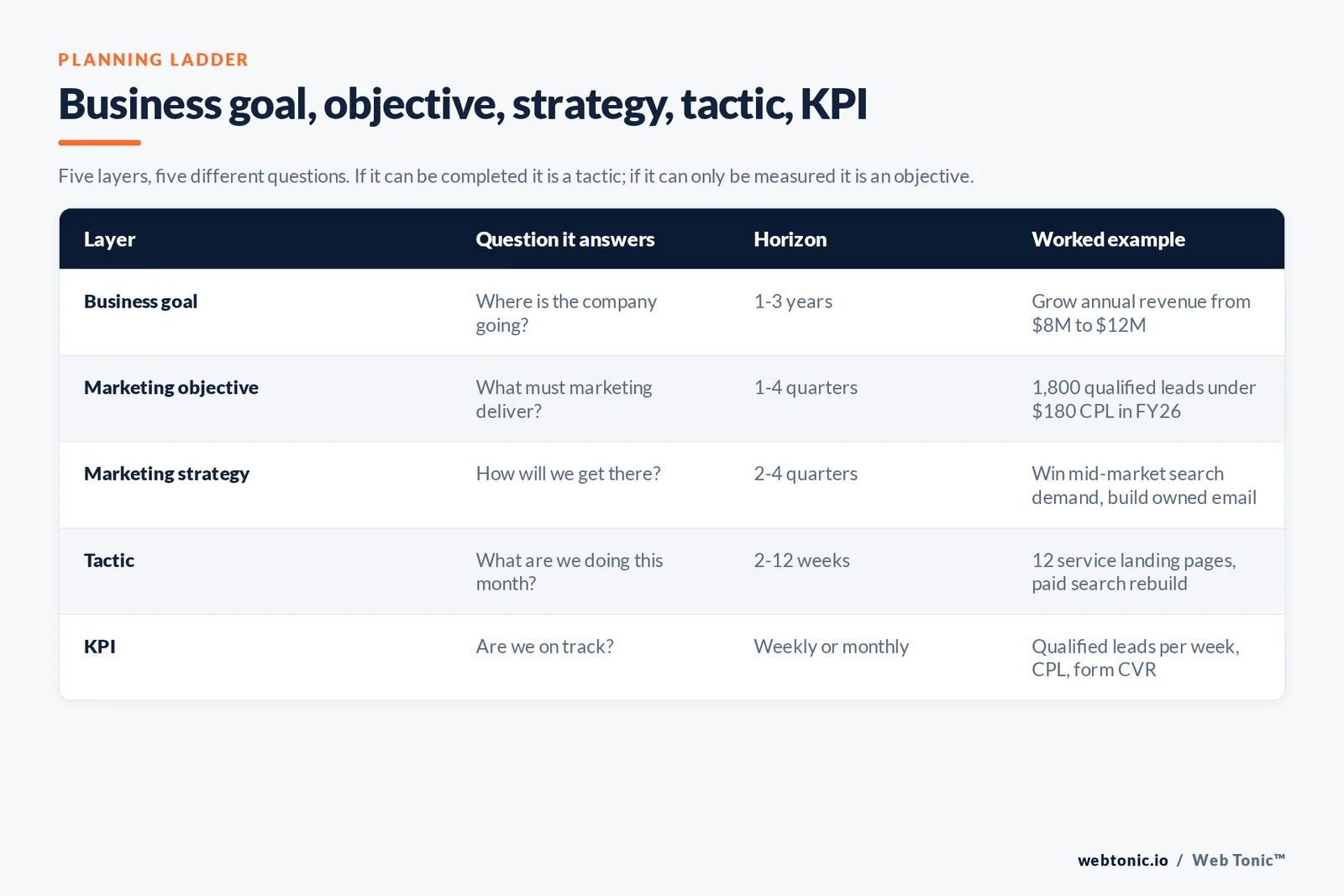
Five layers, each answering a different question. Getting them in the right order is most of the work.
| Layer | Question it answers | Time horizon | Worked example |
|---|---|---|---|
| Business goal | Where is the company going? | 1-3 years | Grow annual revenue from $8M to $12M |
| Marketing objective | What must marketing deliver? | 1-4 quarters | Deliver 1,800 qualified leads at under $180 CPL in FY26 |
| Marketing strategy | How will we get there? | 2-4 quarters | Win mid-market search demand and build an owned email base |
| Tactic | What are we doing this month? | 2-12 weeks | Launch 12 service landing pages and a paid search account rebuild |
| KPI | Are we on track? | Weekly or monthly | Qualified leads per week, cost per lead, form conversion rate |
A useful sanity check: if a line item can be completed, it is a tactic. If it can only be measured, it is an objective. Web Tonic runs this ladder for every client engagement before any media spend, which is why our growth marketing engagements start with a measurement plan rather than a campaign brief.
How to write a SMART marketing objective
SMART — specific, measurable, achievable, relevant and time-bound — is old but it survives because it catches the exact failures that make objectives unusable. Run every draft through the five tests below and rewrite until it passes all five.
| SMART test | Question to ask | Weak version | Fixed version |
|---|---|---|---|
| Specific | Which metric, which segment? | Improve our social media | Grow Instagram engaged followers in the US market |
| Measurable | What is the baseline and the target? | Get more followers | From 14,200 to 20,000 engaged followers |
| Achievable | Does the budget and benchmark support it? | 10x in one quarter | +41%, in line with last year's +38% at similar spend |
| Relevant | Which business goal does it serve? | Because competitors post more | Supports the DTC revenue goal via top-of-funnel reach |
| Time-bound | By when, reviewed how often? | This year, hopefully | By 30 September, reviewed on the first Monday monthly |
30 marketing objective examples by category
Use these as templates: replace the bracketed numbers with your own baseline and a target justified by benchmark or historical trend.
| Category | Example marketing objectives | Primary KPI |
|---|---|---|
| Brand awareness | Lift aided brand awareness from 12% to 18% by year end · grow branded search volume 30% in 6 months · reach 1.2M unique in-market users per quarter | Aided awareness, branded search impressions |
| Product awareness | Reach 55% awareness of the new tier among existing customers within 90 days of launch · secure 15 named media or analyst mentions | Awareness survey, earned mentions |
| Website traffic | Grow non-branded organic sessions from 24,000 to 36,000 per month in 12 months · lift returning-visitor share from 22% to 30% | Organic sessions, returning users |
| Lead generation | Deliver 150 marketing-qualified leads per month at under $180 each · raise demo-request conversion rate from 2.1% to 3.2% | MQLs, cost per lead, conversion rate |
| Sales and revenue | Generate $2.4M in marketing-sourced pipeline this fiscal year · hit a 4.5x blended return on ad spend at $95K monthly media | Sourced revenue, ROAS |
| Customer retention | Cut monthly logo churn from 3.1% to 2.2% within two quarters · lift repeat purchase rate from 18% to 25% | Churn, repeat purchase rate |
| Customer lifetime value | Raise 12-month CLV from $420 to $520 · grow average order value from $86 to $99 through bundling | CLV, average order value |
| Social media | Grow engaged followers 40% across two priority platforms · publish 12 short-form videos monthly at a 4% engagement rate | Engaged followers, engagement rate |
| Email and owned audience | Grow the consented list from 31,000 to 50,000 subscribers · lift email-attributed revenue share from 14% to 20% | List growth, email revenue share |
| Market share and expansion | Enter two new metro markets with 100 leads each in the first quarter · grow category share from 6% to 8% in 18 months | Market share, new-market leads |
Marketing objectives vs communication objectives
Marketing objectives are commercial: leads, sales, share, retention. Communication objectives describe the change you need in the audience's head for those commercial numbers to move — awareness, comprehension, preference, intent. A campaign that hits its communication objective and misses the marketing objective usually has a pricing, product or funnel problem, not a creative one.
| Dimension | Marketing objective | Communication objective |
|---|---|---|
| What it measures | Commercial outcome | Audience knowledge, feeling or intent |
| Typical metric | Leads, revenue, share, churn | Recall, message association, consideration |
| Data source | CRM, analytics, ad platforms | Survey, brand tracker, panel |
| Time to move | Weeks to quarters | One to four quarters |
| Owned by | Marketing lead with sales | Brand and creative lead |
Objectives by business model
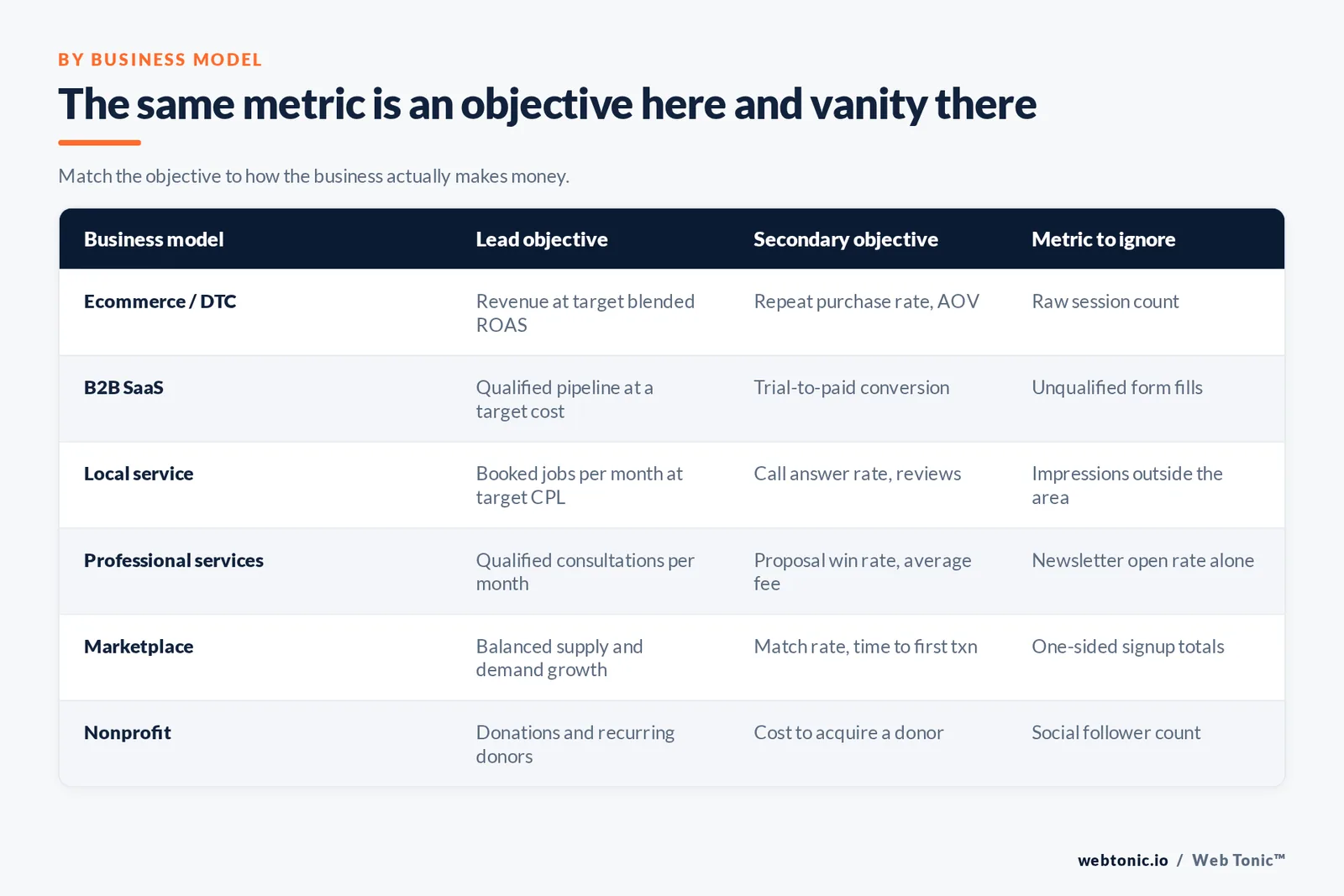
The same metric can be an excellent objective for one model and a vanity number for another. Match the objective to how the business actually makes money.
| Business model | Lead objective | Secondary objective | Metric to ignore |
|---|---|---|---|
| Ecommerce / DTC | Revenue at a target blended ROAS | Repeat purchase rate and AOV | Raw session count |
| B2B SaaS | Qualified pipeline at a target cost | Trial-to-paid conversion rate | Unqualified form fills |
| Local service business | Booked jobs per month at a target cost per lead | Call answer rate and review volume | Impressions outside the service area |
| Professional services | Qualified consultations per month | Proposal win rate and average fee | Newsletter open rate alone |
| Marketplace | Balanced supply and demand growth | Match rate and time to first transaction | One-sided signup totals |
| Nonprofit | Donations and recurring donor count | Cost to acquire a donor | Social follower count |
How to set marketing objectives in six steps
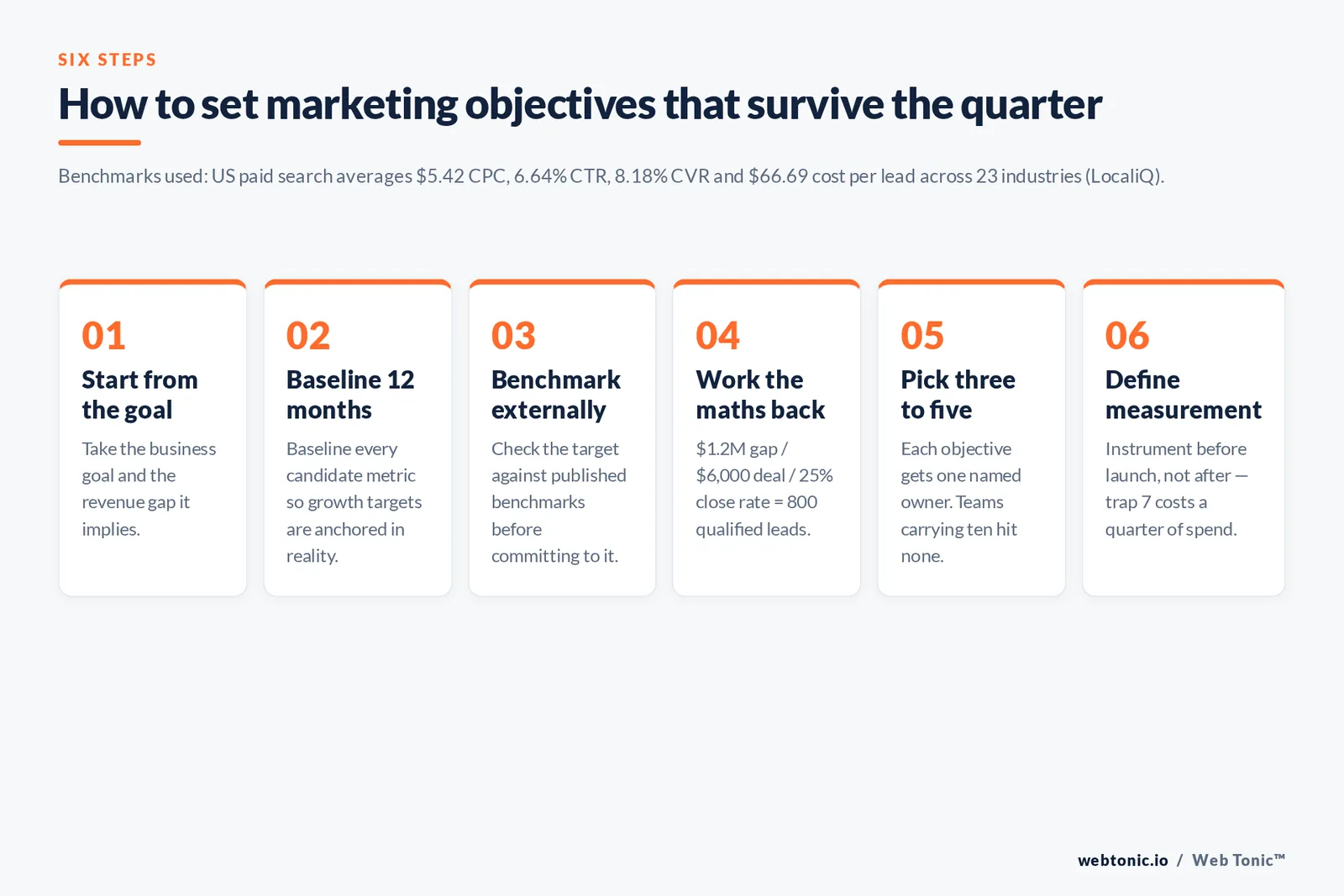
Step 1 — start from the business goal and the revenue gap it implies. Step 2 — baseline every candidate metric for the last 12 months, so growth targets are anchored in reality. Step 3 — benchmark externally: the US search averages of $5.42 CPC, 6.64% CTR, 8.18% conversion rate and $66.69 cost per lead published in LocaliQ's search advertising benchmarks tell you whether a target is ambitious or fantasy. Step 4 — work the maths backwards from revenue to sessions. Step 5 — choose three to five objectives, each with one owner. Step 6 — define the measurement before launch, not after.
The backwards maths is where most plans break. If you need $1.2M in new revenue at a $6,000 average deal and a 25% close rate, you need 800 qualified leads — and at a benchmark-adjusted cost per lead, that dictates the budget. Think with Google and the US Small Business Administration's marketing and sales guide both push the same sequencing for smaller budgets.
| Backwards-maths input | Example figure | Where it comes from |
|---|---|---|
| Revenue gap | $1,200,000 | Business goal minus forecast run rate |
| Average deal or order value | $6,000 | CRM, trailing 12 months |
| Close rate | 25% | Sales pipeline history |
| Qualified leads required | 800 | Deals needed divided by close rate |
| Lead-to-qualified rate | 40% | Marketing-to-sales handoff data |
| Sessions required | 250,000 | Leads divided by site conversion rate |
| Implied media budget | $133,000+ | Leads x benchmark cost per lead |
Choosing the KPIs that prove the objective
One primary KPI, at most three supporting metrics, and one guardrail metric that stops you winning the objective while damaging the business — that is the whole rule. Configure the measurement in analytics before launch; Google documents conversion event setup in the Analytics help centre.
| Objective type | Primary KPI | Supporting metrics | Guardrail |
|---|---|---|---|
| Awareness | Aided awareness or branded search volume | Reach, frequency, direct traffic | Cost per thousand reached |
| Traffic | Non-branded organic sessions | Ranking keywords, click-through rate | Bounce or engagement rate |
| Lead generation | Qualified leads per month | Conversion rate, cost per lead, lead source mix | Sales-accepted lead rate |
| Sales | Marketing-sourced revenue | ROAS, average order value, pipeline velocity | Contribution margin after discounts |
| Retention | Churn or repeat purchase rate | Email engagement, NPS, reactivation rate | Discount depth |
| Lifetime value | 12-month CLV | Purchase frequency, AOV, cross-sell rate | Customer acquisition cost payback period |
Channel mix: which channels can carry which objectives
Objectives are only achievable if a channel exists that can move that metric at your budget. With Google holding roughly 91.27% of global search share per Statcounter, search usually anchors intent-driven objectives, while social and video carry awareness. Aggregate performance benchmarks published by HubSpot, Sprout Social and Mailchimp are the sanity check before a channel target gets signed off.
| Channel | Objectives it moves well | Typical time to signal | Weak fit for |
|---|---|---|---|
| Paid search | Leads, sales, market entry | 2-4 weeks | Category creation |
| SEO and content | Non-branded traffic, leads, authority | 3-9 months | Same-quarter revenue gaps |
| Paid social | Awareness, product launch, DTC revenue | 1-3 weeks | High-consideration B2B deals alone |
| Email and CRM | Retention, CLV, repeat purchase | 1-2 cycles | New audience acquisition |
| Video and YouTube | Awareness, comprehension, consideration | 4-8 weeks | Direct cost-per-lead targets |
| PR and earned media | Awareness, credibility, branded search | 1-2 quarters | Predictable weekly lead flow |
Review cadence: monthly, quarterly, annually
An objective nobody reviews is a document, not a management tool. Set the rhythm when you set the target.
| Cadence | What you review | Decisions allowed |
|---|---|---|
| Weekly | Leading indicators: spend, leads, conversion rate | Budget shifts, creative swaps, bid changes |
| Monthly | Objective progress against pace-to-target | Channel reallocation, tactic changes |
| Quarterly | Re-forecast, strategy fit, guardrail metrics | Retire, add or re-target an objective |
| Annually | Baselines, benchmarks, business-goal alignment | Full objective set rewrite |
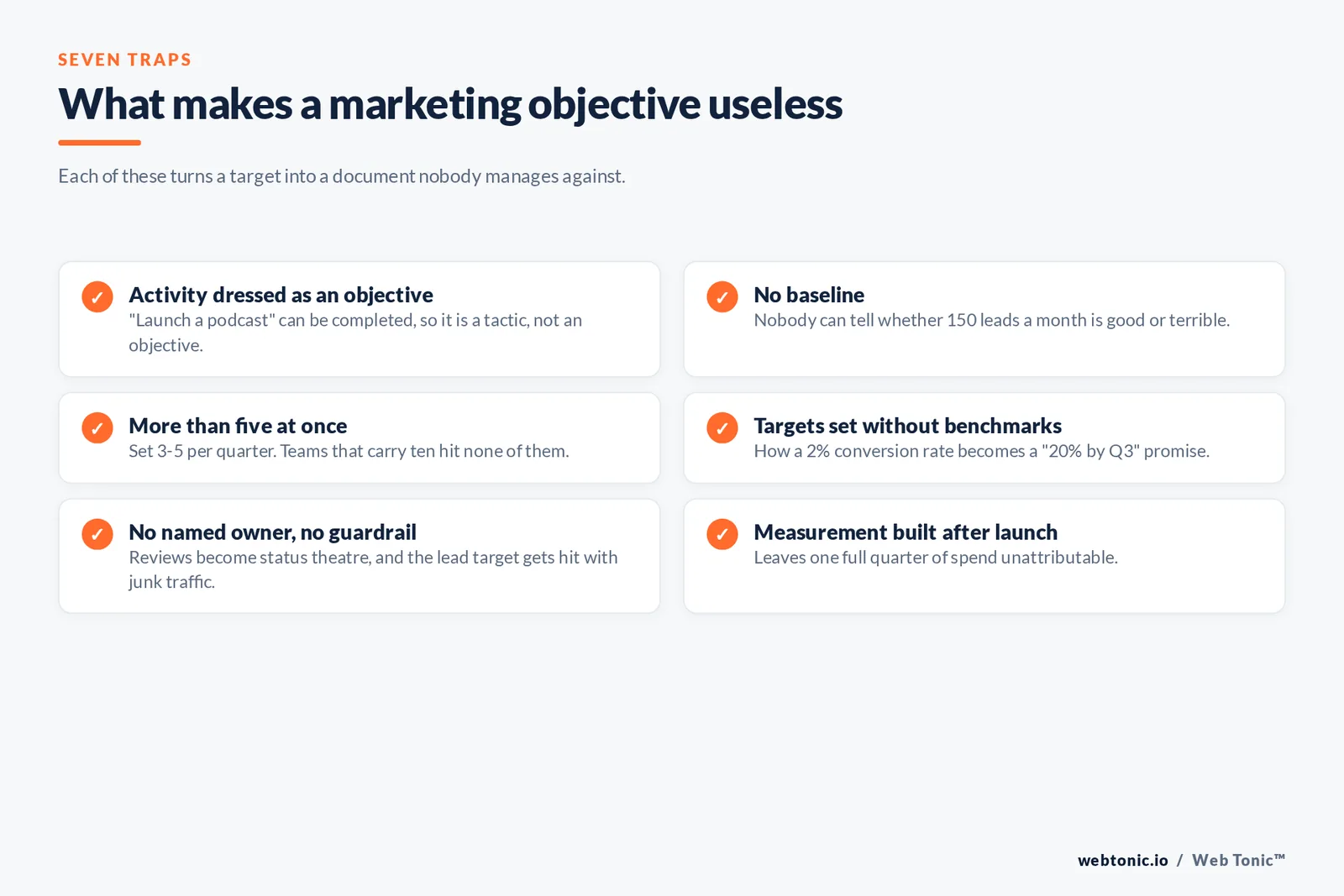
Seven traps that make objectives useless
Trap 1 — activity dressed as an objective ("launch a podcast"). Trap 2 — no baseline, so nobody can tell whether 150 leads a month is good. Trap 3 — carrying more than 5 objectives at once. Trap 4 — targets set without benchmarks, which is how a 2% conversion rate becomes a "20% by Q3" promise. Trap 5 — no owner, so review meetings become status theatre. Trap 6 — no guardrail, so the lead target is hit with unqualified traffic. Trap 7 — measurement built after launch, leaving 1 quarter of unattributable spend.
Fixing traps 2, 4 and 7 is mostly an instrumentation job, which is why our data intelligence work usually precedes any target-setting workshop. More planning walkthroughs sit on the Web Tonic blog, and if you want a second opinion on a draft objective set, get in touch.
FAQ
What are marketing objectives?
Marketing objectives are specific, measurable outcomes marketing commits to within a set timeframe — for example increasing qualified leads from 90 to 150 per month by the end of Q3 at a cost per lead under $180. Each one contains a metric, a baseline, a target and a deadline, and each supports a wider business goal.
What are the five main types of marketing objectives?
Most objective sets fall into five families: brand and product awareness, traffic and audience growth, lead generation, sales and revenue, and retention or customer lifetime value. Market share and expansion objectives are a sixth family used by larger or multi-market businesses.
How do marketing objectives differ from marketing goals?
Goals are directional and long-range ("become the leading provider in our region"). Objectives are the measurable, time-bound targets that prove you are getting there. In practice, one business goal supports two to four marketing objectives, each with its own KPI and owner.
What is an example of a SMART marketing objective?
"Increase non-branded organic sessions from 24,000 to 36,000 per month by 31 December, reviewed monthly, by publishing 12 service pages and 24 articles." It names the metric, baseline, target, deadline, review rhythm and the strategy that will move it.
How many marketing objectives should a business set?
Three to five per quarter, each with a single named owner. Fewer objectives with real resourcing beat a long list nobody can pace — and every objective should have one primary KPI plus no more than three supporting metrics.
How do I know whether a target is realistic?
Compare your baseline against external benchmarks before committing. US paid search averages a $5.42 cost per click, 6.64% click-through rate, 8.18% conversion rate and $66.69 cost per lead across 23 industries, so a target that implies double the benchmark conversion rate needs an explanation beyond optimism.
Sources
LocaliQ, Search Advertising Benchmarks (23 industries) · Statcounter GlobalStats, search engine market share, June 2026 · American Marketing Association · Chartered Institute of Marketing · US Small Business Administration, Marketing and Sales guide · Think with Google · Google Analytics Help, conversion events · HubSpot marketing statistics · Sprout Social social media statistics · Mailchimp email marketing benchmarks. Figures verified at time of publication; example baselines and targets are illustrative.