Table of contents
Marketing collateral is the set of branded assets a company uses to explain, prove and sell what it does — from a one-page case study to a product video, a pitch deck or a business card. Its job is to move a buyer one step further, not to look pretty.
Below: a working definition, 24 collateral types, which assets fit which stage, and a build order that stops teams producing files nobody uses.
Key Takeaways
- Marketing collateral is any asset — digital or physical — created to communicate value and support sales at a specific stage of the buyer journey.
- Only 16% of readers read a page word by word; 79% scan, so scannable layout beats dense prose in every piece of collateral.
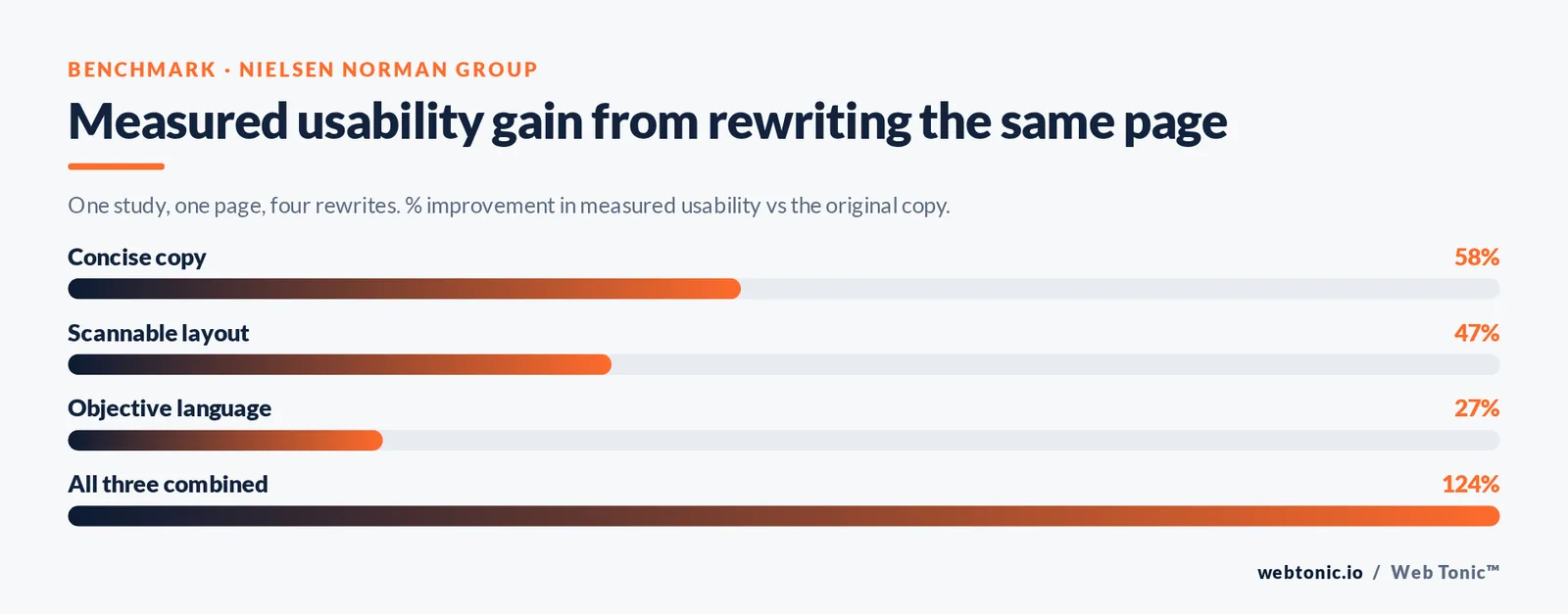
- Nielsen Norman Group measured 124% better usability when copy was concise, scannable and objective at the same time.
- 58% of B2B marketers credit content marketing with increased sales and revenue.
- Short-form video delivers the highest ROI of any video format (41%), and 76% of teams now publish at least one video a month.
- Nearly 40% of companies produce their video collateral for under $5,000 a year — budget is rarely the blocker.
- Social platforms drive over 60% of product discovery, which changes what your top-of-funnel collateral has to look like.
- Build in 7 steps, and govern with one asset library — collateral sprawl, not collateral scarcity, is the usual problem.
What marketing collateral is (and is not)
Marketing collateral refers to the collection of media, documents and designed assets a business uses to promote its products or services, communicate brand messaging and help sales teams convert potential customers. It spans digital collateral such as blog posts, case studies, white papers and landing pages, and physical collateral such as brochures, business cards and trade-show banners.
Two distinctions matter. Collateral is not the same as content marketing: content marketing is a strategy for attracting an audience, while collateral is the inventory of assets that strategy — and your sales process — draws on. And collateral is not brand identity: your logo, palette and type system are the rules; collateral is what gets built with them.
| Concept | What it is | Owner | Example |
|---|---|---|---|
| Brand identity | The rules: logo, colour, type, voice | Brand / design | Brand guidelines PDF |
| Content marketing | The strategy for attracting a target audience | Marketing | Editorial calendar |
| Marketing collateral | The assets built to communicate and convert | Marketing + sales | Case study, one-pager, deck |
| Sales enablement | Getting the right asset to the rep at the right moment | Sales ops | Battlecard in the CRM |
| Digital asset management | Where collateral lives, versioned and findable | Marketing ops | DAM library or shared drive |
The reason to be strict about this is measurement. A blog post is judged on traffic and rankings; a case study is judged on whether deals that saw it close faster. If everything is filed as "content", nothing is accountable.
24 types of marketing collateral, digital and physical
Most companies own more asset types than they realise and fewer of the ones that actually close deals. Here is the full inventory, grouped by what each piece is for.
| Type | Format | Primary job | Best used |
|---|---|---|---|
| 1. Blog posts | Digital | Attract search demand | Awareness |
| 2. Pillar guides | Digital | Own a topic end to end | Awareness |
| 3. Case studies | Both | Prove results with named clients | Decision |
| 4. White papers | Digital PDF | Establish expertise, capture leads | Consideration |
| 5. Ebooks | Digital PDF | Trade depth for contact details | Consideration |
| 6. One-pagers | Both | Answer "what is this" in 30 seconds | Consideration |
| 7. Pitch decks | Digital | Structure the sales conversation | Decision |
| 8. Product sheets | Both | Specs, tiers, compatibility | Decision |
| 9. Battlecards | Digital | Handle competitor objections | Decision |
| 10. Landing pages | Digital | Convert a single campaign promise | All stages |
| 11. Email sequences | Digital | Nurture at the buyer's pace | Consideration |
| 12. Product videos | Digital | Show, rather than claim | Consideration |
| 13. Testimonial videos | Digital | Borrow a customer's credibility | Decision |
| 14. Short-form social video | Digital | Reach cold audiences | Awareness |
| 15. Social media graphics | Digital | Repeat the message cheaply | Awareness |
| 16. Infographics | Both | Make data shareable | Awareness |
| 17. Webinars | Digital | Demonstrate expertise live | Consideration |
| 18. Newsletters | Digital | Stay present between buying cycles | Retention |
| 19. UGC and reviews | Digital | Third-party proof at scale | Decision |
| 20. Brochures | Physical | Leave something behind | Consideration |
| 21. Business cards | Physical | Make the follow-up possible | Awareness |
| 22. Trade-show banners | Physical | Be legible from ten metres | Awareness |
| 23. Packaging inserts | Physical | Drive reorders and reviews | Retention |
| 24. Onboarding kits | Both | Reduce churn in month one | Retention |
Two patterns show up in almost every audit we run. Companies over-produce awareness collateral — blog posts and social graphics — and under-produce the four assets that actually shorten deals: case studies, one-pagers, battlecards and testimonial videos. And physical collateral is either neglected entirely or printed in quantities nobody will ever hand out.
Mapping collateral to the buyer journey
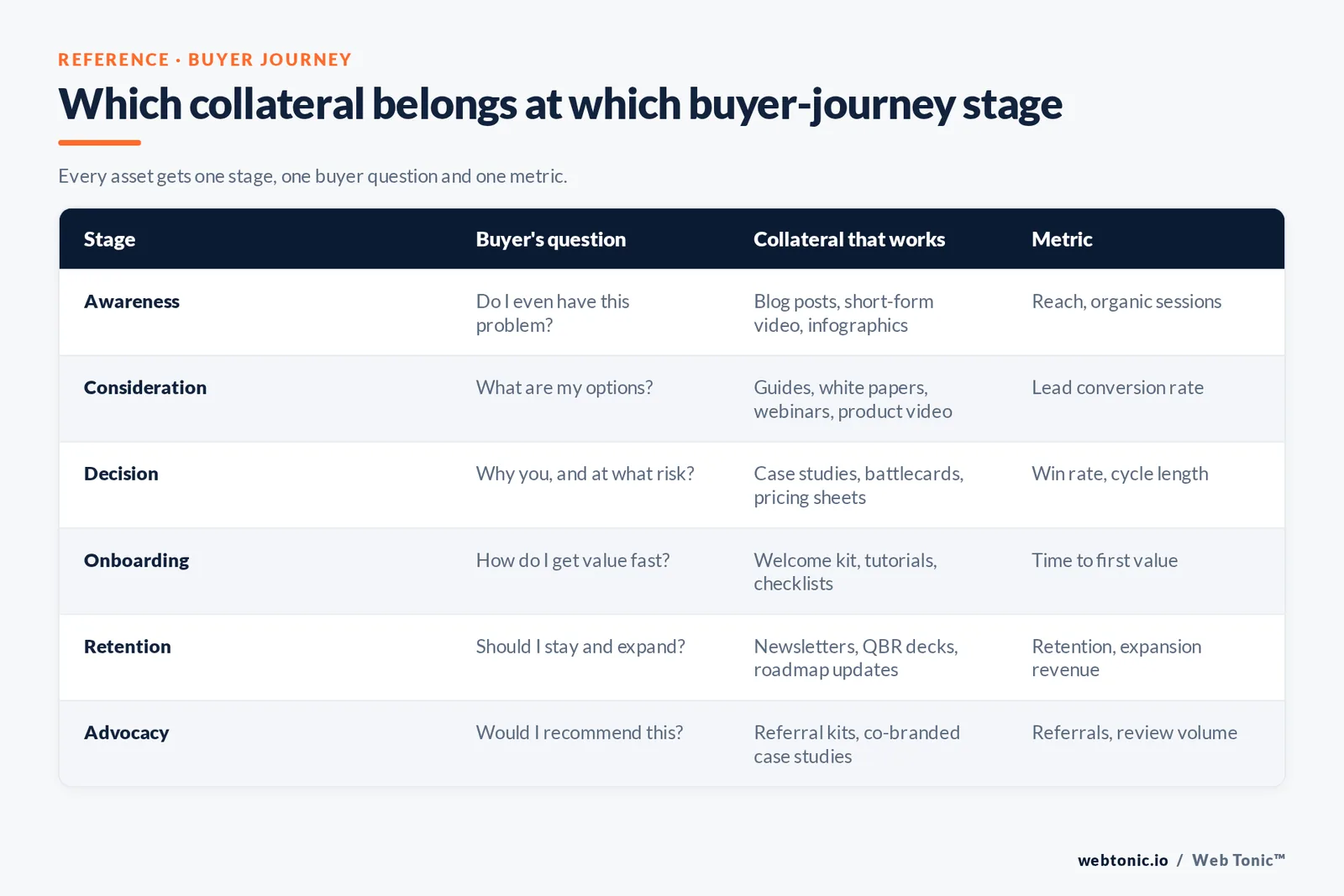
Collateral fails most often because it is technically good and situationally wrong: a 30-page white paper sent to someone who asked for pricing. Map every asset to a stage and a question, and the gaps become obvious.
| Stage | Buyer's question | Collateral that works | Metric |
|---|---|---|---|
| Awareness | Do I even have this problem? | Blog posts, short-form video, infographics | Reach, organic sessions |
| Consideration | What are my options? | Guides, white papers, webinars, product video | Lead conversion rate |
| Decision | Why you, and at what risk? | Case studies, battlecards, pricing sheets | Win rate, cycle length |
| Onboarding | How do I get value fast? | Welcome kit, tutorials, checklists | Time to first value |
| Retention | Should I stay and expand? | Newsletters, QBR decks, roadmap updates | Retention, expansion revenue |
| Advocacy | Would I recommend this? | Referral kits, co-branded case studies | Referrals, review volume |
The channel mix decides how awareness collateral should be shaped. Sprout Social reports that YouTube, TikTok and Instagram together drive over 60% of product discovery, that short-form video returns the highest ROI of any format at 41%, and that total social ad spend is on track for $317.33 billion in 2026. Collateral designed for a desktop PDF reader is simply not competing in that environment. Meanwhile HubSpot's data shows 63% of consumers prefer to research brands on mobile, and average ecommerce conversion sits under 2% — which puts the burden squarely on decision-stage collateral to do the persuading.
What makes marketing collateral effective
Effective collateral obeys reader behaviour rather than internal preference. Nielsen Norman Group's reading research found that 79% of users scan any new page and only 16% read word for word. Rewriting the same page concisely improved measured usability by 58%, a scannable layout by 47%, objective rather than boastful language by 27%, and all three combined by 124%. That single study is a design brief for every one-pager you will ever make.
Format choice matters just as much. NN/g has argued for years that PDFs are poor for online reading — which is why the strongest modern pattern is a web page as the primary asset with a PDF export for the meeting, not a PDF that someone has to download to learn anything.
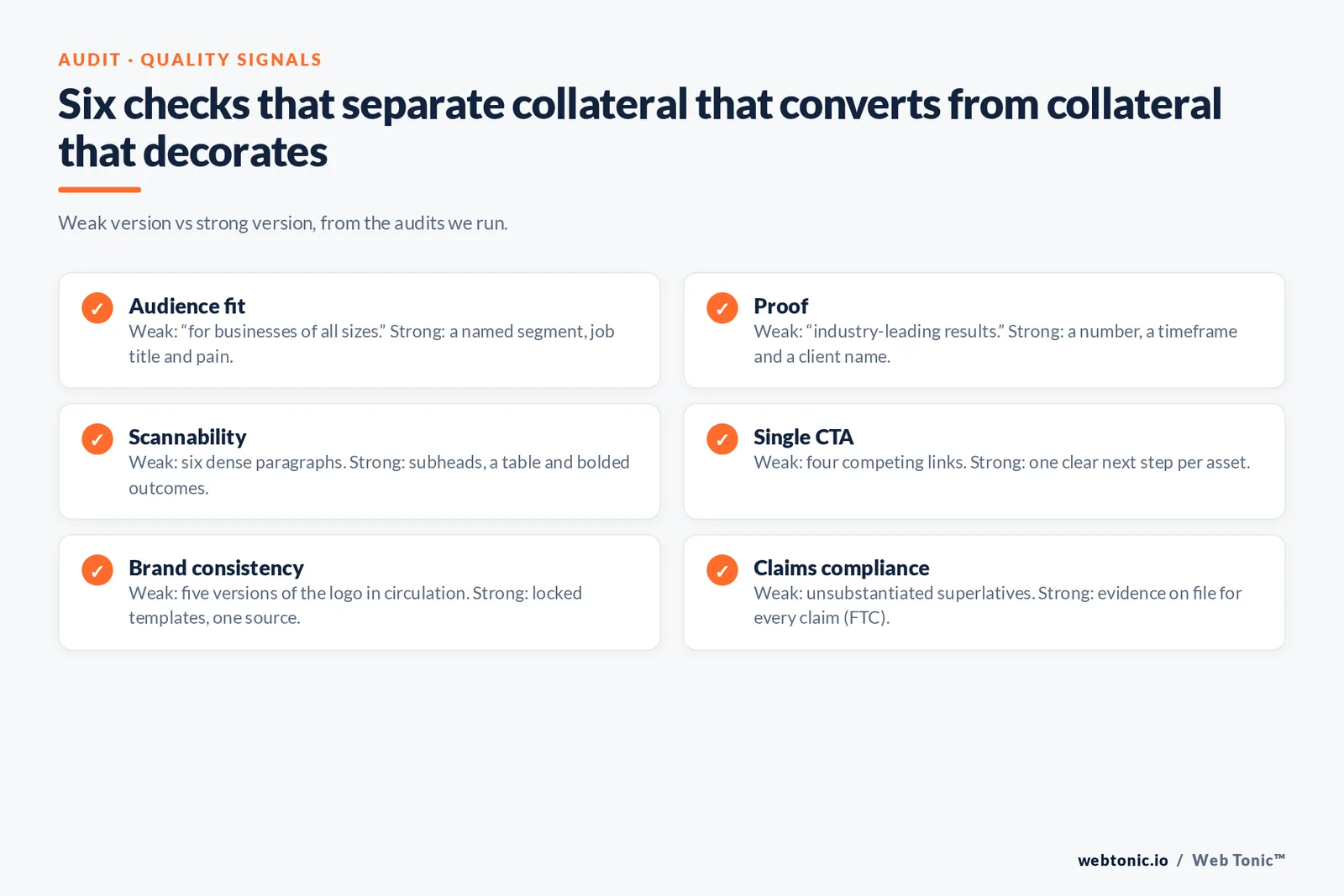
| Quality signal | Weak version | Strong version |
|---|---|---|
| Audience fit | "For businesses of all sizes" | Named segment, named job title, named pain |
| Proof | "Industry-leading results" | A number, a timeframe and a client name |
| Scannability | Six dense paragraphs | Subheads, a table, bolded outcomes |
| Single CTA | Four competing links | One clear next step per asset |
| Brand consistency | Five versions of the logo in circulation | Locked templates, one asset source |
| Accessibility | Text baked into images | Real text, alt text, contrast checked |
| Claims compliance | Unsubstantiated superlatives | Evidence on file for every claim |
The last row is not optional. The FTC's advertising guidance requires that objective claims be substantiated before they are published — which applies to a printed brochure and a paid social ad equally.
How to create marketing collateral in 7 steps
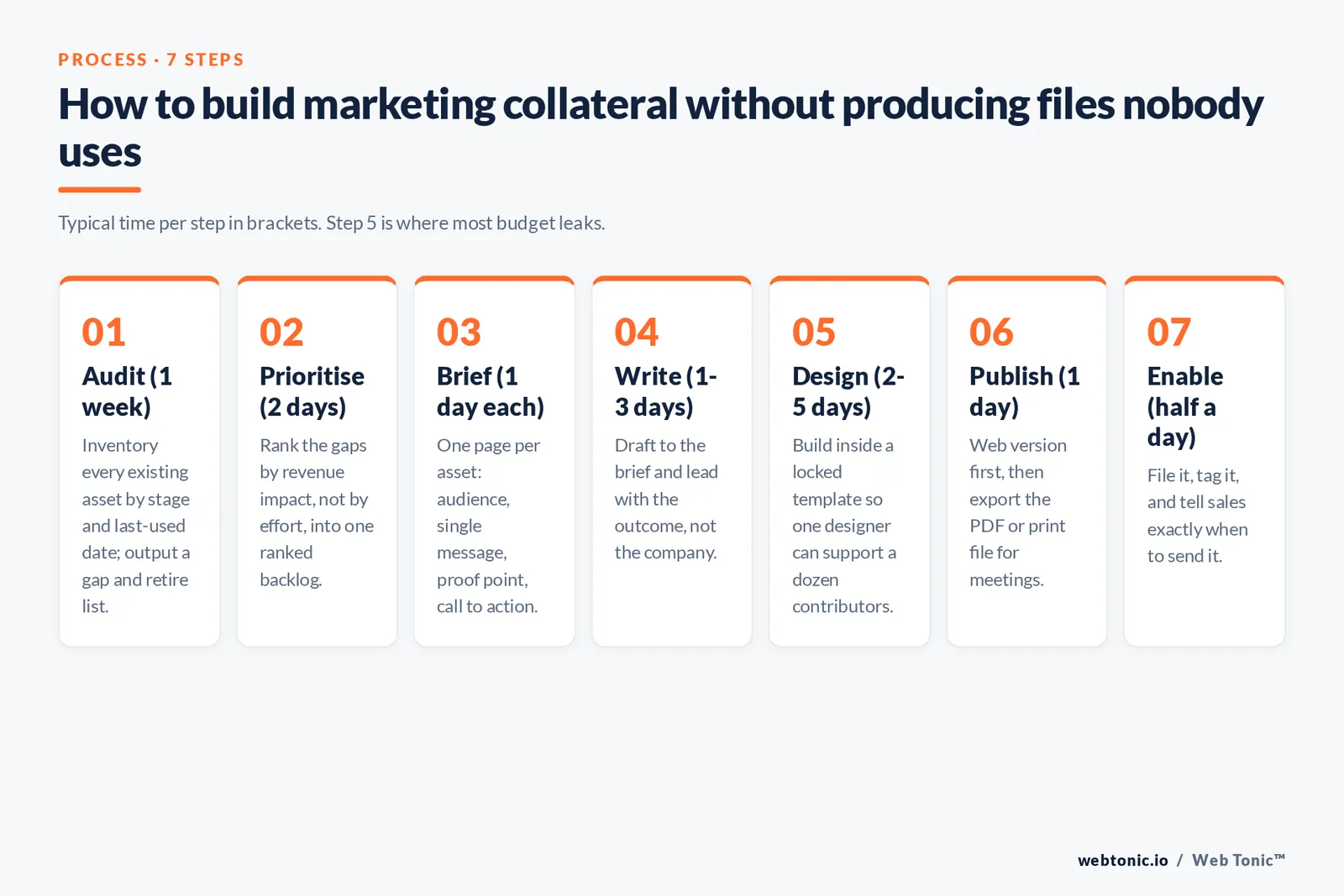
Creating marketing collateral works best as a repeatable process rather than a series of one-off requests. This is the sequence we use with clients.
| Step | What you do | Output | Typical time |
|---|---|---|---|
| 1. Audit | Inventory existing assets by stage and last-used date | Gap and retire list | 1 week |
| 2. Prioritise | Rank gaps by revenue impact, not by effort | Ranked backlog | 2 days |
| 3. Brief | Define audience, single message, proof, CTA | One-page brief per asset | 1 day each |
| 4. Write | Draft to the brief; lead with the outcome | Copy doc | 1–3 days |
| 5. Design | Build in a locked template, not from scratch | Designed asset + source file | 2–5 days |
| 6. Publish | Web version first, then PDF or print export | Live asset and export | 1 day |
| 7. Enable | File it, tag it, train sales on when to send it | Library entry + usage note | Half a day |
Step 5 is where most budget leaks. Templates in a design system — or in a tool the whole team already uses, such as Canva or your brand's Figma library — let one designer support a dozen contributors. It also removes the most common brand failure: six people producing six slightly different versions of the same product sheet.
Video collateral is more affordable than teams assume. Wistia's annual research found nearly 40% of companies spent under $5,000 producing video last year, that 76% now publish at least one video a month, and that planned testimonial-video production climbed from 17% of companies in 2023 to 47% this year. If your decision-stage collateral is text only, the gap is a schedule problem, not a budget one.
Governing collateral: digital asset management and version control
The second year of any collateral programme is about governance, not production. Assets multiply, owners leave, and reps end up emailing a 2023 pricing sheet. A digital asset management layer fixes that — whether that is a dedicated platform like Bynder or Brandfolder, or a disciplined shared drive with version history for smaller teams.
| Governance rule | Why it matters | How to enforce it |
|---|---|---|
| One source of truth | Kills stale versions in inboxes | Share links, never files |
| Naming convention | Assets get found in seconds | type_audience_topic_version_date |
| Review date on every asset | Prevents outdated claims and pricing | Quarterly review queue |
| Locked templates | Protects brand consistency at scale | Editable text, locked layout |
| Usage tracking | Shows what sales actually sends | Link tracking or CRM attachment data |
| Retire list | Less clutter, faster search | Archive anything unused for 12 months |
Measuring whether collateral earns its keep
Every asset should have one metric attached before it is briefed. Content-level metrics tell you whether an asset is read; commercial metrics tell you whether it works. Semrush's research round-up cites Content Marketing Institute data showing 58% of B2B marketers saw increased sales and revenue from content marketing, and notes that 41% of marketers still call email their most effective tool — a reminder that distribution, not just creation, decides collateral ROI. Practitioner analysis at the Content Marketing Institute and the B2B Institute is worth reading alongside it for the brand-versus-activation balance.
| Asset | Leading metric | Commercial metric | Review cadence |
|---|---|---|---|
| Blog post / guide | Organic sessions, rankings | Assisted pipeline | Monthly |
| White paper / ebook | Download conversion rate | MQL-to-SQL rate | Quarterly |
| Case study | Views in late-stage deals | Win rate, cycle length | Quarterly |
| Product video | Watch-through rate | Demo requests | Monthly |
| Landing page | Conversion rate | Cost per acquisition | Weekly |
| Sales one-pager | Send frequency by rep | Stage progression rate | Quarterly |
A collateral set that nobody measures becomes a folder of PDFs. One that is reviewed quarterly becomes an asset that compounds — and it is the fastest way to find the three pieces doing 80% of the work so you can make five more like them. If you want an outside audit of your current set, our growth marketing team runs exactly that exercise, and our data intelligence practice wires the usage tracking behind it.
FAQ
What is marketing collateral and why is it important?
Marketing collateral is the set of branded digital and physical assets a company uses to explain its products or services, build brand awareness and support the sales process. It matters because buyers rarely decide from a single conversation: they read, forward and compare. Collateral is what represents you when nobody from your team is in the room.
What are the most common types of marketing collateral?
Blog posts, case studies, white papers, ebooks, one-pagers, pitch decks, product sheets, landing pages, email sequences, product and testimonial videos, social graphics, infographics, webinars, brochures and business cards. Most B2B teams get the largest return from case studies, one-pagers and battlecards, because those are the assets that shorten decision-stage conversations.
What is the difference between digital and physical marketing collateral?
Digital collateral — pages, PDFs, video, email — is measurable, updatable and cheap to distribute. Physical collateral — brochures, cards, banners, packaging inserts — is memorable and works in rooms and at events where screens do not. Print in small batches, and always point print back to a digital destination you can track.
How do I create effective marketing collateral for my brand?
Audit what exists, rank the gaps by revenue impact, write a one-page brief per asset naming the audience, single message, proof point and call to action, then build inside locked brand templates. Publish a web version first and export a PDF for meetings. Finish by filing the asset properly and telling sales when to use it.
How much marketing collateral does a company actually need?
Fewer, better pieces. One strong asset per buyer-journey stage per core segment covers most companies: roughly six to ten assets, kept current, beats fifty stale files. Add new pieces only when a real gap blocks a real conversation.
Who should own marketing collateral internally?
Marketing owns creation and brand consistency; sales owns feedback on what converts; marketing ops owns the asset library, naming and review dates. Without that third role, collateral quality decays quietly as versions multiply.
Turning collateral into a system
The companies with the best marketing collateral are rarely the ones producing the most. They keep a short inventory mapped to buyer stages, they write for scanners, they prove claims with numbers, they build in templates, and they retire anything untouched for a year. Start with an audit and a single case study rebuilt properly — the pattern will teach you more than a quarter of new production. More frameworks live on the Web Tonic blog, and if you would rather have it built for you, get in touch.
Sources: Nielsen Norman Group (how users read on the web; PDF usability) · HubSpot marketing statistics · Sprout Social social media statistics · Semrush content marketing statistics · Content Marketing Institute · LinkedIn B2B Institute · Wistia video marketing statistics · FTC advertising FAQs · Google Drive version history · Bynder · Brandfolder. Figures verified against the cited pages in 2026.