



Table of contents

A marketing audit answers whether the money you already spend is working. A hire adds capacity to spend more of it. Buying the second before the first is how budgets grow while results do not.
Key Takeaways
- Published market rates put a single-channel marketing audit at roughly $2,500–$7,500 and a full multi-channel review at $8,000–$25,000, against a fully loaded mid-level marketing hire at $157,000–$221,000 a year.
- The two purchases answer different questions. An audit buys a diagnosis; a hire buys ongoing capacity. Only one of them tells you what the capacity should do.
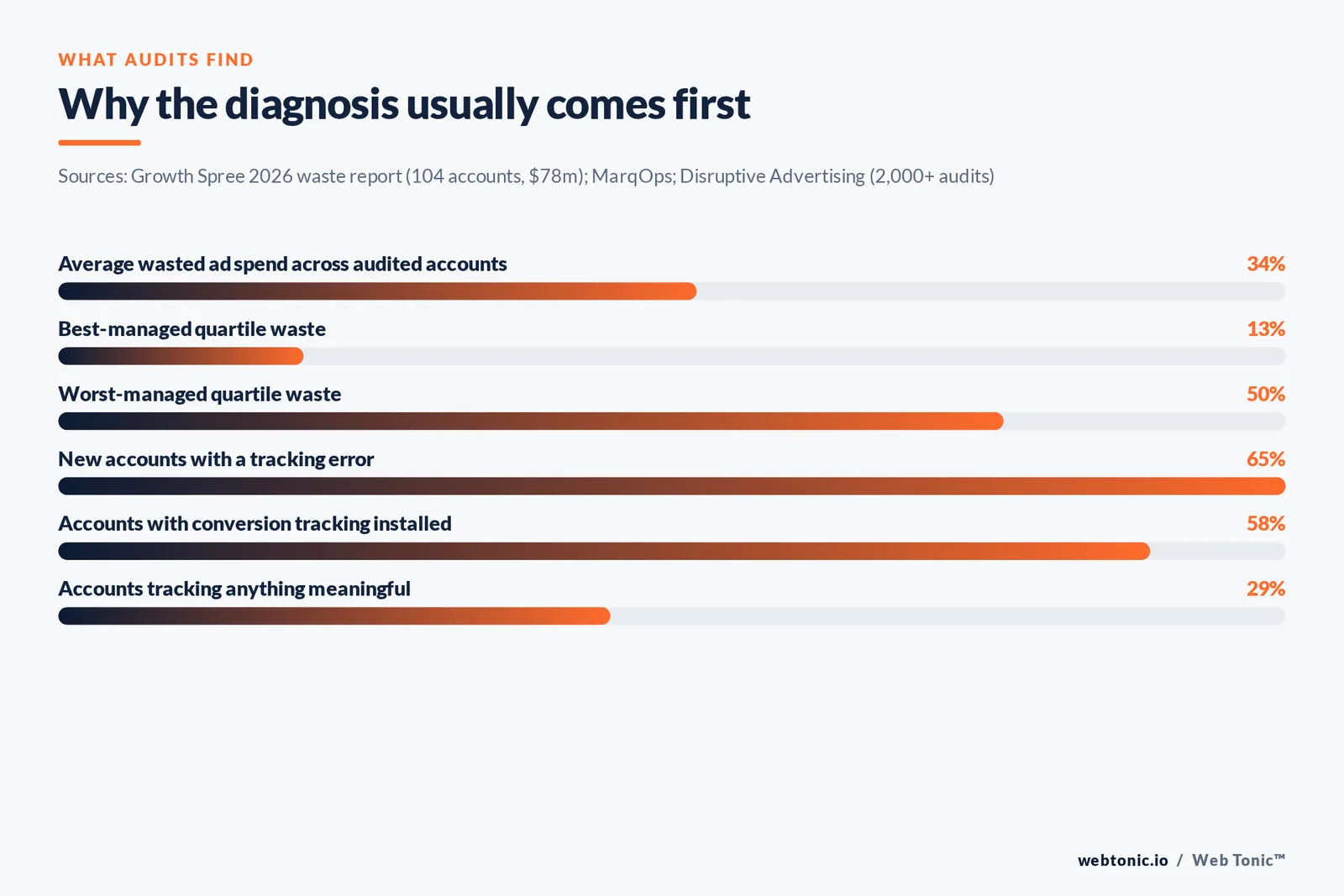
- Waste is measurable and large: one 2026 study of 104 B2B Google Ads accounts and $78m of spend found average waste of 34%, with the worst-managed quartile at 49.8%.
- Measurement is usually broken before strategy is. Practitioner audits report tracking errors in 60–70% of new accounts, and an analysis of 2,000+ account audits found only 29% were tracking conversions usefully.
- Time-to-answer differs by a quarter or more. Average time-to-hire is around 50 days before ramp; an audit produces written findings in 7–30 days.
- The honest sequence for most companies under $100,000 a month in spend: audit, fix, then hire against a written mandate.
- An audit is not a substitute for a team. If your problem is that nothing ships, more diagnosis will not ship it.
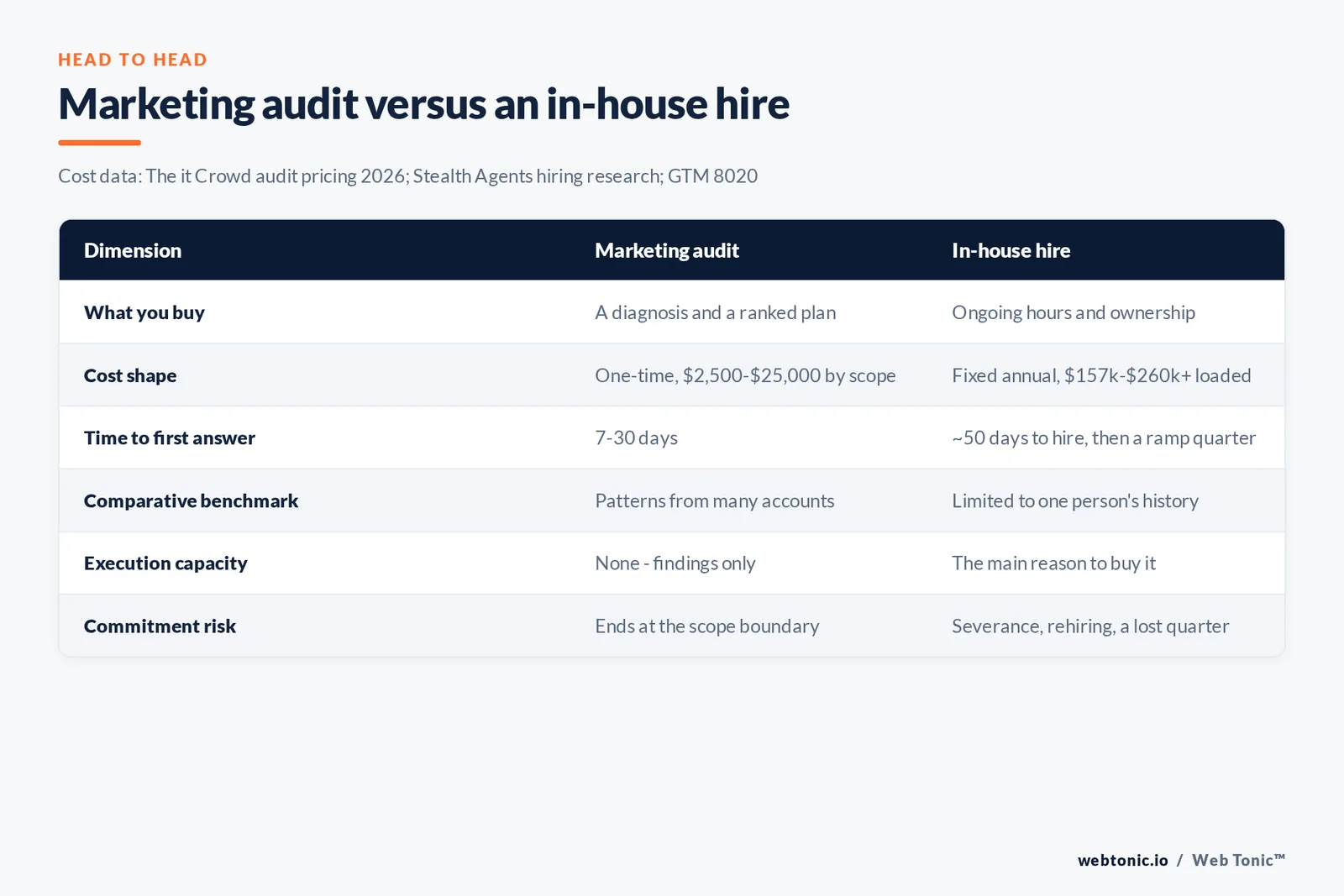
The two purchases are not competing for the same job
Companies put an audit and a hire on the same budget line because both are described as "fixing marketing". They fix different things. A growth audit is a time-boxed diagnostic: someone senior examines tracking, spend, channels, funnel and positioning, then hands you ranked findings and a plan. A hire is a permanent addition of hours, ownership and institutional memory.
The failure mode is predictable. A company that cannot say which channel produces qualified pipeline hires a marketing manager to find out, and the new employee spends their first two quarters doing an unstructured audit on a salary — without the comparative benchmark an outside reviewer brings from other accounts. HubSpot's audit guidance makes the benchmarking point well: a 3% conversion rate reads as acceptable in isolation and reads as a problem when a direct competitor converts at 7%. Context is the product an audit sells.
The reverse failure is just as expensive. A company with a clear plan, a good measurement stack and no hands buys a second audit instead of delivery capacity, then wonders why the same recommendations appear twice.
| Dimension | Marketing audit | In-house hire |
|---|---|---|
| What you buy | A diagnosis and a ranked plan | Ongoing hours and ownership |
| Cost shape | One-time, $2,500–$25,000 by scope | Fixed annual, $157k–$260k+ loaded |
| Time to first answer | 7–30 days | ~50 days to hire, then a ramp quarter |
| Comparative benchmark | Yes — patterns from many accounts | Limited to that person's history |
| Execution capacity | None — findings only | The main reason to buy it |
| Commitment risk | Ends at the scope boundary | Severance, rehiring, a lost quarter |
| Best when | You cannot explain last quarter's results | The plan exists and nothing ships |
What each option costs in 2026
Audit pricing is public and reasonably consistent across providers. One 2026 pricing breakdown puts a single-channel review — paid media only, or SEO only — at $2,500–$7,500, and a comprehensive multi-channel audit covering paid, organic, email and creative at $8,000–$25,000 or more. A second pricing survey describes three tiers — basic $1,000–$3,000, mid-level $3,000–$7,000, comprehensive $7,000–$15,000+. Agency cost benchmarks price a technical SEO audit alone at $1,500–$5,000 for small-business scope. Treat any single number cautiously and the overlap as the real market: low four figures for one channel, five figures for everything.
The hire side is heavier than most budgets assume. 2026 hiring research puts a mid-level in-house marketing manager at $157,000–$221,000 a year all-in and a senior hire at $185,000–$260,000. A separate cost analysis puts base salary at $72,000–$142,720, a fully loaded cost of $110,000–$155,000, recruiting at about $4,700 per hire and average time-to-hire near 50 days. For leadership, 2026 comparison data shows VP-level bases of $160,000–$220,000 in small and mid-market companies and $180,000–$260,000+ at the top of the range.
Put plainly: a comprehensive audit costs a few weeks of a senior hire's fully loaded salary. That ratio is the whole argument for sequencing.
What the audit usually finds — and why that matters to the hiring decision
The reason an audit tends to pay for itself is that the same defects appear again and again, and most of them are invisible from inside the account. A 2026 waste report covering 104 B2B accounts and $78m of spend measured average waste of 34% — roughly $255,000 per account — and, more usefully, a spread from 13.2% in the best-managed quartile to 49.8% in the worst. Broader analysis of wasted marketing spend reaches the same conclusion from a different angle: the waste is structural and it is maintained, not a one-off bad quarter.
Measurement is usually the first thing to break. Practitioner audit data reports a conversion tracking error in roughly 60–70% of newly reviewed accounts, with 73% of failures clustering into five repeatable categories. An analysis of more than 2,000 account audits found 57.7% of accounts had conversion tracking installed and only about half of those were tracking anything meaningful — so roughly 29% of accounts could actually tell whether campaigns worked.
That matters for hiring because a new employee inherits those numbers as truth. Hand a capable marketing manager a reporting stack that overstates conversions two-fold and they will optimise confidently in the wrong direction for a quarter, and their performance review will be written from the same broken data.
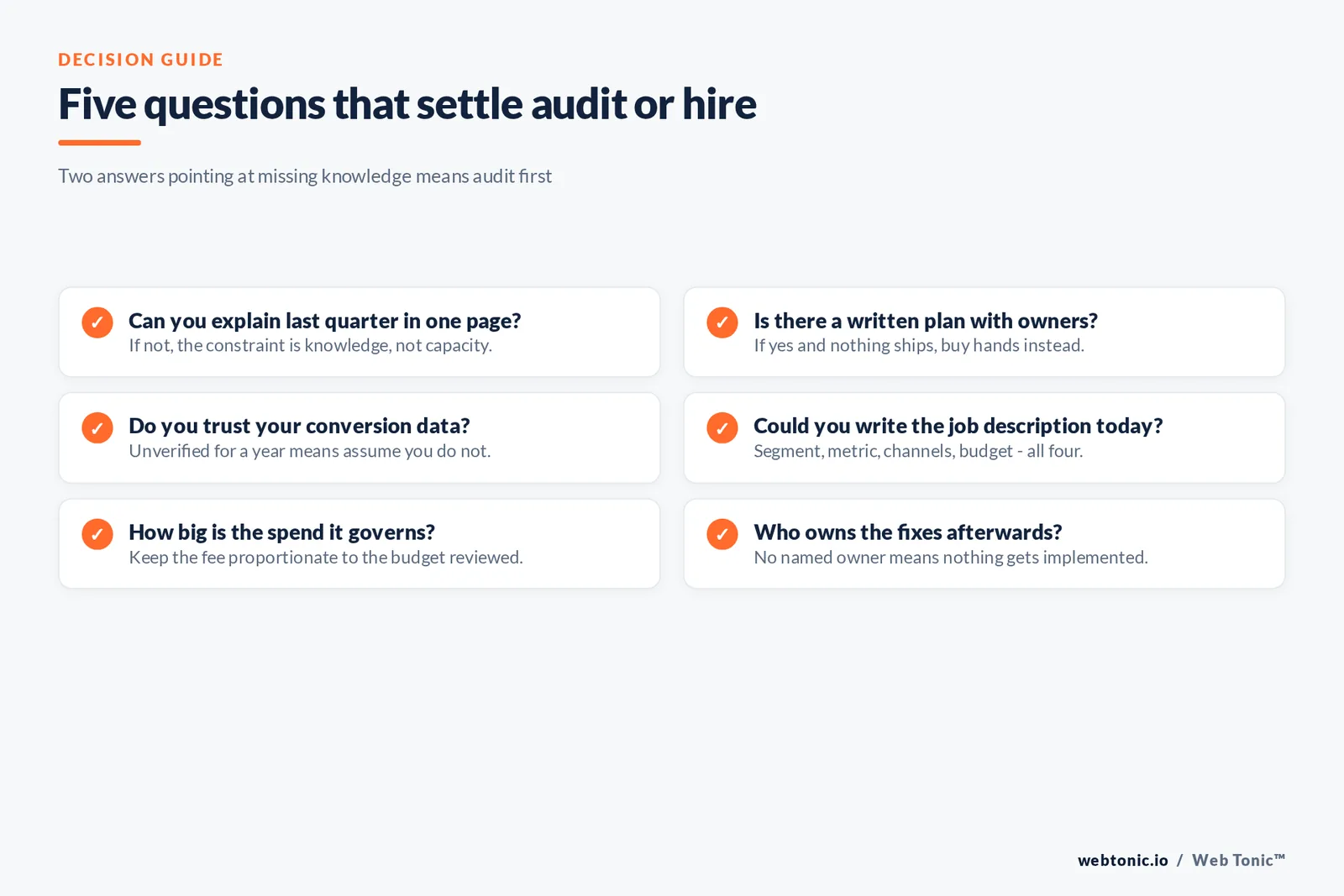
The five questions that settle it
- Can you explain last quarter's results in one page? If not, the constraint is knowledge, not capacity. Audit first.
- Is there a written plan with owners? If yes, and nothing is shipping, the constraint is hands. Hire, or buy delivery.
- Do you trust your conversion data? If nobody has verified the tag setup in twelve months, assume you do not — and fix that before you judge any channel or any person.
- Could you write the job description today? The segment, the metric, the funded channels and the budget. If those four lines do not exist, an audit will write them and your posting will attract the right candidates.
- How large is the spend the decision governs? A five-figure audit against $60,000 of annual spend is out of proportion; the same audit against $1m is rounding error. Buy the scope that fits the budget.
Two or more answers pointing at missing knowledge means audit first. Two or more pointing at missing hands means hire, and scope the audit narrowly around whichever channel you are least able to explain.
| Situation | Recommended move | Reasoning |
|---|---|---|
| Spend rising, results flat | Audit first | Waste of 20–40% is the base rate, not the exception |
| No trusted reporting | Measurement audit before anything | Every later decision inherits the same error |
| Clear plan, no execution | Hire or buy delivery | Another diagnosis changes nothing |
| Marketing lead just left | Audit during the search | Gives the successor a mandate on day one |
| Board or investor pressure | Audit, then decide | Ranked findings survive scrutiny; a hire announcement does not |
| Under $10k monthly spend | Narrow single-channel audit | Keep the fee proportionate to the budget reviewed |
Sequencing the two so neither is wasted
Where the budget allows both, order does most of the work. Run the audit first and require that it ends in artefacts, not adjectives: a findings list with severity and evidence, a 90-day plan with owners, and a corrected measurement baseline. Audit methodology guidance lists the components that make this usable — channel grades, messaging assessment, stack review, analytics and attribution gaps, competitive comparison, and a 90-day action plan with owners and dates.
Then recruit against the plan. The job description stops being "own growth marketing" and becomes "own paid acquisition for segment B, hit cost per qualified opportunity of X, ship the six fixes ranked critical in the audit". Candidates self-select accurately, interviews get concrete, and the person you hire spends month one executing instead of diagnosing.
Keep one guardrail: the audit must hand over to a named internal owner. Scored audit templates work well here because the same 0–5 scoring can be re-run each quarter by your own team, which turns a one-off document into a repeatable review your new hire inherits and maintains.
When the audit is the wrong purchase
An audit is diagnosis, and diagnosis has limits. Do not buy one if you already have a recent, credible review that has not been implemented — the honest move there is to fund implementation. Audit KPI benchmarks track recommendation implementation rate as a first-class metric for exactly this reason: implemented recommendations divided by total recommendations is the number that separates a useful audit from an expensive PDF.
Do not buy one to settle an internal argument you have already lost politically. If a decision-maker has pre-committed to a channel or an agency, ranked findings will not move them and the report becomes ammunition rather than a plan.
And do not buy one instead of the leadership hire you actually need. Where the gap is continuous senior judgement — quarterly planning, team development, cross-functional negotiation — a fractional or full-time leader is the right instrument. An audit informs that person; it does not replace them.
What the audit covers that one hire cannot
Scope is the other asymmetry. A comprehensive review looks across the whole digital estate in one pass — website and landing page experience, SEO and content, paid campaigns, email and lifecycle, social, analytics and the customer journey between them — and reports where the gaps sit relative to competitors. One new employee, however capable, brings depth in two or three of those areas and learns the rest on your budget.
That breadth is why a checklist-driven audit tends to surface cross-channel problems first: a brand promise on the website that the paid campaigns contradict, a lead generation form that quietly fails on mobile, an email programme with no owner, or analytics that cannot connect a campaign to revenue. These are the areas where small teams lose the most money and where an outside review has the clearest advantage, because it compares your setup against many others rather than against last year's version of itself.
Use that to your advantage when you do hire. An audit tells you which skills to buy first — content and web development, or paid campaign management, or analytics — instead of defaulting to a generalist marketing manager and hoping the gaps overlap with their strengths. Companies that recruit against a documented gap list interview better candidates and give the successful one a clear focus in week one.
The cost of delay, in numbers you can check
Both options have a clock. On the hiring side, roughly 50 days to hire plus a ramp quarter means a decision made in January is producing confident direction around midyear. On the audit side, the delay cost is easier to size: apply the observed waste range to your own spend. At $50,000 a month and the 34% average from the 104-account study, an extra quarter of unexamined spend is a material number; even the best-managed quartile figure of 13.2% is not zero.
There is a recovery side too. 2026 server-side tracking benchmarks report recovery of 20–40% of previously lost conversions in typical e-commerce implementations — not new demand, just demand you can finally see and bid on. That is the kind of finding a measurement audit surfaces in days and an unbriefed new hire may never look for.
None of this makes an audit automatically the better buy. It makes the order defensible: understand the spend, fix what is measurably broken, then add the capacity to scale what remains.

Related reading
- Marketing Operations Consulting / RevOps: vs hiring in-house
- Marketing Team Structure & Hiring Advisory: vs hiring in-house
- Marketing Strategy Consulting: vs hiring in-house
- Marketing Strategy Consulting services at Web Tonic
Frequently Asked Questions
Is a marketing audit cheaper than hiring?
Yes, by an order of magnitude, but they are not interchangeable. Published audit ranges run from about $2,500 for one channel to $25,000 for a full multi-channel review, against $157,000–$260,000 a year fully loaded for a mid-level to senior hire. The audit buys a diagnosis; the hire buys capacity.
Can our own team run the audit instead?
Partly. Internal teams can score their own stack against a published template and should do so quarterly. What they cannot supply is the cross-account benchmark and the absence of internal history to defend, which is where most uncomfortable findings come from.
How long does a marketing audit take?
A focused single-channel review runs in about a week. A full multi-channel audit covering measurement, paid, organic, funnel and positioning typically runs two to four weeks depending on data access. Slow audits are usually waiting on account permissions.
What should the audit actually deliver?
Ranked findings with evidence and severity, a corrected measurement baseline, a 90-day plan where every action names an owner and an acceptance test, and a competitive comparison. If the deliverable is a slide deck of observations with no owners, it will not be implemented.
We just hired someone. Is an audit now a vote of no confidence?
Handled openly, it is the opposite. Give the new hire the audit as a resource and let them shape the scope: it hands them a verified baseline, a ranked backlog and the political cover of external evidence for the fixes they were going to propose anyway.
Where to take this next
If you cannot yet explain last quarter in one page, buy the diagnosis before the capacity. Our marketing audit ends in ranked findings and a 90-day plan with owners, data intelligence repairs the measurement layer the findings depend on, growth marketing executes the plan, the full services lineup covers delivery, and the blog has more method detail. If you are weighing an audit against a hire this quarter, talk it through with us.
Sources
The it Crowd — What a Marketing Audit Actually Costs
Ryan Spelts — Understanding Marketing Audit Pricing
Searchlab — Marketing Agency Cost: 2026 Reality Check
Stealth Agents — Cost of Hiring a Marketing Manager in 2026
GTM 8020 — Marketing Manager Cost Breakdown
AgencyRadar — In-House Marketing Hire vs Agency (2026)
Growth Spree — B2B Google Ads Waste Report 2026
Improvado — Wasted Marketing Spend
MarqOps — Google Ads Conversion Tracking: The 2026 Audit Method
Disruptive Advertising — Lessons from 2,000+ Account Audits
HubSpot — What's a Marketing Audit?
MarkCMO — How to Run a Marketing Audit
Sivon HQ — Marketing Audit Template
KPI Depot — Process Audit KPI Benchmarks
SignalBridge — 2026 Server-Side Tracking Benchmark Report


