



Table of contents

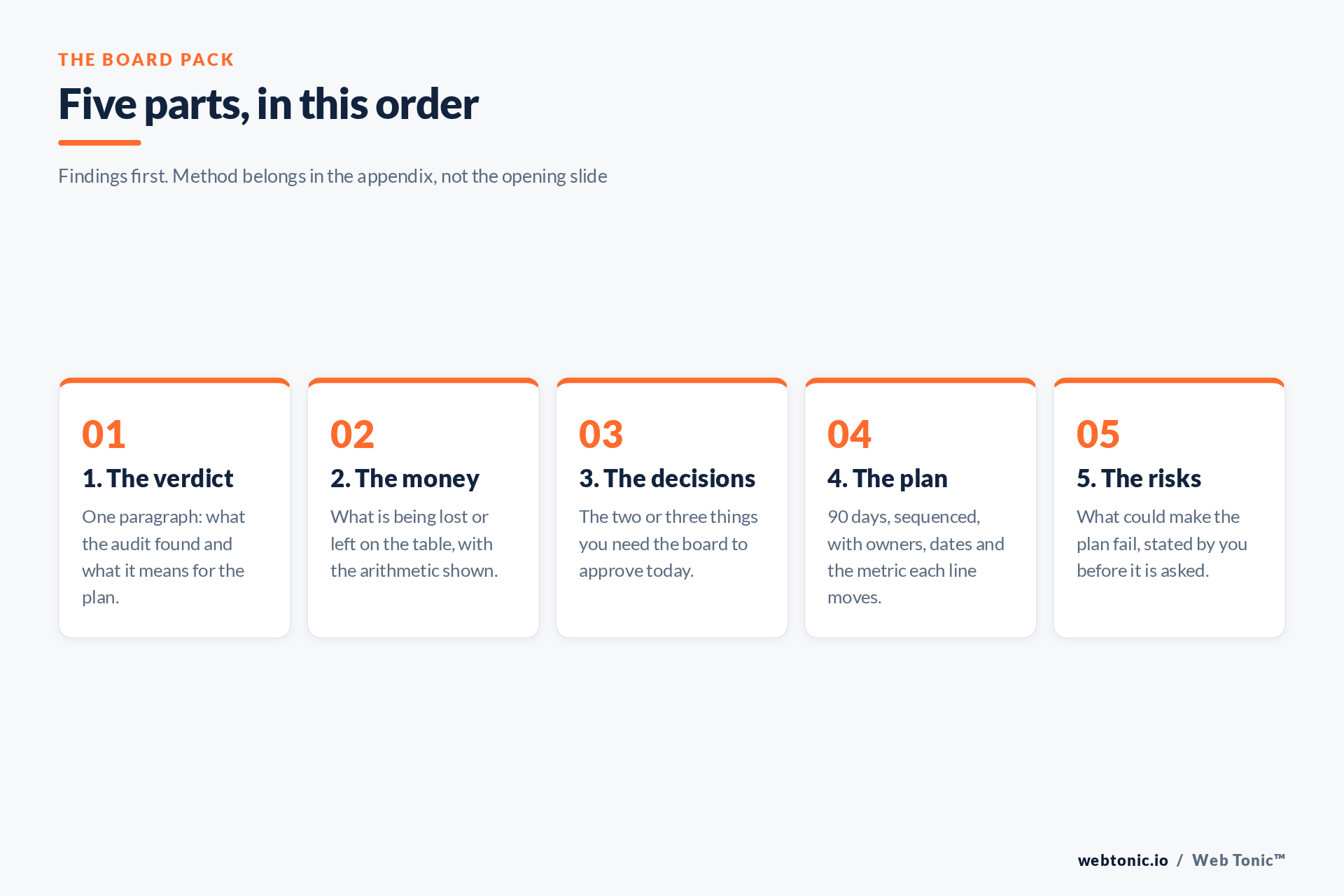
Quick answer: Report a marketing audit to a board in one page and five parts: the verdict, the money at stake with the arithmetic shown, the two or three decisions you need approved, the 90-day plan with owners, and the risks stated before anyone asks.
Last verified: 2026-09-07
A board reads decisions, not diagnostics
The audit document and the board paper are different artefacts. The audit is evidence, ordered by severity and written for the people who will fix things. The board paper is a request for decisions, ordered by money, written for people who will spend eight minutes on it between two other agenda items.
So lead with the verdict. One paragraph that says what the audit found, what it means for the current plan, and what you want approved. A board exists to allocate capital and hold management accountable, not to review tag configuration, and a paper that opens on methodology signals that no decision is being requested.
Put a number on it, and show the arithmetic
Every finding worth board time can be expressed as money or as risk to a commitment. Wasted spend on queries the business already wins organically. Efficiency overstated because a conversion fires twice. Pipeline at risk because a demand channel is shrinking. Write the calculation in one line so it can be checked rather than believed.
Be conservative and say so. A range with a stated assumption survives scrutiny; a single confident figure invites someone to find the one input they disagree with and dismiss the whole paper. Where the underlying number is a customer acquisition cost or a lifetime value, define which version you are using — there are several, and boards have seen all of them.
Ask for two or three decisions, no more
Name the decisions explicitly: approve a budget shift of a stated amount from one channel to another, approve engineering time for tracking remediation, approve pausing a market. Each decision needs the cost, the expected effect, and what happens if the answer is no.
Long recommendation lists get deferred wholesale. Two or three decisions, each with a date, get made. Everything else belongs in the appendix under "already in progress" or "for the next review", which also shows the audit is being worked rather than admired.
Translate findings into board units
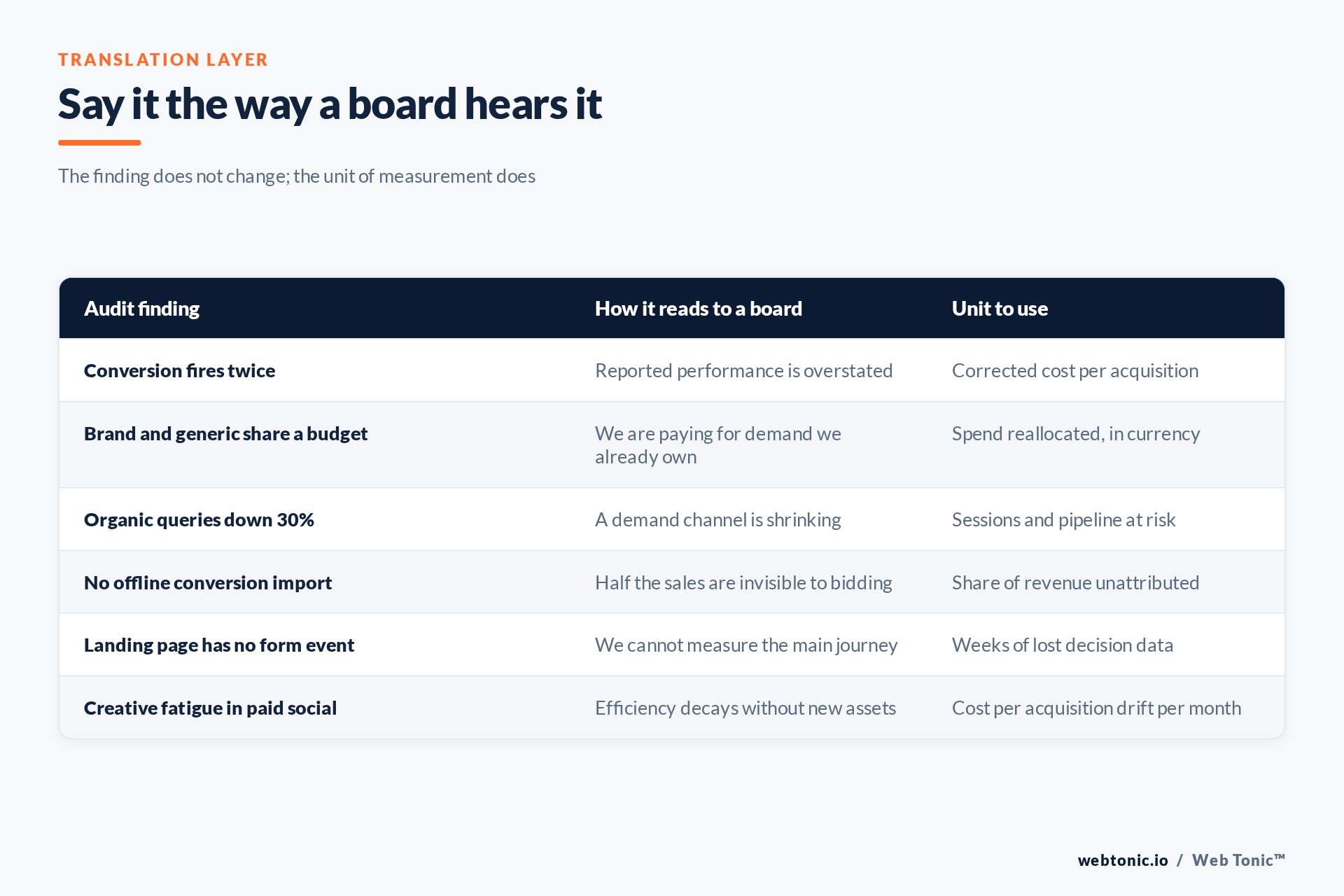
Technical findings survive the translation better than most people expect, as long as the unit changes. "Event Match Quality dropped" becomes "our paid social optimisation is running on worse data than last quarter, which raises acquisition cost". "No offline conversion import" becomes "a share of revenue is invisible to the platforms making bidding decisions". The evidence stays in the appendix; the sentence in the paper is in currency, pipeline or time.
Keep the metric set small and consistent between meetings. Three to five key performance indicators, defined once, reported the same way every quarter, is how a marketing performance review becomes comparable rather than re-argued. A balanced scorecard style layout works well when the board also wants leading indicators alongside revenue.
| Section | Length | Test it must pass |
|---|---|---|
| Verdict | One paragraph | Readable on its own, with no charts |
| Money at stake | Three to five lines | Every figure shows its arithmetic |
| Decisions requested | Two or three | Each has a cost and a date |
| 90-day plan | One table | Owner and metric on every line |
| Risks | Three bullets | Raised by you, not by the board |
| Appendix | Unlimited | Holds all method and evidence |
State the risks yourself
Three bullets, in your own words, before the meeting finds them: what the plan depends on, where the data is still weak, and what you would do if the first 30 days do not move. Naming a weakness in your own paper costs one sentence; having it discovered in the room costs the paper's credibility.
Include measurement honesty here. If tracking remediation lands mid-quarter, the numbers will step rather than trend, and it is far better to have predicted that than to explain it later. Where the audit questions cannot be answered because access was refused, say that too.
Prepare for the four questions that always come
Boards reliably ask: how confident are you in these numbers, what did the last plan not deliver and why, what would you cut to fund this, and who owns it. Have one-line answers ready. The last one matters most — a plan without a single named owner reads as a plan that will not happen, whether or not that is fair.
Send the paper at least 48 hours ahead and keep the presentation to a few minutes on the verdict and the decisions. The meeting is for the questions, not for the reading. Our data intelligence and analytics pages cover the evidence layer that sits behind the appendix.
What goes wrong
The failure mode: the audit is presented in full. Forty slides of findings, no ranking, no money, no ask. The board thanks you, defers everything, and asks for "a shorter version next time" — and the audit's momentum is gone. Cap the paper at one page plus appendix.
The second failure mode is unquantified findings. "Tracking needs work" competes badly against a sales request with a revenue number attached. Attach the arithmetic, even roughly, and label it as an estimate.
The third is inconsistency between meetings. Changing the metric definitions between quarters — even improving them — makes every trend unreadable and quietly costs trust. If a definition must change, show both versions once, side by side, and then keep the new one. More process notes in the help library.
Related reading
- How to Report Marketing Strategy Consulting to a Board
- Fractional CGO / Head of Growth — How to Report It to a Board
- Marketing Operations Consulting / RevOps — How to Report It to a Board
- Marketing Strategy Consulting services at Web Tonic
Frequently Asked Questions
How long should a board paper on a marketing audit be?
One page: verdict, money at stake, the decisions requested, the 90-day plan and the risks. All method and evidence goes into an appendix that most members will not read.
How many decisions should I ask a board to make?
Two or three, each with a cost, an expected effect and what happens if the answer is no. Longer recommendation lists get deferred as a block.
Should technical findings go to the board at all?
Yes, but restated in currency, pipeline or time. "Conversion fires twice" becomes "reported performance is overstated, so our real acquisition cost is higher than the plan assumes".
Which metrics should the board see every quarter?
Three to five, defined once and reported identically each time. Consistency matters more than completeness; if a definition has to change, show both versions once and then keep the new one.
Sources: Board of directors, Key performance indicator, Balanced scorecard, Customer lifetime value, Customer acquisition cost (Wikipedia); Harvard Law School Forum on Corporate Governance; Harvard Business Review. Verified 2026-09-07.


