



Table of contents

No benchmark study prices a marketing audit as a product, which is exactly why quotes for the same brief differ by a factor of three. This page uses the published 2026 consulting pricing data to build a defensible cost model - and states plainly where a figure covers advisory work generally rather than audits specifically.
Key Takeaways
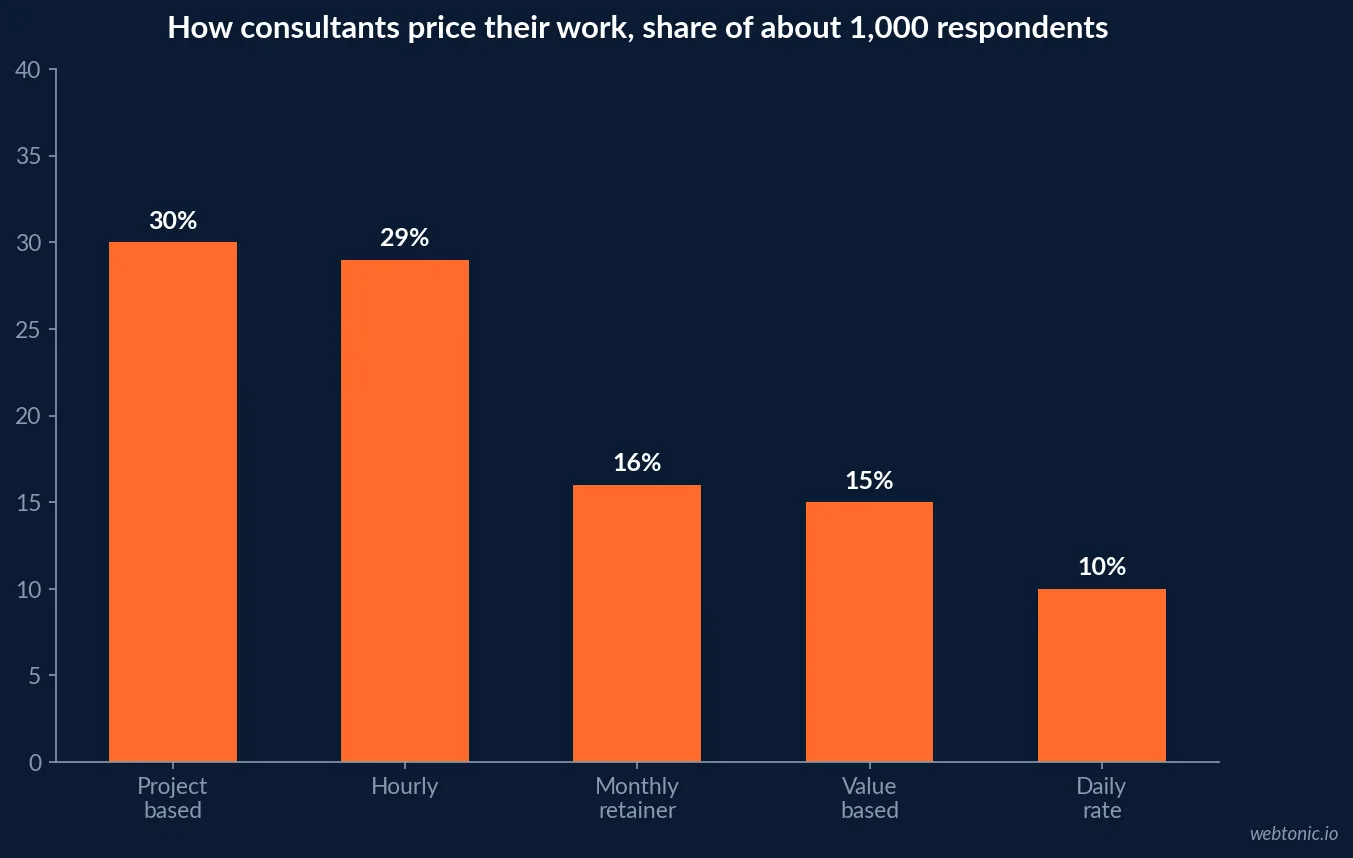
- Project pricing leads consulting at 30%, hourly at 29%, retainers at 16%.
- Value-based pricing is used by 15% and daily rates by 10%.
- Loaded project rates run USD 300 to USD 700 an hour.
- Hourly advisory runs USD 200 to USD 600 an hour.
- Retainers run USD 5,000 to USD 25,000 a month, 6 to 12 months.
- Project scope bought on a retainer has been costed at 4 to 5 times.
- Fractional leadership averages USD 180 an hour, band USD 130 to 220.
- 79% of consultants say they want to charge more than they do.
- Marketing budgets sit at 9.0% of revenue and grow just 1.7%.
- High Growth firms spend 12.0% of revenue against 5.0% at No Growth firms.
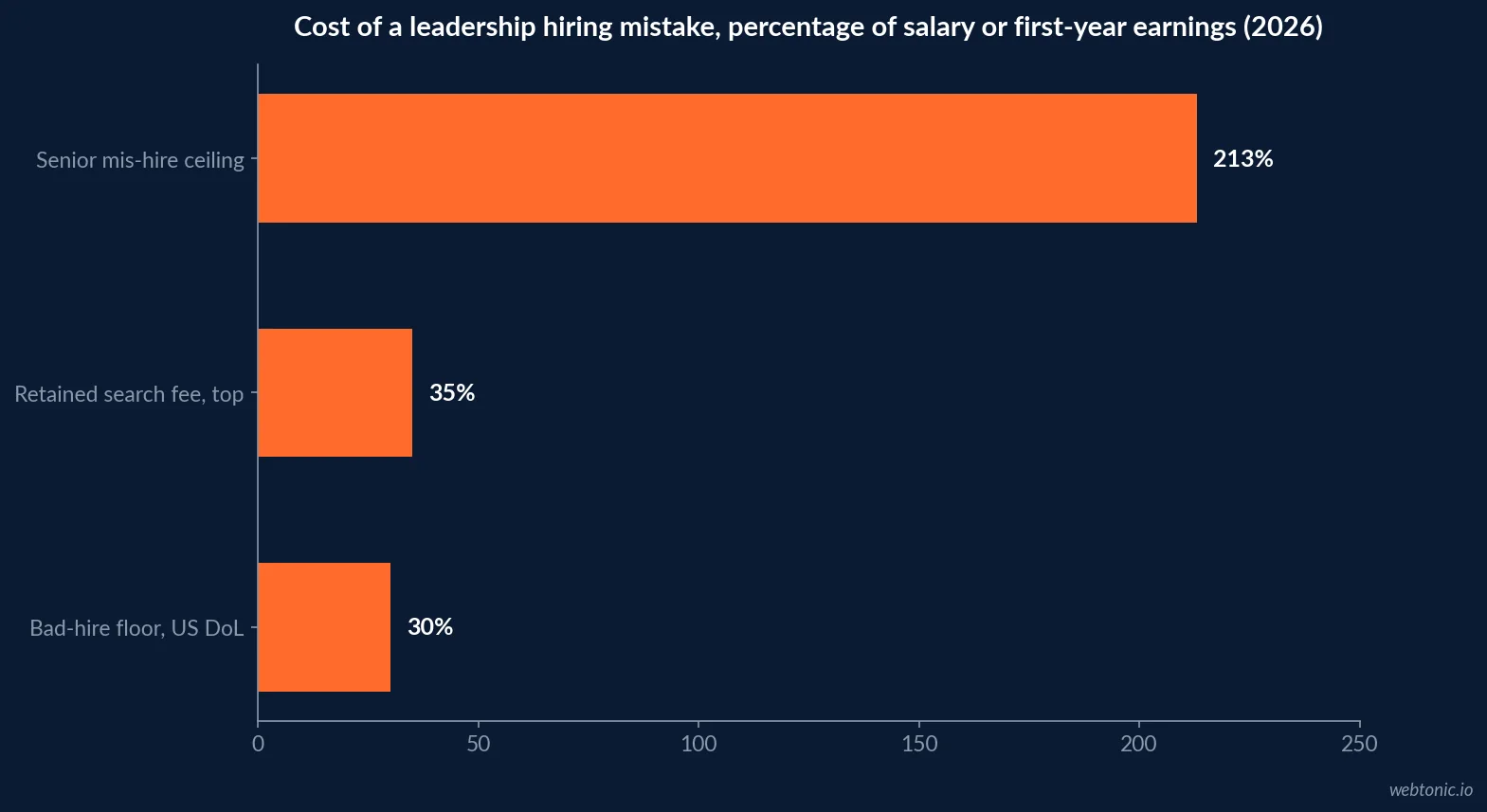
- Bad hires start at 30% of first-year earnings, reaching 213% of salary.
- Retained search adds 25% to 35% of salary.
- Consulting reaches USD 1,111.35 billion in 2026.
Why there is no price list
Audits are sold by consultancies, agencies and freelancers under a dozen names - growth audit, marketing performance review, digital marketing audit - with no shared scope definition. So the pricing evidence has to come from how advisory work is priced generally. A study of roughly 1,000 consultants found project-based pricing at 30%, hourly at 29%, monthly retainers at 16%, value-based pricing at 15% and daily rates at 10%, with 79% saying they want to charge more than they currently do and 38% earning USD 10,000 or more a month.
That last figure explains most quote variance. Prices in this category are anchored on adviser positioning, not on a costed unit of work, which is why the buyer's leverage is scope definition rather than negotiation.
| Pricing model | Share of consultants | Fit for an audit |
|---|---|---|
| Project-based | 30% | Best fit - fixed scope, fixed number |
| Hourly | 29% | Workable with a capped estimate |
| Monthly retainer | 16% | Wrong shape for a one-off diagnosis |
| Value-based | 15% | Only with an agreed baseline |
| Daily rate | 10% | Good for a short focused review |
The rate evidence, stated honestly
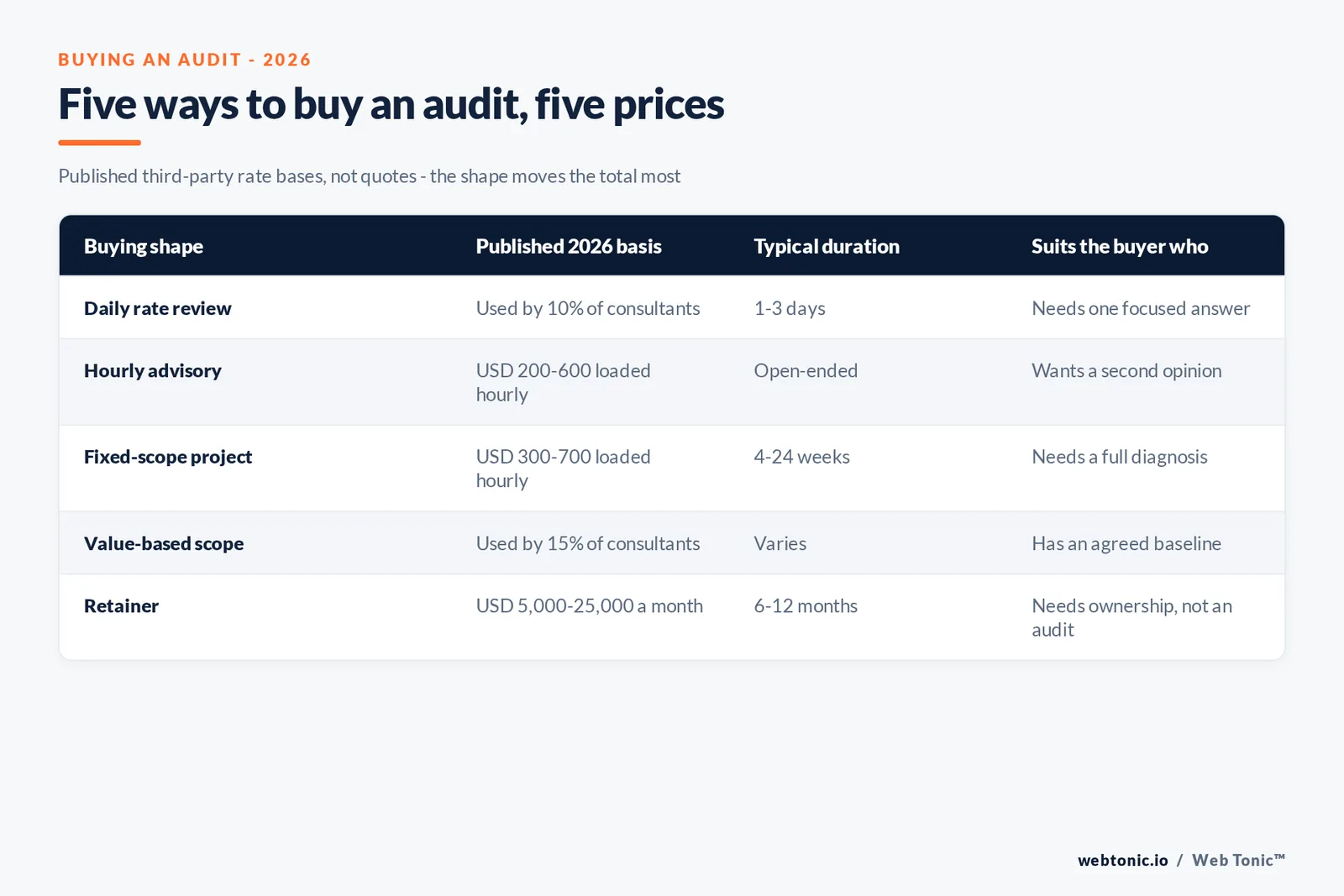
Published 2026 rate data for fractional marketing leaders puts the average at USD 180 an hour, the median at USD 175 and the middle half of the market between USD 130 and USD 220, with typical engagements consuming about nine hours a week, roughly 468 hours a year. Engagement comparison data adds loaded equivalents of USD 200 to 500 on retainer, USD 300 to 700 on project work and USD 200 to 600 hourly, with retainers at USD 5,000 to USD 25,000 a month over six to twelve months and projects running four to twenty-four weeks.
None of those figures is an audit price. They are the inputs to one: hours multiplied by a loaded rate, inside a scope you specified. Any quote you cannot rebuild from those two variables is not comparable to another quote.
| Rate reference | 2026 figure | Applies to |
|---|---|---|
| Average fractional hourly | USD 180 | Senior marketing direction |
| Median fractional hourly | USD 175 | Senior marketing direction |
| 25th to 75th percentile | USD 130-220 | Market band, all seniorities |
| Loaded project rate | USD 300-700 | Fixed-scope work such as an audit |
| Loaded hourly advisory | USD 200-600 | Reviews and second opinions |
| Typical project duration | 4-24 weeks | Diagnosis or reset engagements |
The mismatch that costs the most
The single most expensive error in this category is buying project-shaped work on a retainer. The 2026 engagement data costed the same scope at USD 180,000 on a retainer against USD 40,000 as a project - four to five times the price. An audit is, by definition, bounded: a diagnosis with a deliverable and an end date.
The reverse mistake is subtler. Buying continuous ownership as a series of audits produces a shelf of reports and no execution. If the real requirement is someone accountable for the plan every week, that is a retainer or a hire, and the audit is only the entry point. We keep those two purchases separate in growth marketing engagements rather than blurring them into one fee.
What the audit is competing against in the budget
Audit fees are approved out of a flat budget. The CMO Survey 2026 reports marketing budgets at 9.0% of company revenue and 9.6% of total company budgets, with spend growth of just 1.7%, headcount growth down 50% year on year and training compressed to 3.8% of marketing spend from 5.8% before the pandemic. Hinge's High Growth Study 2026 shows the spread that matters: 12.0% of revenue on marketing at High Growth firms against 5.0% at No Growth firms, with median growth at 9.9%, the lowest since 2018.
Practical consequence: price the audit as a reallocation decision, not an addition. The recommendations it produces will have to be funded the same way.
| Budget line | 2026 figure | Effect on audit pricing |
|---|---|---|
| Marketing as % of revenue | 9.0% | Sets the pool the fee comes from |
| Marketing spend growth | 1.7% | New money is unlikely |
| Training share of spend | 3.8% | Implementation capacity is thin |
| Headcount growth | Down 50% year on year | Expect no new hires to execute |
| High Growth marketing spend | 12.0% of revenue | Comparator for ambitious plans |
| No Growth marketing spend | 5.0% of revenue | Comparator for constrained plans |
The cost of skipping the diagnosis
The strongest financial case for an audit is not efficiency, it is avoided commitment. A senior hire made from an undiagnosed problem is the most expensive marketing purchase available. 2026 mis-hire research cites the US Department of Labor floor of at least 30% of first-year earnings, senior mis-hire costs reaching 213% of salary, and retained search fees of 25% to 35%, while Built In's 2026 compensation data puts a US CMO at USD 225,908 base plus USD 67,667 additional, USD 293,575 total.
Against those numbers, a project-priced diagnosis is a rounding error - provided it actually concludes something. An audit that ends in a list of observations has not reduced any risk.
| Decision made without a diagnosis | Published 2026 cost | What an audit changes |
|---|---|---|
| Senior mis-hire | Up to 213% of salary | Defines the role and scorecard first |
| Bad hire, floor estimate | 30% of first-year earnings | Tests whether the role is the gap |
| Retained search | 25-35% of salary | Delays the fee until the need is proven |
| Full-time CMO hire | USD 293,575 total comp | Compares against project-shaped advice |
| Channel expansion | Funded from a 1.7% growth budget | Forces a stop-doing list |
What should be inside the fee
Scope is the price. The line items below are the ones that most often sit outside a low quote and inside a high one, which is where the factor-of-three gap usually comes from. Ask which of them are included before comparing two numbers, and treat the reconciliation work as non-negotiable - given that only 13% of B2B marketers report significantly improved effectiveness, an audit that accepts platform-reported numbers at face value cannot tell you much.
For channel-level cost context, the same reasoning applies to media budgets in our Google Ads cost guide: the headline number matters far less than what it is assumed to cover.
| Scope line | Usually in a low quote | Usually in a full quote |
|---|---|---|
| Tool export review | Yes | Yes |
| Data reconciliation across sources | No | Yes |
| Interviews with the internal team | No | Yes |
| Prioritised decision list | Sometimes | Yes |
| Measurement specification | No | Yes |
| Implementation roadmap with owners | No | Yes |
Why fees have not deflated
Buyers keep expecting AI to cut advisory prices. The market data does not show it. Management consulting services were valued at USD 1,063.77 billion in 2025, forecast at USD 1,111.35 billion in 2026 and USD 1,407.09 billion by 2030. Demand for judgement is growing roughly in line with supply.
What has changed is the composition of the work. Data pulls, competitor scans and first-draft writing are cheap now, so paying senior rates for them is indefensible. The defensible fee covers the conclusion: what to stop, what to fund, in what order, measured how. If a proposal reads as a deliverables list rather than a decision list, ask for the decision list before you compare prices.
Budget tiers and what each realistically buys
Most buyers start from an approvable number rather than a rate card. The tiers below map published 2026 rate bases to realistic audit scope. They are illustrative arithmetic from third-party rate data, not a quoted price - and every tier assumes the hours are stated in writing.
One caution at the top of the range: at USD 5,000 to USD 25,000 a month over six to twelve months, a retainer approaches the cash cost of a senior hire without the permanence. That is defensible when ownership genuinely has to sit outside the company, and expensive when it does not - which is the single question a good audit answers early. Our team background is one input into judging that, but the data is the other.
| Approvable budget | Published 2026 rate basis | Realistic audit scope |
|---|---|---|
| Under USD 5,000 | Daily rate, 10% of consultants | One-channel review or focused diagnostic |
| USD 5,000-15,000 | USD 200-600 hourly advisory | Measurement audit plus decision list |
| USD 15,000-40,000 | USD 300-700 loaded project rate | Full programme audit and roadmap |
| USD 40,000 plus | Published project comparison | Multi-market or multi-entity audit |
| USD 5,000-25,000 a month | Retainer band | Ongoing ownership, not an audit |
Related reading
- Marketing KPI Scorecard Cost and Pricing Statistics
- Marketing Strategy Consulting Statistics: Cost and Pricing
- Marketing Team Structure Statistics: Cost and Pricing
- Marketing Strategy Consulting services at Web Tonic
Frequently Asked Questions
How much does a marketing audit cost in 2026?
No published benchmark study prices a marketing audit as a standalone product, so the defensible answer comes from consulting pricing data. Engagement comparison data for 2026 puts loaded hourly equivalents at USD 300 to 700 for project work and USD 200 to 600 for hourly advisory, with projects running four to twenty-four weeks. Because an audit is a fixed-scope diagnosis, it is a project-shaped purchase, and one published comparison costed the same scope at USD 40,000 as a project against USD 180,000 bought on a retainer. Anyone quoting a single number without a scope and an hours assumption is quoting a guess.
Should an audit be priced as a project or a retainer?
A project, in almost every case. A study of roughly 1,000 consultants found project pricing leading at 30%, hourly at 29%, retainers at 16%, value-based at 15% and daily rates at 10%. Retainers are the correct shape for continuous decision ownership, not for a one-off diagnosis; the published retainer band of USD 5,000 to USD 25,000 a month with a six to twelve month minimum and 30-day notice makes that obvious once you compare total outlay.
Is a free audit worth anything?
A free audit is a sales instrument, and that is not automatically disqualifying - it is disqualifying when the deliverable is a tool export. The test is whether the output includes a prioritised decision list, a measurement specification and the data sources used. Given that 33% of B2B marketers name measuring results as a challenge prompting action, an audit that does not fix measurement is unlikely to change any outcome regardless of price.
What does an audit cost if you do nothing with it?
The full price, plus the cost of the decision it was meant to prevent. Marketing spend growth is running at just 1.7% while budgets sit at 9.0% of company revenue, so most audit recommendations have to be funded by reallocation. The expensive alternative is a hiring decision made without a diagnosis: US Department of Labor guidance puts the floor cost of a bad hire at 30% of first-year earnings, senior mis-hire estimates reach 213% of salary, and retained search fees run 25% to 35%.
How do I compare two audit quotes fairly?
Normalise them to scope and hours, not to the headline fee. Ask what is measured, which data sources are reconciled, how many hours are assumed, who writes the recommendations and what the deliverable looks like. Published rate data puts fractional marketing leadership at an average of USD 180 an hour with a 25th to 75th percentile band of USD 130 to USD 220, so a fee gap of three times on the same brief is almost always a scope gap rather than a seniority gap.
Sources
Consulting Success - Consulting Fees Study
Content Marketing Institute - B2B Content Marketing Trends 2026
GoFractional - Fractional CMO Rates 2026
Fractional Pulse - Fractional Executive Engagement Comparison 2026
The CMO Survey - Highlights and Insights Report 2026
Hinge Research Institute - High Growth Study 2026
Talentfoot - The Cost of a Leadership Mis-hire, 2026 Data
Built In - CMO Salary Data 2026
The Business Research Company - Management Consulting Services Global Market Report


