Table of contents

Market segmentation is the practice of dividing a broad market into smaller groups of buyers who share characteristics, needs or behaviours, so that each group can be served with a distinct product, price, message or channel instead of one generic campaign.
The idea is 70 years old — Wendell R. Smith set it out in the Journal of Marketing in 1956 — and it still decides which campaigns feel relevant and which get ignored.
Key Takeaways
- Segmentation groups buyers by shared traits; targeting picks which groups to serve; positioning decides what you say to them. That is the 3-step STP model.
- There are 5 workhorse bases: demographic, geographic, psychographic, behavioural and firmographic.
- Segmented email campaigns earned 14.31% higher opens and 100.95% more clicks than non-segmented ones in a study of about 11,000 campaigns.
- Segmented sends also produced 9.37% fewer unsubscribes and 4.65% fewer bounces — relevance protects the list as well as the revenue.
- A usable segment must be measurable, big enough to matter, reachable and different enough to justify separate work.
- The most common failure is building 8–10 beautiful segments that no campaign or product decision ever uses.
How market segmentation works
The mechanics are the same whether you sell trainers or industrial pumps. You gather data about the market, look for clusters where behaviour or needs genuinely differ, describe those clusters in language a marketer can act on, then check whether serving them separately earns more than treating everyone the same.
A workable process has four stages:
- Define the market you are dividing. "Everyone" is not a market. Start from the category and the job the customer is hiring you for.
- Choose the segmentation variables. Pick the 2–3 variables most likely to explain different buying behaviour, not every field in the database.
- Build and profile the segments. Size each one, describe its needs, and attach the data that proves the group behaves differently.
- Test the value. Run a differentiated offer or message against a control. If the segmented version does not win, the segment is a description, not a strategy.
The reference frameworks are consistent on this. Qualtrics frames segmentation as creating approachable subsets of a market; Corporate Finance Institute stresses the commercial test of whether a segment can be profitably served; and the American Marketing Association keeps a running body of practitioner work on how the discipline is evolving.
The five types of market segments
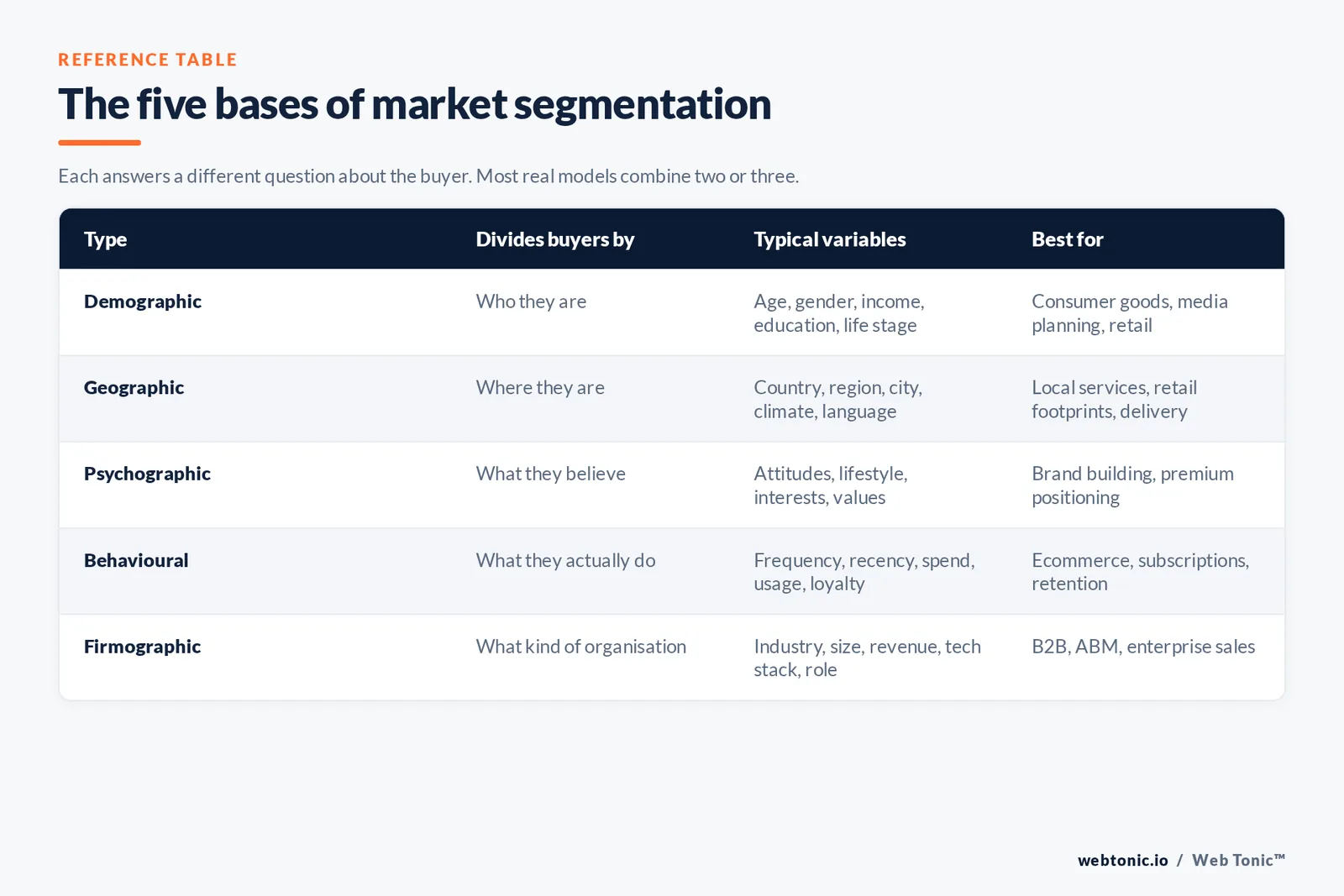
Most segmentation models in practice are combinations of five bases. Each answers a different question about the buyer.
| Type | Divides buyers by | Typical variables | Best for |
|---|---|---|---|
| Demographic | Who they are | Age, gender, income, education, household size, life stage | Consumer goods, media planning, retail |
| Geographic | Where they are | Country, region, city, climate, urban vs rural, language | Local services, retail footprints, delivery models |
| Psychographic | What they believe and value | Attitudes, lifestyle, interests, values, personality | Brand building, premium positioning, creative strategy |
| Behavioural | What they actually do | Purchase frequency, recency, spend, usage, loyalty, channel | Ecommerce, subscriptions, retention programmes |
| Firmographic | What kind of organisation they are | Industry, company size, revenue, tech stack, buying role | B2B, account-based marketing, enterprise sales |
Two practical notes. First, behavioural data usually outperforms demographic data for predicting the next purchase, which is why customer segmentation models in CRM systems lean on recency, frequency and value. Second, psychographic segments are the hardest to verify and the easiest to invent; if you cannot point to survey or first-party evidence, treat the segment as a hypothesis.
Segmentation, targeting and positioning (STP)
Segmentation is only the first move of a 3-part sequence taught as STP:
- Segment — divide the market into groups with meaningfully different needs.
- Target — choose which groups you will serve, based on size, growth, fit and competitive intensity.
- Position — decide what you will stand for in the mind of that specific group, then make product, price and message follow.
The classic framework, summarised well by Mind Tools, exists to stop marketers skipping straight from data to campaign. Segment-then-target forces an uncomfortable but valuable decision: which buyers you are deliberately not chasing this year. Strategy work published under Harvard Business Review's segmentation coverage makes the same point — segmentation that never leads to a trade-off rarely changes results.
Which data to segment with
Segments are only as good as the evidence behind them. Four data sources cover most needs, and the best models mix at least two:
| Data source | What it reveals | Strength | Limitation |
|---|---|---|---|
| First-party CRM and order data | Real purchase behaviour, value, churn risk | Accurate and directly actionable | Only describes people who already bought |
| Web and app analytics | Journeys, sources, intent signals | Large samples, near real time | Identity gaps and consent limits |
| Surveys and interviews | Motivations, attitudes, unmet needs | Explains the "why" behind behaviour | Sample cost and stated-vs-actual bias |
| Third-party market data | Market size, demographics, category trends | Sizes segments you cannot see internally | Aggregated, rarely specific to your brand |
On the analytics side, platform tooling has made segment building routine: Google Analytics audience segments let you isolate behaviour cohorts and reuse them for advertising. For market sizing, national statistics such as the American Community Survey and digital adoption datasets like DataReportal's Digital 2026 report — which counts roughly 5.66 billion social media users spending about 2 hours 40 minutes a day on social platforms — anchor segments in something bigger than your own funnel. Attitudinal shifts are tracked in sources such as Pew Research's social trends work.
If your data is scattered across a CRM, an ad platform and three spreadsheets, that is the first problem to solve. Our data intelligence practice exists mostly to make segments trustworthy before anyone spends money against them.
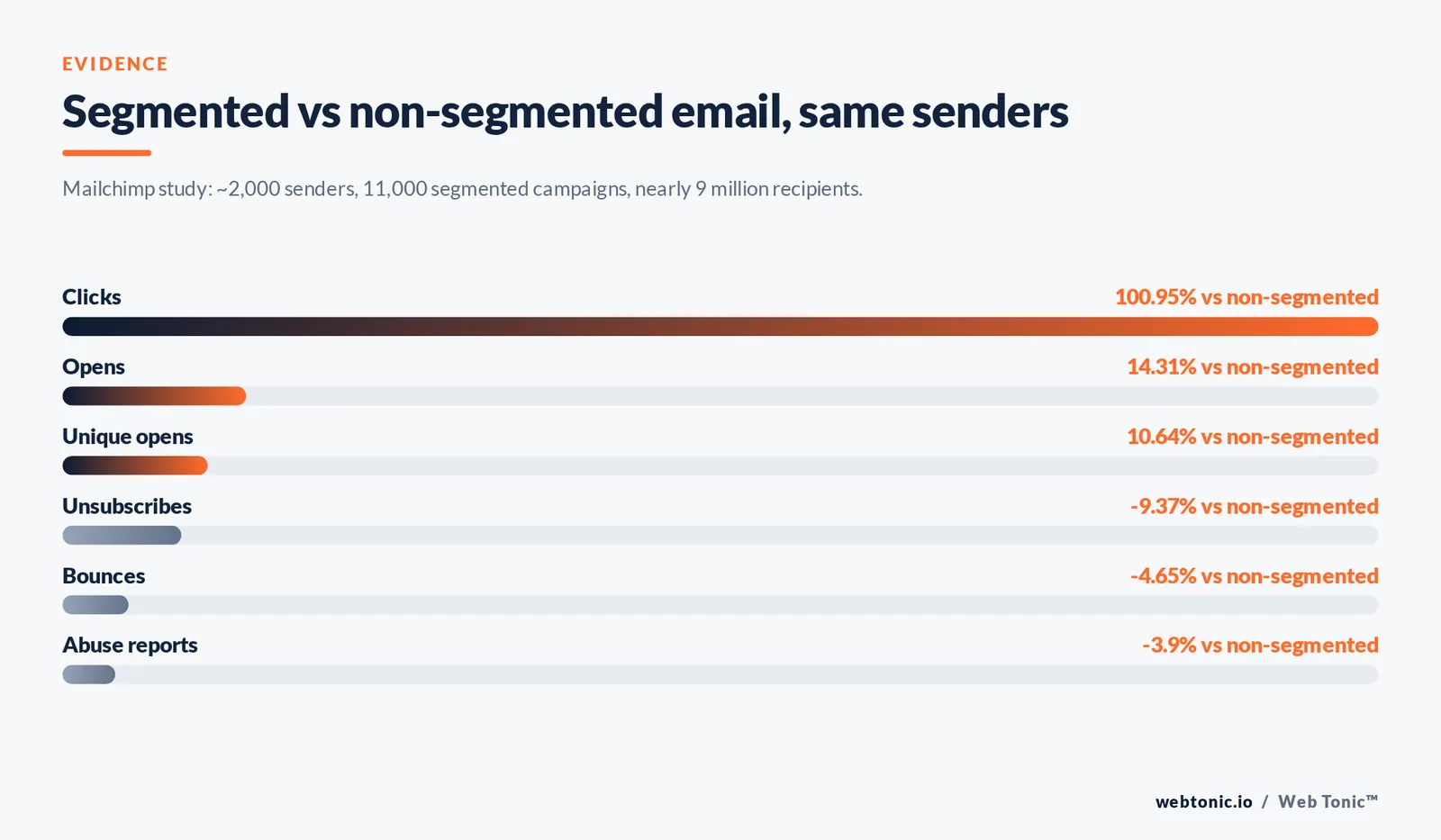
What segmentation is worth: the evidence
The business case is not theoretical. In an analysis of about 2,000 senders, 11,000 segmented campaigns and nearly 9 million recipients, Mailchimp's segmentation study compared segmented and non-segmented sends from the same accounts.
| Metric | Segmented vs non-segmented | What it tells you |
|---|---|---|
| Opens | +14.31% | Relevance earns attention before the click |
| Unique opens | +10.64% | Gain is broad, not driven by repeat openers |
| Clicks | +100.95% | The offer matches the segment's intent |
| Unsubscribes | −9.37% | Fewer people opt out of a relevant list |
| Bounces | −4.65% | Better list hygiene as a side effect |
| Abuse reports | −3.90% | Less brand damage per send |
Doubling click-through by grouping the same audience differently is the clearest argument in marketing for doing the segmentation work. The same logic applies to paid media, where segment-specific creative and landing pages lift conversion rate at identical media cost — the mechanism behind most of the gains our performance creative team reports.
Market segmentation examples
Concrete patterns travel better than definitions. Five that recur across categories:
- Life-stage retail. A homeware brand splits buyers into first-apartment, first-home and renovating segments. Same catalogue, 3 different email programmes and price emphases.
- Value tiers in ecommerce. Grouping customers by 12-month spend into top 10%, middle 60% and dormant 30% turns one newsletter into a loyalty programme, a cross-sell programme and a win-back programme.
- Geographic service radius. A multi-location dental group segments by drive time, running separate local campaigns per clinic instead of one regional message.
- Firmographic B2B. A SaaS vendor splits by company size: self-serve under 50 employees, sales-assisted 50–500, and enterprise above that — three pricing pages, three sales motions.
- Behavioural streaming. Media platforms segment by genre affinity and session length, then personalise recommendations, which is the pattern marketing-cloud segmentation tooling is built to automate.
Notice what the good examples have in common: each segment leads to a different action. If two segments receive the same campaign, they are one segment.
Benefits of segmenting a market
Segmentation pays out in six ways, in rough order of how quickly you feel them:
- Sharper messages. You write to one reader instead of an average of everyone, which lifts response rates immediately.
- Lower acquisition cost. Ad spend concentrates on groups that convert, so the same budget buys more customers.
- Better product decisions. Segment needs tell you which features and bundles to build, not just how to advertise.
- Pricing power. Distinct segments tolerate different price points and tiers.
- Higher retention. Relevance reduces churn and unsubscribes, as the 9.37% unsubscribe reduction above shows.
- Clearer growth choices. Sizing segments shows where the next 10% of revenue realistically comes from, a discipline the U.S. Small Business Administration puts at the centre of market research.
These benefits compound with channel strategy. Understanding how a target audience is defined on social platforms, or how customer segmentation is modelled with analytics and machine learning, both start from the same segment definitions.
How to create a market segmentation strategy step by step
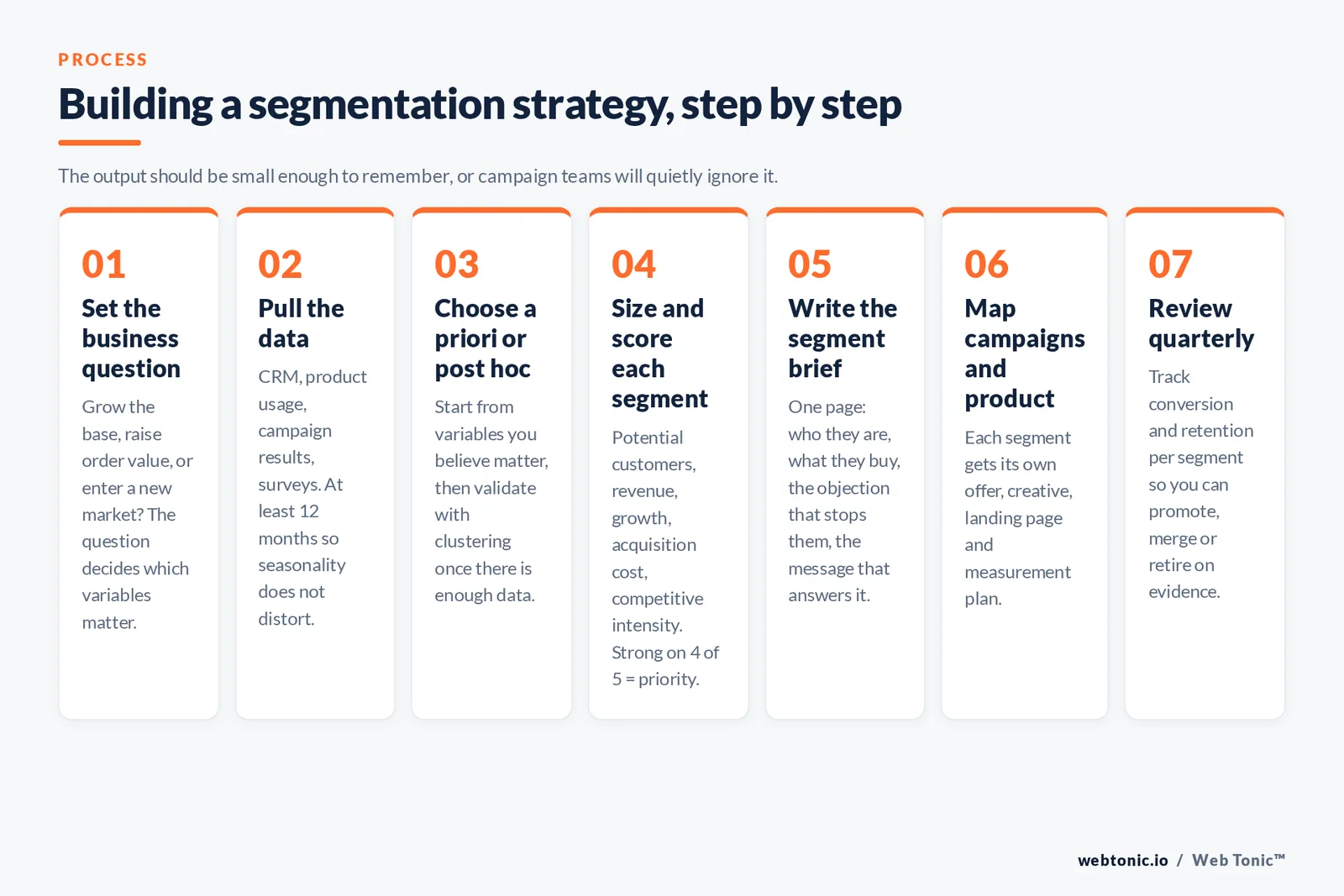
A market segmentation strategy is the written decision about which market segments your company will serve, with what products and services, and through which channels. Building one is a repeatable process, and the market segmentation process below is the version we use with clients.
- Step 1 — set the business question. Are you trying to grow the customer base, raise average order value, or enter a new market? The question decides which segmentation variables matter.
- Step 2 — pull the data. Combine customer data from the CRM, product usage, campaign results and survey responses. Aim for at least 12 months of history so seasonality does not distort the segments.
- Step 3 — choose a priori or post hoc segmentation. A priori segmentation starts from variables you already believe matter — company size, life stage, region. Post hoc segmentation lets clustering on the data reveal groups you had not defined, then you name them afterwards. Most brands run a priori first because it is cheap, then validate with post hoc analysis once there is enough data.
- Step 4 — size and score each market segment. For every segment record the number of potential customers, current revenue, growth rate, acquisition cost and competitive intensity. A segment that scores well on 4 of those 5 dimensions is a priority segment.
- Step 5 — write the segment brief. One page per target audience: who they are, what they want, what they currently buy, the objection that stops them, and the message that answers it.
- Step 6 — build the campaign and product mapping. Each segment gets its own offer, creative, landing page and measurement plan. This is where a segmentation model stops being a slide and starts changing revenue.
- Step 7 — review quarterly. Track each segment's conversion rate and retention separately so you can promote, merge or retire segments on evidence.
The output should be small enough to remember. If your marketing strategy needs a lookup table to explain which customer belongs where, the model will quietly be ignored by the people running campaigns.
Market segmentation in practice, by business type
The same five bases produce very different segmentation strategies depending on what a company sells. These patterns show how brands translate segments into products, services and marketing.
| Business type | Primary segmentation base | How the segments are used | Typical segment count |
|---|---|---|---|
| Ecommerce brand | Behavioural, by spend and recency | Lifecycle email flows, paid retargeting audiences, loyalty tiers | 4–6 |
| Marketplace or retailer | Category affinity plus geography | Personalised recommendations and regional assortment, the model Amazon popularised | 6–10 |
| Premium automotive | Demographic income plus psychographic values | Model line-up and brand campaigns per aspiration tier, as in the Mercedes-Benz range | 3–5 |
| Local service business | Geographic drive time | Location pages, local ads and staffing per catchment | 1 per location |
| B2B software company | Firmographic size and industry | Pricing tiers, sales motion, vertical case studies | 3–4 |
| Consumer subscription | Behavioural usage plus life stage | Plan design, onboarding paths, churn-risk interventions | 4–5 |
Generational labels deserve a warning. Segmenting a market by "Millennials" or "Gen Z" feels actionable and rarely is: the group spans 15 years of income, life stage and category behaviour. A behavioural segment built from what customers bought last quarter almost always outperforms an age band. Geographic segments carry the opposite risk — they are reliable but coarse, so a company selling across Europe, Asia and the United States should treat country as a delivery constraint first and a targeting variable second.
Whatever base you choose, the test of a good market segment is unchanged since 1956: it must group buyers who respond to the same offer, in numbers large enough to pay for the effort of serving them separately.
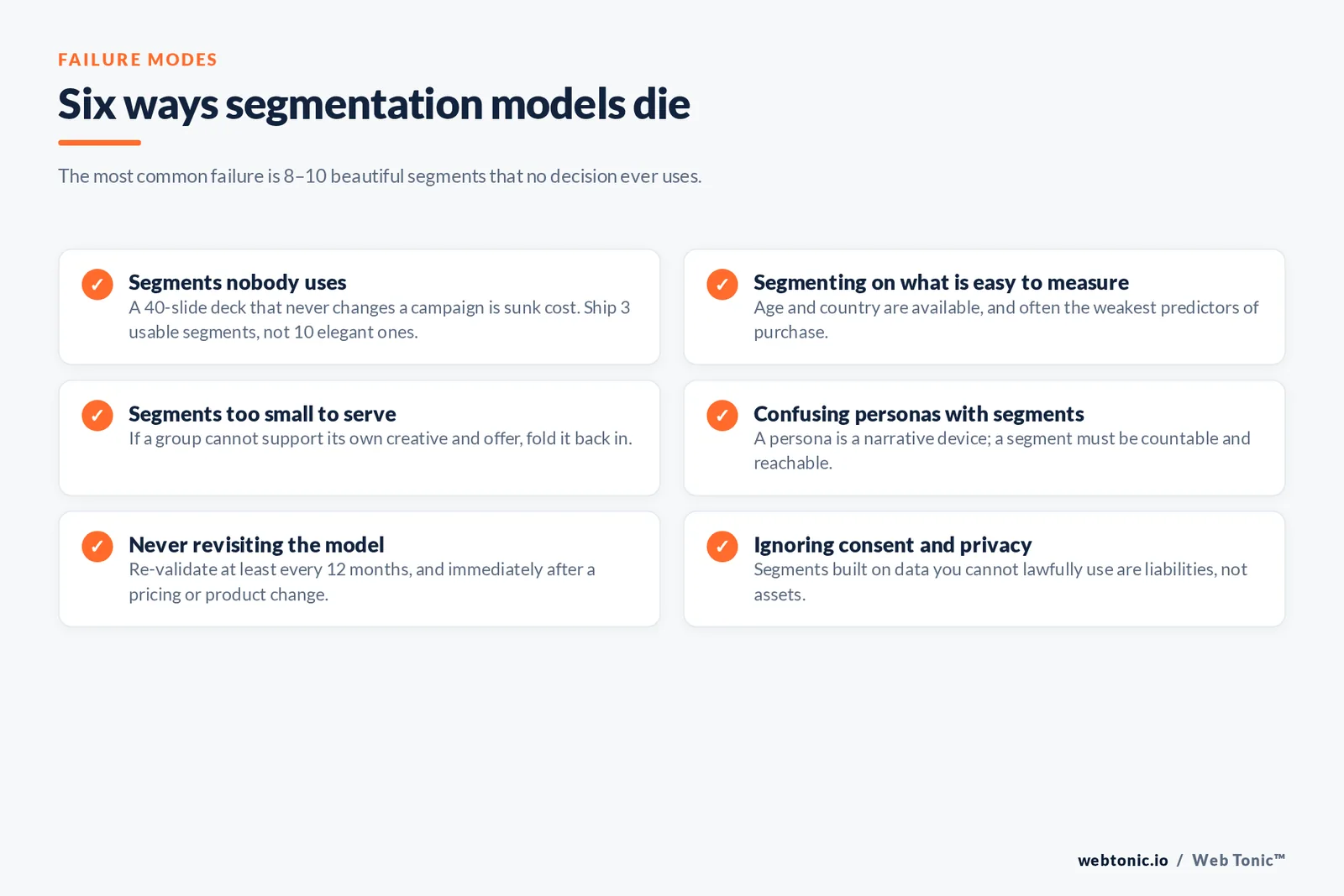
Common market segmentation mistakes
- Segments nobody uses. A 40-slide segmentation deck that never changes a campaign is sunk cost. Ship 3 usable segments rather than 10 elegant ones.
- Segmenting on what is easy to measure. Age and country are available; they are often the weakest predictors of purchase.
- Segments too small to serve. If a group cannot support its own creative and offer, fold it back in.
- Confusing personas with segments. A persona is a narrative device; a segment must be countable and reachable.
- Never revisiting the model. Markets move. Re-validate segments at least every 12 months, and immediately after a pricing or product change.
- Ignoring consent and privacy. Segments built on data you cannot lawfully use are liabilities, not assets.
Related terms
| Term | Definition | Relationship to segmentation |
|---|---|---|
| Target market | The segment or segments a business chooses to serve | The output of targeting, the step after segmentation |
| Customer segmentation | Grouping existing customers by behaviour or value | A subset focused on buyers you already have |
| Buyer persona | A narrative profile of a representative buyer | A communication tool built on top of a segment |
| Product differentiation | Making an offer distinct within the whole market | The alternative strategy Smith contrasted in 1956 |
| Positioning | The place a brand occupies in a buyer's mind | The final step of the STP sequence |
For hands-on help turning a segmentation model into live campaigns, see our growth marketing services, browse related guides on the Web Tonic blog, or get in touch.
FAQ: market segmentation questions
What is market segmentation in simple terms?
It is dividing a large market into smaller groups of buyers who share needs or behaviours, so each group can be served with a message, product or price that fits them better than a single generic campaign would.
What are the four main types of market segmentation?
Demographic, geographic, psychographic and behavioural. In B2B a 5th base, firmographic segmentation, groups organisations by industry, size and revenue instead of grouping individuals.
How many segments should a business have?
Usually 3 to 5. Each one needs its own offer, creative and measurement, so more segments mean more work; if you cannot resource a segment properly, it is better merged.
What makes a segment worth using?
Four tests: it is measurable, large enough to be profitable, reachable through a channel you can afford, and different enough from other segments to justify separate treatment.
How is market segmentation different from targeting?
Segmentation describes the market; targeting chooses from it. Segmentation is analysis, targeting is a decision about where to spend, and positioning is what you then say to the chosen group.
Sources
Wendell R. Smith, "Product Differentiation and Market Segmentation as Alternative Marketing Strategies," Journal of Marketing, 1956 · Mailchimp, "Effects of List Segmentation on Email Marketing Stats" · Qualtrics market segmentation guide · Corporate Finance Institute · American Marketing Association segmentation topic hub · Harvard Business Review segmentation coverage · Mind Tools STP model · HubSpot customer segmentation · IBM customer segmentation · Salesforce segmentation resources · Google Analytics Help, audience segments · U.S. Census Bureau, American Community Survey · DataReportal, Digital 2026 Global Overview Report · Pew Research Center social trends · Sprout Social audience research. Figures cited as published at the time of writing.