



Table of contents
Key Takeaways
- 91% of businesses use video as a marketing tool in 2026, matching the all-time high (Wyzowl).
- B2B marketers who use video experience 49% faster revenue growth compared to those who do not (Pixel8 Production).
- 64% of manufacturing companies lead all industries in video applicability, ahead of financial services at 59% and retail at 58% (Skyrex Productions).
- 52% reduction in sales cycle length is achievable using explainer videos in manufacturing (Skyrex Productions).
- 71% of manufacturing buyers watch video content before requesting a quote (Marketing LTB).
- Most B2B brands spend between $3,000 and $15,000 per product video in 2026 (Vidico).
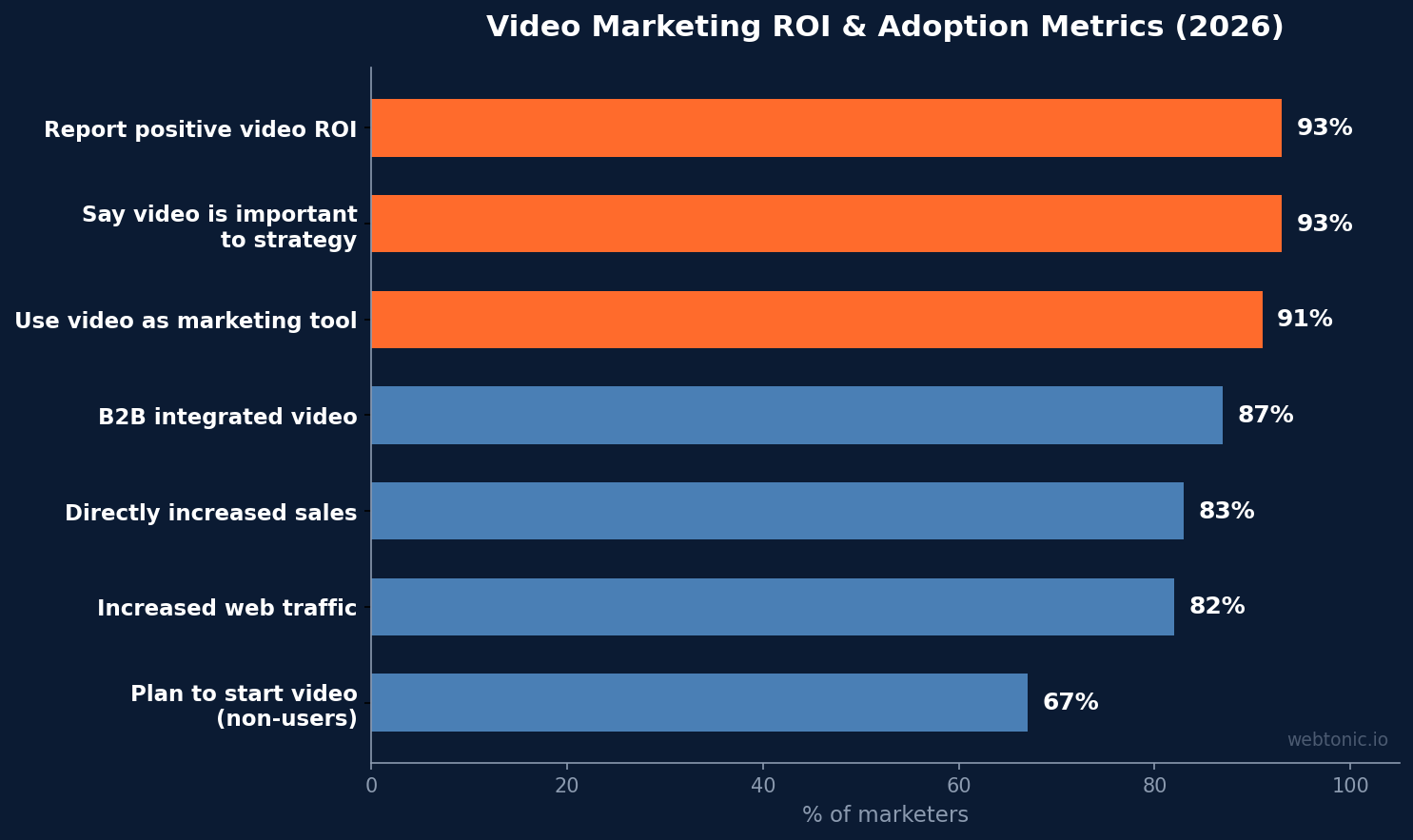
- 83% of marketers report that video has directly increased sales (Wyzowl).
Manufacturing Video Marketing at a Glance
| Metric | Value | Source |
|---|---|---|
| Businesses using video | 91% | Wyzowl 2026 |
| B2B video revenue growth lift | 49% faster | Pixel8 / HubSpot |
| Manufacturing video applicability rank | #1 (64%) | Skyrex Productions |
| Sales cycle reduction with explainers | 52% | Skyrex Productions |
| Buyers watching video pre-RFQ | 71% | Marketing LTB |
| Average product video cost (B2B) | $3,000–$15,000 | Vidico |
| Marketers reporting video increased sales | 83% | Wyzowl 2026 |
| Video marketing ROI (positive) | 93% | Wyzowl 2026 |
| B2B buyers engaging with video in journey | 70% | Vidyard / Pixel8 |
| Marketing budget allocated to video | 31% | Wyzowl 2026 |
Why Video Marketing Outperforms in Manufacturing
Manufacturing has traditionally relied on trade shows, technical documentation, and in-person facility visits to close deals. Video content is fundamentally changing that equation. According to Skyrex Productions, 64% of manufacturing companies lead all industries in video applicability, outpacing financial services (59%) and retail (58%). The complexity of manufacturing products — CNC machines, industrial robotics, precision components — makes video uniquely effective because a 90-second demo can communicate what would take pages of technical documentation.
Inbound281 reports that more than half of industrial buyers make purchase decisions before ever interacting directly with a manufacturer. This means the digital content on your website, especially video, determines whether your company even reaches the shortlist. As noted by Marketing LTB, 71% of manufacturing buyers watch video content before requesting a quote, and those who do are significantly more likely to convert. For manufacturers exploring their broader digital presence, our performance creative services cover video production strategy alongside paid media.
Video Marketing ROI and Revenue Impact
The return on investment for video in manufacturing is now well-documented. Wyzowl's 2026 survey (266 respondents, 12 consecutive years of data) found that 93% of marketers say video marketing has given them a good ROI — the highest percentage in the survey's history. Additionally, 83% of marketers report that video has directly increased sales, and 82% say video has helped increase web traffic.
For B2B manufacturers specifically, the data is even more compelling. Pixel8 Production reports that B2B marketers who use video experience 49% faster revenue growth than those who do not, based on aggregated data from HubSpot and Demand Gen Report research. Furthermore, 72% of B2B buyers say vendor video influences their shortlist decisions, and video testimonials added to proposals drive a 22% increase in close rates (Vidyard, cited by Pixel8). The financial case is clear: 92% of video marketers plan to spend the same or more on video in 2026 (Wyzowl), with an average 31% of total marketing budget now allocated to video.
Production Costs and Budgeting for Manufacturing Video
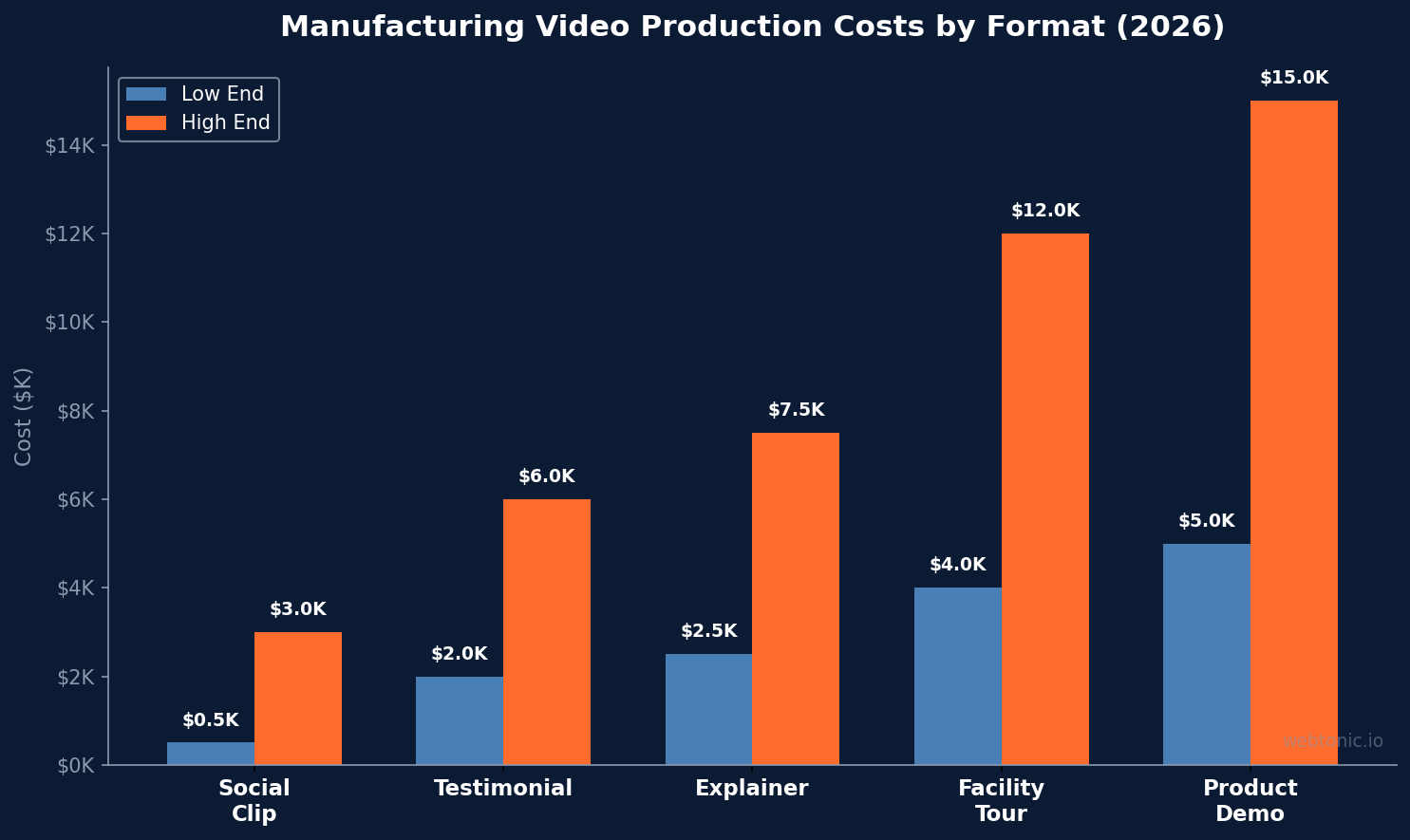
Understanding production costs is essential for manufacturers evaluating video investment. According to Vidico, most B2B brands spend between $3,000 and $15,000 per product video in 2026. The range depends heavily on format and complexity:
| Video Type | Typical Cost Range | Best Manufacturing Use |
|---|---|---|
| Explainer / animated | $2,500–$7,500 | Process overviews, product specs |
| Product demo (live action) | $5,000–$15,000 | Equipment showcases, capabilities |
| Facility / plant tour | $4,000–$12,000 | Trust building, supplier evaluation |
| Customer testimonial | $2,000–$6,000 | Social proof, case studies |
| Training / how-to | $1,500–$5,000 | Onboarding, after-sales support |
| Social media (short-form) | $500–$3,000 | LinkedIn, awareness campaigns |
Skyrex Productions notes that manufacturing leaders in EVs, electronics, semiconductors, green energy, and robotics are now building internal video libraries as digital infrastructure, treating video not as a campaign expense but as a long-term asset. With 59% of video marketers creating content in-house (Wyzowl), the cost barrier continues to fall, though 24% of non-adopters still cite expense as the primary barrier. For comprehensive advertising strategies including video, explore our growth marketing services.
Buyer Behavior: How Manufacturing Prospects Use Video
Understanding how industrial buyers consume video content is critical for creating the right assets. Pixel8 Production reports that 70% of B2B buyers engage with video during the purchasing journey, and Vidyard's data shows a 46% lift in purchase intent from product demo videos versus non-video pages. Manufacturing-specific buying behavior includes several distinct patterns:
- 40% of B2B buyers consume three to five pieces of content before reaching out to a salesperson (Skyrex Productions).
- 57% of industrial buyers make purchase decisions before ever contacting a manufacturer (Inbound281).
- 96% of individuals rely on videos to gain deeper insights into products rather than reading manuals or text instructions (Skyrex Productions).
- 69% of video marketers create social media videos, the most popular singular use case for video marketing in 2026 (Wyzowl).
For manufacturers, this means product demos, facility tours, and technical capability videos should be the top priorities. These formats answer the questions procurement teams and engineers are asking before they pick up the phone. Our data intelligence services can help track how video content contributes to your pipeline.
Video Formats That Drive Manufacturing Results
Not all video formats perform equally in the manufacturing sector. Wyzowl's 2026 data shows that 51% of video marketers create live action video, followed by animated video (23%) and screen-recorded content (19%). For B2B manufacturing, the data from multiple sources points to clear format winners:
| Format | Effectiveness Metric | Manufacturing Context |
|---|---|---|
| Product demo | +46% purchase intent lift | Equipment capabilities, CNC processes |
| Explainer video | 52% sales cycle reduction | Complex specs, process overviews |
| Customer testimonial | +22% proposal close rate | Social proof for procurement teams |
| Facility tour | Top trust-building format | Quality assurance, supplier evaluation |
| Short-form social | +44% LinkedIn engagement YoY | Brand awareness, talent recruitment |
Pixel8 Production reports a 44% year-over-year growth in LinkedIn video engagement, with 70% of B2B video marketers now using LinkedIn as a distribution channel. For manufacturers, LinkedIn is particularly valuable for reaching procurement managers, engineers, and operations leads who actively browse the platform for supplier content.
Distribution Channels and Platform Performance
Where you publish manufacturing video content matters as much as what you create. Wyzowl 2026 data shows that 69% of video marketers create social media videos as their top use case, and Pixel8 Production found that the leading B2B channels for video distribution include:
- YouTube — used by 90% of B2B video marketers, functions as a search engine for product specifications and how-to content.
- LinkedIn — used by 70% of B2B video marketers, with 44% year-over-year engagement growth on video posts.
- Company website — 82% say video increased web traffic (Wyzowl), making embedded product pages a priority.
- Email — adding video to emails can boost click-through rates by 200–300% (Pixel8 aggregated data).
For manufacturing companies, embedding product demos on key web pages and distributing shorter clips on LinkedIn has proven the most effective dual-channel strategy. Companies combining organic LinkedIn video with targeted Meta Ads services often see the highest engagement from both brand awareness and lead generation perspectives.
Adoption Barriers and How Manufacturers Overcome Them
Despite strong adoption numbers, barriers remain. Wyzowl 2026 identified the top reasons businesses do not use video marketing:
- 24% say it is too expensive — the joint #1 barrier alongside those who feel it is not needed.
- 24% do not feel video marketing is needed — often due to reliance on trade shows and referrals.
- 19% cite lack of time as their primary barrier to adoption.
- 10% are unclear on the ROI of video marketing.
- 10% do not know where to start with video production.
However, 67% of marketers who do not currently use video plan to start in 2026 (Wyzowl). For manufacturers, the shift toward in-house production (59% already produce internally) and the availability of affordable short-form options ($500–$3,000 per social clip) are reducing these barriers rapidly. Industrial companies that invest in a basic video production workflow — even a smartphone, tripod, and good lighting on the plant floor — can produce authentic content that resonates with technical buyers.
Best Practices for Manufacturing Video Marketing
- Lead with data, not features. Technical buyers respond to measurable outcomes — include specific performance data, tolerances, and throughput numbers in every video.
- Create a video library, not one-off campaigns. Manufacturing leaders are building internal video libraries as digital infrastructure (Skyrex Productions). Plan 8–12 assets covering your top products, processes, and testimonials.
- Optimize for LinkedIn first. With 44% YoY engagement growth on LinkedIn video (Pixel8 Production), this is the highest-ROI distribution channel for B2B manufacturers.
- Keep explainers under 2 minutes. The 52% sales cycle reduction from explainer videos comes from concise, specs-focused content, not long-form brand films.
- Add testimonials to proposals. The 22% increase in close rates from video testimonials makes them a direct revenue driver for sales teams.
- Measure beyond views. Track RFQ submissions, time-on-page for product demo pages, and qualified pipeline contribution. Our Google Ads strategy guide covers attribution models that apply to video as well.
- Invest in facility tours for trust. 40% of B2B buyers consume 3–5 pieces of content before contacting a supplier — a plant tour video addresses quality assurance and capability questions simultaneously.
Manufacturing Video Marketing vs. Other Industries
| Metric | Manufacturing | B2B Average | All Industries |
|---|---|---|---|
| Video applicability | 64% | 59% (financial) | 58% (retail) |
| Buyers watching pre-RFQ | 71% | 70% | N/A |
| Video ROI (positive) | 93% | 93% | 93% |
| Sales cycle reduction | 52% | ~40% | N/A |
| Revenue growth lift | 49% faster | 49% faster | N/A |
| Budget share to video | ~31% | 31% | 31% |
Frequently Asked Questions
What is the average ROI of video marketing for manufacturers?
93% of marketers report a positive ROI from video marketing in 2026, the highest figure in Wyzowl's 12-year survey history. For B2B manufacturers specifically, companies using video experience 49% faster revenue growth than non-adopters, and 83% say video has directly increased sales. The ROI is particularly strong for product demonstrations and facility tours that address technical buyer questions.
How much does a manufacturing product video cost?
Most B2B brands spend $3,000 to $15,000 per product video in 2026, according to Vidico. Simpler formats like animated explainers start at $2,500–$7,500, while live-action product demos and facility tours range from $4,000–$15,000. Short-form social content for LinkedIn can be produced for $500–$3,000 per clip, making it accessible for manufacturers with smaller budgets.
What types of video content work best for manufacturing companies?
Product demonstration videos deliver the highest impact, with a 46% lift in purchase intent over non-video pages. Explainer videos reduce sales cycles by 52%, and customer testimonials added to proposals increase close rates by 22%. Facility tours build trust for procurement teams evaluating potential suppliers, especially for precision manufacturing and custom fabrication.
Which platforms should manufacturers use for video distribution?
YouTube (used by 90% of B2B video marketers) and LinkedIn (70%, with 44% YoY engagement growth) are the top two platforms for manufacturing video. Company websites see direct traffic benefit — 82% of video marketers report increased web traffic from embedded content. Email video integration can boost click-through rates by 200–300%.
How many manufacturers currently use video marketing?
91% of businesses across all industries use video as a marketing tool in 2026 (Wyzowl), and manufacturing has one of the highest applicability rates at 64%. Among B2B marketers specifically, 87% have integrated video into their programs, with 61% planning budget increases over the next 12 months (Pixel8 / HubSpot / Demand Gen Report).
Sources
wyzowl.com/video-marketing-statistics
pixel8production.com/blog/video-marketing-statistics-b2b-2026
skyrexproductions.com – real ROI of manufacturing video
inbound281.com – video marketing for manufacturers 2026
vidico.com/news/product-video-cost
marketingltb.com – manufacturing marketing statistics
cufinder.io – specialized manufacturing benchmarks


