Table of contents
81% of manufacturing and industrial buyers already have a vendor shortlist before they contact anyone, according to a 121-respondent 2026 buying-journey study - so demand generation in this sector is won or lost during research most marketing teams cannot see. Every figure below comes from a buyer-side study, not a vendor's tactics deck.
Key Takeaways
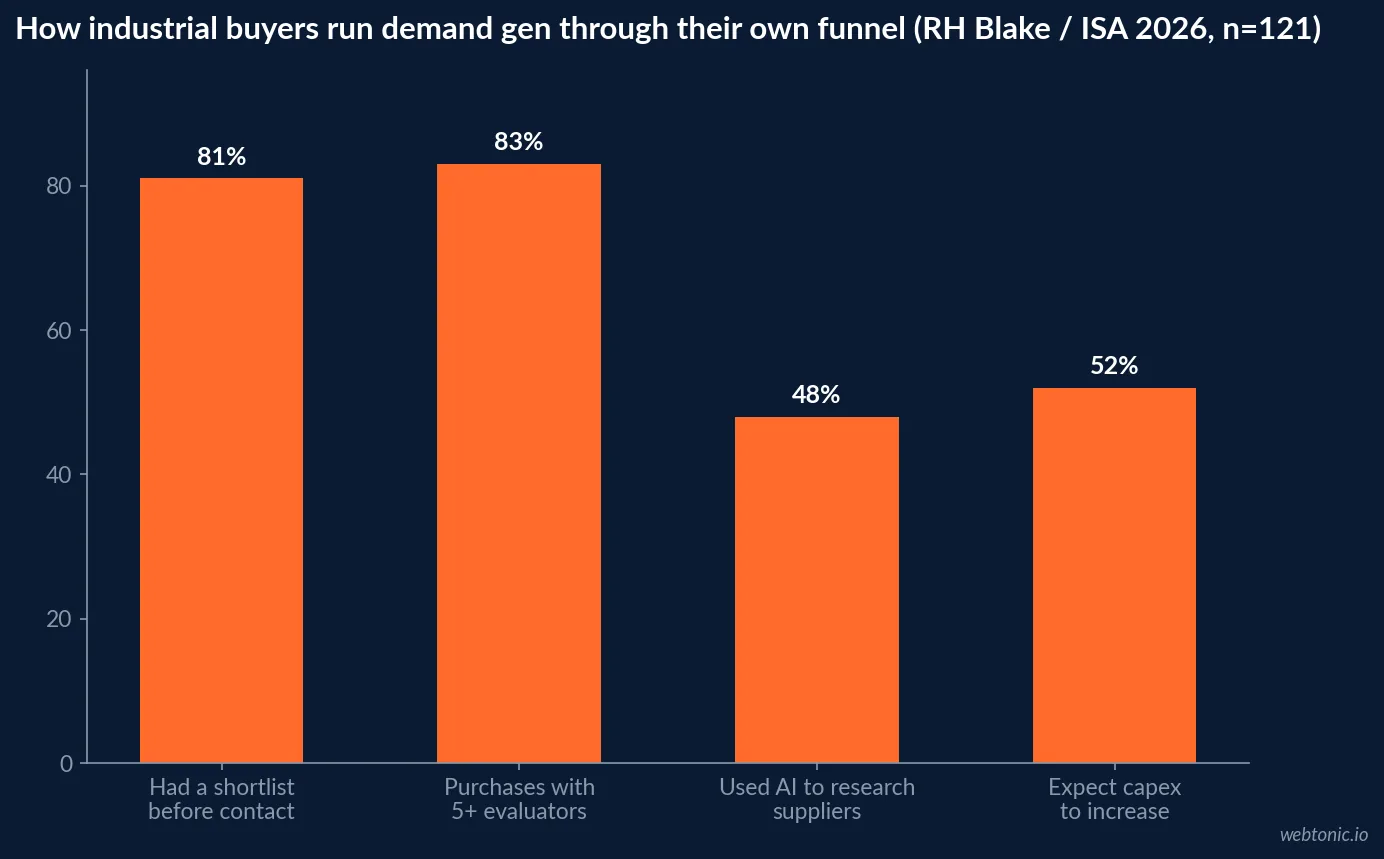
- 81% already had a shortlist before contacting any vendor, RH Blake/ISA 2026 found.
- 64% first engaged a vendor within the first quarter of their buying journey.
- 83% of purchases involve five or more evaluators.
- 66% of respondents hold final or significant decision-making authority.
- 48% used AI to research suppliers in the past 90 days, up from 25% in 2024.
- AI trust averages just 4.9 out of 10 for a major buying decision.
- 21% rate AI trust at 1-2 out of 10, the lowest possible score.
- 52% expect capital expenditure to increase in the next 12 months.
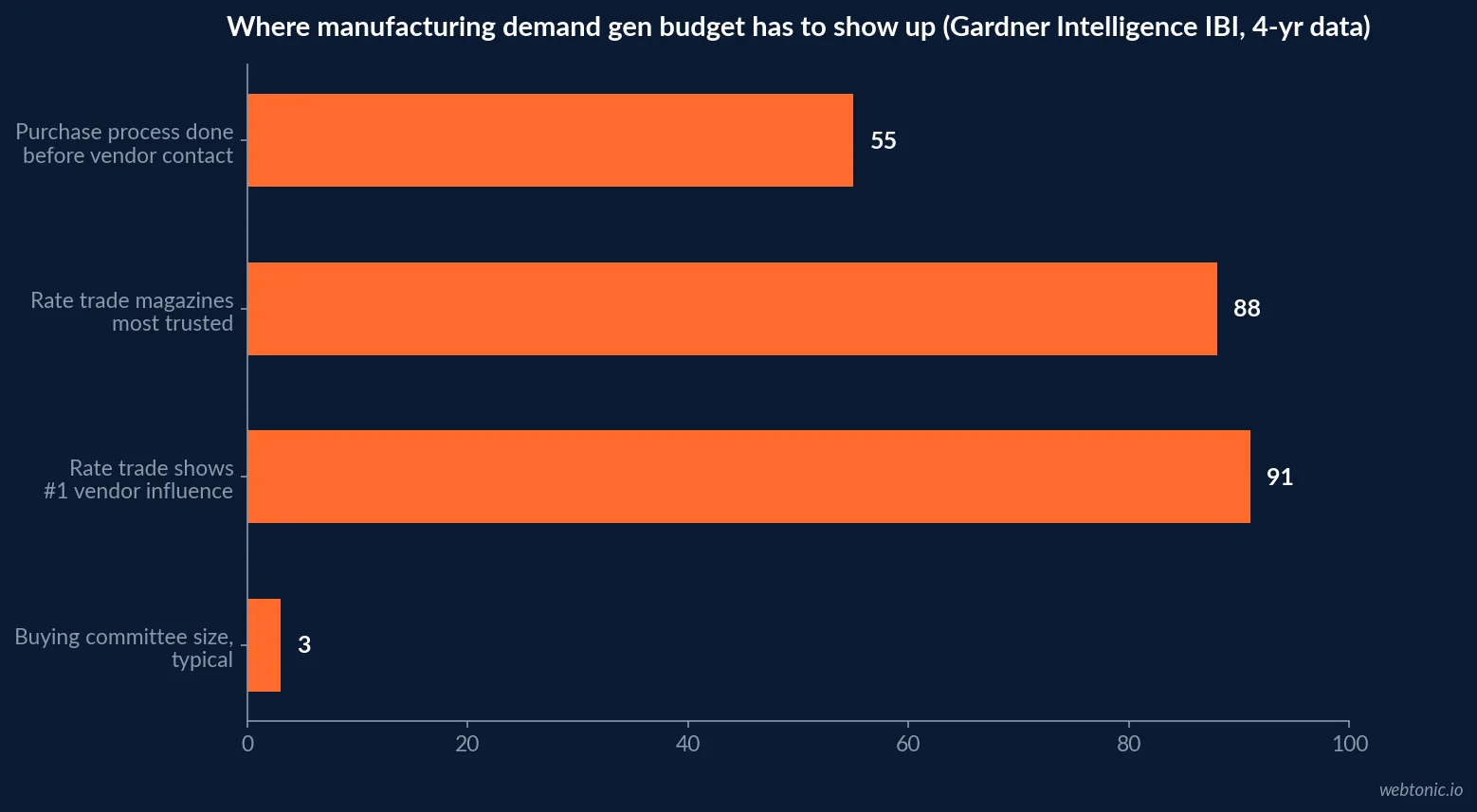
- More than 55% of the purchase process completes before vendor contact, Gardner Intelligence found.
- 88% rate trade magazines the most credible information source.
- 91% rate trade shows the #1 vendor-influence factor since the survey began.
- Typical manufacturing buying committee size is three people.
- Nearly half of capital equipment purchases are project-driven, not calendar-driven.
- 67% of manufacturing marketers call their content only moderately effective.
- Only 48% say there is enough quality thought leadership in their industry.
- 59% said a competitor's thought leadership led them to reduce work with an existing supplier.
- Vendor websites are the first research source for 37% of buyers, ahead of every other channel.
The shortlist is built before your funnel even starts
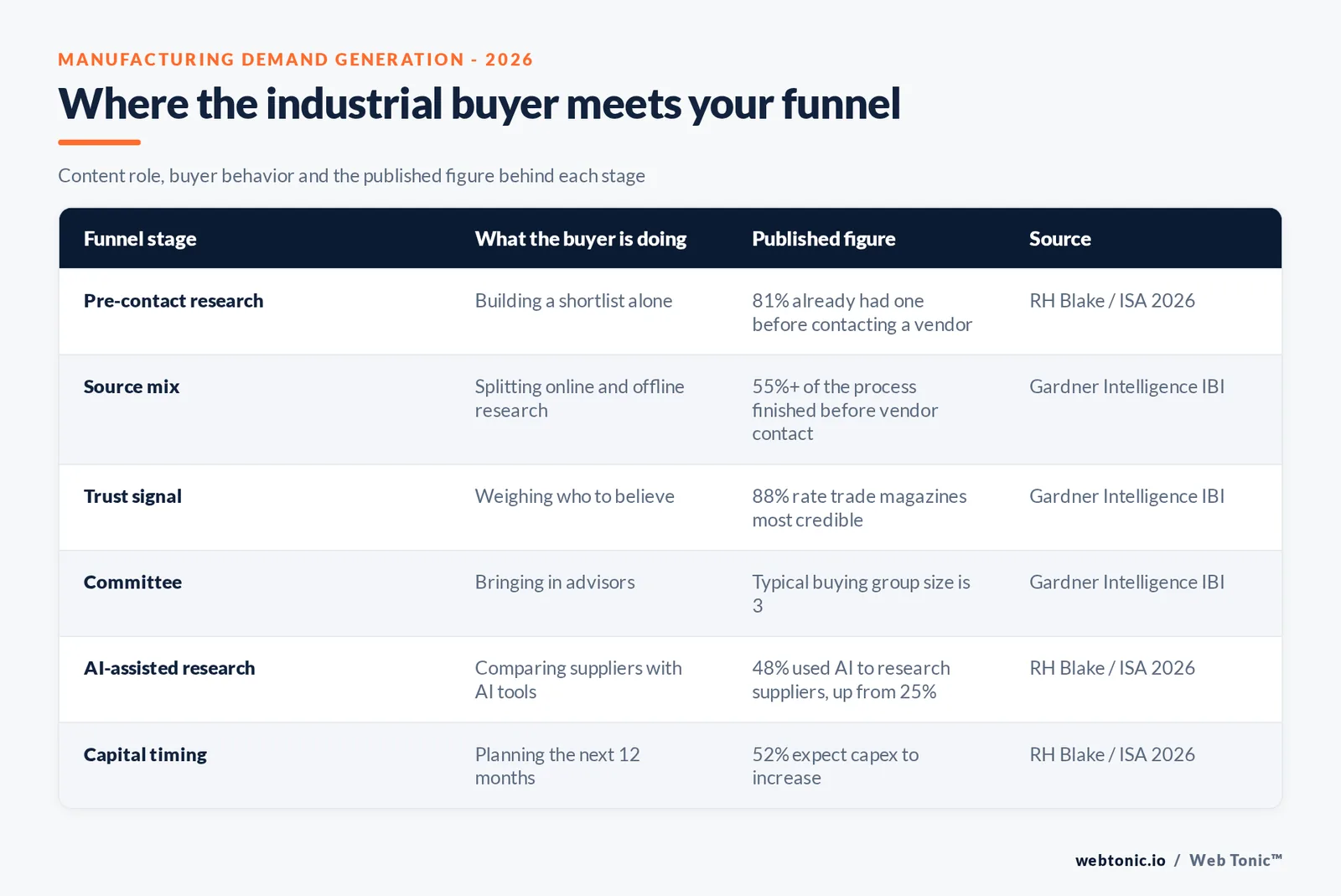
The 2026 B2B Manufacturing Buying Journey and Thought Leadership Research, produced by ISA/Automation.com with RH Blake and surveying 121 global manufacturing, industrial-services, technology and engineering professionals, found 81% already had a shortlist before contacting any vendor, and 64% first engaged a vendor within the first quarter of their buying journey - meaning most of what a demand-gen team calls "top of funnel" is already mid-funnel from the buyer's side.
Vendor websites are the single largest first-touch research source at 37%, ahead of peer recommendations (15%), webinars (12%), trade publications (11%) and generative AI tools (5%) - which makes the website itself, not a gated whitepaper, the primary demand-gen asset for this industry.
| Research behavior | Figure | Source | What it means for demand gen |
|---|---|---|---|
| Already had a shortlist pre-contact | 81% | RH Blake / ISA 2026 (n=121) | Awareness content decides the shortlist |
| First vendor contact within 25% of journey | 64% | RH Blake / ISA 2026 | Early visibility beats late-stage push |
| Vendor website as first research source | 37% | RH Blake / ISA 2026 | The website is the top-of-funnel asset |
| Purchase process done before vendor contact | 55%+ | Gardner Intelligence IBI | Content must do the selling pre-call |
| Sources used throughout the process | 83% vendor sites, 55% peers, 54% trade pubs | RH Blake / ISA 2026 | Multi-channel presence, not one asset |
Who is actually deciding, and how many of them are there
Gardner Intelligence's multi-year Industrial Buying Influence study and its own four-year trend recap put the typical manufacturing buying committee at three people, holding steady for four straight years. RH Blake/ISA's 2026 research found 83% of purchases involve five or more evaluators, with 66% of its respondents personally holding final or significant decision-making authority.
Both figures point the same direction: a demand-gen program built around one persona and one buying moment is targeting a committee that does not exist. Content has to carry differently for the advisor who influences and the signer who commits.
Trade shows and trade magazines still outrank digital influence
Gardner Intelligence's data rates trade shows the #1 vendor-influence factor at 91% since its survey began, and reports trade shows jumped to the #1 information source in 2025 - the sharpest single-year gain in the entire dataset. Separately, 88% of manufacturing buyers rate trade magazines "more credible and trusted" for product and process information, ahead of any digital-only channel measured.
That does not make digital demand gen pointless - it makes it a supporting channel to a face-to-face and editorial-trust motion that manufacturing marketers routinely underfund relative to how buyers say they actually decide.
| Influence channel | Figure | Source | Notes |
|---|---|---|---|
| Trade show, vendor-influence rating | 91% | Gardner Intelligence IBI | #1 factor since the survey began |
| Trade magazine, trust rating | 88% | Gardner Intelligence IBI | No digital channel scores comparably |
| Nearly half of capex purchases are project-driven | ~50% | Gardner Intelligence IBI | Urgency-based campaigns fight buyer behavior |
| Thought leadership use at awareness/consideration | 80% | RH Blake / ISA 2026 | Rose from a lower base year over year |
| Thought leadership use at decision stage | 48% | RH Blake / ISA 2026 | Usage drops as the deal nears close |
AI research adoption doubled - trust did not follow
RH Blake/ISA's 2026 study found 48% used AI to research suppliers in the past 90 days, nearly double the 25% measured in 2024. But the average AI-trust score for a major buying decision is just 4.9 out of 10, and 21% rated their AI trust at 1 or 2 out of 10 - the lowest possible score on the scale. Buyers reported using AI mainly for technical-fit assessment (60%) and supplier comparison (50%), then verifying independently before committing capital.
The practical implication: AI-optimized content earns a supplier a spot on the AI-assisted shortlist, but the trade-show floor, the trade-magazine review and the sales/applications engineer conversation still close the sale that shortlist enables.
How manufacturing marketers rate their own content, and why the gap matters
The Content Marketing Institute's manufacturing research, run annually with MarketingProfs, found 67% of manufacturing marketers rate their content strategy only moderately effective, 13% rate it not very or not at all effective, and just 20% call it very effective. That self-assessment lines up with RH Blake/ISA's separate finding that only 48% of buyers believe there is enough quality thought leadership in their industry - down 14 points in two years - and that 59% said a competitor's thought leadership led them to end or reduce work with an existing supplier.
The gap is not a volume problem; it is a relevance and format problem, given that vendor websites already win 37% of the first-touch research moment above.
| Content self-assessment (CMI/MarketingProfs) | Share of manufacturing marketers | Reading |
|---|---|---|
| Content strategy very effective | 20% | A minority are actually converting research into pipeline |
| Content strategy moderately effective | 67% | Most sit in an ambiguous middle rather than a clear win |
| Content strategy not very / not at all effective | 13% | A real failure segment, not a rounding error |
| Buyers who see enough quality thought leadership | 48% | Down 14 points in two years, per RH Blake/ISA |
| Buyers who reduced work over competitor thought leadership | 59% | Content is now a retention risk, not just an acquisition tool |
What the budget line actually needs to fund
Given 52% expect capex to increase in the next 12 months per RH Blake/ISA, and nearly half of purchases are project-triggered rather than calendar-triggered per Gardner Intelligence, the highest-leverage spend is always-on: a website built to answer the 83% of research that happens before contact, a trade-show and trade-publication presence that matches how buyers say they actually decide, and AI-legible technical content for the 48% now researching with AI tools before they ever trust one enough to buy from it.
That spend also has to be sequenced against the CMO Survey's own budget data: marketing budgets sit at 9.4% of company revenues and 11.4% of overall company budgets as of the most recent wave, which sets the ceiling most manufacturing marketing teams are actually negotiating inside, not an open-ended growth number.
| Budget input | Figure | Source | Why it caps or sizes the spend |
|---|---|---|---|
| Marketing budget, % of revenue | 9.4% | The CMO Survey | The realistic ceiling for most programs |
| Marketing budget, % of overall company budget | 11.4% | The CMO Survey | Sets internal competition for the same dollars |
| Industrial & Commercial paid search CPC (2025) | USD 5.70 | WordStream 2025 Google Ads Benchmarks | Paid search still competes for the same buyer moment |
| Business + Finance email open rate | 31.35% | Mailchimp email benchmarks | Nurture email remains a viable mid-funnel channel |
| Business + Finance email click rate | 2.78% | Mailchimp email benchmarks | Sets a realistic nurture conversion floor |
What buyers themselves ask suppliers to fix first
Thomasnet's own polling of more than 250 verified registered industrial buyers found the most repeated advice was procedural, not creative: respond to inquiries on a stated timeline rather than going silent, keep product data current and easy to navigate on the website, and give a real price the first time rather than negotiating from an inflated anchor. None of that requires a bigger content budget - it requires operational discipline behind the website that already wins 37% of first-touch research.
Combined with RH Blake/ISA's finding that 81% arrive with a shortlist already built, the practical reading is that demand generation in this sector is won by being findable, current and responsive before the sales conversation starts, not by out-spending a competitor on gated content once it does.
Sequencing demand gen against a paid channel
Because up to 55% of the buying process closes before a vendor is contacted, paid search and paid social spend aimed at bottom-of-funnel keywords arrives too late for the 81% who already have a shortlist. The more defensible allocation puts paid budget against the awareness and consideration window - where thought-leadership usage runs at 80% per RH Blake/ISA - and reserves search spend for the smaller pool of buyers still actively comparing at decision stage. See our Google Ads agency practice for how that split is usually modeled for a long sales-cycle B2B account.
If you want this funnel mapped against your own product line, talk to us or see our growth marketing practice and data and analytics practice for how the buying-committee data above gets built into attribution.
Frequently Asked Questions
How much of the buying process happens before a manufacturer talks to a vendor?
More than half, on two separate studies. Gardner Intelligence's Industrial Buying Influence data puts it at more than 55% of the purchase process completed before a buyer contacts a vendor. RH Blake and ISA's 2026 B2B Manufacturing Buying Journey Research, surveying 121 global manufacturing, industrial-services, technology and engineering professionals, found 81% already had a vendor shortlist before making first contact, and 64% first engaged a vendor within the first quarter of their journey - with a shortlist already assembled.
Who is actually in the room when a manufacturer buys?
A small committee, consistently. Gardner Intelligence's multi-year Industrial Buying Influence data puts the typical manufacturing buying group at three people, and RH Blake/ISA's 2026 study found 83% of purchases involve five or more evaluators, with 66% of its respondents personally holding final or significant decision-making authority. Demand generation content aimed at a single buyer persona misses the advisors who influence but do not sign.
Are manufacturing buyers actually using AI to research suppliers?
Yes, and it nearly doubled in a year: RH Blake/ISA's 2026 research found 48% of respondents used AI to research suppliers in the past 90 days, up from 25% in the 2024 wave. Trust has not kept pace - the average AI-trust score for a major buying decision is just 4.9 out of 10, and 21% of respondents rated their AI trust at 1 or 2 out of 10, the lowest possible - buyers use AI to shortlist, then verify independently before committing.
What still beats digital content for influencing an industrial buyer?
The trade show, by a wide margin. Gardner Intelligence's data rates trade shows the #1 vendor-influence factor at 91% since the survey began, and trade shows jumped to the #1 information source overall in 2025 - the sharpest single-year gain in the dataset. 88% of manufacturing buyers separately rate trade magazines as the most credible information source, ahead of any digital channel measured.
How effective do manufacturing marketers think their own content strategy is?
Middling, by their own admission. The Content Marketing Institute's manufacturing research, run with MarketingProfs, found 67% of manufacturing marketers rate their content strategy only moderately effective, 13% rate it not very or not at all effective, and just 20% call it very effective - a self-assessment that tracks with RH Blake/ISA's separate finding that only 48% of buyers think there is enough quality thought leadership in their industry, down 14 points in two years.
Sources
RH Blake / ISA Automation.com - 2026 B2B Manufacturing Buying Journey Research
Gardner Intelligence - Industrial Buying Influence study 2025
Gardner Web - 10 things the Industrial Buying Influence data has taught us
Content Marketing Institute - Manufacturing Content Marketing Benchmarks, Budgets and Trends
Thomasnet - Priceless advice: industrial buyers weigh in
The CMO Survey - Highlights and Insights Report 2025
WordStream - 2025 Google Ads benchmarks by industry
Mailchimp - Email marketing benchmarks by industry