Table of contents
A manufacturing "affiliate program" is not a retail cost-per-sale link - it is a dealer or distributor partner program funded through co-op advertising funds and volume rebates, and the 2025 benchmark study behind this page named real manufacturers (Andersen, Copeland, JELD-WEN, Marvin, Siemens) rather than modeling from a retail network. Budgeting the wrong model here means quoting a commission percentage that does not exist in this channel.
Key Takeaways
- 80% of manufacturers run one unified partner program, not several separate ones.
- 70% cite sales volume as the top tier-eligibility criterion.
- 89% use volume specifically as a tier-assignment factor once inside the program.
- 60% run three to five partner tiers.
- 80% of co-op funds are earned as a percent of spend, not a fixed amount.
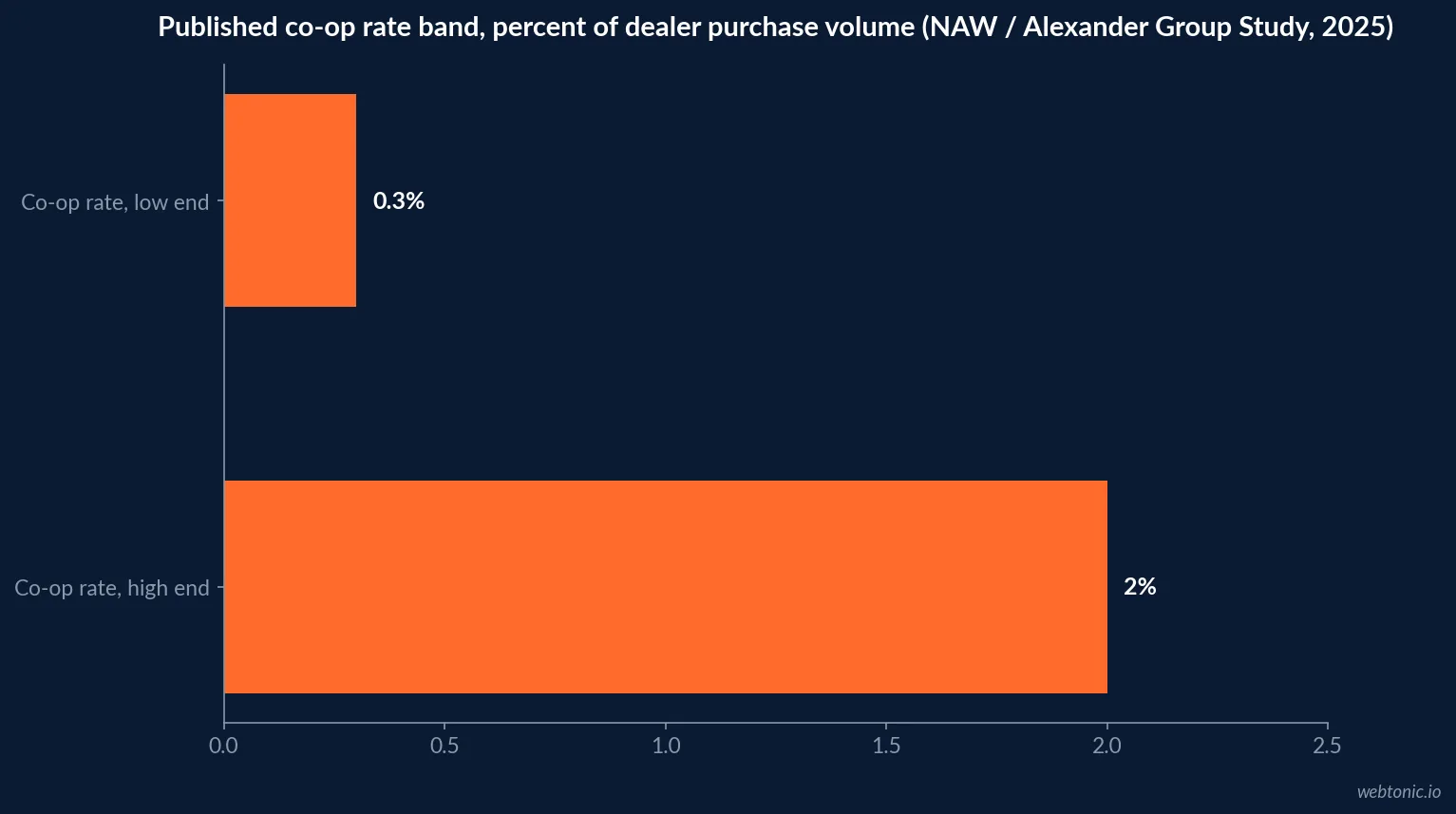
- Co-op rates typically run 0.3% to 2.0% of dealer purchase volume.
- Only 50% of programs strongly enforce co-op spend-rule adherence.
- Just 33% give displays for free - most charge for point-of-sale materials.
- Lowest-tier rebates range 0% to 3.5% of qualifying volume.
- Highest-tier rebates range 2.5% to 8.5%.
- 38% keep pricing/discounting formally inside the partner program, 38% run it outside.
- Discounts typically range 10% to 30%, varying by industry.
- Only 18% offer non-financial incentives beyond the money.
- 69% of B2B partnership leaders are raising investment, PartnerStack/Wynter found.
- USD 2.7 billion in all-time GMV moved through PartnerStack's B2B network.
- 52% year-over-year transaction growth on that same network.
The study behind this page: a manufacturer benchmark, not a retail model
Most affiliate-marketing statistics pages price a retail cost-per-sale network. That model does not exist in industrial manufacturing, where the equivalent channel is a dealer or distributor partner program. The NAW / Alexander Group Manufacturer-Dealer Partner Program Study 2025 built its figures from partner-program documentation, a distributed survey and one-hour interviews with named manufacturing participants including Andersen, Copeland, Cornerstone, Georg Fischer, Hearth & Home, JELD-WEN, Janus International, Legrand AV, Lixil, Marvin, Panda Windows, Siemens and Sun Windows - a manufacturer-side sample, not a publisher-side one.
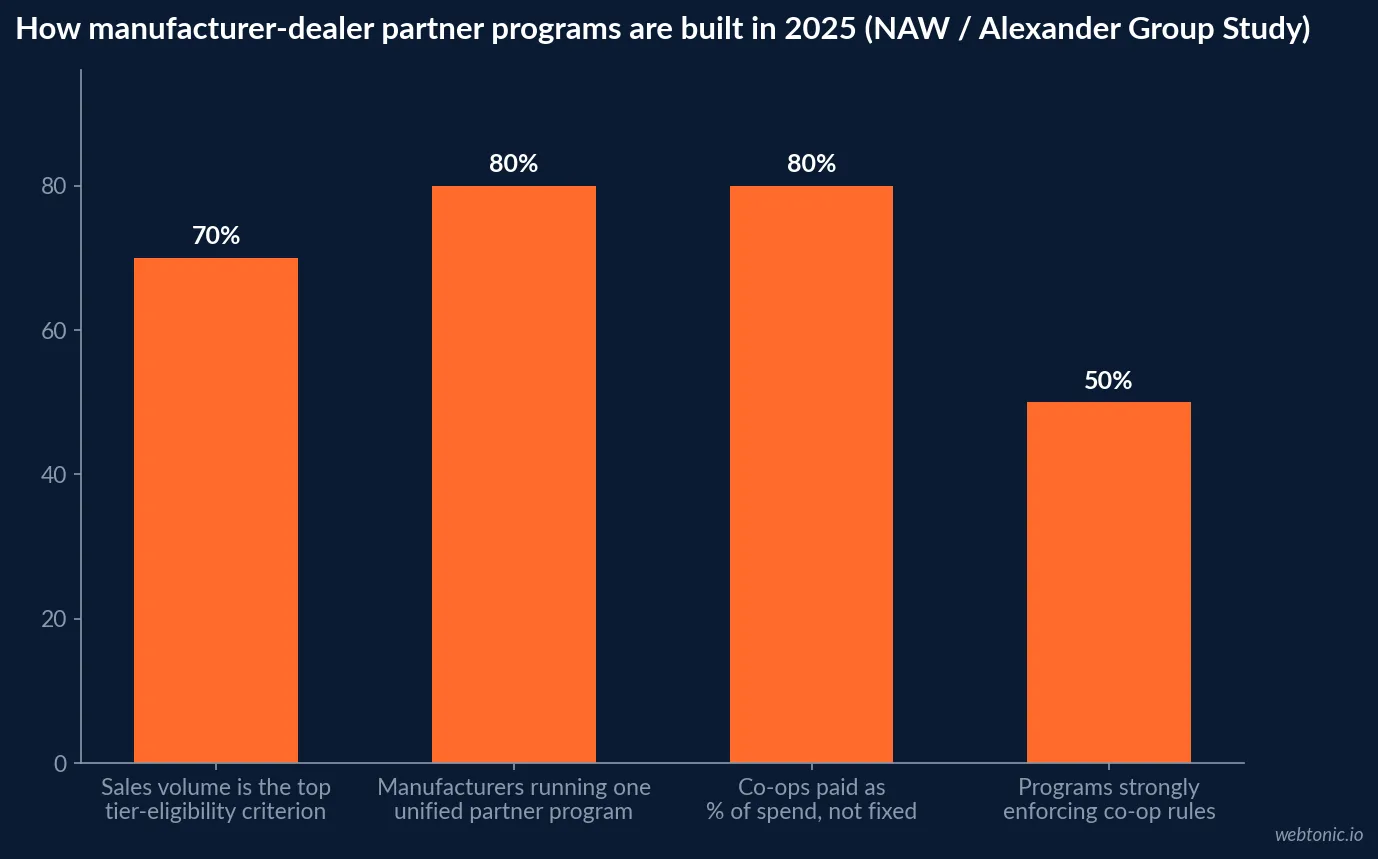
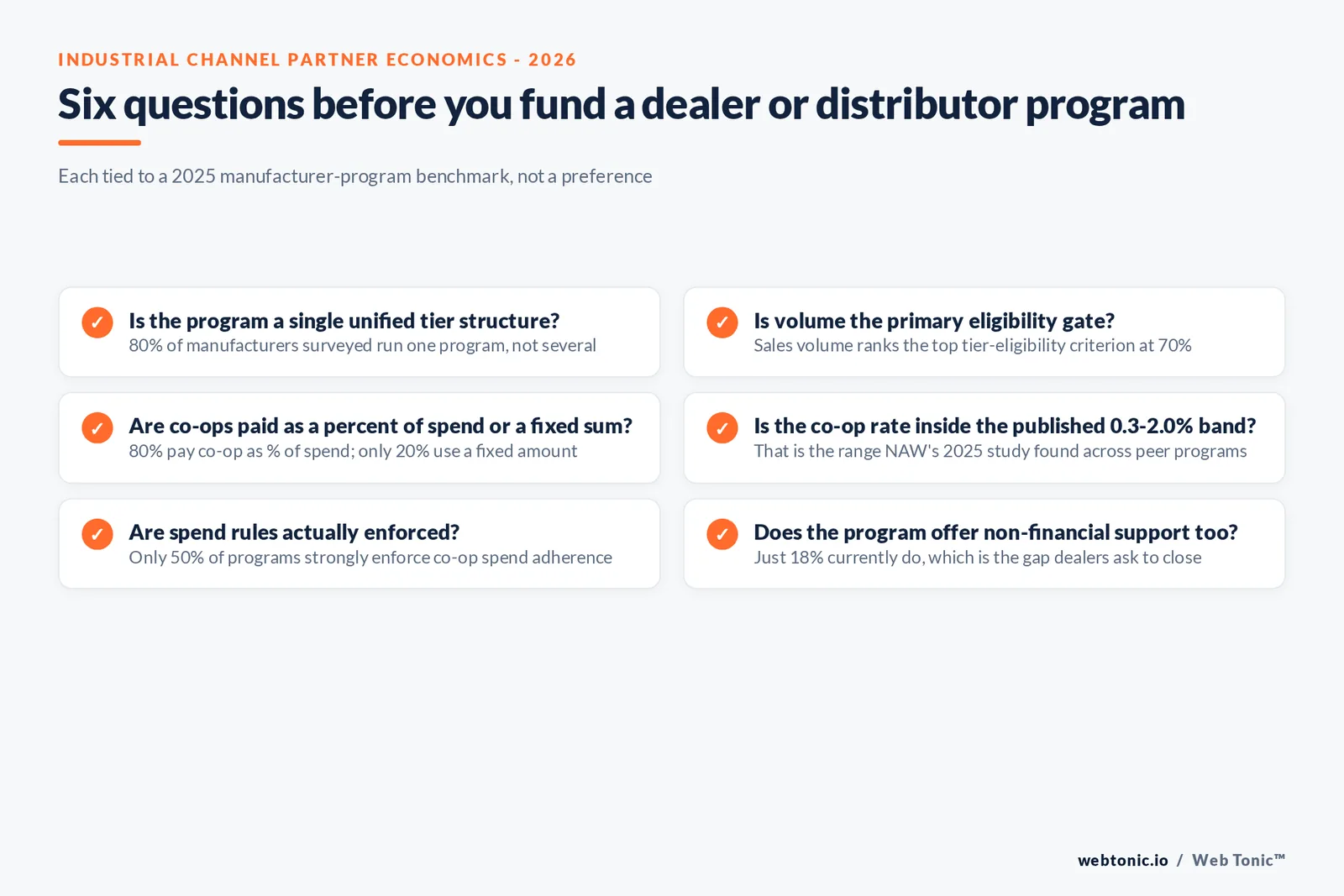
80% of manufacturers surveyed run a single unified partner program rather than several disparate ones, and 60% structure it across three to five tiers, most commonly built around sales volume - cited as the top eligibility criterion by 70% and used as a tier-assignment factor by 89% once a dealer is inside the program.
| Program element | Figure | What it means for the budget line |
|---|---|---|
| Single unified partner program | 80% | One tier ladder to fund, not several parallel ones |
| Sales volume as top eligibility criterion | 70% | Entry gate is revenue, not marketing activity |
| Volume used in tier-assignment | 89% | Tier movement tracks purchase volume closely |
| Programs with 3-5 tiers | 60% | Budget scales in known steps, not continuously |
| Post-installation service required | 38% | A service-capability gate on top of volume for some programs |
How co-op funds are actually priced and policed
The same study found 80% of co-op advertising funds are earned as a percent of spend rather than a fixed dollar amount, with the published range typically running 0.3% to 2.0% of a dealer's qualifying purchase volume. Enforcement is the softer half of the equation: only 50% of programs strongly enforce adherence to co-op spend rules, and displays - the point-of-sale materials dealers use to actually spend the fund - are given away free in just 33% of programs.
That gap between a published rate and enforced compliance is exactly where budget leaks in a channel partner program: money is committed at the published percentage, but without enforcement it does not reliably convert into the marketing activity it was meant to fund.
| Co-op / rebate mechanic | Published figure | Source note |
|---|---|---|
| Co-op paid as % of spend vs. fixed | 80% / 20% | NAW / Alexander Group Study 2025 |
| Co-op rate band | 0.3% - 2.0% of purchase volume | NAW / Alexander Group Study 2025 |
| Programs strongly enforcing co-op rules | 50% | NAW / Alexander Group Study 2025 |
| Displays given free | 33% | NAW / Alexander Group Study 2025 |
| Lowest-tier rebate range | 0% - 3.5% of qualifying volume | NAW / Alexander Group Study 2025 |
| Highest-tier rebate range | 2.5% - 8.5% of qualifying volume | NAW / Alexander Group Study 2025 |
Where discounting sits, and what dealers say is still missing
Pricing discounts sit formally inside the partner program for 38% of manufacturers and are managed outside it for another 38%, with the remainder split between the two or handled case by case - typical discount ranges run 10% to 30%, varying by industry and by what non-price benefits ride alongside the discount. The clearest gap in the study: only 18% of manufacturers currently offer non-financial incentives - executive access, in-person events, marketing support beyond the co-op check - even as "almost all cited go-forward investment" specifically to differentiate on that dimension.
Dealers, per the study's own framing, consistently ask for more executive access and in-person events - the relationship layer that a rebate percentage cannot substitute for.
Where the B2B SaaS partnership platform data fits - and where it does not
PartnerStack and Wynter's State of Partnerships in GTM 2026 report found 69% of B2B SaaS leaders raising partnership investment, with zero respondents reporting a decrease, and PartnerStack's own 2026 Network Report puts its all-time GMV at USD 2.7 billion with 52% year-over-year transaction growth. Those figures describe a tracked, software-native partnership motion - useful as a reference for manufacturers layering a digital reseller or systems-integrator program (Rockwell Automation's PartnerNetwork and Siemens' Solution Partner program are both built on this newer model) on top of the traditional dealer channel.
They are not a substitute for the co-op and rebate data above, which still governs the physical distribution side of the business for most industrial manufacturers.
| Channel model | Governs | Key 2025-2026 figure | Source |
|---|---|---|---|
| Traditional dealer/distributor program | Physical goods, co-op + rebates | 0.3-2.0% co-op, 2.5-8.5% top-tier rebate | NAW / Alexander Group 2025 |
| Digital reseller / solution-partner program | Software, integration services | 69% raising investment, USD 2.7B GMV | PartnerStack / Wynter GTM 2026 |
| Certified installer / technology partner | Brand-specific specification | Contract-specific, not publicly rated | Rockwell Automation, Siemens (own pages) |
How this differs from the retail affiliate channel priced elsewhere on this site
Our companion hub on manufacturing digital marketing statistics covers the demand side of this industry; the general retail-network affiliate model - cost-per-sale commissions, cookie windows, FTC disclosure - is priced separately for brands that actually run that model. Manufacturers evaluating whether to add a retail-style affiliate arm on top of an existing dealer network should budget the two as genuinely separate line items, not variations on one commission rate, because the co-op and rebate figures above do not translate into a cost-per-sale percentage at all.
| Question a manufacturer should ask before adding a channel | Dealer/distributor answer | Retail-affiliate answer |
|---|---|---|
| What is the payout mechanism? | Co-op fund (% of spend) plus volume rebate | Cost-per-sale commission through a tracked link |
| Who enforces compliance? | The manufacturer's channel team, per contract | The network, per its own terms and the FTC's 16 CFR 255 |
| What is the typical rate? | 0.3-2.0% co-op, 2.5-8.5% top-tier rebate | Category-specific, no single published average |
| What does the 2025-2026 data say about growth? | 50% enforcement gap is the open risk | Network-reported publisher/advertiser confidence is rising |
Building the industrial partner-program budget
A defensible line item separates the co-op fund (priced against the published 0.3-2.0% band, not a guessed flat percentage), the volume rebate ladder (0-3.5% at entry, 2.5-8.5% at the top tier), an enforcement allocation - since only half of programs currently police their own spend rules - and a non-financial relationship budget, the gap only 18% of manufacturers currently fund. Skipping the last line is the single most commonly cited dealer complaint in the underlying study.
None of these four lines is optional if the goal is a program dealers actually use rather than one that looks complete on a slide. A co-op fund with no enforcement (the 50% gap above) pays out the same whether or not the dealer ever ran the campaign it was meant to fund, which is the single most common way this budget quietly disappears.
What a disclosure review still needs to cover
Even though a manufacturer dealer program is not a retail affiliate link, the same baseline transparency principle behind the FTC's 16 CFR Part 255 endorsement rules is worth applying internally: dealers should know exactly which tier they qualify for, exactly what percentage of spend the co-op fund reimburses, and exactly which spend categories the program covers before they commit marketing dollars against an assumed reimbursement. The enforcement gap the NAW/Alexander Group study found - half of programs not strongly enforcing their own rules - runs in both directions: dealers who assume coverage that was never actually guaranteed lose trust in the program just as fast as one that under-pays a compliant claim.
For the demand-generation side of the same industry - how the funnel behaves before a dealer or direct buyer even reaches this partner conversation - the buyer-research patterns we track for industrial demand generation live in our growth marketing practice. To have this partner-program structure modeled against your own dealer network, talk to us or see our data and analytics practice for tracking co-op spend against actual dealer activity.
Frequently Asked Questions
Do manufacturers actually run an 'affiliate program' the way a retailer does?
No, and calling it that misprices the channel. Retail affiliate networks pay a cost-per-sale commission through a link. Manufacturers instead run dealer or distributor partner programs funded mostly through co-op advertising funds and volume rebates. The NAW / Alexander Group Manufacturer-Dealer Partner Program Study 2025, drawing on documentation and interviews with named manufacturers including Andersen, Copeland, JELD-WEN, Marvin and Siemens, found 80% of manufacturers run a single unified partner program rather than several separate ones, structured around tiers, not individual affiliate links.
How is a manufacturer co-op fund actually priced?
The same 2025 study found 80% of co-op funds are earned as a percent of a dealer's purchase spend rather than a fixed dollar amount, with the published rate typically running 0.3% to 2.0% of that spend. Only 50% of programs strongly enforce adherence to co-op spend rules, and displays are rarely given for free - just 33% of programs do that. Sales volume is the single most-cited tier-eligibility criterion, at 70%.
What do rebates look like across dealer tiers?
By the same study, lowest-tier rebates typically range 0% to 3.5% of qualifying volume, while the highest tier ranges 2.5% to 8.5%, with most manufacturers paying back to dollar one once a dealer clears the qualifying threshold. Discounts sit inside the program for 38% of manufacturers and are managed outside it for another 38%, with typical discount ranges of 10% to 30% depending on the industry and what other benefits ride alongside the discount.
Is there a B2B partnership platform figure that applies to industrial manufacturers directly?
Indirectly. PartnerStack's own network - built for B2B SaaS rather than physical-goods manufacturing - reports USD 2.7 billion in all-time GMV and 52% year-over-year transaction growth, and 69% of B2B SaaS leaders say they are raising partnership investment. Those numbers describe the software-partnership model manufacturers are increasingly borrowing structure from (tiered enablement, tracked commission), not the co-op/rebate economics that still govern the physical dealer channel.
What is the biggest gap dealers report in manufacturer partner programs?
Non-financial support. The NAW/Alexander Group study found only 18% of manufacturers currently offer non-financial incentives - executive access, in-person events, marketing support beyond the co-op fund - even though dealers consistently ask for more of exactly that. Manufacturers investing in the financial tiering while skipping the relationship layer are optimizing the smaller half of what dealers say they actually want.
Sources
NAW / Alexander Group - Manufacturer-Dealer Partner Program Study 2025
PartnerStack / Wynter - The State of Partnerships in GTM 2026
PartnerStack - 2026 Network Report
Rockwell Automation - PartnerNetwork Program
Siemens - Solution Partner Program
eCFR - 16 CFR Part 255, FTC Endorsement Guides