Table of contents
LinkedIn charges a locksmith about $110 per lead against $34 on Local Services Ads. That is only worth paying for one thing: commercial access-control contracts worth $50–$500 per door per year. Here is the 2026 benchmark data and the break-even maths.
Key Takeaways
- Sponsored content CPC averages $5.50–$8.50 ($3.94 median for top performers).
- CPM runs $31–$50, up to $78+ for account-based audiences.
- Median cost per lead is ~$110; seniority ranges run $45–$250+.
- Google LSA averages $53 across home services and $34 for locksmith work.
- Lead Gen Forms convert at 10–18% (median 13%) vs 2–6% for landing pages.
- But form leads reach SQL at 25–40% vs 40–55% for landing-page leads.
- Sponsored content CTR benchmarks sit at 0.44–0.65%.
- SMB targeting: $3–$5 CPC vs $15–$25+ for enterprise audiences.
- 4 in 5 LinkedIn members hold decision-making authority; 65M decision-makers, 10M C-level.
- LinkedIn revenue reached $19.8B for the full year, up 12% YoY in Q4.
- Commercial access control is a $10.64B market growing at 8.8% CAGR.
- $10 minimum daily budget per campaign — roughly $300/month to test anything.
1. What LinkedIn Ads Cost in 2026
LinkedIn is the most expensive mainstream paid channel per click, and the benchmark sets agree on the ranges. Datavinity and Foundry CRO publish the tightest data.
| Metric | Global average | Top performers / range |
|---|---|---|
| CTR (sponsored content) | 0.44–0.65% | 0.55–0.80%+ |
| CPC (sponsored content) | $5.50–$8.50 | $3.94 median; $2.29–$24+ full range |
| CPM | $31–$50 | Up to $78+ (ABM audiences) |
| On-platform conversion rate | 2.0–6.1% | Up to 10%+ |
| Lead Gen Form CVR | 13% | 15–20% |
| Landing page CVR | 4.02% | 6–8% |
| Cost per lead | ~$110 median | $75–$200 typical; $408 reported average |
| Minimum daily budget | $10 per campaign | ≈$300/month floor |
Seniority is the biggest cost lever. Published 2026 cost guidance puts CPL at $45–$100 for SMB targeting, $65–$150 mid-market, $80–$200 enterprise and $100–$250+ for C-suite and VP audiences. For a locksmith, that argues for targeting facility and operations managers rather than executives — the people who actually specify hardware are cheaper to reach than the people who sign at the top.
2. The Channel Comparison That Matters
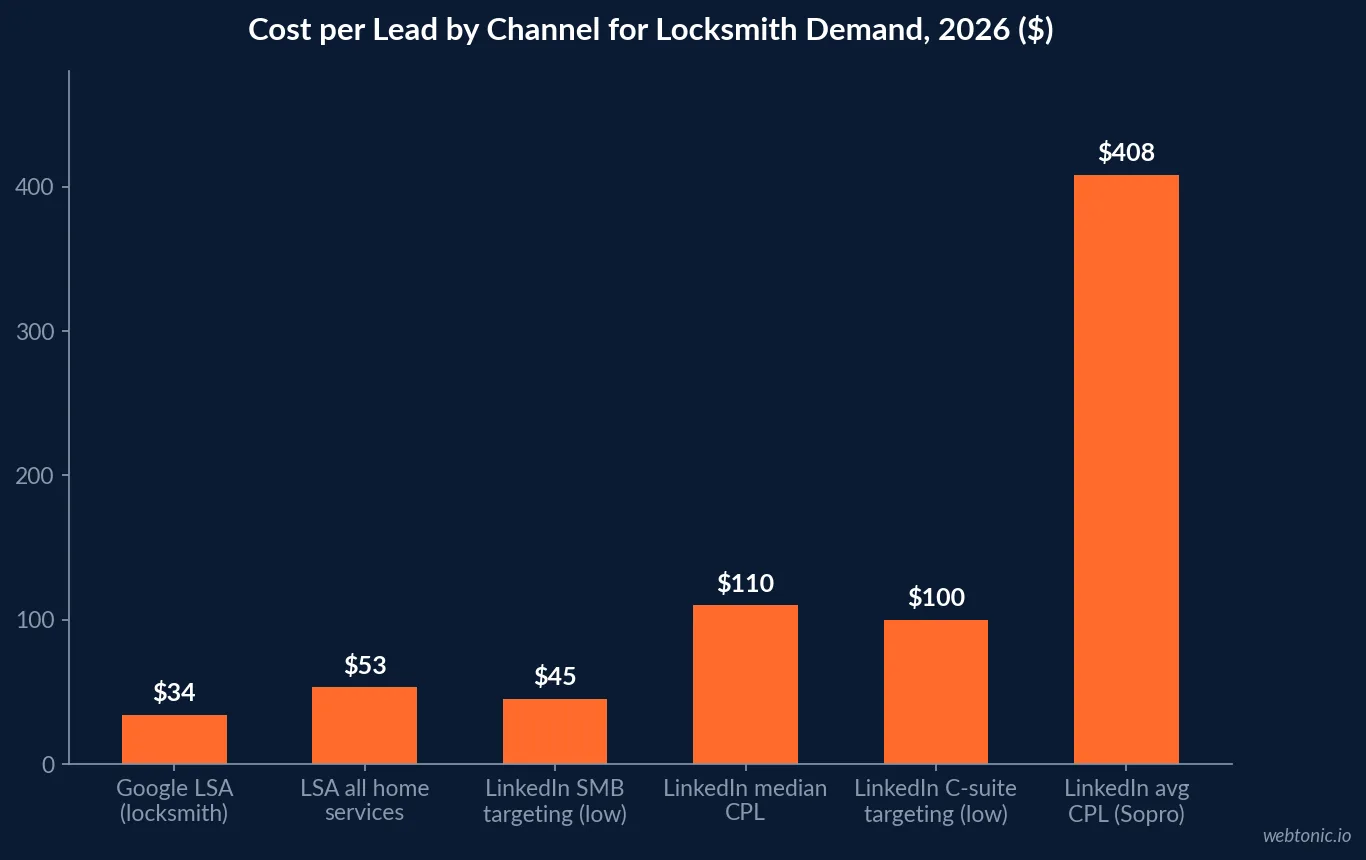
Set the LinkedIn number against what the same shop pays elsewhere. Local Services Ads data across 888 contractors and $6.72M of tracked spend puts the home-services average at $53 per lead, 49% cheaper than blended Google Ads at $104, while locksmith-specific LSA cost per lead sits near $34, up 21% year over year.
| Channel | Typical cost per lead | Demand type | Fit for locksmith |
|---|---|---|---|
| Google Local Services Ads | $34 | Existing, urgent | Primary — lockouts and rekeys |
| Google Ads (blended) | $104 | Existing, researched | Secondary capture |
| LSA all home services | $53 | Existing, urgent | Benchmark reference |
| LinkedIn (SMB targeting) | $45–$100 | Created, no urgency | Commercial contracts only |
| LinkedIn (median) | ~$110 | Created, no urgency | Justified by contract size |
| LinkedIn (C-suite) | $100–$250+ | Created, long cycle | Rarely worth it locally |
The conclusion is not that LinkedIn is bad — it is that LinkedIn and LSA are not substitutes. One buys urgency that already exists; the other buys access to people who have never thought about their master-key schedule. Comparing their CPLs directly is the most common way locksmith shops talk themselves out of the more profitable half of the business. Our locksmith digital marketing statistics lay out the full channel mix.
3. Why Commercial Work Changes the Maths
A $110 lead is absurd for a $215 lockout and cheap for a recurring access-control account. The industry data makes the gap explicit.
- Commercial services account for roughly 35% of locksmith industry revenue.
- 65% of locksmiths now provide electronic access control; 54% offer stand-alone access control.
- Master-key systems appear in about 18% of business calls; access-control audits in ~14% of corporate contracts.
- Typical project values: $1,500–$4,000 small commercial rekey programs, $4,000–$15,000 multi-tenant master-key systems, $1,800–$4,500 per electronic access-control install.
- A 500-door account at $200 per door per year produces $100K recurring revenue at 70–85% gross margin and 5–10% annual churn.
- Commercial-led operators trade at 3x–7x EBITDA versus 3x–4x SDE for residential-emergency shops.
Run the break-even. At a 13% Lead Gen Form conversion rate and a $110 CPL, thirty leads cost $3,300. If one becomes a 200-door contract at $200 per door, that is $40,000 of annual recurring revenue against a one-time acquisition cost — and the multiple on exit rises with the RMR mix. The channel is not expensive; the lockout comparison is just the wrong denominator.
4. The Audience You Are Actually Buying
LinkedIn's pitch is authority density, and the platform-level numbers support it.
| Audience metric | 2026 figure | Relevance to locksmith B2B |
|---|---|---|
| Members with decision-making authority | 4 in 5 | Low waste on junior audiences |
| Decision-makers on platform | 65 million | Facility and ops layer included |
| C-level executives | 10 million | Usually too senior and too costly |
| Users in management or above | 45% | Property/facility manager reach |
| Company pages | 69 million+ | Account-list targeting |
| Share of B2B social leads | ~80% | Platform-reported; treat as directional |
| Audience purchasing power | 2x average web user | Supports premium contract pitch |
| Full-year revenue | $19.8B (+12% YoY in Q4) | Stable, well-funded ad platform |
Those figures come from Leadfeeder's 2026 compilation, LinkedInsider and LinkedIn's own earnings reporting. Note the honest caveat carried by the better sources: the 80% of B2B social leads figure is share of social-sourced leads, not of all B2B leads, and it originates with LinkedIn's marketing materials.
5. Targeting Structure for a Local Shop
LinkedIn is the only paid channel that layers job title, seniority, function, company size and industry simultaneously. For a locksmith, that precision is the entire value proposition — and the fastest way to overspend if left broad.
| Layer | Recommended setting | Why |
|---|---|---|
| Geography | Metro plus service radius only | National reach is unservable |
| Job function | Facilities, operations, real estate | Specifies hardware |
| Seniority | Manager to director | $45–$150 CPL vs $250+ C-suite |
| Company size | 11–200 employees | $3–$12 CPC band |
| Industry | Property mgmt, healthcare, education, hospitality | Highest door counts |
| Account lists | Local property managers and GCs | +30–50% CPC but highest intent |
| Exclusions | Existing customers, competitors, students | Removes structural waste |
| Format | Single image + Lead Gen Form; Thought Leader Ads to test | TLA: 2.68% CTR at $2.29 CPC |
Thought Leader Ads are the notable 2026 efficiency story: 2.68% CTR at $2.29 CPC, roughly 77% cheaper per click than single-image ads, because the ad runs from a person's profile rather than a company page. For an owner-operated locksmith business, that format is unusually well matched — the owner is already the brand, which is the same credibility asset that decides local visibility in our locksmith local SEO statistics.
6. Forms vs Landing Pages
The conversion-rate story reverses when you follow leads downstream, and this is where most B2B benchmark articles stop.
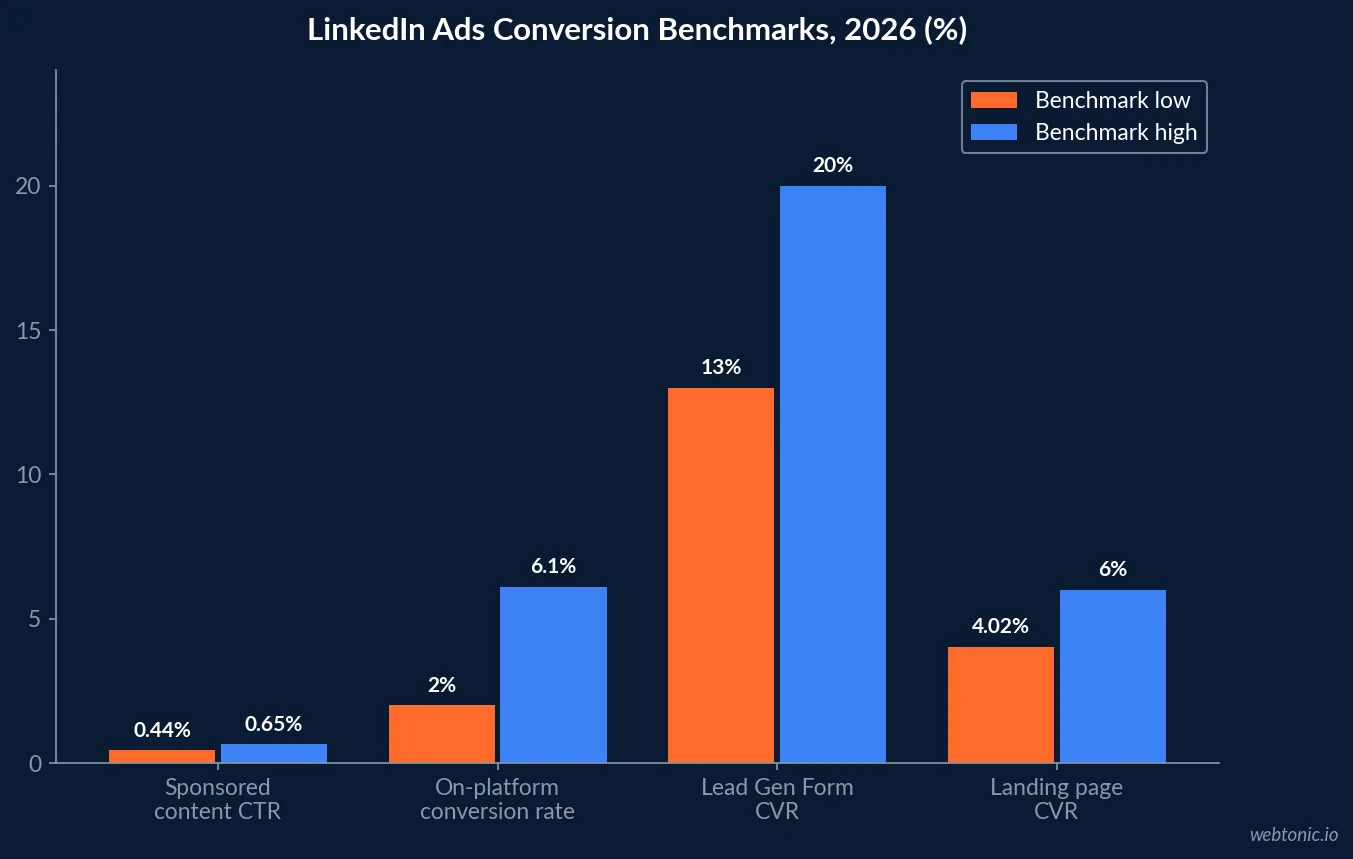
Lead Gen Forms convert at 10–18% (median 13%) against 2–6% for landing pages, and LinkedIn's own reporting puts form conversion near 13% versus ~4% off-platform. Pre-filled profile data cuts drop-off to about 28% against 65% on external forms. But landing-page leads reach sales-qualified at 40–55% versus 25–40% for form leads — the friction was doing qualification work.
The practical resolution for a locksmith: use the form for a low-commitment offer (a site security walkthrough, a master-key schedule review) and treat qualification as a phone job. A form fill from a facility manager is a conversation, not a pipeline entry, and the 34% median missed-call rate in this trade means the follow-up discipline matters more than the ad.
7. The Market Tailwind
The reason this channel is worth revisiting in 2026 is that the underlying commercial demand is growing faster than lockout volume.
- The commercial and physical access-control market was $10.64B in 2025, forecast to $26.84B by 2035 at an 8.8% CAGR.
- Cloud-based access control adoption among SMEs rose 25%.
- Electronic access control integration added ~$180M to US locksmith revenue in the most recent reported year.
- 85% of shops now perform commercial door-hardware installation, up from 75% a year earlier.
- Rekeying after tenant turnover is demanded in about 25% of residential jobs — the natural bridge into property-management accounts.
That is a market where a decision-maker's attention is worth buying at a premium, because the resulting relationship is multi-year and hardware-locked. It is also a market with a long consideration cycle, which means LinkedIn spend should be judged on pipeline created over two quarters, not on cost per lead in a monthly report.
8. Budgeting and Measurement
The floor is structural: $10 minimum daily budget per campaign, so about $300 a month before you learn anything. A realistic locksmith test looks like this.
| Item | Recommendation | Rationale |
|---|---|---|
| Monthly test budget | $1,000–$1,500 | ≈ 10–15 leads at $110 CPL |
| Test duration | 90 days minimum | Commercial cycles exceed one month |
| Campaign count | 2 (one form, one landing page) | Compare CVR and SQL rate |
| Primary KPI | Cost per qualified site survey | Not cost per form fill |
| Secondary KPI | Pipeline value per $1,000 spent | Contracts, not leads |
| Attribution | CRM with source field, not platform only | Cycle outlives the click |
| Kill criterion | No qualified survey in 60 days | Protects the LSA budget |
| Reallocation target | LSA at $34 CPL | Guaranteed floor for capture |
Every one of those numbers has to live in a CRM, not in Campaign Manager. A locksmith running LinkedIn without a joined view will see a $110 cost per lead next to a $34 LSA figure and cut the wrong channel. Our data intelligence team wires that join, and our growth marketing team runs the split.
9. The Bottom Line
LinkedIn Ads are wrong for locksmith emergency demand and can be right for locksmith commercial demand. The costs are unambiguous — $5.50–$8.50 CPCs, $31–$50 CPMs, ~$110 median CPL, a $300/month practical floor — and so is the alternative: $34 per lead on Local Services Ads for people already locked out. What justifies the premium is the contract on the other side: 35% of industry revenue is commercial, a 500-door account at $200/door is $100K of recurring revenue at 70–85% margin, and the access-control market is compounding at 8.8% a year toward $26.84B. Target facility managers, not executives; use forms to book surveys, not to count leads; judge it on pipeline over two quarters. If you want that program modelled against your own contract values, talk to our team.
Frequently Asked Questions
Should a locksmith advertise on LinkedIn at all?
Only for commercial work, and only with the contract maths in front of you. LinkedIn CPCs run $5.50 to $8.50 for sponsored content and median cost per lead lands near $110, against a $34 average cost per lead on Google Local Services Ads and $53 across home services generally. That premium is indefensible for lockouts. It becomes defensible when the target is a facility manager who can sign an access-control contract worth $50 to $500 per door per year — a 500-door account is $100,000 of recurring revenue at 70–85% gross margin, which absorbs a $110 lead cost many times over.
What do LinkedIn Ads cost in 2026?
Sponsored content CPCs average $5.50 to $8.50 with a $3.94 median among top performers, and the full range runs from $2.29 for Thought Leader Ads to $24 or more for C-suite targeting. CPMs sit at $31 to $50, rising past $78 for tight account-based audiences. Cost per lead is the widest variable: published medians cluster near $110, seniority-based ranges run $45 to $100 for SMB targeting and $100 to $250+ for C-suite, and one B2B dataset puts the average as high as $408. LinkedIn also enforces a $10 minimum daily budget per campaign, so no campaign tests for less than about $300 a month.
Do LinkedIn Lead Gen Forms work for a locksmith?
They convert well and qualify poorly, which is a trade-off worth planning for. Lead Gen Forms convert at 10–18% (median 13%) against 2–6% for landing pages, because the form pre-fills from the member's profile and never leaves the feed. But the same benchmark sets report landing-page leads converting to sales-qualified at 40–55% versus 25–40% for form leads. For a locksmith selling site surveys, use the form to book a walkthrough and qualify on the call — never treat a form fill as a commercial opportunity.
Who should a locksmith target on LinkedIn?
The people who own doors, not the people who lose keys. LinkedIn is the only major paid channel that can layer job title, seniority, job function, company size and industry at once, which maps directly onto facility managers, property managers, operations directors, school and healthcare administrators, and general contractors inside a defined metro. Keep it geographically tight and company-size bounded: benchmarks show SMB-targeted campaigns running $3 to $5 CPCs against $15 to $25+ for enterprise, and a locksmith's serviceable radius rules enterprise national accounts out anyway.
How does LinkedIn compare with Google for locksmith lead generation?
They serve different halves of the business. Google captures existing demand — someone is locked out or has already decided to upgrade their access control — at $34 to $53 per lead. LinkedIn creates demand among people with authority who were not searching, at roughly $110 per lead with a longer cycle and a much larger contract at the end. The correct structure for a commercial-minded shop is Google and Local Services Ads for capture, LinkedIn as a small, patient layer aimed at recurring-revenue accounts, with attribution joined in a CRM rather than compared platform to platform.
Sources
Foundry CRO — LinkedIn Ads Benchmarks 2026
Datavinity — LinkedIn Ads Benchmarks 2026
ContactLevel — LinkedIn Ads Cost: CPC, CPM & CPL (2026)
AdLibrary — LinkedIn Advertising Costs 2026
Leadfeeder — LinkedIn Statistics 2026
LinkedInsider — LinkedIn Statistics 2026
LinkedIn — Q4 Earnings & Business Highlights
Emergen Research — Commercial & Physical Access Control Market
CT Acquisitions — Locksmith Buyer's Playbook 2026
Elev8 Operations — Local Services Ads Statistics 2026
Gitnux — Locksmith Industry Statistics 2026