Table of contents
No vendor prices video marketing for landscaping specifically, so this page anchors a budget in the industry's own digital-marketing spend data and applies 2026 cross-industry video research to a business built around visible, seasonal, before/after work. Every cross-industry figure is labeled as such.
Key Takeaways
- U.S. landscaping services generated USD 188.8 billion in 2025, per IBISWorld data cited by NALP, across 692,777 businesses.
- IBISWorld's own 2026 update puts the market at USD 176.7 billion across 556,238 businesses - a different segmentation, both cited here.
- Lawn care clients spent an average USD 2,486.95 a month on digital marketing in 2025.
- That spend generated an average 26 leads a month at a USD 90 cost per lead.
- Cost per lead fell 7.2% year over year even as spend rose 17.3%.
- 91% of businesses use video as a marketing tool in 2026 (cross-industry).
- 82% of businesses upload video to YouTube, the single most-used platform.
- 69% call YouTube their most effective video platform.
- 96% of people have watched an explainer video to learn about a product or service.
- 85% say video convinced them to buy something.
- 63% would rather learn via a short video than any other format.
- Only 12% prefer a text-based article for the same purpose.
- NALP's 2025 Financial Benchmark Study found a median of 355 customers per company, generating USD 14,682 per customer.
Benchmarks at a glance
Three research lines anchor this page: landscaping industry sizing, the industry's own paid-marketing spend data, and 2026 cross-industry video research, labeled throughout.
| Metric | 2026 figure | Source |
|---|---|---|
| U.S. landscaping market size (2025) | USD 188.8 billion, 692,777 businesses | IBISWorld data, cited by NALP |
| U.S. landscaping market size (2026 update) | USD 176.7 billion, 556,238 businesses | IBISWorld, direct 2026 report |
| Average monthly lawn care digital marketing spend | USD 2,486.95 (2025) | Coalmarch, 2026 Benchmark Report |
| Average cost per lead, lawn care | USD 90, down 7.2% YoY | Coalmarch, 2026 Benchmark Report |
| Businesses using video as a marketing tool | 91% | Wyzowl, 2026 Video Marketing Statistics |
| Consumers who'd rather learn via short video | 63% | Wyzowl, 2026 Video Marketing Statistics |
How big the market a landscaping video is competing in actually is
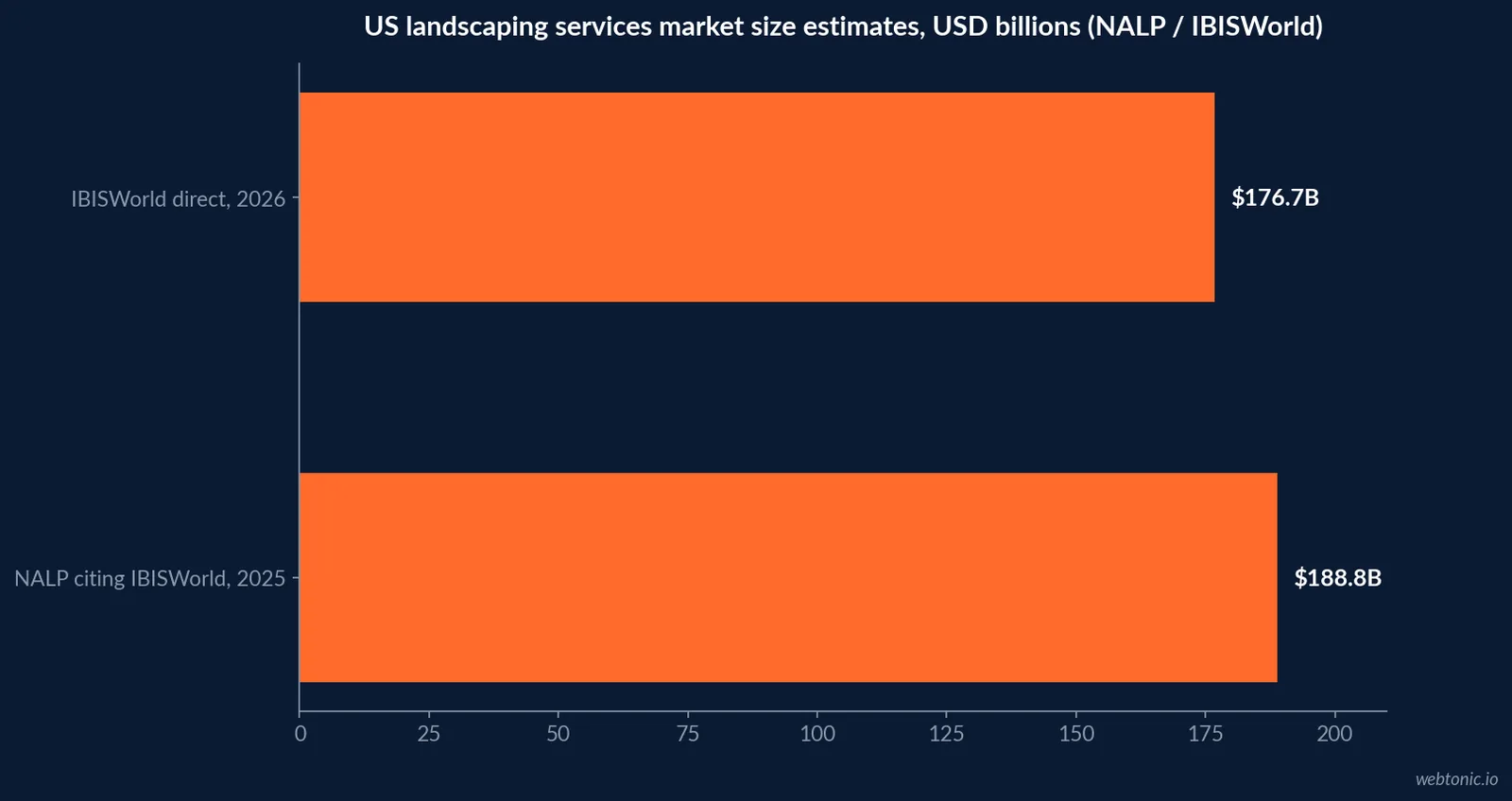
The two most-cited industry size figures do not agree exactly, and it's worth stating both rather than picking one. NALP's own published statistics page cites IBISWorld data putting the landscape services industry at USD 188.8 billion in 2025, employing more than 1.4 million people across 692,777 businesses, a 4.8% increase from 2024. IBISWorld's own direct 2026 industry report instead puts the market at USD 176.7 billion across 556,238 businesses for 2026 - a different year and evidently a different segmentation of the same broad industry code. Either figure describes a market large enough that even a small, well-made video has room to stand out inside it.
| Landscaping industry figure | 2025 (NALP/IBISWorld) | 2026 (IBISWorld direct) |
|---|---|---|
| Market size | USD 188.8 billion | USD 176.7 billion |
| Number of businesses | 692,777 | 556,238 |
| YoY change | +4.8% | +0.9% (2026 alone) |
| Employment | 1.4 million+ people | not separately reported |
What the industry already spends on digital marketing
Coalmarch's 2026 Marketing Benchmark Report, drawn from hundreds of pest control and lawn care clients representing millions in ad spend, found lawn care clients' average monthly digital marketing spend rose 17.3% to USD 2,486.95 in 2025, generating an average of 26 leads a month. Cost per lead actually fell 7.2% to USD 90, down from USD 97 - evidence that higher spend was paired with sharper targeting, not simply more budget chasing the same demand.
A video budget should be read against that USD 2,487 baseline, not treated as a new, separate cost center. Wistia's 2026 cross-industry data shows almost 40% of companies spend under USD 5,000 a year producing video - well within a single year of a landscaping company's existing digital marketing spend.
| Lawn care digital marketing (Coalmarch 2026) | 2024 | 2025 | Change |
|---|---|---|---|
| Average monthly spend | USD 2,121 | USD 2,486.95 | +17.3% |
| Average monthly leads | 25 | 26 | +4% |
| Average cost per lead | USD 97 | USD 90 | -7.2% |
Where to put the video once it's made
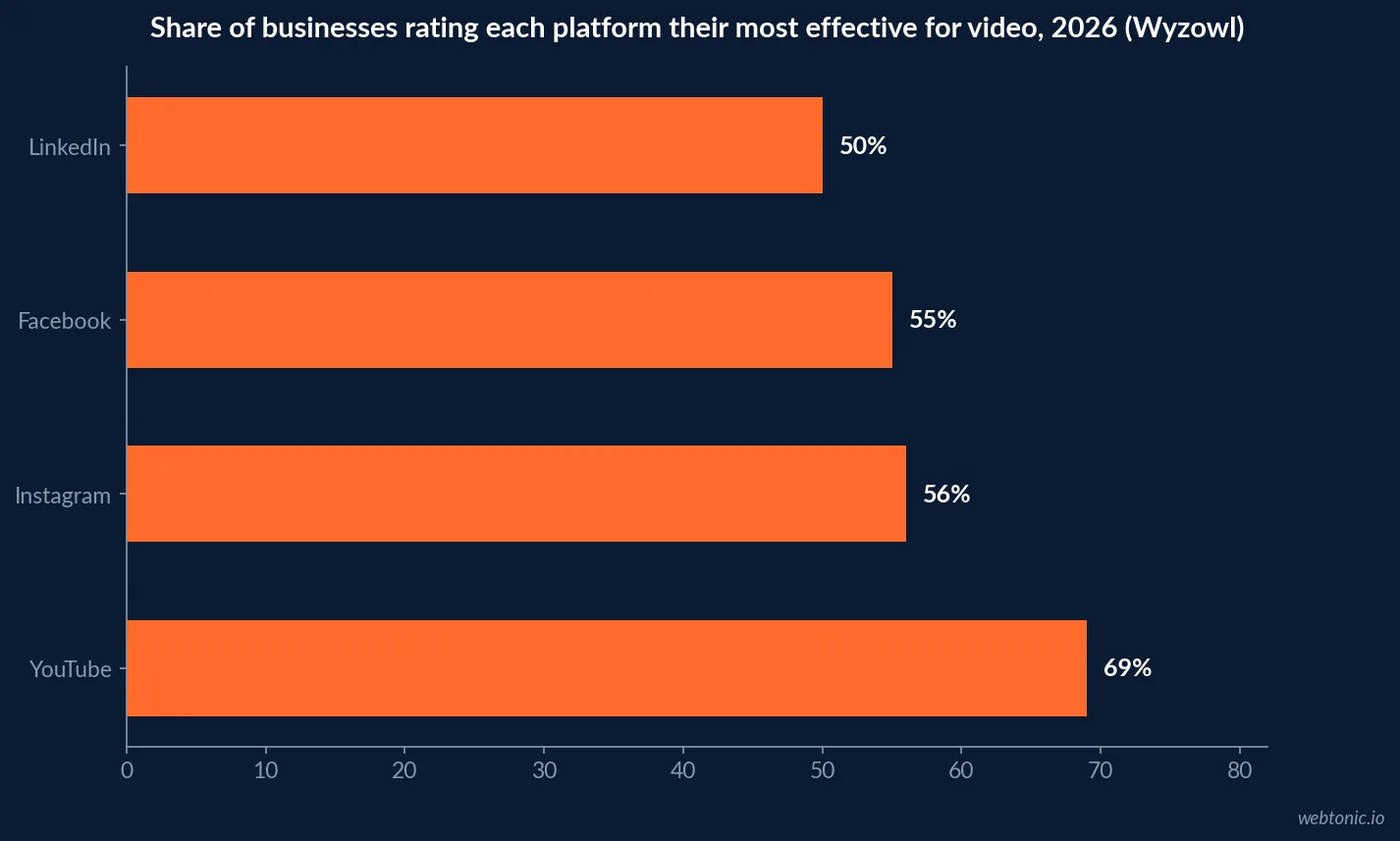
Wyzowl's 2026 channel data is specific: YouTube is the most widely used video platform, with 82% of businesses uploading there, followed by LinkedIn at 70%, Instagram at 69%, Facebook at 66%, and TikTok at 40%. Usage and effectiveness don't rank identically, though: YouTube is also rated most effective by 69% of businesses, ahead of Instagram (56%), Facebook (55%), and LinkedIn (50%) - meaning a landscaping company's LinkedIn presence, if it has one, is likely more useful for commercial or B2B contracts than for driving video engagement.
| Video platform (Wyzowl 2026) | Share using it | Share rating it most effective |
|---|---|---|
| YouTube | 82% | 69% |
| 70% | 50% | |
| 69% | 56% | |
| 66% | 55% | |
| Webinars | 56% | 42% |
| TikTok | 40% | not in top tier |
Why the format fits transformation work so well
Landscaping's core sales pitch - a bare or overgrown yard becomes a finished, photograph-ready install - maps directly onto what Wyzowl's 2026 customer-view data says people respond to: 96% of people have watched an explainer video to learn about a product or service, and 85% say they've been convinced to buy something after watching one. Asked how they'd most like to learn about a product or service, 63% say a short video, far ahead of text articles (12%), infographics (7%), sales calls (5%), ebooks or manuals (4%), and webinars (4%).
89% of consumers say video quality affects their trust in a brand, which for a landscaping company means a shaky, poorly lit clip can undercut the same transformation story a crisp one would sell.
| How consumers say they prefer to learn (Wyzowl 2026) | Share choosing it |
|---|---|
| Watch a short video | 63% |
| Read a text-based article | 12% |
| Read an infographic | 7% |
| Join a sales call | 5% |
| Read an ebook or manual | 4% |
| Attend a webinar | 4% |
Short clips versus long explainers: what the platform data suggests
Not every landscaping transformation needs a long-form YouTube video. Socialinsider's 2026 benchmark data on short-form platforms found TikTok's average engagement rate fell from 3.70% in 2025 to 2.60% in 2026, while Instagram Reels held at 0.45% and YouTube Shorts rose slightly to 0.30%. TikTok still leads by a wide margin on conversation, averaging 50 comments per video against 20 on Reels and 10 on Shorts. For a landscaping company, a fast-cut before/after transformation suits that short-form format well; a longer walkthrough of a full design process is better suited to the long-form YouTube home discussed above, where Pew Research Center found 84% of U.S. adults already spend time.
| Short-form platform (2026) | Average engagement rate | YoY change |
|---|---|---|
| TikTok | 2.60% | down from 3.70% |
| Instagram Reels | 0.45% | steady |
| YouTube Shorts | 0.30% | up slightly |
How often landscaping is the job in the first place
Landscaping's demand is a real, sizable share of home-improvement spending, which is part of why the category can justify its own video budget rather than borrowing time from other marketing. Angi's own 2026 data on home improvement demand lists landscaping installation among the categories finished by 18% of households, tied with flooring installation and appliance repair, spanning everything from simple tree removals to full backyard transformations - precisely the range a video library should be built to demonstrate.
Seasonality should set the production calendar
Landscaping demand is not flat across the year, and neither should video production be. NALP's published industry data notes 2026 is expected to bring mild to moderate growth overall with real variation between markets, and Coalmarch's benchmark data shows paid budgets are deliberately concentrated in peak-demand windows for lawn services rather than spread evenly, because the seasonal window is narrower and demand swings are more pronounced than in year-round categories. The same logic argues for filming and promoting transformation video ahead of spring bookings, when demand (and the payoff from a compelling before/after) is highest, rather than treating video as a one-time asset shot whenever convenient.
Who should actually shoot and edit it
Wistia's 2026 data on production ownership shows most companies handle video in-house, using video crews, creative teams, or individual contributors, while roughly a quarter also outsource some video work to freelancers or agencies - and outsourced production grew faster year over year (+7%) than in-house did. For a landscaping company, the practical split is usually straightforward: crews already on site can capture the raw before/after footage as part of the job; the decision to make is whether editing, music, and captions get handled internally or sent to a freelancer for a more polished result.
What the numbers a company should track look like
NALP's 2025 Financial Benchmark Study gives a useful sense of scale for what a video program is ultimately meant to protect: participating companies had a median of 355 customers, generating USD 14,682 per customer, with typical companies reporting 8.5% sales growth. A video budget under a few thousand dollars a year, set against that per-customer revenue figure, only needs to influence a handful of decisions to pay for itself.
Frequently Asked Questions
How much should a landscaping company budget for video?
No study prices video for landscaping specifically. The closest anchor is Coalmarch's 2026 industry benchmark report: lawn care clients in its dataset spent an average USD 2,486.95 a month on digital marketing overall in 2025. A reasonable starting video allocation is a slice of that total budget, not a separate large line item - Wistia's 2026 cross-industry data shows almost 40% of companies spend under USD 5,000 a year on production, which fits comfortably inside a landscaping company's existing spend.
Why does video suit landscaping better than some other services?
Because the work is visually transformative and finishes in a single visit or season - a bare yard becomes a finished install, which is the exact before/after arc video is best at showing. Wyzowl's 2026 data backs the format choice broadly: 96% of people have watched an explainer video to learn about a product or service, and 85% say they've been convinced to buy after watching one.
Which platform should a landscaping company post video to first?
YouTube, by a wide margin, according to Wyzowl's 2026 channel data: 82% of businesses upload video there, and 69% call it their most effective platform - ahead of Instagram (56% effective) and Facebook (55%). For a landscaping company, that argues for a permanent home for transformation videos on YouTube, then repurposing clips to Instagram and Facebook where local, visual discovery happens.
Does landscaping's seasonality change how video should be budgeted?
Yes. Coalmarch's 2026 data shows lawn care paid marketing spend is deliberately uneven across the year - budgets are concentrated in peak-demand months rather than spread flat - and the same logic applies to video: a company gets more return filming and promoting transformation content ahead of spring and early summer, when 78% of homeowners are already searching online for a landscaping company, than spreading production evenly across a slow winter.
Should the video be made in-house or outsourced?
Most companies do a mix. Wistia's 2026 data on who makes video shows most teams handle production in-house using video crews, creative teams, or individual contributors, while close to a quarter also outsource to freelancers or agencies, and outsourced production grew faster year over year (+7%) than in-house. A landscaping company with a phone camera and a finished job already has the raw footage; the outsourcing question is mainly about editing polish, not the filming itself.
Web Tonic's performance creative team builds seasonal video content for home-service and outdoor brands. For the paid side of a landscaping company's channel mix, see this Google Ads pricing guide, or browse agencies we rate for Google Ads. Want a video plan scoped to a specific season? Talk to our team.
Sources
NALP, Landscape Industry Statistics (citing IBISWorld data)
IBISWorld, Landscaping Services in the US, 2026
Coalmarch, 2026 Pest Control and Lawn Care Marketing Benchmark Report
Wyzowl, Video Marketing Statistics 2026
Wistia, State of Video Report 2026
Socialinsider, TikTok vs. Reels vs. Shorts 2026
Pew Research Center, Americans' Social Media Use 2025
Angi, Most Popular Home Improvement Projects, 2026