Table of contents
None of the spreadsheet-only landscaping contractors in a 2026 industry-wide survey reported a profit margin above 15%. That single finding, from a study of 510 commercial landscaping professionals, is the strongest argument for real tracking this industry has produced - this page walks through it alongside 2026 call-tracking and paid-search measurement data.
Key Takeaways
- 0% of spreadsheet-only contractors exceeded a 15% profit margin.
- Spreadsheet users cluster in a 4% to 7% margin range.
- Only 9% of spreadsheet users break above an 11% margin.
- 45% of spreadsheet users are slightly or not at all satisfied with their setup.
- Over 50% believe their current system will restrict future growth.
- 40% of spreadsheet users forecast a profit decline this year.
- 46% of contractors still struggle with basic scheduling.
- Manual-tool users save less than 5 hours a week from their systems.
- 59% of contractors plan to grow revenue in 2026.
- 47% now name increasing margins a top priority instead.
- 52% of home-services calls are answered by a person.
- 38% of answered calls are genuine leads.
- 45% of those leads convert on the call itself.
- 55% of home-services businesses never ask the lead to book.
- A 5-point gain on three metrics compounds to about 38% more conversions.
- LocalIQ's 2026 landscaping search CPL sits at USD 38.47.
- One agency's 2025 landscaping client book shows an USD 85.48 CPL instead.
- Landscaping's paid-search click-through rate runs 4.5% to 4.6%.
The margin data that makes tracking non-optional
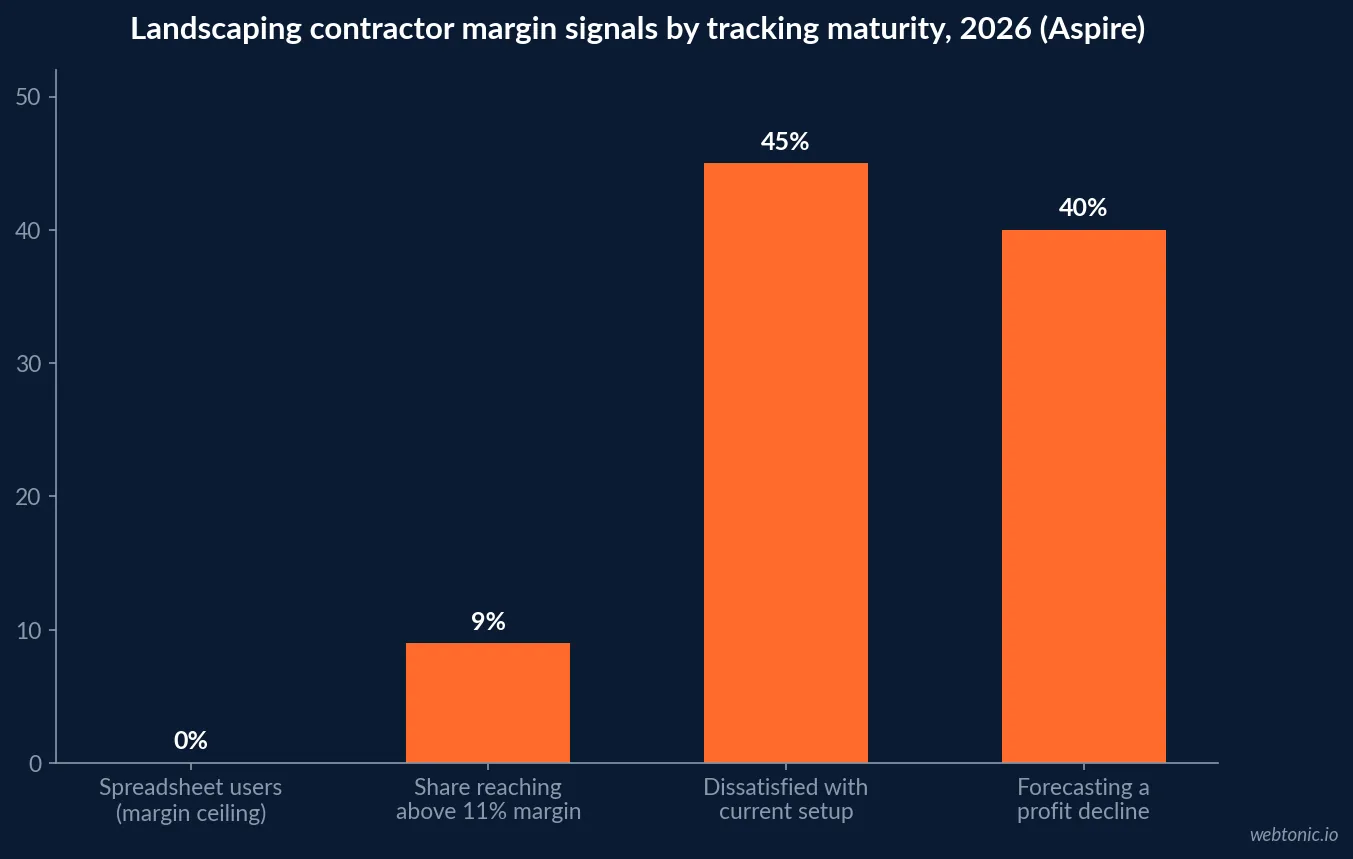
The clearest 2026 evidence that tracking is not a nice-to-have comes from Aspire's 2026 Landscaping Technology Trends Report, built on a Thrive Analytics survey of 510 commercial landscaping professionals run between December 2025 and January 2026. Among contractors relying primarily on spreadsheets, none reported a profit margin above 15%. Spreadsheet users cluster heavily in the 4% to 7% range, with only 9% breaking above 11%.
The report's own framing is worth repeating: that is not a ceiling contractors hit because they are not working hard enough. It is a ceiling they hit because job costing updates at month-end close instead of mid-job, so every decision is made on numbers that are already stale.
| Tracking maturity signal (2026, Aspire/Thrive Analytics) | Spreadsheet / manual users | What it costs them |
|---|---|---|
| Profit margin above 15% | 0% of respondents | A hard ceiling on scaling profitably |
| Typical margin range | 4%-7% | Half the margin of tighter-tracked peers |
| Share reaching above 11% margin | 9% | Nearly everyone else is stuck below it |
| Satisfaction with current setup | 45% slightly/not satisfied | Ongoing operational friction |
| Belief system restricts future growth | 50%+ | Growth plans built on a system they distrust |
| Forecasting a profit decline this year | 40% | Confidence eroding as revenue keeps climbing |
Why "we have software" is not the same as tracking
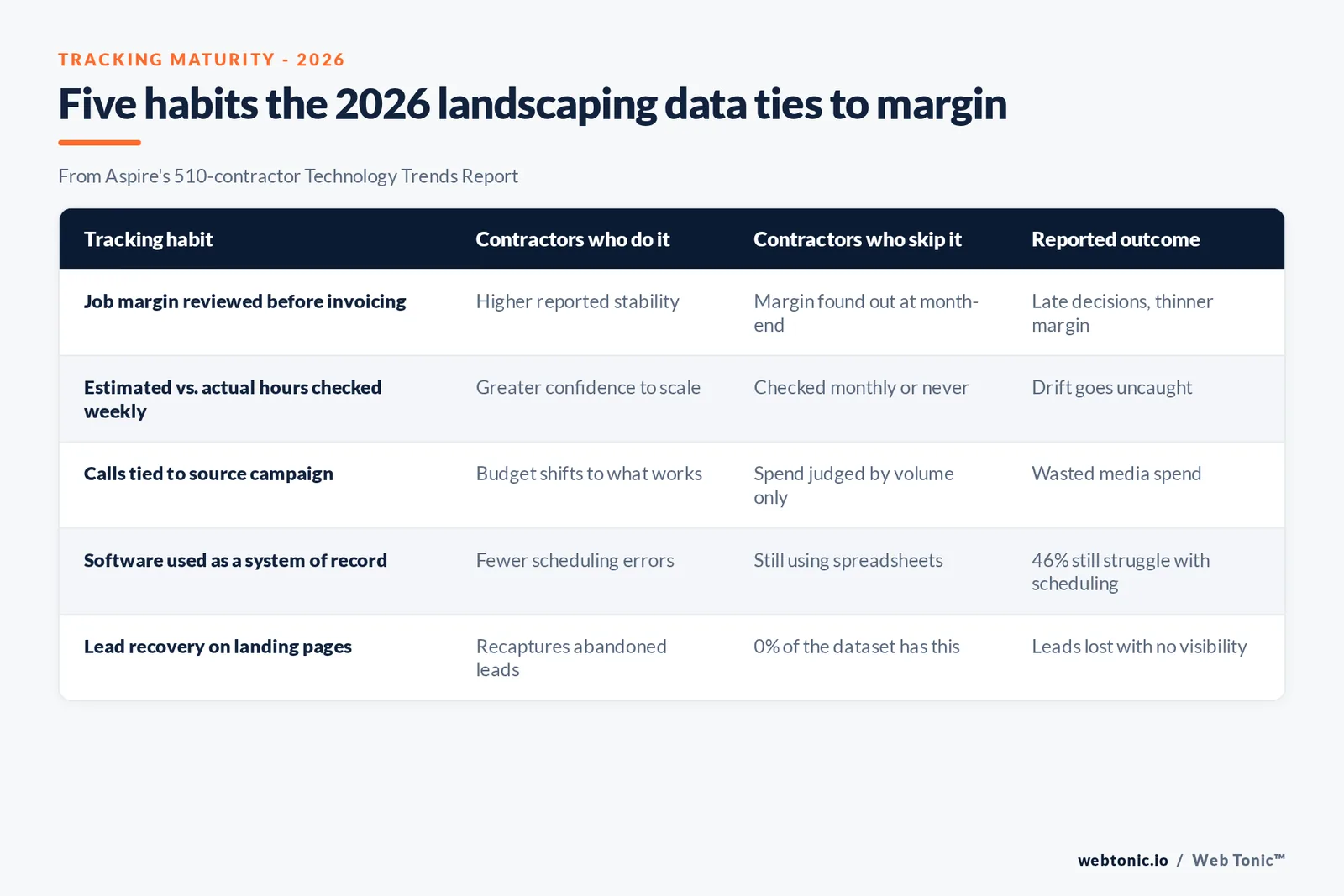
Owning a tool and using it as an operating system are different things. The same Aspire survey found 46% of contractors still struggle with basic scheduling even where software exists, and manual-tool users save less than 5 hours a week from whatever system they run - a spreadsheet that gets exported, re-keyed and emailed around every Friday is not a tracking system, it is a snapshot of last week dressed up as data.
By contrast, the report ties two specific weekly habits to reported financial stability: comparing estimated hours to actual production weekly, and reviewing job margins before invoicing rather than after. Neither requires new software - both require someone to look at the numbers before the job closes, not after.
What gets missed without call tracking
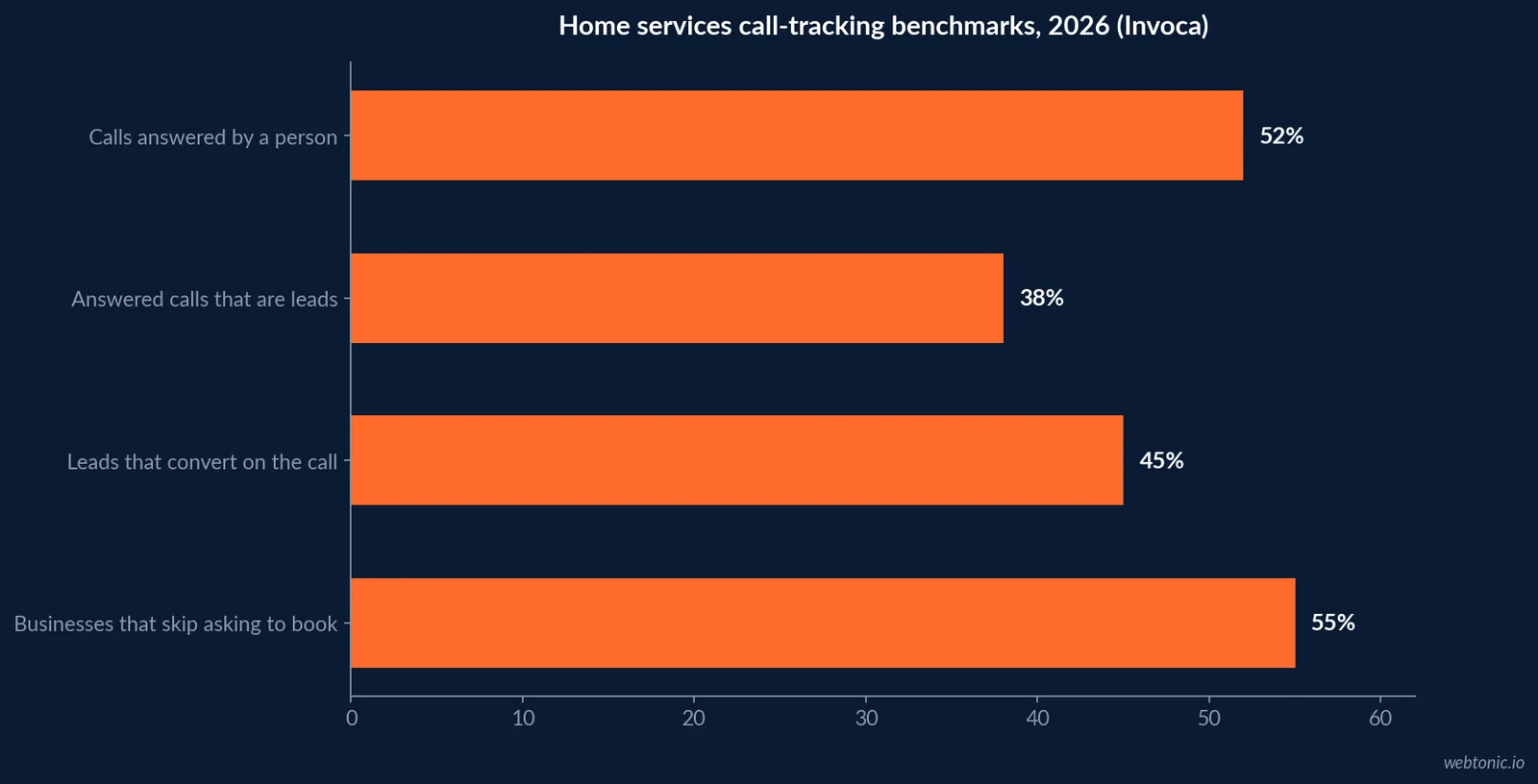
Landscaping still runs mostly on the phone, which makes call data as important as web analytics. Invoca's 2026 Home Services Lead Conversion Benchmarks Report, built on more than 70 million tracked calls across nine sub-industries including lawn and tree services, found only 52% of inbound calls are answered by a person at all. Of the calls that are answered, 38% qualify as genuine leads, and 45% of those leads convert on the call - meaning 55% of home-services businesses never actually ask the caller to book.
Invoca's own modeling shows why this matters for a tracking dashboard specifically: lifting the answer rate, lead rate and conversion rate by just five percentage points each compounds to roughly 38% more conversions from the exact same call volume - no extra ad spend required, just visibility into where calls are actually being lost.
| Call-handling metric (Invoca, 2026 home services) | Benchmark | What it means untracked |
|---|---|---|
| Calls answered by a person | 52% | Nearly half the phone budget rings out |
| Answered calls that are leads | 38% | Most answered calls are not sales opportunities |
| Leads that convert on the call | 45% | Over half the real leads leave without booking |
| Businesses that skip asking to book | 55% | A training gap, not a lead-quality gap |
| Compounded gain from a 5-point lift on each | ~38% more conversions | Available with zero new spend |
Why the paid-search numbers disagree with each other
Two credible 2026 sources report meaningfully different landscaping paid-search numbers, and the gap is itself the argument for tracking your own account rather than borrowing an industry figure. LocalIQ's 2026 home-services benchmarks put landscaping search ads at a 4.52% click-through rate, a USD 4.10 cost per click and an USD 38.47 cost per lead. Evergrow Marketing's 2025 client-book data, drawn from its own landscaping and lawn-care accounts, shows a similar 4.56% CTR but a much higher USD 85.48 cost per lead and USD 4.14 CPC.
Both figures are legitimate; they come from different account samples, different geographies and different definitions of a qualified lead. A landscaping company that only knows the industry average and not its own number cannot tell which of these two realities it is actually living in.
| Metric | LocalIQ 2026 (home services benchmark) | Evergrow 2025 (agency client book) |
|---|---|---|
| Click-through rate | 4.52% | 4.56% |
| Cost per click | USD 4.10 | USD 4.14 |
| Cost per lead | USD 38.47 | USD 85.48 |
| Conversion rate | n/a published | 4.85% (up from 4.16% prior year) |
| Sample basis | Proprietary cross-client aggregate | One agency's landscaping/lawn-care book |
The margin gap widens, it does not close, with scale
A separate 2026 Aspire analysis of its own benchmarking survey, comparing landscaping operators by revenue tier, found the tracking gap does not shrink as a business grows - it widens. Among businesses doing USD 3 million or more a year, 10.3% of tightly integrated platform users reported margins below 4%, against 20.4% of everyone else on looser systems - twice the rate. At USD 11 million and up, the gap widened further: sub-4% margins dropped to 7.7% for the tightly tracked group while climbing to 28.3% for the rest. That data is vendor-published and should be read with the obvious self-interest disclosed, but the direction matches the independent 510-contractor finding above: reporting quality does not become optional once a company scales, it becomes more expensive to ignore.
| Revenue tier (2026 Aspire benchmarking survey) | Tightly tracked, margin below 4% | Looser systems, margin below 4% |
|---|---|---|
| USD 3 million+ annual revenue | 10.3% | 20.4% |
| USD 11 million+ annual revenue | 7.7% | 28.3% |
Why speed-to-lead belongs on the same dashboard
Tracking is not only about margin; it is also about how fast a lead gets answered, since landscaping demand is often reactive. Housecall Pro's 2026 State of Home Service Spending report, based on a survey of over 1,100 U.S. homeowners, found 58% contact a pro only when there is a sudden problem, and 68% shop additional quotes when the first price comes in higher than expected. A tracking dashboard that shows lead volume but not response time is missing the metric that decides whether that reactive homeowner books the first company that answers or the third one they eventually reach.
BrightLocal's 2026 consumer search behavior survey adds the channel context: 73% of local business searches now start on a mobile device, and 71% of consumers use Google Search at some point in their search journey - which is exactly the channel a landscaping company's call-tracking numbers need to be segmented by, not lumped into a single "phone calls" total.
| Homeowner behavior signal (2026) | Figure | Source |
|---|---|---|
| Contact a pro only after a sudden problem | 58% | Housecall Pro |
| Shop additional quotes if price is higher than expected | 68% | Housecall Pro |
| Local searches starting on mobile | 73% | BrightLocal |
| Searches using Google at some point | 71% | BrightLocal |
Building the minimum viable tracking stack
None of this requires an enterprise platform on day one. The 2026 data points to three specific habits: track job margin while the job is open, not at month-end; tie every phone call back to the campaign or keyword that generated it; and review estimated-versus-actual hours weekly rather than monthly. Our data and analytics practice wires exactly this layer - call tracking, job costing and a weekly dashboard - underneath a landscaping company's existing field-service software rather than replacing it.
For the paid-media side of the same stack, see our guide to what Google Ads actually costs, or talk to us about auditing where your current numbers are arriving too late to act on.
Frequently Asked Questions
What is the single most important metric a landscaping company should track?
Job-level margin, tracked while the job is still open, not at month-end close. Aspire's 2026 Landscaping Technology Trends Report, based on a Thrive Analytics survey of 510 commercial landscaping professionals, found that none of the spreadsheet-only respondents reported a profit margin above 15%, while spreadsheet users cluster in the 4% to 7% range and only 9% break above 11%. The gap is not effort - it is how late the numbers arrive.
How much does poor call tracking cost a landscaping company?
Enough to matter on every paid dollar spent. Invoca's 2026 Home Services Lead Conversion Benchmarks Report, covering lawn and tree services among nine home-services sub-industries, found only 52% of inbound calls are answered by a person, 38% of answered calls are genuine leads, and 45% of those leads convert on the call. A five-point improvement in each of those three numbers compounds to roughly 38% more conversions from the same call volume, which is a measurement fix, not a media-spend increase.
What conversion rate should a landscaping company expect from paid search?
It depends heavily on whose data you read, which is itself the point of tracking your own. LocalIQ's 2026 home-services benchmarks put landscaping search ads at a 4.52% click-through rate and USD 38.47 cost per lead, while agency-reported client data from Evergrow Marketing's 2025 book of landscaping accounts shows a 4.56% CTR but an USD 85.48 cost per lead - almost double. Neither number is wrong; they are different samples, which is exactly why a company needs its own dashboard rather than a borrowed industry average.
Do landscaping companies actually use analytics dashboards?
Not consistently. Aspire's 2026 survey found 46% of respondents still struggle with basic scheduling even when software is in place, and manual-tool users save less than 5 hours a week overall - not because spreadsheets are inherently bad, but because job costing updates at month-end instead of mid-job, so the numbers a manager sees are already a month stale by the time a decision gets made.
What should a landscaping company's tracking stack include at minimum?
Call tracking tied to the specific campaign or keyword that generated the call, a job-costing system that updates during the job rather than after invoicing, and a weekly (not monthly) review of estimated hours against actual production. Aspire's 2026 data ties exactly that combination - comparing estimated to actual hours weekly and reviewing job margins before invoicing - to reported financial stability, while spreadsheet-only operations report the opposite.
Sources
Aspire (via Thrive Analytics) - 2026 Landscaping Technology Trends Report
Invoca - 2026 Home Services Lead Conversion Benchmarks Report
LocalIQ - Home Services Advertising Benchmarks 2026
Evergrow Marketing - 2025 Green Industry Google Ads Benchmarks
Aspire - Same Revenue, Different Margin: New Insight from the Technology Trends Report
Housecall Pro - The State of Home Service Spending, 2026
BrightLocal - Where Are Your Customers Really Searching? (2026)