Table of contents

Landscaping is a thin combo for LinkedIn: no industry-specific ad benchmark exists, because the platform only pays where the buyer is commercial or the goal is hiring. This page states that plainly, then uses 2026 commercial-landscaping data from NALP and Aspire alongside labeled cross-industry B2B LinkedIn figures to show where the budget actually earns its keep.
Key Takeaways
- No landscaping-specific LinkedIn ad benchmark is published anywhere.
- 40% of landscape businesses are investing in sales and marketing in 2026.
- Commercial maintenance is 83% of commercial contractors' revenue.
- Residential maintenance adds another 63% for mixed-book firms.
- 35% of commercial landscape revenue comes from repeat clients.
- Word-of-mouth adds another 26% of revenue.
- Inbound marketing is credited with only 16% of revenue.
- Outbound sales accounts for 14%.
- Referral partnerships bring in 10%.
- 54% of firms name staffing a top business risk for 2026.
- 70% of firms are raising wages to compete for labor.
- 44% of those firms are raising wages by 4% or more.
- Cross-industry LinkedIn cost per lead runs USD 202.
- That cross-industry LinkedIn click-through rate is 0.67%.
- LinkedIn is used by 47% of B2B companies overall.
- Median B2B LinkedIn company-page engagement rate is 5.1%.
- Top-decile B2B pages reach a 22.92% engagement rate.
- 60% of commercial landscape firms cite economic uncertainty as their top risk.
- LinkedIn counts more than 130 million self-identified decision-makers.
- Nearly 930,000 people work as landscaping and groundskeeping employees nationally.
Why there is no landscaping LinkedIn benchmark to quote
Ad-platform benchmark studies segment by industry categories built for retail, home services and B2B software, and landscaping never gets its own row because most landscaping revenue is residential and local, the exact opposite of what LinkedIn's job-title and company-size targeting is built to reach. NALP's coverage of Aspire's 2026 Commercial Landscape Industry Report, based on a survey of more than 1,000 commercial landscape owners and executives, is the closest thing to a demand-side data point: it shows only 40% of landscape businesses are even investing in sales and marketing this year, commercial ad budgets included.
That is the honest starting point. Anyone quoting a landscaping-specific LinkedIn CPC or CPL figure is quoting a guess dressed as data.
Where landscaping revenue already comes from
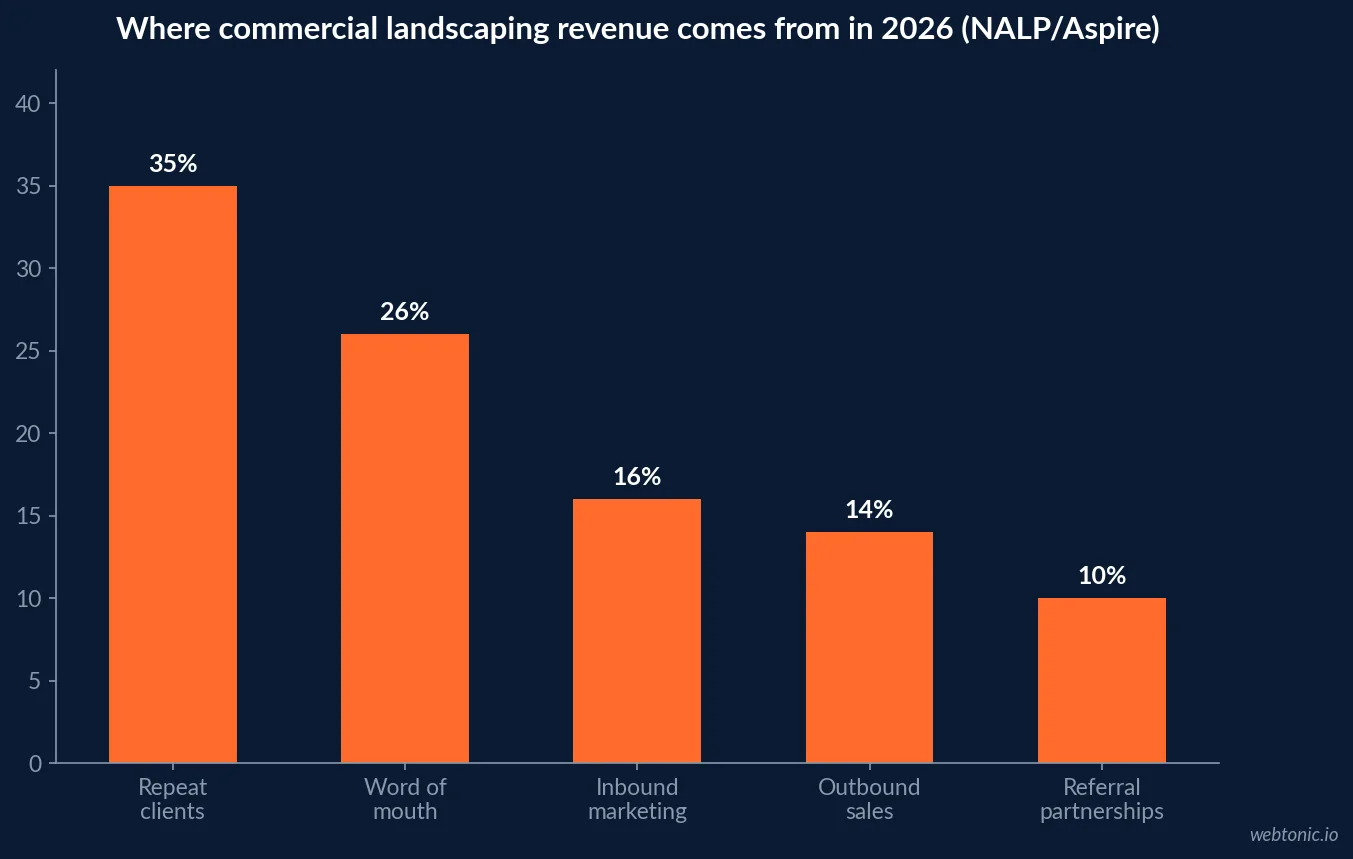
Before budgeting a dollar for LinkedIn, look at what is already working. Aspire's 2026 survey, reported by NALP, found 35% of commercial landscape revenue comes from repeat clients, 26% from word-of-mouth, 16% from inbound marketing, 14% from outbound sales and 10% from referral partnerships. Retention is so central that 54% of respondents named it their top goal for the year.
That mix tells you LinkedIn is not replacing referrals; at best it is a wedge into the accounts that referrals do not reach - the anonymous property-management company or national retail chain that has never heard of your crew.
| Revenue source, commercial landscaping (2026) | Share of revenue | LinkedIn's role |
|---|---|---|
| Repeat clients | 35% | Not touched by ads; protected by service quality |
| Word-of-mouth referral | 26% | Not touched by ads; amplified by case studies |
| Inbound marketing (all channels) | 16% | LinkedIn is one of several channels inside this |
| Outbound sales | 14% | LinkedIn Sales Navigator supports, ads rarely drive this |
| Referral partnerships | 10% | LinkedIn can open the first conversation |
Who the buyer actually is
Job-title targeting only works if the job titles exist in volume, and in commercial landscaping they do. Aspire's 2026 report puts commercial maintenance at 83% of commercial contractors' revenue and residential maintenance at 63% for mixed-book firms, with two-thirds of respondents saying most of their project income is bid-build rather than design-build. Every one of those commercial maintenance contracts has a named decision-maker: property manager, facilities director, HOA board member or asset manager.
That is the audience list a landscaping LinkedIn campaign should build against - not "homeowners," not "gardening enthusiasts," but the specific titles that sign recurring maintenance and snow contracts.
| Target title | Contract type they control | Why LinkedIn reaches them | Why Google/Meta usually do not |
|---|---|---|---|
| Property manager | Multi-site grounds maintenance | Job title targeting is precise | Rarely searches landscaping keywords |
| HOA board member | Community common-area contracts | LinkedIn profile shows the role | Often searches informally, hard to target |
| Facilities director | Corporate campus contracts | Company-size + title filters work well | Buried inside broad B2B search terms |
| Developer / superintendent | New build design-build work | Reachable via construction company pages | Long project cycles waste ad impressions |
| Homeowner | One-off residential jobs | Almost never the right audience here | This is where Google and Meta win instead |
The cross-industry benchmark to plan against
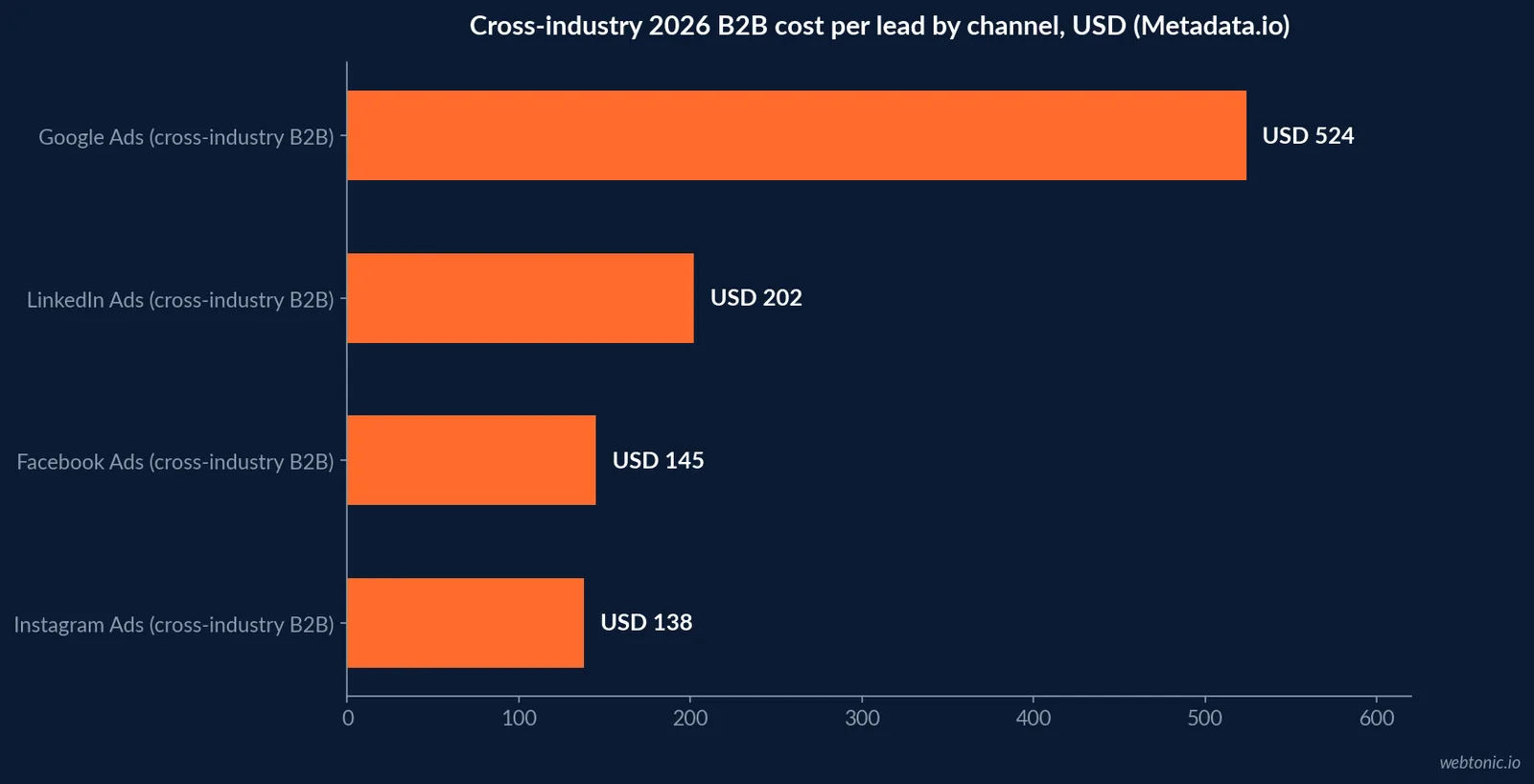
Since no landscaping-specific figure exists, use the closest labeled cross-industry number and say so out loud. Metadata.io's 2026 study of 153 B2B advertisers and USD 57.6 million of 2025 ad spend puts LinkedIn at USD 202 per lead and a 0.67% click-through rate, against USD 145 for Facebook, USD 138 for Instagram and USD 524 for Google Ads across the same advertiser base. These are B2B software and services averages, not landscaping averages - deal sizes in commercial grounds contracts are smaller and sales cycles shorter, so a disciplined landscaping campaign should beat this ceiling, not match it.
| Channel (cross-industry B2B, 2026) | Cost per lead | Click-through rate | Source |
|---|---|---|---|
| LinkedIn Ads | USD 202 | 0.67% | Metadata.io |
| Facebook Ads | USD 145 | n/a | Metadata.io |
| Instagram Ads | USD 138 | n/a | Metadata.io |
| Google Ads | USD 524 | n/a | Metadata.io |
| LinkedIn company pages, median engagement | n/a | 5.1% | Oktopost Q1 2026 |
| LinkedIn company pages, top decile | n/a | 22.92% | Oktopost Q1 2026 |
The organic and recruiting case, not just ads
Oktopost's Q1 2026 B2B LinkedIn Benchmark, built from 9,077 company-page samples across 285 publishable benchmark cells, found a median engagement rate of 5.1% and a top-decile rate of 22.92% in March 2026. A landscaping company with strong before-and-after project photography can compete for that top decile with organic posts alone, before a paid budget is even discussed. HubSpot's 2026 marketing-channel data puts LinkedIn usage at 47% of B2B companies overall, confirming it is a mainstream B2B channel even though it was never built with lawn care in mind. Sprout Social's 2026 LinkedIn statistics roundup puts the platform at 1.3 billion members worldwide, with over two-thirds of users interacting with brand content weekly - scale that a landscaping company will never fully use, but that makes the commercial and recruiting slices of it worth targeting precisely rather than ignoring outright.
Recruiting is the second, often stronger, case. NALP's 2026 talent-trends research names staffing as one of the industry's top business risks, and Aspire's survey found 54% of commercial landscape companies call recruiting and retention a major threat to their goals, with 60% naming economic uncertainty as the top concern overall. 70% of firms are raising wages to compete for labor, and 44% of those are raising by 4% or more - a LinkedIn recruiting campaign for crew leads and branch managers is competing with that wage spend for the same finite labor pool. The pool itself is not small: the U.S. Bureau of Labor Statistics counts nearly 930,000 landscaping and groundskeeping employees nationally, at a mean wage of roughly USD 19.13 an hour - the labor market a LinkedIn recruiting budget actually competes in, not the general applicant pool a job board reaches. On the buyer side, LinkedIn's own 2025 B2B audience data counts more than 130 million self-identified decision-makers among its members - the pool a job-title-targeted commercial campaign is drawing from.
What a landscaping LinkedIn budget should actually fund
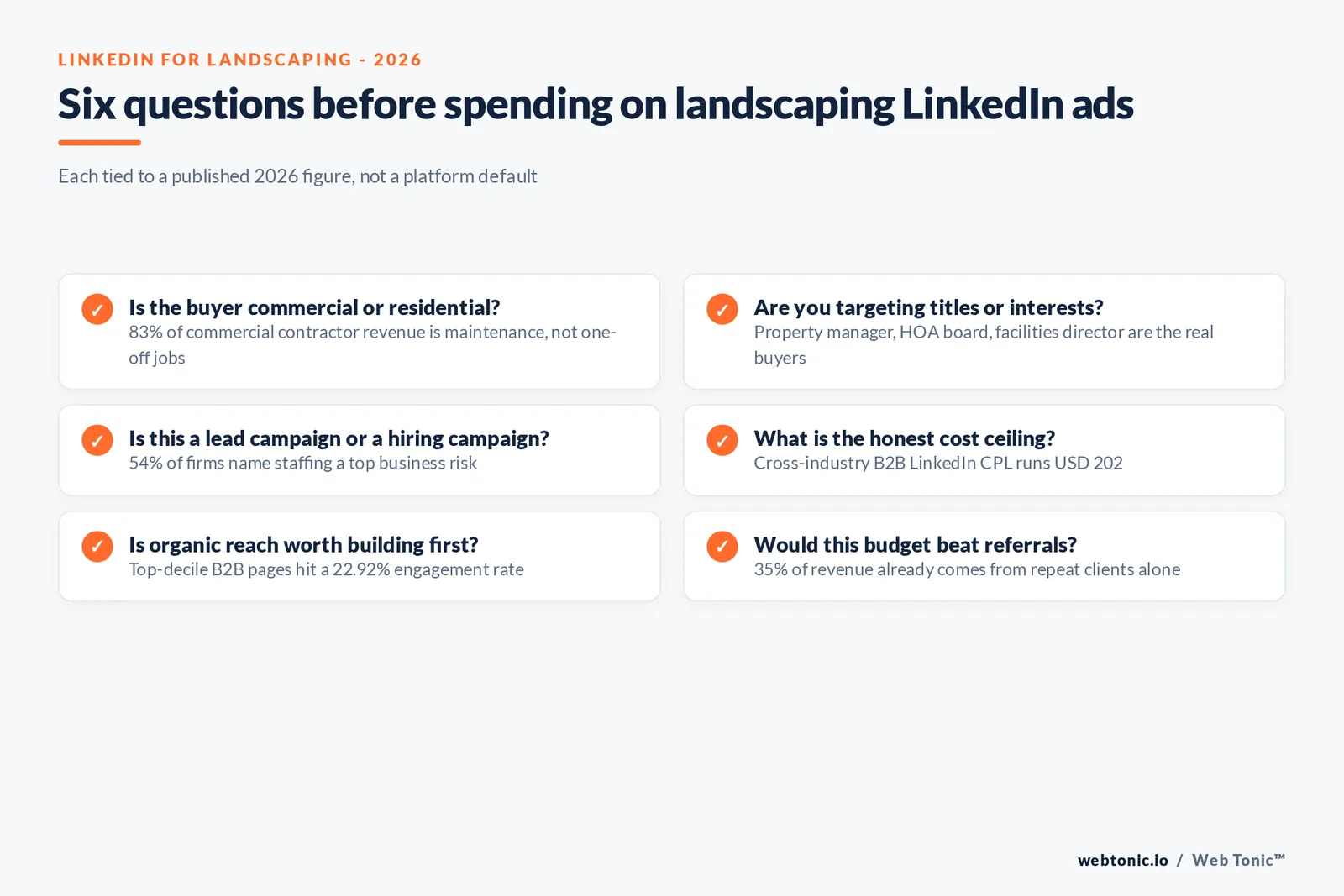
Two use cases justify the spend: account-based campaigns aimed at named property-management and facilities companies for recurring maintenance contracts, and recruiting campaigns aimed at experienced crew leads and account managers in a tight labor market. Everything residential - mowing, one-off cleanups, small design jobs - belongs on Google, Meta or referral programs where the buyer actually searches and scrolls.
Our growth marketing practice builds the job-title and company-size lists that make a B2B landscaping LinkedIn campaign defensible, rather than running it on a broad "landscaping industry" interest audience that mostly reaches other landscapers.
| Landscaping LinkedIn use case | Right audience | Right budget signal | Wrong way to run it |
|---|---|---|---|
| Commercial maintenance contracts | Property managers, facilities directors | Named account lists, not interests | Broad homeowner targeting |
| HOA and community contracts | HOA board members, community managers | Local company-size filters | National spend with no geo-fence |
| Design-build project leads | Developers, construction superintendents | Long nurture, not one-click leads | Judging ROI after two weeks |
| Crew and management recruiting | Job titles in landscaping and grounds care | Cost per hire, not cost per click | Comparing it to a Google CPL |
| Residential leads (any kind) | Homeowners in service area | Google and Meta budget instead | Any LinkedIn spend at all |
What the creative and format should look like
LinkedIn's own audience data, cited on HubSpot's 2026 marketing statistics roundup, states that four out of five LinkedIn members drive business decisions at their company - which matters for creative because it means the person seeing a landscaping ad in-feed is rarely the one who will physically walk the property. Creative built for a property manager or facilities director should lead with contract terms, response time and portfolio scale, not curb-appeal photography alone; save the before-and-after imagery for the residential channels where the viewer is the homeowner.
Sponsored Content and single-image ads remain the two formats with the most published B2B benchmark coverage, but a short video walkthrough of a completed commercial site - irrigation systems, snow removal readiness, seasonal color rotations - gives a property manager something a static image cannot: proof the crew executes at the scale their portfolio requires.
| LinkedIn ad format | Best audience fit | What the creative should prove |
|---|---|---|
| Single image ad | Property managers, HOA boards | Portfolio scale and service area |
| Sponsored Content (native feed) | Facilities directors, developers | Case study or contract renewal proof |
| Short video walkthrough | All commercial buyer titles | Execution quality on a real site |
| Recruiting-focused post/ad | Crew leads, branch managers | Wage, culture and growth path |
| Thought-leadership article | All B2B titles, top of funnel | Operational credibility, not a hard sell |
Timing the budget to the industry's own calendar
Commercial landscaping's B2B buying cycle does not match retail's, and NALP's 2026 coverage of the Aspire report gives a clue why: 60% of contractors cite economic uncertainty as their top business risk this year, which typically pushes commercial contract renewals and RFPs toward the calendar quarters when budgets are confirmed rather than spread evenly across the year. A LinkedIn budget aimed at property managers should track that renewal calendar - usually late fall and early winter for the following season's grounds contracts - rather than running flat all year the way a residential Google Ads budget does.
Recruiting campaigns follow a different clock entirely: they need to run ahead of the spring hiring crunch, not during it, since Aspire's data shows 70% of firms are already raising wages to compete for the same labor pool once the season starts.
| Landscaping LinkedIn campaign | When it should run | What competes for the same budget |
|---|---|---|
| Commercial contract / RFP targeting | Late fall through early winter | Direct sales outreach and referral follow-up |
| Recruiting for crew leads and managers | Late winter, ahead of spring ramp-up | Wage increases (70% of firms raising pay) |
| Design-build / developer targeting | Aligned to permit and construction cycles | Long sales cycles, not ad-driven urgency |
| Brand/thought-leadership content | Year-round, low spend | Organic posting instead of paid budget |
Reading the numbers honestly
The uncomfortable truth in this data is that LinkedIn's best-documented number for landscaping companies is a labor-market one, not an ad-platform one: 54% naming staffing a risk and 70% raising wages say more about why a landscaping company would use LinkedIn than any CPC figure does. If a vendor pitches a landscaping-specific LinkedIn benchmark with no disclosed sample, ask which cross-industry study it was quietly rebadged from.
For the channels landscaping companies actually win on, see our breakdown of what Google Ads really costs, or talk to us about building the account-based list a commercial landscaping LinkedIn campaign needs to earn its budget.
Frequently Asked Questions
Does LinkedIn advertising work for landscaping companies?
Only for the commercial and B2B side. Residential mowing, cleanup and design-build leads come from Google, Meta and referrals; NALP's 2026 data shows word-of-mouth and repeat clients already drive 61% of commercial landscape revenue between them. LinkedIn earns its budget only when the buyer is a property manager, HOA board, facilities director or developer signing a recurring maintenance contract, or when the campaign is a recruiting push into a labor market where 54% of landscape companies name staffing their top business risk.
What does LinkedIn advertising cost, since no landscaping-specific benchmark exists?
No landscaping-specific LinkedIn ad benchmark exists publicly, so the honest number is the cross-industry B2B one, labeled as such. Metadata.io's 2026 study of 153 B2B advertisers and 57.6 million USD of 2025 spend puts LinkedIn cost per lead at 202 USD against a 0.67% click-through rate. Treat that as a B2B ceiling to plan against, not a landscaping guarantee, and expect the actual number to move with deal size and the tightness of the property-manager or facilities audience you build.
Who should landscaping companies target on LinkedIn?
Job titles, not zip codes: property manager, facilities director, HOA board member, asset manager, commercial developer, and construction superintendent for design-build leads. Aspire's 2026 Commercial Landscape Industry Report found commercial maintenance already makes up 83% of commercial contractors' revenue, and that base of recurring accounts is exactly the audience LinkedIn's job-title targeting is built to reach - residential homeowners are not on this list.
Should a landscaping company use LinkedIn for hiring instead of leads?
For many crews, yes, and honestly that is the stronger case. NALP's 2026 recruiting research names staffing a top-three business risk, and 70% of surveyed commercial landscape companies say they are raising wages this year to compete for labor, with 44% raising by 4% or more. A LinkedIn budget aimed at crew leads, account managers and branch managers competes directly with that wage spend for the same limited pool of people.
How should a landscaping company measure whether LinkedIn is worth the spend?
Track cost per qualified commercial lead and cost per hire separately from residential channels, and compare both against the 202 USD cross-industry B2B LinkedIn cost-per-lead figure and against what a hire actually costs to source through a job board. If neither number holds up after two full quarters of a job-title-targeted campaign, the audience was too broad, not the platform.
Sources
National Association of Landscape Professionals - The State of Commercial Landscaping in 2026 (Aspire data)
National Association of Landscape Professionals - Talent Trends for 2026
Metadata.io - B2B Advertising Benchmarks 2026
Oktopost - B2B LinkedIn Benchmark, Q1 2026 Report
HubSpot - The Top Marketing Channels of 2026, According to Marketers
HubSpot - 2026 Marketing Statistics, Trends & Data
Sprout Social - 30 LinkedIn Stats to Inform Your 2026 Strategy
LinkedIn - The B2B Audience on LinkedIn: Who They Are, and How They Engage
U.S. Bureau of Labor Statistics - Landscaping and Groundskeeping Workers