Table of contents

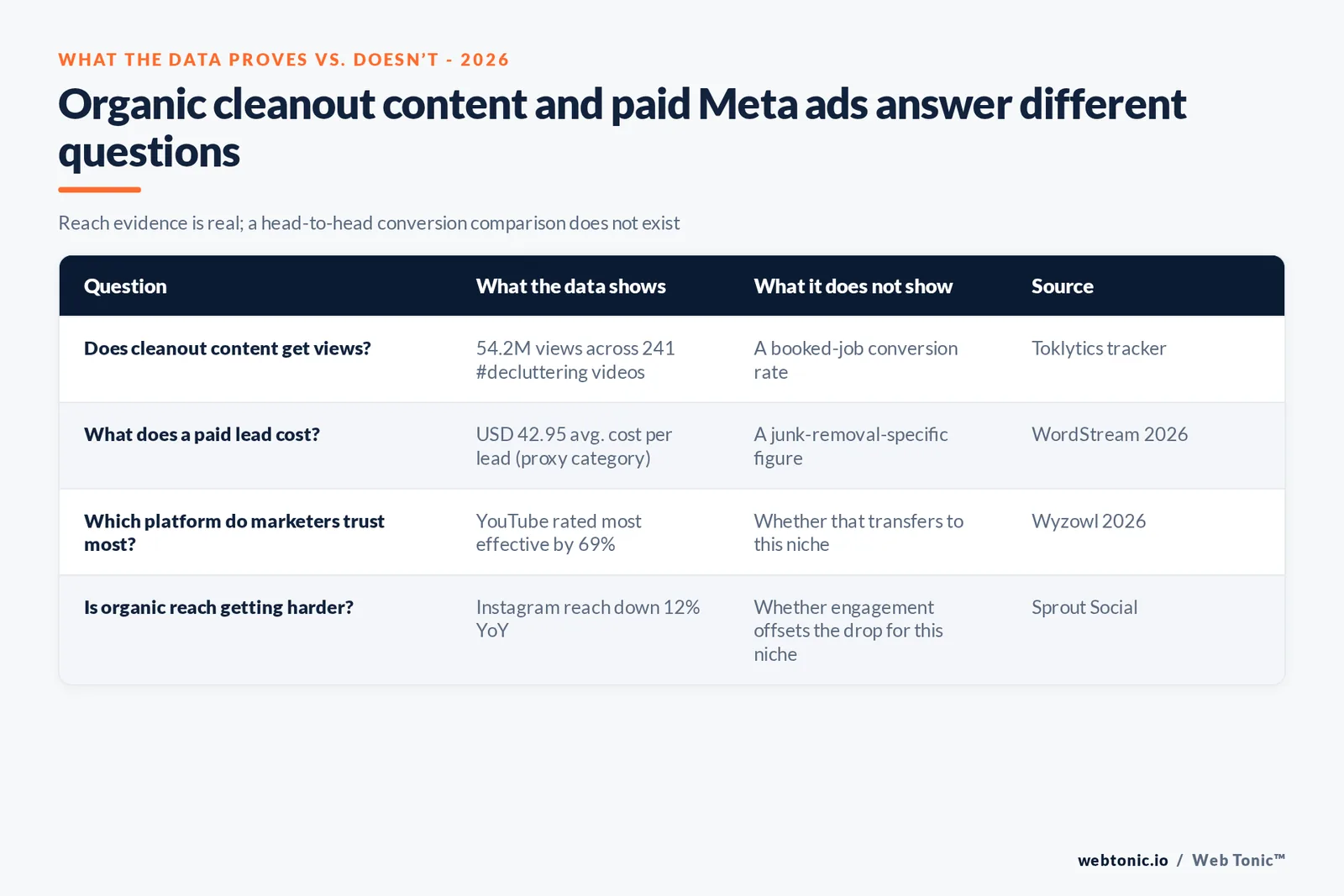
This title makes a claim this page will not fabricate a number to support: no study directly measures organic-social conversion against paid-ad conversion for junk removal or dumpster rental. What the evidence actually shows is strong organic reach and engagement for cleanout-style content, set against real, separately measured paid-ad cost data. Both are true; neither proves the other converts "better" in a controlled sense.
Key Takeaways
- #decluttering videos on TikTok have logged 54.2 million total views across 241 tracked videos, averaging 224,700 views each, per Toklytics' hashtag tracker.
- That hashtag carries a 7.9% viral ratio - the share of videos exceeding twice the average view count.
- A single creator's cleanout video documented by 1-800-GOT-JUNK? passed 1 million views within two days of posting.
- WordStream's 2026 Home and Home Improvement Meta ads proxy averages USD 42.95 per lead - the real, comparable cost for the paid side of this equation.
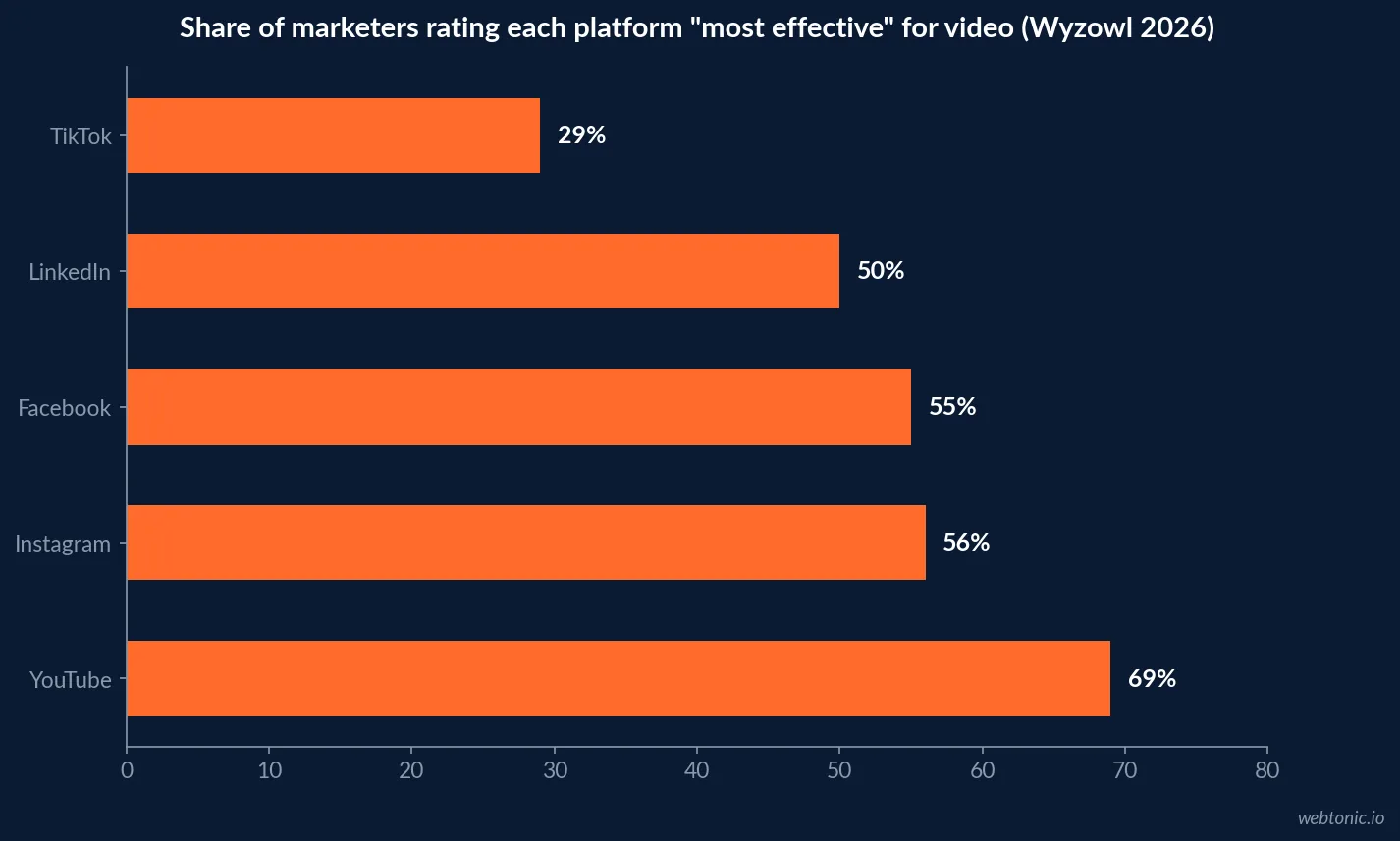
- YouTube is rated most effective for video marketing by 69% of marketers, per Wyzowl's 2026 survey of 266 respondents; TikTok is rated least effective at 29% despite its raw reach numbers.
- 91% of businesses now use video as a marketing tool, back to an all-time high after a 2025 dip, per the same Wyzowl survey.
- Instagram's average organic reach rate fell 12% year over year, per Socialinsider data cited in Sprout Social's own research.
- A typical organic post now reaches roughly 3-4% of followers on Instagram.
- Average inbound engagement still rose 20% year over year on posts that do land, per Sprout's Content Benchmarks Report.
- 73% of social users say they will buy from a competitor if a brand does not respond to them on social, per Sprout's 2025 Index.
What the organic side actually shows
Cleanout and decluttering content is a genuinely strong organic format. Toklytics' hashtag tracker records 241 TikTok videos under #decluttering accumulating 54.2 million total views, averaging 224,700 views per video with a 7.9% viral ratio. 1-800-GOT-JUNK? has documented its own case of a creator partnership - a homeowner sharing a multi-generational decluttering journey - whose first video passed 1 million views within two days and sparked a wider community response. Both data points measure reach and engagement. Neither includes a booked-job or revenue figure.
| Organic reach evidence | Figure | Source | What it measures |
|---|---|---|---|
| #decluttering TikTok videos tracked | 241 videos | Toklytics hashtag tracker | Volume of tagged content |
| Total views under #decluttering | 54.2 million | Toklytics hashtag tracker | Aggregate reach |
| Average views per video | 224,700 | Toklytics hashtag tracker | Typical single-video reach |
| Viral ratio (videos exceeding 2x average) | 7.9% | Toklytics hashtag tracker | Breakout-hit frequency |
| Single creator cleanout video, 48-hour views | 1,000,000+ | 1-800-GOT-JUNK? published case | Best-case organic outcome, not typical |

What the paid side actually costs, for the same comparison
Set against that reach data, WordStream's 2026 Facebook Ads Benchmarks - the closest published proxy for this category, built from roughly 1,800 sampled US campaigns - puts the Home and Home Improvement lead-generation average at USD 42.95 per lead, the third-most expensive category tracked. That figure is a real, guaranteed, measurable cost. A viral organic video carries close to zero incremental media cost once the content exists, but it also carries no guaranteed volume, no audience targeting, and - critically - no measured conversion rate in any published study.
| Metric | Organic cleanout content | Paid Meta lead ads (Home & Home Improvement proxy) |
|---|---|---|
| Incremental cost per view/impression | Near zero once filmed and posted | Built into a USD 42.95 cost per lead |
| Guaranteed volume | None - reach is algorithm-dependent | Predictable, spend-scalable |
| Targeting control | None - broad, algorithmic audience | Full geographic and demographic targeting |
| Measured conversion-to-booked-job rate | Not published by any study | Not published by any study either |
Why "converts better" is the wrong test, on the evidence available
Wyzowl's 2026 State of Video Marketing survey, drawn from 266 marketing professionals and consumers, rates YouTube most effective for video marketing by 69% of marketers, followed by Instagram (56%), Facebook (55%) and LinkedIn (50%). TikTok is rated least effective at just 29% - a striking contrast against the platform's raw hashtag view counts above. Marketers' own effectiveness ratings and a platform's raw reach numbers are measuring different things, and this category's evidence base sits squarely in that gap: strong reach data, no controlled conversion comparison.
| Video marketing platform (Wyzowl 2026) | Rated "most effective" by marketers | Widely used by |
|---|---|---|
| YouTube | 69% | 82% of video marketers |
| 56% | 69% of video marketers | |
| 55% | 66% of video marketers | |
| 50% | 70% of video marketers | |
| TikTok | 29% (least effective rated) | 40% of video marketers |
Reach is getting harder, but engagement on winners is up
Sprout Social's own research points to a tightening organic environment generally: Instagram's average organic reach rate fell 12% year over year per Socialinsider data, with a typical post now reaching only 3-4% of followers. At the same time, Sprout's 2025 Content Benchmarks Report found average inbound engagement rose 20% year over year - audiences are more selective about what they engage with, but engage more deeply when content earns it. Sprout's Index also found 73% of social users say they will buy from a competitor if a brand does not respond to them on social, which raises the practical cost of running organic social without a response workflow.
| Organic social trend (2026) | Figure | Source |
|---|---|---|
| Instagram avg. organic reach rate, YoY change | -12% | Socialinsider, via Sprout Social |
| Typical Instagram post reach, share of followers | 3-4% | Socialinsider, via Sprout Social |
| Avg. inbound engagement, YoY change | +20% | Sprout Social 2025 Content Benchmarks Report |
| Social users who'll buy from a competitor after no reply | 73% | Sprout Social Index |
The audience gap the title's claim quietly skips over
The "social converts better" framing implicitly assumes one buyer and one platform, but junk removal and dumpster rental split into two different buyers on two different platforms. Consumer cleanout jobs are exactly the audience TikTok and Instagram reach organically. Commercial roll-off demand - general contractors, property managers and facility managers - looks nothing like that audience. ZenABM's 2026 LinkedIn benchmark report, built from 211 B2B companies and 161,256 ads, found the median B2B advertiser generates USD 5.21 in pipeline per dollar spent on LinkedIn - a platform with essentially no organic cleanout-content presence but a direct line to the commercial buyers who drive that demand. Organic social's reach evidence and LinkedIn's paid B2B evidence are answering two different buyer questions, not competing for the same one.
| Buyer type | Platform where they're actually found | Evidence |
|---|---|---|
| Homeowner (junk removal, consumer cleanouts) | TikTok / Instagram, organic-heavy | 54.2M #decluttering views (Toklytics) |
| General contractor / property manager (roll-off rental) | LinkedIn, paid-heavy | USD 5.21 pipeline per ad dollar (ZenABM 2026) |
What the content itself should actually look like
Wyzowl's 2026 data on video format also points toward a specific production choice for this niche: live-action video is the most commonly created format, used by 51% of video marketers, ahead of animated (23%) and screen-recorded (19%) formats - and 59% of marketers create their video in-house rather than outsourcing it. Cleanout and hauling content is inherently live-action and naturally in-house (a crew is already on site with a phone), which lines up with the format marketers report succeeding with most broadly, even before accounting for this niche's specific reach data.
| Video production choice (Wyzowl 2026, all industries) | Share of video marketers |
|---|---|
| Live-action video (most common format) | 51% |
| Animated video | 23% |
| Screen-recorded video | 19% |
| Produced in-house rather than outsourced | 59% |
What this means for a junk removal or dumpster rental content plan
The honest conclusion: cleanout and transformation content is a genuinely strong organic format with real, sourced reach numbers behind it, and paid Meta lead ads in this category run a real, sourced cost of USD 42.95 per lead. Neither figure proves the other "converts better" - that head-to-head test does not exist in the published data, and a marketing plan built on the assumption it does is building on an unmeasured claim. The more defensible strategy this evidence supports is running both, matched to the right buyer: organic cleanout content for reach and brand trust with homeowners at near-zero incremental cost, paid Meta or LinkedIn spend for guaranteed, targeted lead volume with the buyer organic content cannot reach. Our creative team builds cleanout-style organic content and paid ad creative from the same job footage, and our growth marketing team can help set up the tracking this category still lacks. Talk to us about building both sides properly.
Frequently Asked Questions
Does any study actually prove organic social converts better than paid ads for junk removal?
No, and this page says so directly. No public study measures a junk removal or dumpster rental business's organic-social conversion rate against its paid-ad conversion rate on a controlled basis. What does exist is strong evidence of organic reach and engagement for cleanout-style content, and separately, real published cost-per-lead figures for paid Meta ads. The two data sets answer different questions and should not be read as a head-to-head conversion comparison.
What does the organic reach evidence for this niche actually look like?
Toklytics' hashtag tracker recorded 241 TikTok videos under #decluttering accumulating 54.2 million views, averaging 224,700 views per video with a 7.9% viral ratio (share of videos exceeding 2x the average). Separately, 1-800-GOT-JUNK?'s own published case documents a single creator's cleanout video reaching over 1 million views within two days. Neither figure includes a booked-job conversion rate - they measure reach and engagement, not sales.
How does that reach evidence compare to what paid ads cost in this category?
WordStream's 2026 Facebook Ads Benchmarks put the Home and Home Improvement proxy category at a USD 42.95 average cost per lead, the third-highest of every tracked category. A viral organic video carries no equivalent per-lead cost, but it also carries no guaranteed volume or targeting - the comparison is reach-per-dollar-spent (near-zero incremental cost for organic once content exists) against a guaranteed, measurable but pricier paid-lead cost.
Which platforms do marketers in general rate as most effective for video, and does that transfer here?
Wyzowl's 2026 survey of 266 marketing professionals and consumers found YouTube rated most effective by 69% of video marketers, followed by Instagram (56%), Facebook (55%) and LinkedIn (50%); TikTok was rated least effective for video marketing generally at 29%, despite the hashtag-level reach data above. That gap - TikTok's raw view counts versus marketers' own effectiveness rating - is itself a case for treating reach and conversion as separate questions.
Is organic reach actually getting easier or harder in 2026?
Harder, generally. Sprout Social's research on organic reach found Instagram's average reach rate dropped 12% year over year per Socialinsider data, with a typical post now reaching roughly 3-4% of followers, even as Sprout's own Index reports a 20% year-over-year jump in average inbound engagement on the posts that do land. The honest read: fewer posts break through, but the ones that do - like a strong cleanout transformation video - engage more deeply than before.
Sources
Toklytics - #decluttering TikTok hashtag tracker
1-800-GOT-JUNK? - How to handle generational clutter: Jose Ruiz on letting go
WordStream/LocaliQ - Search Advertising Benchmarks by Industry (2026)
Wyzowl - Video Marketing Statistics 2026
Sprout Social - The Secrets to Organic Reach in 2026
ZenABM - LinkedIn Ads Benchmarks: Real Data from 211 B2B Companies in 2026