Table of contents

No published study prices an investor-ready growth plan as a product, so this page builds the cost from consulting-wide 2026 rate data and states every assumption. The unit of analysis here is one raise or board cycle, not an hour and not a headcount.
Key Takeaways
- No benchmark study prices this deliverable directly.
- Loaded project rates run USD 300 to 700 an hour.
- Hourly advisory runs USD 200 to 600 loaded.
- Typical consulting projects last 4 to 24 weeks.
- Advisory retainers run USD 5,000 to 25,000 a month.
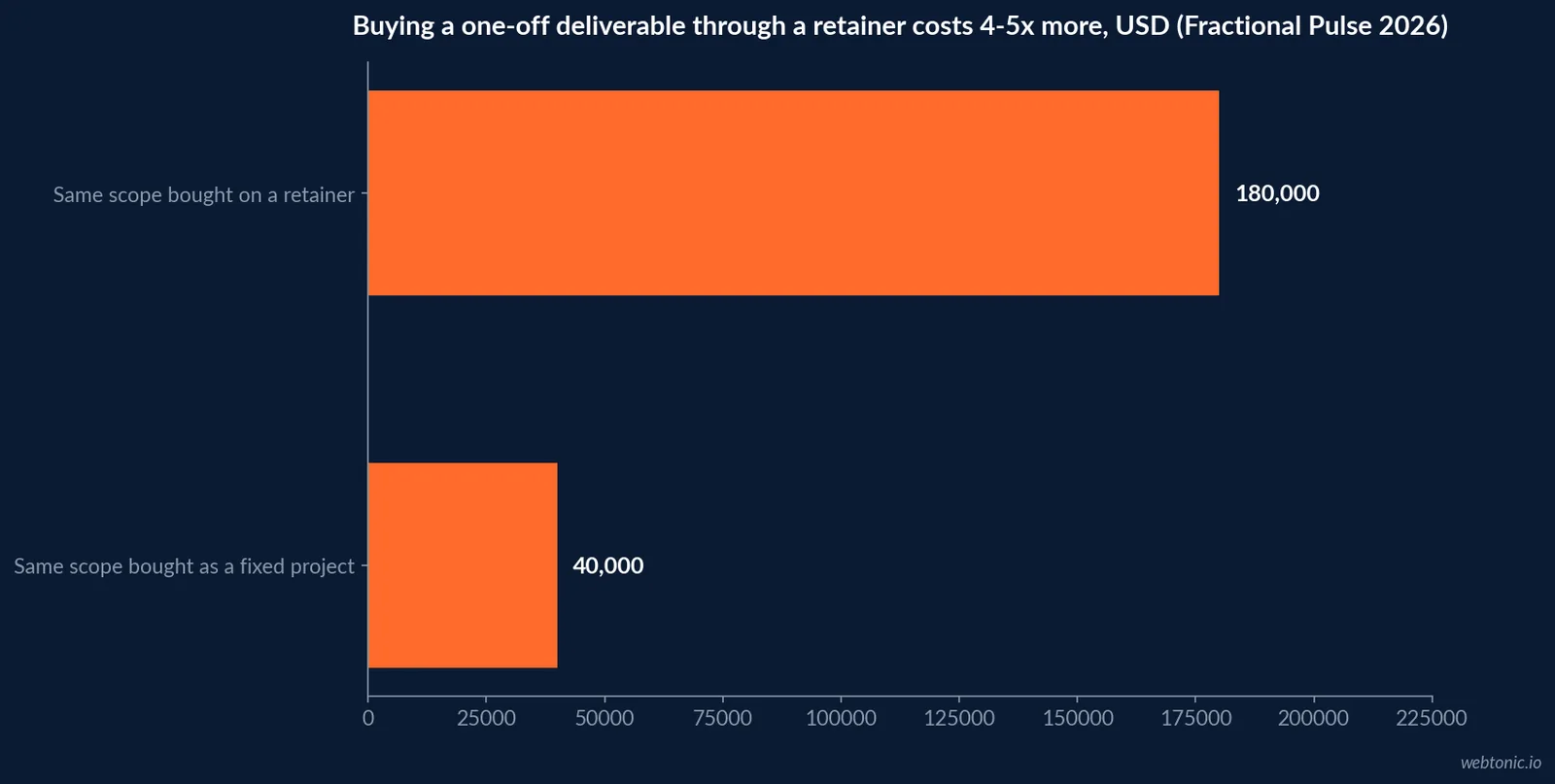
- Retainer-bought project work costs 4 to 5 times more.
- That is USD 180,000 against USD 40,000 for comparable scope.
- Fixed-price projects are 30% of consulting engagements.
- Hourly pricing is 29%, retainers 16%.
- Value-based fees are 15% and day rates 10%.
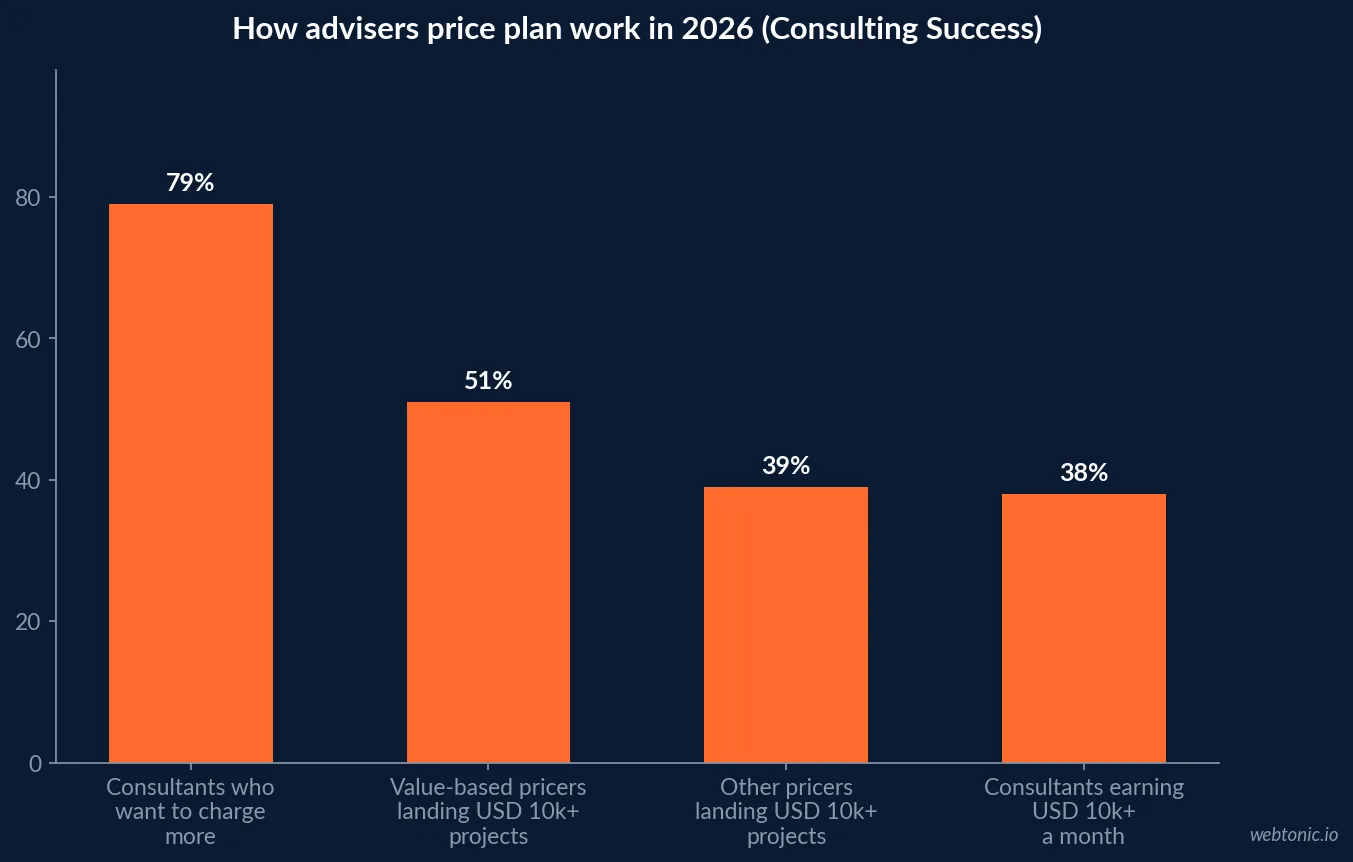
- 79% of consultants want to charge more.
- 51% of value-based pricers land USD 10,000-plus projects.
- 38% of consultants earn USD 10,000 or more a month.
- Median fractional leadership rate is USD 175 an hour.
- Median chief marketing officer tenure is 4.1 years.
- 31% of S&P 500 companies have no chief marketing officer.
- A bad leadership hire starts at 30% of first-year earnings.
- Senior mis-hire exposure reaches 213% of salary.
- Median CAC payback of 16 months sets the plan's horizon.
Why there is no price list for this
An investor-ready growth plan is sold as advisory work, and advisory work is not surveyed by deliverable. The available 2026 evidence is consulting-wide: Consulting Success surveys roughly 1,000 consultants on pricing models, and Fractional Pulse publishes engagement shapes and loaded rates. Neither prices a diligence pack.
So treat every number below as a rate base applied to a scope you define, not as a quote. The variable that actually moves the invoice is how many hours of senior time the pack absorbs before a board reads it.
The rate bases the model is built from
Fractional Pulse reports loaded rates of USD 300 to 700 an hour for project work, USD 200 to 600 for hourly advisory and USD 200 to 500 inside a retainer, with projects running 4 to 24 weeks and retainers USD 5,000 to 25,000 a month on 6 to 12 month terms plus a 30-day notice period. Go Fractional reports a median fractional marketing leadership rate of USD 175 an hour, an average of USD 180 and a 25th to 75th percentile range of USD 130 to 220.
The spread between USD 130 and USD 700 is not inconsistency. It is the difference between renting capacity and buying a document that has to survive questioning.
| Rate base (2026) | Published range | Source of the figure | What it prices |
|---|---|---|---|
| Project work, loaded hourly | USD 300-700 | Fractional Pulse | A defined deliverable with a date |
| Hourly advisory, loaded | USD 200-600 | Fractional Pulse | Review and challenge of your draft |
| Retainer hours, loaded | USD 200-500 | Fractional Pulse | Availability across a quarter |
| Fractional leadership, median | USD 175 an hour | Go Fractional | Ongoing ownership, about 9 hrs a week |
| Fractional leadership, quartiles | USD 130-220 | Go Fractional | Seniority and market spread |
Pricing the pack per raise event
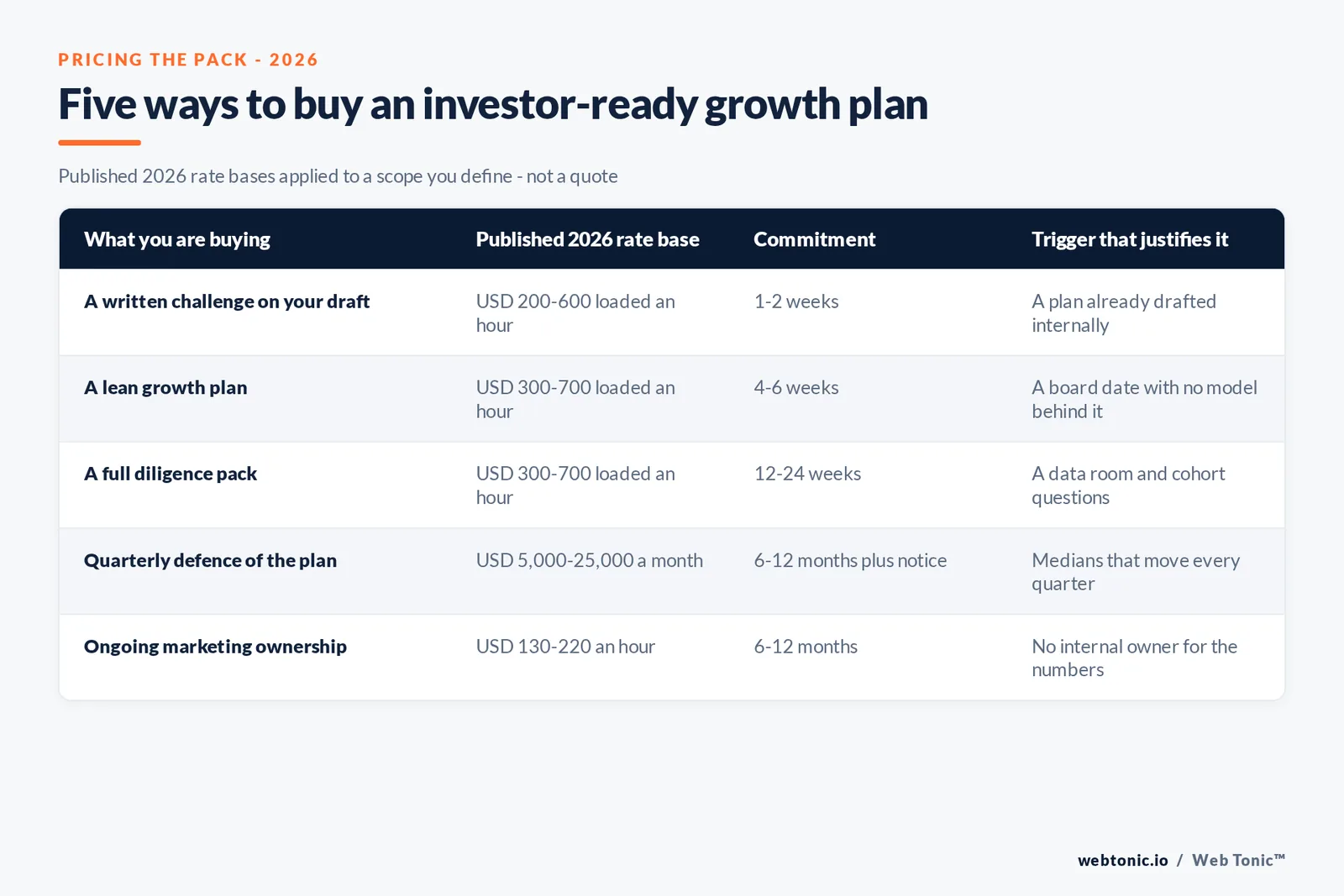
The useful model prices one plan against one window. A lean plan - market sizing, channel model, unit economics and a one-page scorecard - is a 4 to 6 week project. A full diligence pack that survives a data room adds attribution rebuilds, cohort work and scenario modelling and moves toward the 24 week end of the published range.
Multiply the hours you actually need by the loaded rate and the arithmetic is unromantic but defensible. What it will not do is produce a single headline number, which is exactly why quoted certainty on this deliverable should make you suspicious.
| Scope of the pack | Published project length band | Rate base applied | What the board gets |
|---|---|---|---|
| Plan review only | 1-2 weeks | USD 200-600 hourly advisory | A written challenge on your draft |
| Lean growth plan | 4-6 weeks | USD 300-700 project | Channel model and unit economics |
| Full diligence pack | 12-24 weeks | USD 300-700 project | Data room grade documentation |
| Quarterly defence | 6-12 month retainer | USD 5,000-25,000 a month | Re-benchmarking each quarter |
| Ongoing ownership | 6-12 months plus notice | USD 130-220 an hour | A named marketing owner |
The most expensive way to buy it
Fractional Pulse is blunt about the mismatch: buying project-shaped work through an open-ended retainer costs roughly four to five times more, illustrated as USD 180,000 against USD 40,000 for comparable scope. Retainers are priced for availability, and availability is not what a one-off pack consumes.
The reverse error is just as costly. Buying a project when the real need is quarterly defence leaves you re-procuring every board cycle at project rates.
How the fee will be structured
Consulting Success reports fixed-price projects at 30% of engagements, hourly at 29%, monthly retainers at 16%, value-based fees at 15% and day rates at 10%. It also reports that 79% of consultants believe they should charge more, that 38% earn USD 10,000 or more a month, and that value-based pricers land projects above USD 10,000 at 51% versus 39% for everyone else.
Read that as a negotiating map. A fixed price is the modal offer, and a value-based framing is the one most likely to arrive with a larger number attached to it.
| Pricing model | Share of engagements | Buyer's advantage | Buyer's risk |
|---|---|---|---|
| Fixed-price project | 30% | A known total for a known scope | Change requests on every addition |
| Hourly | 29% | You pay only for time used | No ceiling on the total |
| Monthly retainer | 16% | Availability across a quarter | Four to five times the cost for one-off scope |
| Value-based fee | 15% | Price tied to the outcome | Largest headline numbers |
| Day rate | 10% | Easy to compare across firms | Ignores preparation time |
The cost of the alternative
The comparison that matters is not against a cheaper adviser but against going without. Spencer Stuart puts median chief marketing officer tenure at 4.1 years against 5.0 years across the C-suite, reports 31% of S&P 500 companies with no chief marketing officer, and finds 77% of vacancies filled within six months. Talentfoot puts the floor cost of a bad leadership hire at 30% of first-year earnings and senior mis-hire exposure at up to 213% of salary, with retained search fees of 25% to 35%.
Against a mis-hire that can cost more than twice a salary, a fixed-scope plan is a rounding error. It is also the artefact that makes the eventual hire's brief specific.
What the plan has to contain to justify the fee
The fee is defensible when the pack carries benchmarks, not assertions. Benchmarkit's CY-2025 benchmarks put median customer acquisition cost payback at 16 months, median lifetime value to acquisition cost at 4.1 times, the median blended acquisition cost ratio at USD 1.30 and median revenue per employee at USD 175,000.
A pack that shows each of its own numbers beside the published median is doing the work a board would otherwise do out loud. That is the part you are paying for. Our data and analytics practice builds those comparisons before the plan is written.
Where the budget for it comes from
The CMO Survey 2026 reports marketing budgets at 9.0% of revenue and 9.6% of firm budgets, with spend growth of only 1.7% and headcount growth down 50% year on year. Hinge's 2026 High Growth Study reports high-growth professional services firms spending 12.0% of revenue on marketing against 5.0% for no-growth firms.
In practice the plan is funded from a flat budget by displacing something. Naming what it displaces, before the invoice arrives, is the cheapest way to keep the engagement from stalling in week three.
| Budget fact (2026) | Figure | Source | Consequence for the engagement |
|---|---|---|---|
| Marketing budgets | 9.0% of revenue | The CMO Survey | A flat pot funds the plan |
| Marketing spend growth | 1.7% | The CMO Survey | No new money is arriving |
| Marketing headcount growth | Down 50% year on year | The CMO Survey | External hours fill the gap |
| High-growth marketing spend | 12.0% of revenue | Hinge 2026 | Growth firms fund advisory more easily |
| No-growth marketing spend | 5.0% of revenue | Hinge 2026 | Scope has to be smaller, not vaguer |
Two contract terms that decide the real total
Fractional Pulse reports retainers on 6 to 12 month terms with a 30-day notice period. Those two clauses, not the headline rate, decide what a plan costs if the raise slips or the board changes its mind mid-engagement.
Ask for the notice period and the change-request rate in writing before signing. A fixed price with an uncapped change-request rate is an hourly engagement wearing a project's clothes.
The market context behind the quote
The Business Research Company sizes management consulting at USD 1,111.35 billion in 2026, up from USD 1,063.77 billion in 2025 and heading for USD 1,407.09 billion by 2030. The Fractional Work Report puts fractional demand growth at 149% year on year with roughly 150,000 US practitioners and marketing at 20% of demand.
Supply is expanding faster than the surveys can price it, which is genuinely good news for buyers who define scope tightly. It is bad news for anyone shopping on headline rate alone.
How to buy it without overpaying
Define the document list first, price it as a project at a loaded rate, keep the retainer for the quarterly defence rather than the writing, and put the notice period in the contract. Then benchmark the plan's own numbers against the published medians so the fee is arguing for itself.
If you want the marketing half of the pack built and instrumented, talk to us, look at how our growth marketing practice models channel scenarios, or read our breakdown of what paid search actually costs before you commit a channel budget in the plan.
Frequently Asked Questions
What does an investor-ready growth plan cost?
No published benchmark prices this deliverable as a product, so the honest answer is a model. Consulting-wide 2026 data puts loaded project rates at USD 300 to 700 an hour and typical projects at 4 to 24 weeks, which means a focused four to six week plan with senior time on it lands in the low tens of thousands, while a full diligence pack with data work behind it runs several times that. Anyone quoting a single number without naming the hours is quoting a guess.
Is a retainer or a project the cheaper way to buy it?
For a one-off pack, a project. Fractional Pulse reports that buying project work through an open-ended retainer costs roughly four to five times more - USD 180,000 against USD 40,000 for comparable scope - because retainers are priced for availability, not for a deliverable. Retainers earn their price when the plan has to be defended quarterly, not when it has to be written once.
How do consultants price this kind of work?
Consulting Success, surveying roughly 1,000 consultants, reports fixed-price projects at 30% of engagements, hourly at 29%, monthly retainers at 16%, value-based fees at 15% and day rates at 10%, with 79% saying they want to charge more. Value-based pricers are also likelier to land larger projects: 51% versus 39% for the rest. Expect a fixed price and expect it to be defended on outcome.
What is the cost of not having one?
It shows up as leadership churn and rework. Spencer Stuart puts median S&P 500 chief marketing officer tenure at 4.1 years, the shortest in the C-suite, with 31% of those companies carrying no chief marketing officer at all. Talentfoot's 2026 data puts the floor cost of a bad leadership hire at 30% of first-year earnings and senior mis-hire exposure at up to 213% of salary. A plan is cheap against either number.
Should the plan be priced against the raise or against the year?
Against the raise. The pack is consumed in one window - a fundraise, a board reset, a sale process - and its value is decided there. Pricing it as an annual line encourages scope drift; pricing it per event forces a date, a document list and an owner, which is also what makes it defensible in diligence.
Sources
Consulting Success - Consulting fees study
Fractional Pulse - Fractional executive engagement comparison
Go Fractional - Fractional CMO rates
Talentfoot - Cost of a leadership mis-hire, 2026 data
Spencer Stuart - CMO tenure 2026 snapshot
Benchmarkit - CY-2025 B2B SaaS performance metrics benchmarks
The CMO Survey - Highlights and Insights Report 2026
Hinge Marketing - 2026 High Growth Study
Fractional Jobs - The Fractional Work Report
The Business Research Company - Management consulting services market report