Table of contents
TikTok's US audience skews younger than any other major platform, and insurance's highest-value buyers skew older than the median policyholder - so the honest budget question for insurance TikTok ads is not "what does a lead cost here," it is "who is actually on this platform, and is that who we are trying to reach." 2026 audience and behavior data answers that question more usefully than a made-up CPL figure would.
Key Takeaways
- 63% of US adults under 30 use TikTok, per Pew Research.
- Only 12% of adults 65 and older do, the exact opposite skew from insurance's premium base.
- 57% of Gen Z use TikTok for financial/insurance research, per LIMRA.
- 84% of Gen Z use some social platform for that research.
- 66% of Gen Z use YouTube for it, still the top platform.
- 40% of Gen Z recall insurance ads specifically on TikTok, per Gen Re.
- 66% recall insurance ads on television, still the top recall platform.
- 39% recall insurance ads on radio.
- 34% recall insurance ads on Instagram.
- Only 6% recall seeing no insurance ads at all.
- 43% of Gen Z adults already have life insurance coverage.
- 45% have a life insurance need-gap, per LIMRA.
- 33% of Gen Z already follow insurance companies on social platforms.
- 46% follow financial advisors directly.
- No named study prices a TikTok-specific insurance CPC or CPL as of 2026.
- Finance and Insurance has the lowest Meta traffic CTR of any industry, at 1.46%, the closest verified paid-social proxy.
- And the highest Meta traffic CPC, at USD 0.86.
Start with who is actually there
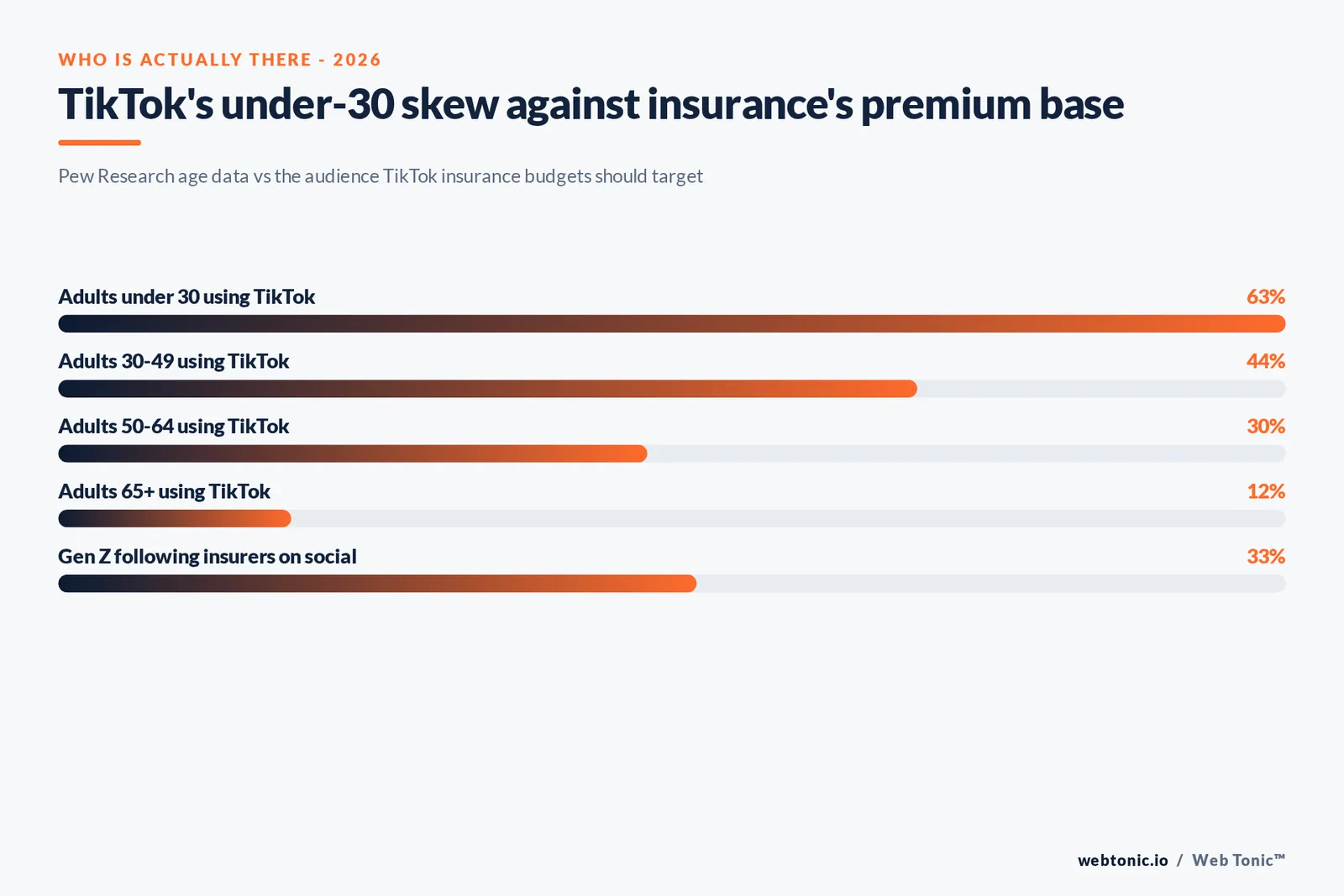
Pew Research Center's 2026 data on American TikTok use finds 63% of adults under 30 on the platform, against a steep drop-off by age - just 12% of adults 65 and older use it. That is close to the inverse of where insurance premium dollars sit: older adults carry more life insurance face value, more auto coverage tiers, and higher-value homeowners policies. A TikTok budget is, by construction, a bet on the buyer an insurer will have in five or ten years, not the one renewing a policy this quarter.
That is not a reason to skip the platform - it is a reason to budget it against the right goal. Judged as a direct-response channel competing with search on cost per bound policy, TikTok will look expensive against an older-skewing buyer base. Judged as a brand and education channel building awareness with future first-time buyers, the audience math works in its favor.
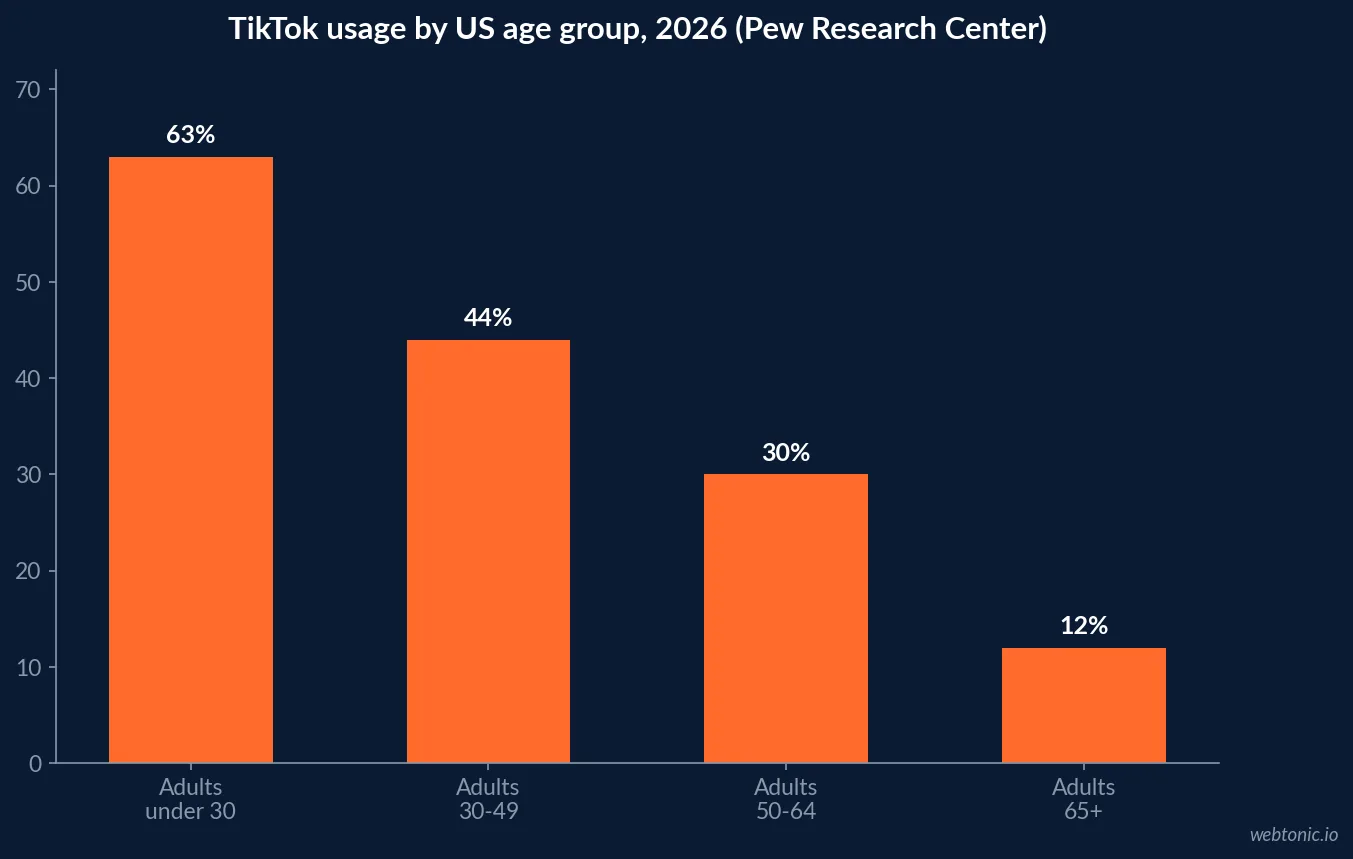
| Age group | Share using TikTok (2026) | Source |
|---|---|---|
| Adults under 30 | 63% | Pew Research Center |
| Adults 30-49 | 44% | Pew Research Center |
| Adults 50-64 | 30% | Pew Research Center |
| Adults 65+ | 12% | Pew Research Center |
The audience does engage with insurance content, specifically
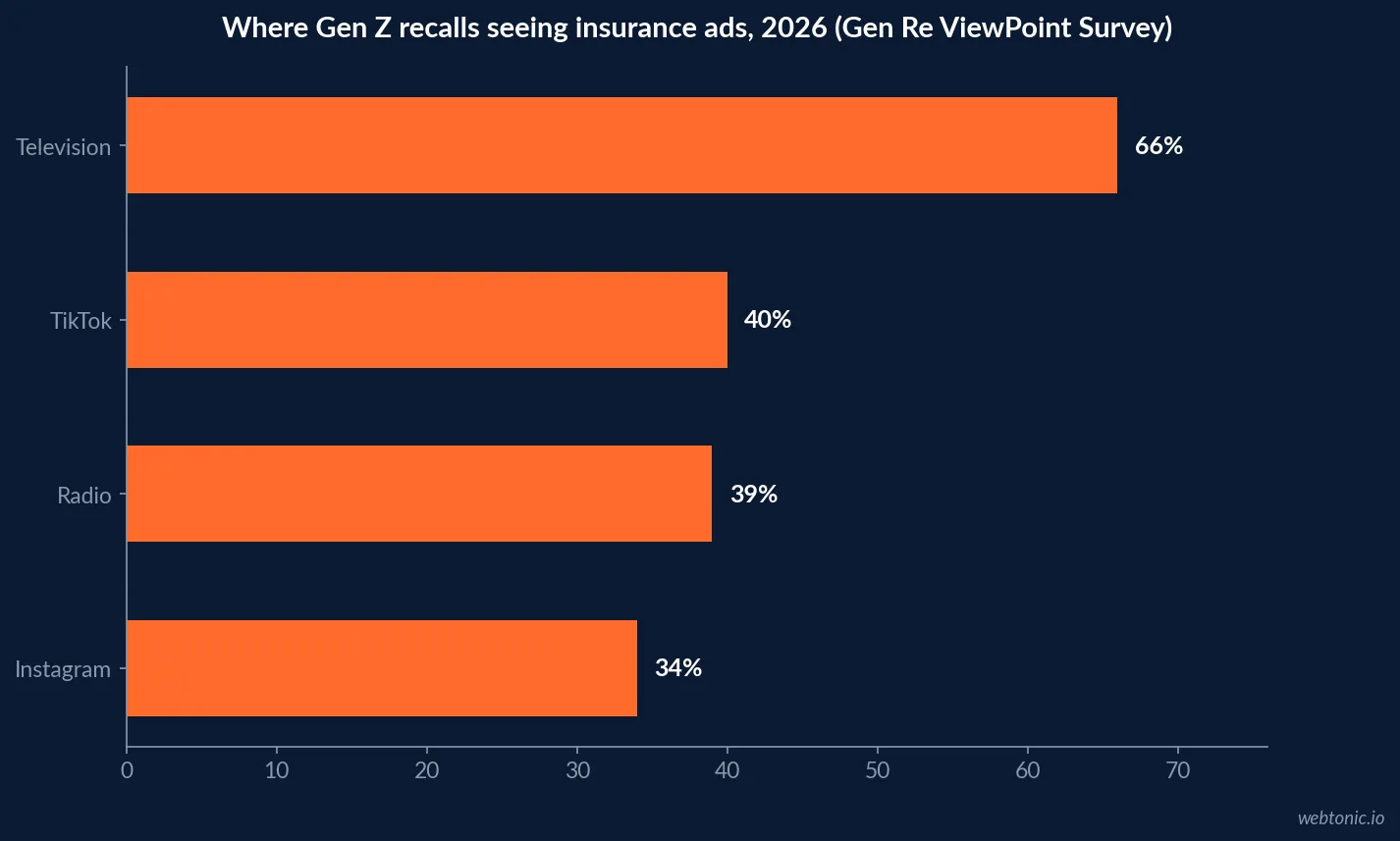
LIMRA's 2026 research on Gen Z and life insurance found 84% use social media for financial and insurance information, with 57% naming TikTok specifically, behind YouTube's 66% but ahead of X and Reddit at 34% each. The Gen Re Gen Z ViewPoint Survey asked the recall question directly: 40% of Gen Z respondents recall seeing insurance advertisements on TikTok, trailing only television's 66% and roughly matching radio's 39%, and ahead of Instagram's 34%. Only 6% of respondents recalled seeing no insurance advertising at all - this generation is not unreachable, it is already being advertised to constantly, which raises the bar for what a new TikTok campaign needs to say to register.
| Ad-recall platform (Gen Z, 2026) | Recall share | Source |
|---|---|---|
| Television | 66% | Gen Re Gen Z ViewPoint Survey |
| TikTok | 40% | Gen Re Gen Z ViewPoint Survey |
| Radio | 39% | Gen Re Gen Z ViewPoint Survey |
| 34% | Gen Re Gen Z ViewPoint Survey | |
| Saw no insurance ads at all | 6% | Gen Re Gen Z ViewPoint Survey |
The coverage gap TikTok's audience actually has
LIMRA's data puts current Gen Z life insurance ownership at 43%, with 45% of Gen Z adults carrying a life insurance need-gap - meaning they either lack coverage entirely or hold less than they need. That gap is the honest content angle for this platform: not a rate quote, which this audience mostly cannot yet act on at scale, but education that closes the gap between "I should have this" and "I don't know what or how much to buy," which LIMRA separately measures as a top reason Gen Z has not purchased.
33% of Gen Z already follow insurance companies directly on social platforms and 46% follow financial advisors, which argues for building an owned TikTok presence that this audience is already primed to opt into, ahead of paying to interrupt a feed they have not chosen to follow.
| Gen Z insurance fact (2026) | Figure | Source |
|---|---|---|
| Currently have life insurance coverage | 43% | LIMRA |
| Have a life insurance need-gap | 45% | LIMRA |
| Follow insurance companies on social | 33% | LIMRA |
| Follow financial advisors on social | 46% | LIMRA |
| Follow financial influencers on social | 32% | LIMRA |
What the platform's own audience actually knows about insurance
Gen Re's 2025 Gen Z ViewPoint Survey, run with 321 respondents aged 18 to 24 in partnership with the University of Southern Maine's risk management program, found 23% of this cohort have never purchased any type of insurance at all, and 54% do not see insurance as a prestigious career - a perception problem that shapes how a brand video should talk to this audience, not just where it should run. The same survey found 48% agree insurance is a necessary and valuable product even without having bought any yet, which is the opening an educational TikTok presence is built to use.
The survey's demographic breakdown is itself useful for targeting: respondents split 50% female, 49% male, with 31% identifying as Hispanic or Latino/a and 37% based in the South - a region where, separately, J.D. Power's shopping data shows some of the country's highest auto-insurance shop-and-switch rates. A platform-specific campaign aimed at this cohort is reaching people who are demographically likely to be actively comparing carriers within a few years, not decades.
| Gen Re Gen Z ViewPoint Survey fact (2025, n=321) | Figure |
|---|---|
| Have never purchased any type of insurance | 23% |
| Do not see insurance as a prestigious career | 54% |
| Agree insurance is a necessary, valuable product | 48% |
| Have work experience in the insurance industry | 34% |
| Based in the South region | 37% |
Why there is no honest TikTok-specific cost number to publish
No named, methodology-stated study publishes a TikTok cost-per-click or cost-per-lead figure isolated to insurance advertisers as of 2026 - the aggregator sites that claim to have one do not disclose a real sample or method, which is exactly the kind of number this page will not manufacture. The closest verified proxy sits one platform over: WordStream/LocaliQ's 2026 Facebook Ads Benchmarks puts Finance and Insurance at the lowest traffic-campaign click-through rate of any tracked industry, 1.46%, and the highest cost per click, USD 0.86. That is Meta, not TikTok, but it is real, sourced, and directionally consistent with what a regulated, low-engagement paid-social category should expect to pay wherever it buys short-form video attention.
What good content on this platform actually needs to say
Two Gen Re findings should shape the script before a media buyer ever picks a budget number. First, 54% of this cohort do not see insurance as a prestigious career and, by extension, are unlikely to trust content that reads like a corporate ad read straight from a brand guideline. Second, the perception gap is smaller than the purchase gap: 48% already agree insurance is necessary and valuable even among the 23% who have never bought a policy. The content problem on this platform is not persuading people insurance matters - most already believe that - it is helping them figure out what and how much to buy, which is the same barrier LIMRA independently measures as a top reason Gen Z has not purchased yet.
How to budget it without pretending it is search
Treat a TikTok line as a brand and education budget sized against future policy value, not against this quarter's cost per bound policy. Content that closes the "I don't know what to buy" gap LIMRA measures, published on an owned account this audience already follows a third of the time, is the defensible use case. Pairing that with our paid social budgeting breakdown gives a same-family comparison point while a TikTok-specific benchmark still does not exist in citable form.
Our performance creative practice builds short-form video for regulated categories with the compliance pass built in from the first script, and our paid social team can help decide whether the same creative belongs on Meta first while TikTok-specific insurance benchmarks mature.
The compliance layer short-form video adds
Beyond TikTok's own financial-services advertiser review, every state-level rule still applies: the NAIC's Unfair Trade Practices Act model bars misleading advertisements in any medium, explicitly including electronic postings, regardless of runtime. A 15-second script has less room to include a required disclosure than a 60-second one, which makes the compliance review step more consequential on this platform, not less.
Frequently Asked Questions
Is there a published TikTok-specific cost benchmark for insurance ads?
No named primary study publishes a TikTok cost-per-click or cost-per-lead figure specifically for insurance advertisers; that data point does not exist in a citable, methodology-stated form as of 2026. The closest verified paid-social proxy is WordStream/LocaliQ's 2026 Facebook Ads Benchmarks, where Finance and Insurance records the lowest traffic-campaign click-through rate (1.46%) and the highest cost per click (USD 0.86) of any tracked industry - a cross-platform signal that paid social is an expensive lane for this category generally, not a TikTok-specific number.
Who is actually the insurance audience on TikTok?
Pew Research Center's 2026 data puts TikTok use at 63% among US adults under 30, against just 12% of adults 65 and older. Since most insurance premium volume sits with older, asset-holding buyers, TikTok's real audience for insurance is Gen Z first-time buyers and renters/auto shoppers building insurance awareness years before they are the highest-value policyholder, not the median premium buyer today.
Does that younger audience actually engage with insurance content on TikTok?
Yes, measurably. LIMRA's 2026 research found 57% of Gen Z adults use TikTok specifically for financial and insurance research, and the Gen Re Gen Z ViewPoint Survey found 40% recall seeing insurance advertisements on TikTok - the third-most-recalled platform behind television (66%) and radio (39%), and ahead of Instagram (34%). Only 6% of Gen Z respondents recalled seeing no insurance advertising anywhere.
What should an insurance TikTok budget actually be spent on?
Given the audience skew, brand and education content aimed at future policyholders is a more defensible use of TikTok spend than a direct-response quote-form campaign competing on the same cost basis as search or Meta. LIMRA's finding that 33% of Gen Z already follow insurance companies directly on social platforms suggests an owned-channel content push, not only paid reach, has a receptive audience already in place.
Are there extra compliance rules for insurance ads on TikTok specifically?
TikTok's advertiser policies hold financial-services and insurance categories to stricter review than most verticals, on top of the state-level rules that already apply everywhere: the NAIC's Unfair Trade Practices Act model bars misleading advertisements in any medium, explicitly including electronic postings, and short-form video's compressed runtime makes it easy to omit a required disclosure that a longer format would have room for.
Sources
Pew Research Center - 8 Facts About Americans and TikTok, 2026
LIMRA - 2026 Insurance Barometer Study
LIMRA - Facts About Life Insurance: Gen Z, 2026
Gen Re - Gen Z ViewPoint Survey
PPC Land - WordStream/LocaliQ 2026 Facebook Ads Benchmarks coverage
NAIC - Unfair Trade Practices Act Model Law #880