Table of contents
Insurance carries the highest Facebook cost per click of any industry WordStream tracks, and since January 2025 it has also carried some of the tightest targeting restrictions on the platform. That combination is why so many insurance Meta accounts overspend: they budget like a normal vertical while running under Special Ad Category rules that remove the levers - age, ZIP, lookalikes - that would normally bring cost per click back down. This page uses WordStream's 2025/2026 benchmark reports, Meta's own policy language, and J.D. Power's 2026 shopping data to show where the money actually goes and where it should go instead.
Key Takeaways
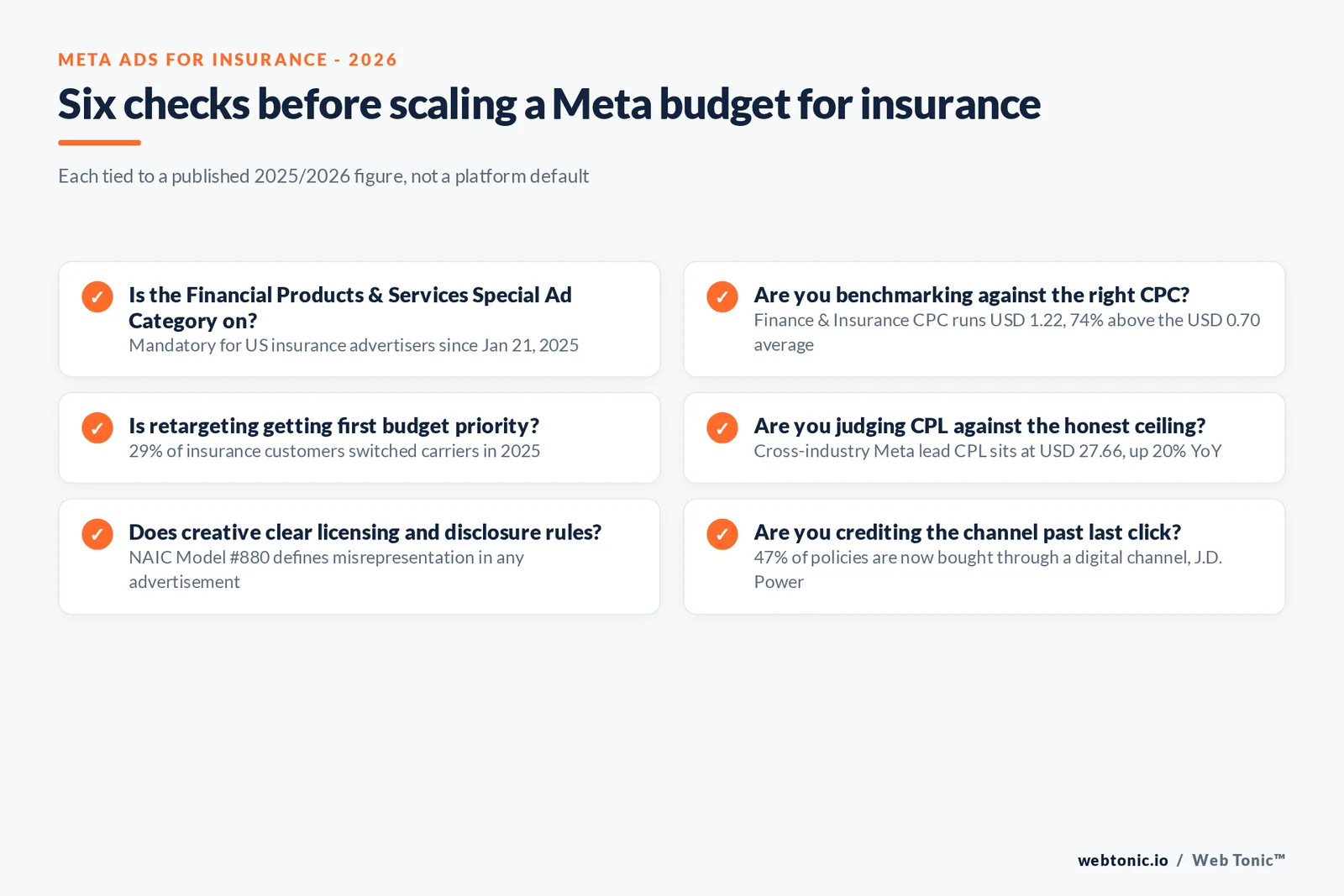
- Finance & Insurance Facebook CPC runs USD 1.22, the highest of any tracked industry.
- That is 74% above the USD 0.70 all-industry Facebook CPC average.
- Finance & Insurance Facebook CTR is just 0.98%, among the three lowest industries.
- Cross-industry Facebook lead cost per lead runs USD 27.66, up 20% year over year.
- Cross-industry Facebook lead conversion rate averages 7.72%.
- Meta has required the Financial Products and Services Special Ad Category since January 21, 2025.
- That category removes age, gender, ZIP and lookalike targeting for insurance advertisers.
- On Google, Finance & Insurance search CTR hits 9.83%, the second highest of any industry.
- Yet Finance & Insurance Google Ads conversion rate is just 2.64%, the lowest tracked.
- 29% of insurance customers switched carriers in 2025.
- 57% of consumers shopped for auto insurance in 2025, a record share.
- 47% of new policies are now bought through a digital channel.
- Only 35% still close through an agent, and 17% through a call center.
- Price-comparison tools nearly double consideration: 39% vs 21% without them.
- Yet 28% of insurance shoppers see no price-comparison tool at all.
- The top 10 P/C insurers write roughly half of the US market between them.
- State Farm alone holds a 10.4% market share of direct premiums written.
Why insurance is one of Meta's most expensive verticals
WordStream's 2025 Facebook Ads Benchmarks report, built from 1,180 campaigns running between April 2024 and June 2025, puts Finance and Insurance at a USD 1.22 cost per click for traffic campaigns - the highest of any industry the report tracks, and 74% above the USD 0.70 all-industry average. Click-through rate for the category sits at just 0.98%, the third lowest of any industry measured, alongside Automotive Repair (0.80%) and Physicians and Surgeons (0.83%). Shopping, Collectibles and Gifts, by contrast, gets a 4.13% CTR - insurance is simply not an "anytime treat" people click on impulse.
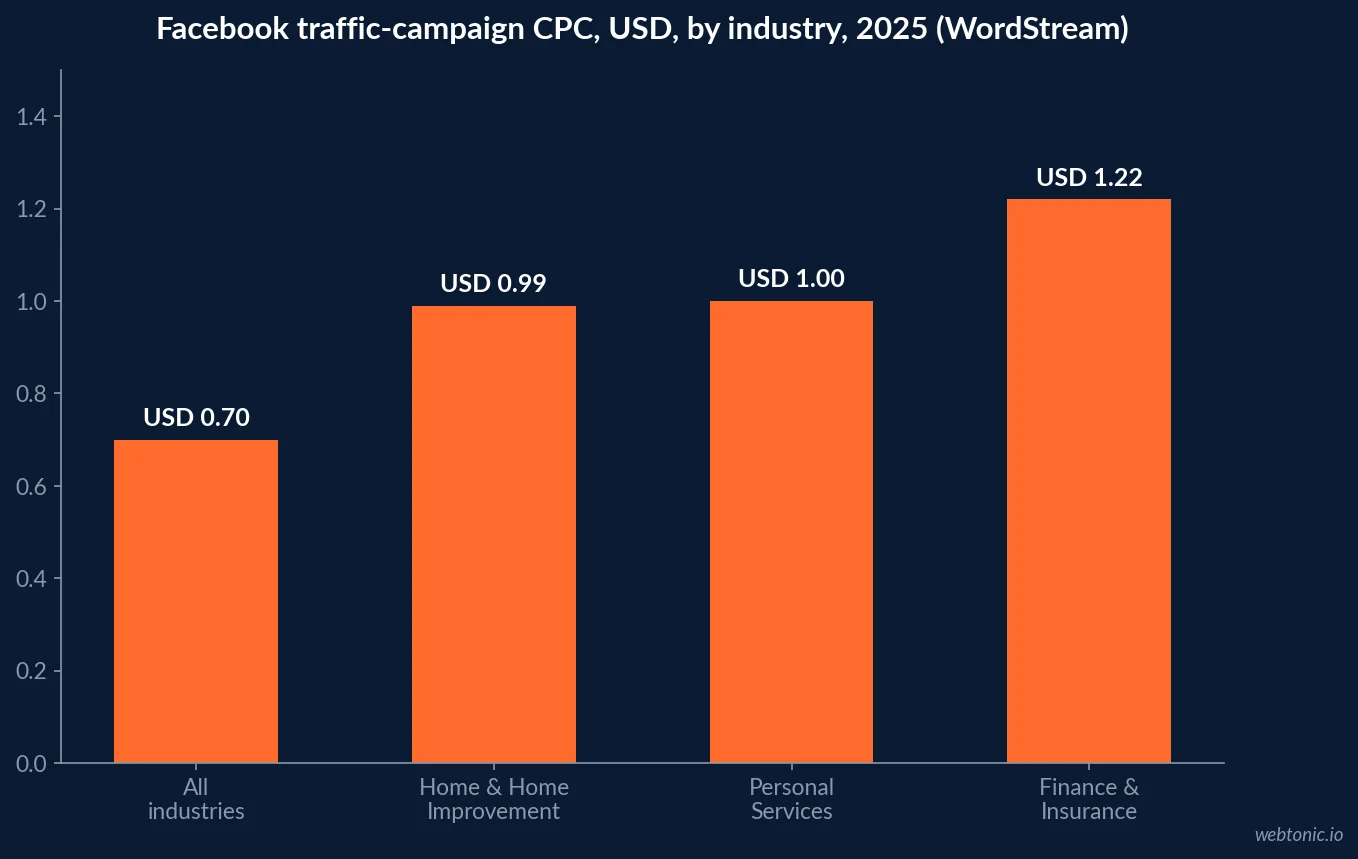
| Facebook traffic objective (2025) | Cost per click | Click-through rate | Source |
|---|---|---|---|
| All industries | USD 0.70 | 1.71% | WordStream |
| Finance & Insurance | USD 1.22 | 0.98% | WordStream |
| Personal Services | USD 1.00 | n/a | WordStream |
| Home & Home Improvement | USD 0.99 | n/a | WordStream |
| Shopping, Collectibles & Gifts (for contrast) | USD 0.34 | 4.13% | WordStream |
The targeting handcuffs nobody budgets around
Since January 21, 2025, Meta has required US advertisers running ads for financial products and services - insurance named explicitly - to declare the Financial Products and Services Special Ad Category. Under that category, an account loses age, gender, ZIP-code and exclusion targeting, plus lookalike and most detailed-interest audiences - the exact levers a normal account uses to bring cost per click down. Data Axle's coverage of the rule confirms the category expanded well beyond the old "Credit" bucket to cover banking, insurance and investment products broadly. Most insurance advertisers still plan budgets as if they can target a 35-54, homeowner, ZIP-radius audience; legally, in the US, they cannot.
| Targeting lever | Available to most industries | Available under Special Ad Category |
|---|---|---|
| Age range | Yes | No (broad only) |
| Gender | Yes | No |
| ZIP / radius exclusion | Yes | Restricted |
| Lookalike audiences | Yes | No |
| Most detailed interests | Yes | Limited list only |
| Custom audiences from site visitors | Yes | Yes |
What "overspend" looks like on a lead campaign
WordStream's same 2025 report puts the cross-industry average cost per lead at USD 27.66, up from USD 22.87 the year before - a 20% increase the report attributes to broad economic headwinds hitting most verticals at once. Finance and Insurance was not named in the top or bottom three for lead-objective metrics specifically, so the honest number to plan against is this cross-industry ceiling, not a guessed insurance-only figure. Given the traffic-objective CPC gap already documented above, an insurance lead campaign has no real basis to expect a below-average CPL; budgeting to the average, not to a hoped-for discount, is the defensible starting point.
Who is actually buying right now
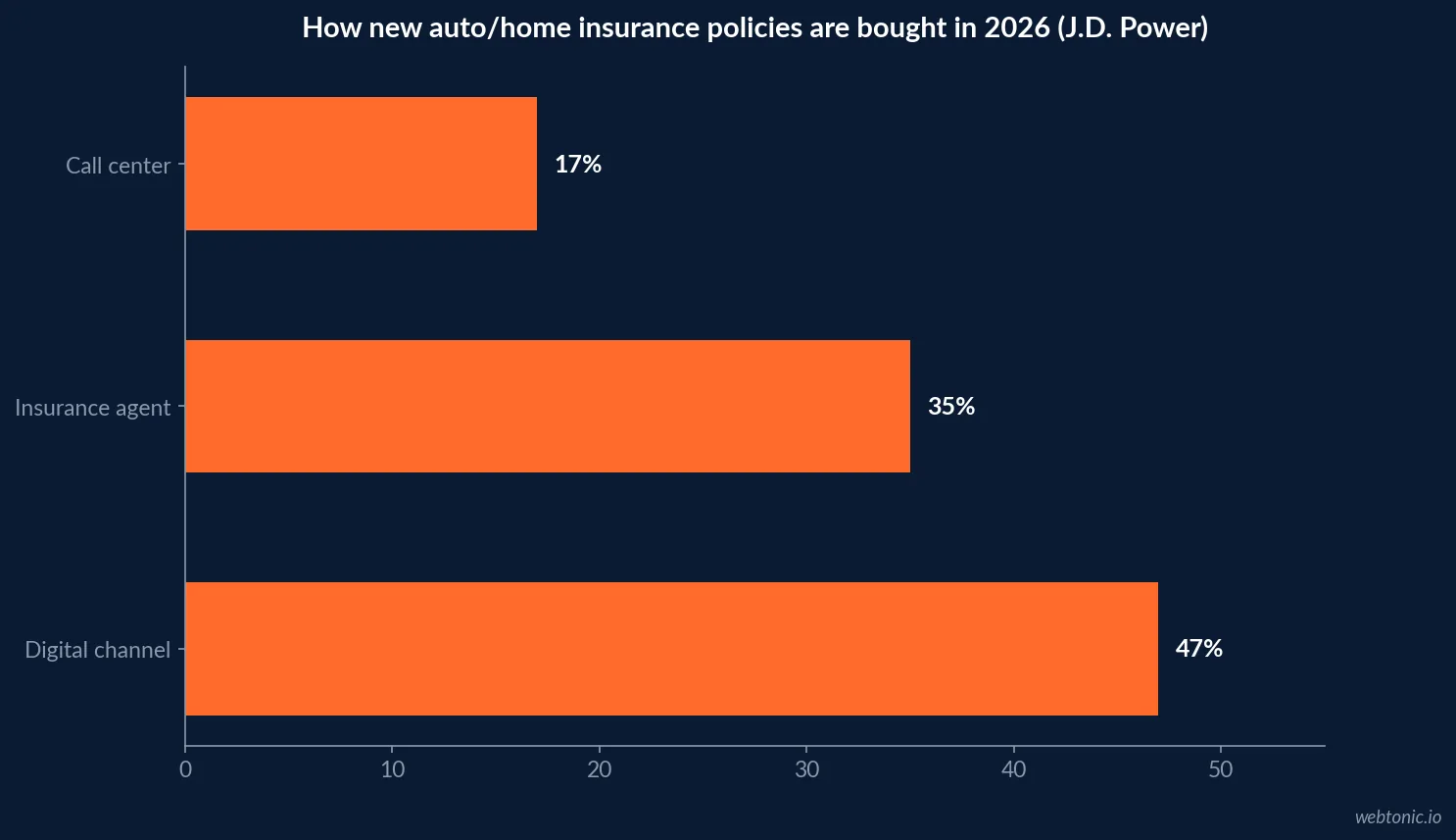
J.D. Power's 2026 research found 47% of insurance policy buyers now purchase through digital channels, against 35% through an agent and 17% through a call center. Shopping activity is also unusually high: 57% of customers shopped for auto insurance in 2025, the highest share in the study's history, and 29% switched insurers that year. Price-comparison tools matter more than most accounts assume: shoppers who see them are nearly twice as likely to consider a purchase (39% vs 21% without), yet 28% of insurance shoppers encounter no comparison tool at all, and only a third see tools comparing against competing brands rather than just the same insurer's own options.
| 2026 insurance shopping behavior | Share | Source |
|---|---|---|
| Policies bought through a digital channel | 47% | J.D. Power |
| Policies bought through an agent | 35% | J.D. Power |
| Policies bought through a call center | 17% | J.D. Power |
| Customers who shopped for auto insurance in 2025 | 57% | J.D. Power |
| Customers who switched insurers in 2025 | 29% | J.D. Power |
| Consideration lift from a price-comparison tool | 39% vs 21% | J.D. Power |
Everyone is chasing the same crowded audience
Part of why Meta CPCs stay high for insurance is structural: the market is concentrated among a handful of national brands with the budget to outbid everyone else on the same broad, Special-Ad-Category-limited audience. The Insurance Information Institute's 2024 data shows the top 10 writers of property/casualty insurance controlling roughly half the US market by direct premiums written, with State Farm alone at 10.4% and Progressive at 7.3%. A regional or independent agency bidding into that same auction, under the same forced-broad targeting, is competing dollar for dollar against advertisers with a fundamentally larger budget - which is exactly the scenario where retargeting a smaller, warmer audience beats broad prospecting on cost per result.
| Top P/C insurance writers by direct premiums written, 2024 | Market share | Source |
|---|---|---|
| State Farm | 10.4% | III / NAIC / S&P Global |
| Progressive | 7.3% | III / NAIC / S&P Global |
| Berkshire Hathaway | 6.0% | III / NAIC / S&P Global |
| Allstate Corp. | 5.3% | III / NAIC / S&P Global |
| Liberty Mutual | 4.1% | III / NAIC / S&P Global |
Where the budget should move instead
A Special-Ad-Category account still keeps one meaningful lever: custom audiences built from its own first-party signals - quote-form abandoners, renewal-window website visitors, past claimants outside a lookalike model. With 29% of customers switching carriers annually and digital already the leading purchase channel, a retargeting-heavy budget split is closer to where the buyer actually is than another broad prospecting push into the same USD 1.22 CPC auction everyone else is bidding into. Our growth marketing team builds that first-party audience layer before touching creative spend.
| Insurance Meta budget allocation | Typical account today | Data-informed shift |
|---|---|---|
| Broad prospecting (age/interest guesses removed anyway) | 50-60% | 20-30% |
| Retargeting quote-abandoners and past visitors | 10-15% | 35-40% |
| Renewal-window custom audiences | Rarely built | 15-20% |
| Creative testing reserve | 5% | 10% |
Compliance sits underneath every number here
Beyond Meta's own ad-standards policy, insurance advertising in the US answers to state insurance law. The NAIC's Unfair Trade Practices Act (Model #880) defines misrepresentation and false advertising of insurance policies as an unfair trade practice regardless of the medium, and the Advertisements of Life Insurance and Annuities Model Regulation (#570) sets standards most states have adopted in some form for how coverage terms may be described in an ad. Creative built for a Special-Ad-Category account should already be cleared against both before it ever reaches a CPC discussion.
| Compliance layer | What it governs | Reference |
|---|---|---|
| Meta's ad-standards policy | Financial/insurance category declaration, prohibited claims | transparency.meta.com |
| NAIC Model #880 | Misrepresentation & false advertising, any medium | NAIC |
| NAIC Model #570 | How life/annuity coverage terms may be described | NAIC |
| State insurance department rules | Agent licensing tied to the advertised entity | Varies by state |
Measuring success beyond cost per click
Because 35% of policies still close through an agent and 17% through a call center, a Meta campaign's real return often lands outside the platform's own reporting. Track cost per bound policy across every closing channel a lead can take, not just in-platform conversions, and weight retargeting segments by how recently a visitor's renewal window opens rather than by raw click volume. For the search side of the same budget conversation, see our breakdown of what Google Ads really costs, or talk to us about building the first-party audience layer a Special-Ad-Category account needs to stop overspending on broad reach.
| Metric to track | Why it matters here | Where it is usually missed |
|---|---|---|
| Cost per bound policy, all channels | Captures the 35%+17% that close off-platform | Ads dashboard only shows on-platform leads |
| Retargeting share of spend | Tests whether budget follows the 29% switcher pool | Rarely separated from prospecting in reporting |
| Renewal-window audience size | Matches spend timing to real buying windows | Almost never built as its own segment |
| Compliance review turnaround | Keeps creative inside NAIC/Meta rules before spend | Often skipped under launch deadlines |
Frequently Asked Questions
Why is Meta advertising so expensive for insurance?
WordStream's 2025 Facebook Ads Benchmarks report, built from 1,180 campaigns running between April 2024 and June 2025, puts Finance and Insurance at a USD 1.22 cost per click for traffic campaigns against a USD 0.70 all-industry average - the highest CPC of any measured category. Click-through rate sits at just 0.98%, among the three lowest industries tracked, because insurance shoppers rarely click on impulse the way shopping or travel audiences do.
What is the Special Ad Category, and why does it matter for insurance?
Since January 21, 2025, Meta has required every US advertiser promoting financial products and services - insurance explicitly included - to declare the Financial Products and Services Special Ad Category, per Meta's own Transparency Center policy. That designation removes age, gender, ZIP code, exclusion and lookalike targeting, the exact tools an account would normally use to keep cost per click down. Broader forced targeting is a direct, published reason insurance CPCs run high, not just competition.
Is Meta or Google Ads more expensive for insurance?
They fail differently. WordStream's 2026 Google Ads benchmarks report (13,474 campaigns, April 2025-March 2026) shows Finance and Insurance posting a 9.83% search click-through rate - the second highest of any industry - but only a 2.64% conversion rate, the lowest of any tracked industry. Meta's problem is cost per click before the click; Google's problem is turning a high-interest click into a lead once it lands.
Where should insurance Meta budget go instead of broad awareness?
Toward the audience most likely to act: J.D. Power's 2026 U.S. Insurance Shopping Study found 29% of insurance customers switched carriers in 2025, and 57% shopped for auto insurance that year, the highest share in the study's history. A Special-Ad-Category-compliant campaign cannot target those switchers by name, but it can build retargeting and lookalike-free custom audiences from a site's own quote-abandonment and renewal-window traffic, which is exactly where a constrained account still has room to be efficient.
How should an insurance advertiser measure Meta success if CPC will always be high?
Stop treating cost per click as the scoreboard. J.D. Power's Insurance Intelligence Report puts digital channels at 47% of new policy purchases against 35% through an agent and 17% through a call center - meaning a Meta-driven visit that converts by phone or through an agent two weeks later never shows up in the ads dashboard at all. Track cost per bound policy across every closing channel, not cost per click in isolation.
Sources
WordStream - Facebook Ads Benchmarks 2025 (1,180 campaigns, Apr 2024-Jun 2025)
WordStream/LocaliQ - Search Advertising Benchmarks by Industry 2026
Meta Transparency Center - Financial and Insurance Products and Services policy
Data Axle - The 2025 Meta Special Ad Categories Rules
Insurance Business America, reporting J.D. Power's 2026 U.S. Insurance Shopping/Digital Experience Studies
Insurance Information Institute - Facts + Statistics: Industry Overview
NAIC - Unfair Trade Practices Act, Model #880
NAIC - Advertisements of Life Insurance and Annuities Model Regulation, Model #570