Table of contents
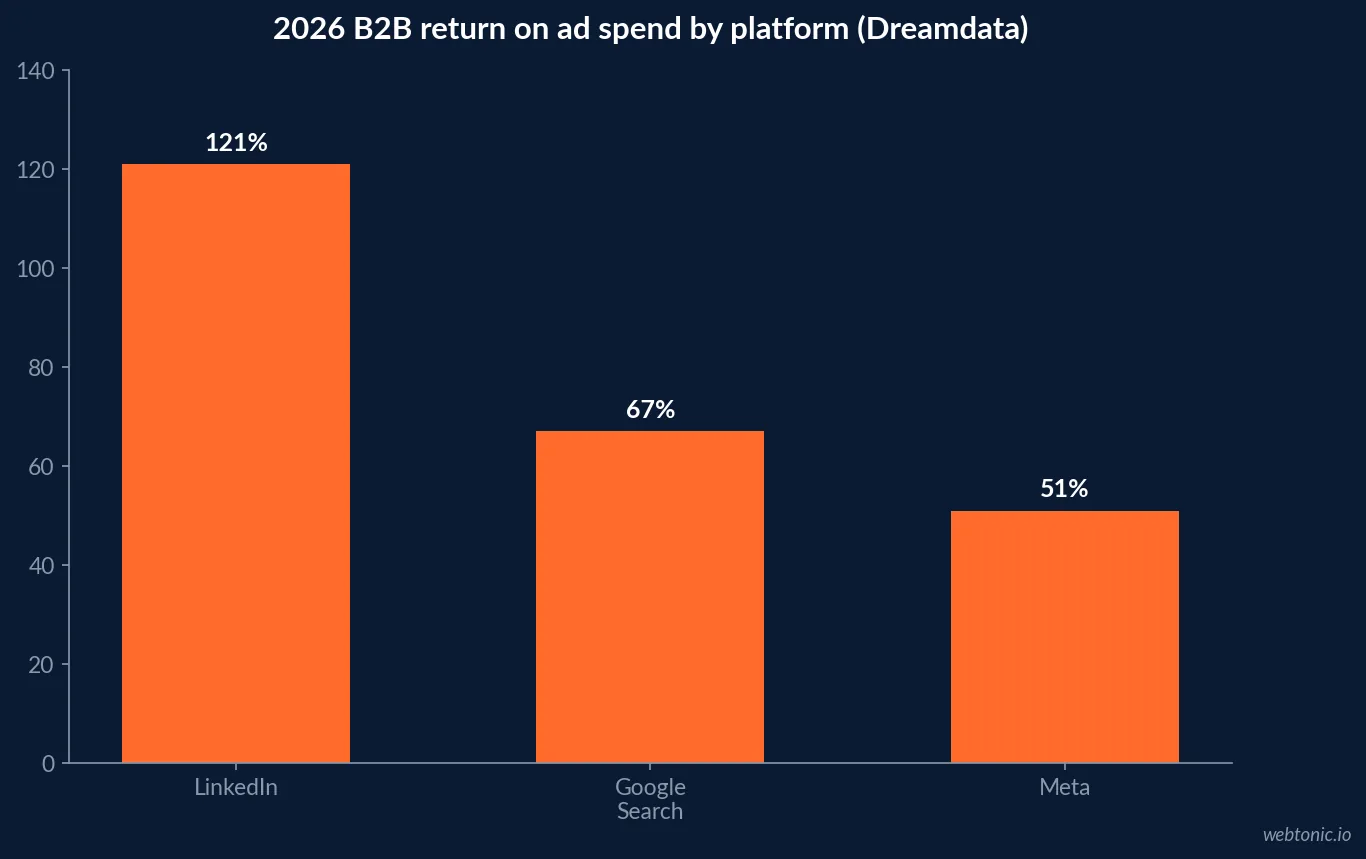
LinkedIn is the only major ad platform delivering a positive return on ad spend for B2B marketers in 2026. For insurance, that number is irrelevant to consumer personal-lines advertising and highly relevant to commercial insurance, group benefits and InsurTech budgets aimed at the brokers who still place most of the industry's premium.
Key Takeaways
- LinkedIn posts 121% ROAS for B2B marketers in 2026, the only platform with a positive figure.
- Google Search posts 67% ROAS in the same report.
- Meta posts 51% ROAS, the lowest of the three.
- LinkedIn now captures 41% of B2B paid social budgets.
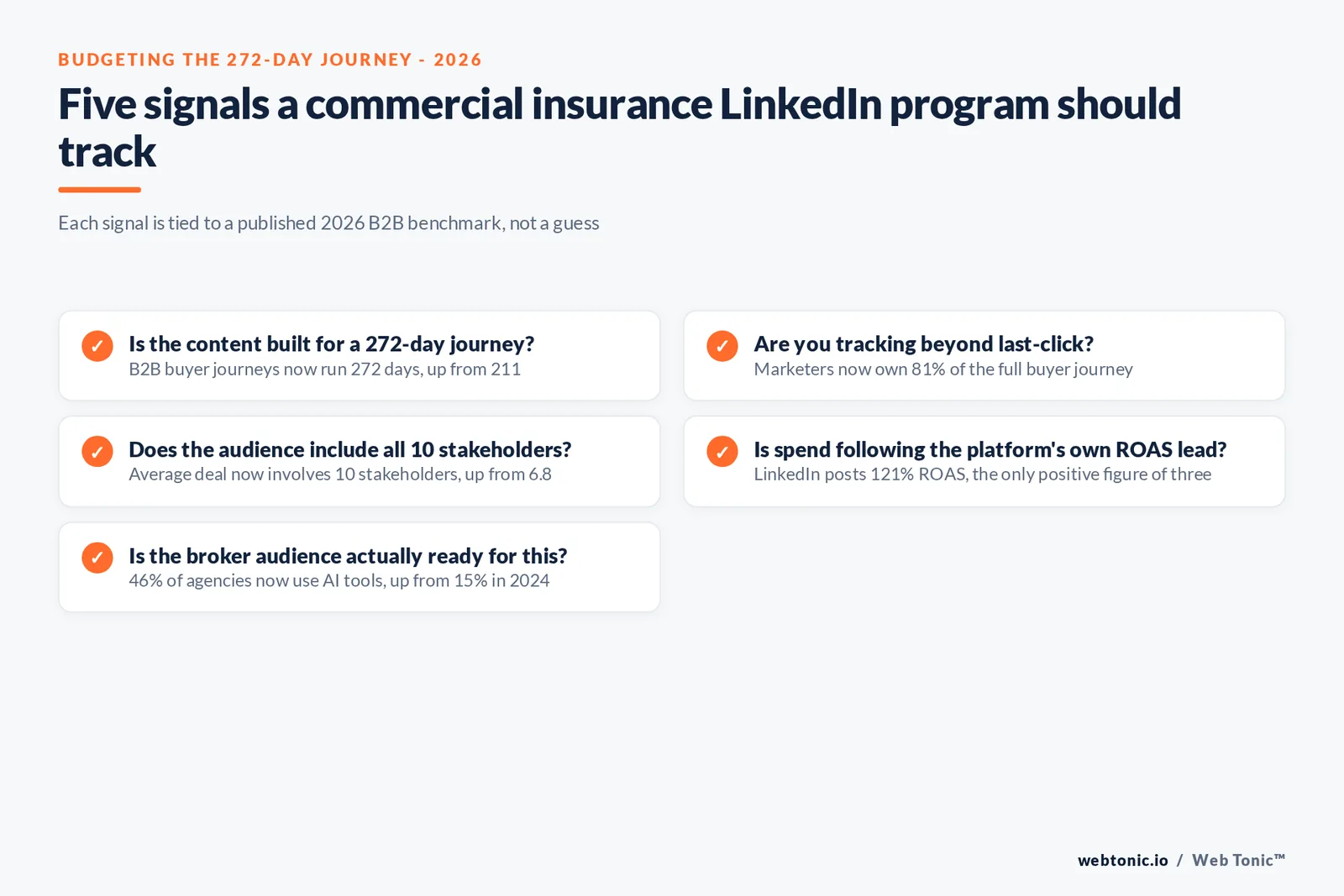
- The B2B buyer journey now runs 272 days, up from 211 a year earlier.
- Buyers spend roughly 220 days self-educating before entering a sales pipeline.
- That journey now spans 88 touchpoints, up from 76.
- Across 4 channels on average, up from 3.7.
- And involves 10 stakeholders, up from 6.8.
- Marketers now own 81% of that full buyer journey.
- Independent agents and brokers place 62% of all US P&C premium.
- That share has held at a five-year average of 62%.
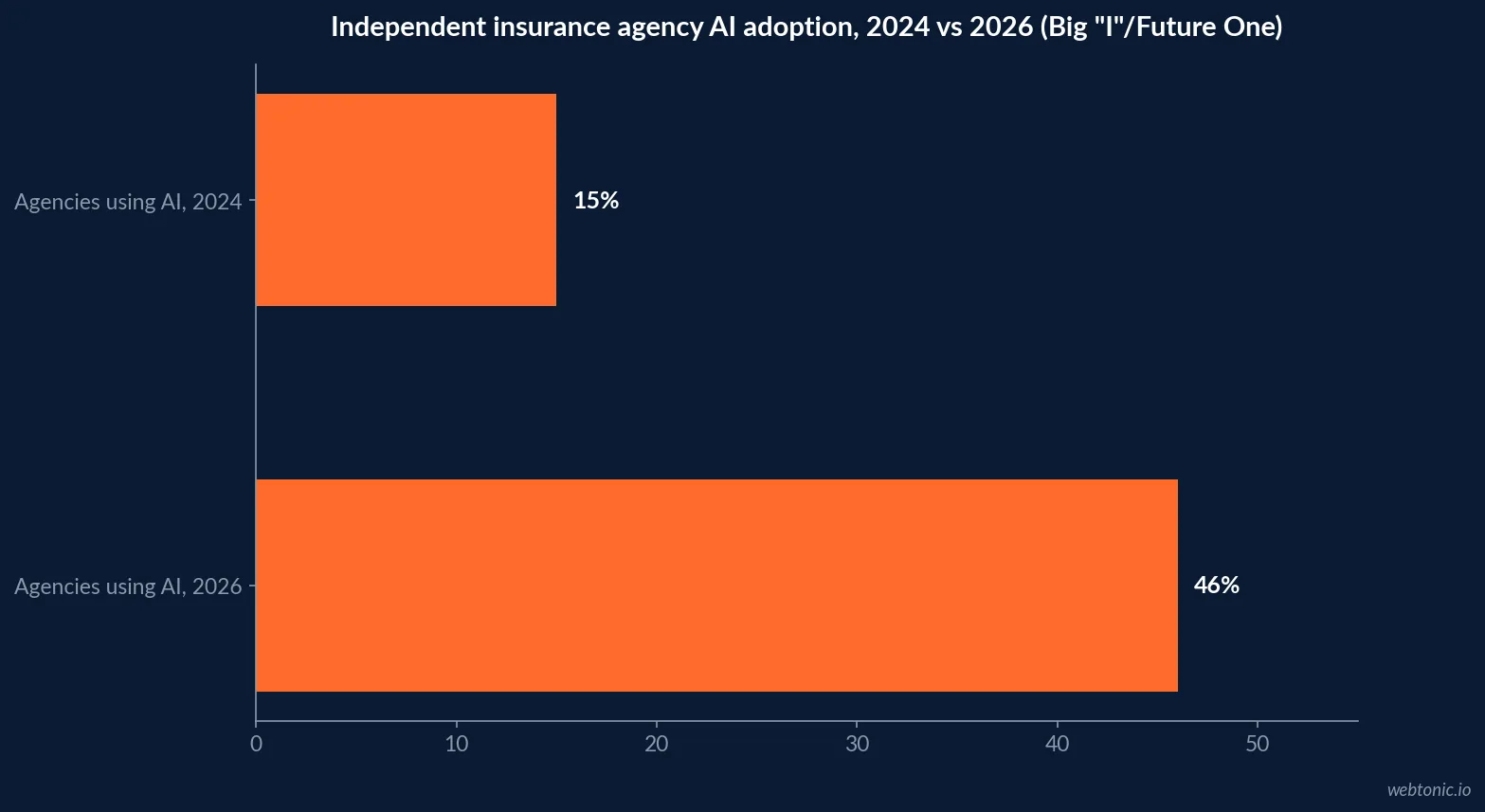
- 46% of independent agencies now use AI tools, up from 15% in 2024.
- Marketing content generation is the top AI use case at 49% among agencies.
- 60% of agencies cite lack of AI knowledge as their top adoption barrier.
- The Dreamdata dataset covers over 66 million B2B sessions and 3.5 million customer journeys.
The number that reframes the platform question
Dreamdata's LinkedIn Ads Benchmarks Report 2026, built from aggregated data covering over 66 million sessions and 3.5 million customer journeys across thousands of B2B companies, found LinkedIn is the only platform of the three measured to deliver a positive return on ad spend for B2B marketers: 121% ROAS, against 67% for Google Search and 51% for Meta. That performance has already moved budget: LinkedIn now captures 41% of B2B paid social spend, the largest single share among the platforms tracked.
For commercial insurance, benefits brokerage and InsurTech-to-carrier selling - all relationship-driven, long-cycle B2B categories - that is the platform economics that matters, not a consumer CPC benchmark built for personal auto or home insurance ads.
| Platform (B2B, 2026) | Return on ad spend | Share of B2B paid social budget | Source |
|---|---|---|---|
| 121% | 41% | Dreamdata 2026 | |
| Google Search | 67% | Not the largest share | Dreamdata 2026 |
| Meta | 51% | Not the largest share | Dreamdata 2026 |
Who this budget is actually reaching in insurance
The audience case starts with distribution structure. The Big "I" 2026 Market Share Report found the independent agency channel places 62% of all US property and casualty premium, a figure that has held at the five-year average of 62% through a hard market. That is the buyer LinkedIn is built to reach: agency principals, commercial lines producers, and benefits brokers evaluating a carrier's appetite, a group benefits platform, or an InsurTech tool on behalf of their own clients, not an individual comparing personal auto rates.
The Big "I" and Future One 2026 Agency Universe Study adds a readiness signal: 46% of independent agencies now use AI tools, up sharply from 15% in 2024, with marketing content generation the leading use case at 49%. An audience already investing in its own marketing technology is a more receptive audience for a carrier's or vendor's LinkedIn thought leadership than one that has not started digitizing yet.
| Broker/agency fact (2026) | Figure | Source |
|---|---|---|
| Share of US P&C premium via independent agents | 62% | Big "I" Market Share Report |
| Five-year average for that same channel share | 62% | Big "I" Market Share Report |
| Agencies now using AI tools | 46% (up from 15% in 2024) | Big "I"/Future One Agency Universe Study |
| Top AI use case: marketing content generation | 49% | Big "I"/Future One Agency Universe Study |
| Top adoption barrier: lack of AI knowledge | 60% | Big "I"/Future One Agency Universe Study |
The journey a LinkedIn budget actually has to cover
Dreamdata's report also measures how much longer and more distributed the B2B decision has become: the average buyer journey now runs 272 days, up from 211 days a year earlier, spanning 88 touchpoints (up from 76) across 4 channels (up from 3.7) and involving 10 stakeholders (up from 6.8). Marketers now own 81% of that full journey, and buyers spend roughly 220 days - about seven months - forming a decision through self-directed content consumption before a sales conversation even starts.
For an insurance carrier or InsurTech vendor selling into brokers or benefits administrators, that 220-day window is exactly what a LinkedIn content and ad program has to occupy: not a single campaign chasing a form fill, but a sustained presence a stakeholder group encounters repeatedly before procurement ever opens a conversation. LinkedIn's own B2B Institute research makes the same case from the brand side: measurable business impact from B2B brand investment shows up on a similarly long horizon, not inside a single campaign window.
| B2B buyer journey metric | 2026 figure | Prior-year figure | Source |
|---|---|---|---|
| Journey length | 272 days | 211 days | Dreamdata 2026 |
| Touchpoints | 88 | 76 | Dreamdata 2026 |
| Channels involved | 4 | 3.7 | Dreamdata 2026 |
| Stakeholders involved | 10 | 6.8 | Dreamdata 2026 |
| Self-education period before sales contact | ~220 days | Not reported | Dreamdata 2026 |
What the agencies themselves already spend on marketing
The demand side of this budget question has its own number now. Insurance Journal's coverage of the Big "I" 2026 Agency Universe Study found the average independent agency marketing budget rose from USD 14,300 in 2024 to USD 20,600 in 2026 - a jump of roughly 44% in two years. The same study counted 37,000 independent agencies operating in 2026, down from 39,000 in 2024, even as most reported profitability and the share reporting revenue declines fell from 12% to 8%.
Agencies rank their own marketing channels by usage, and the order matters for anyone buying media to reach them: Facebook still dominates at 70%, ahead of Instagram at 46% and LinkedIn at 35%. That does not mean LinkedIn is the wrong channel to reach a broker - a channel a broker uses less for their own customer marketing can still be exactly where they go to research a carrier partnership or an InsurTech vendor, which is a business decision, not a consumer one.
| Agency-side marketing fact (2026) | Figure | Source |
|---|---|---|
| Average agency marketing budget | USD 20,600 (up from USD 14,300 in 2024) | Big "I" via Insurance Journal |
| Independent agencies operating | 37,000 (down from 39,000 in 2024) | Big "I" via Insurance Journal |
| Agencies reporting a revenue decrease | 8% (down from 12% in 2024) | Big "I" via Insurance Journal |
| Agencies using Facebook for their own marketing | 70% | Big "I" via Insurance Journal |
| Agencies using Instagram | 46% | Big "I" via Insurance Journal |
| Agencies using LinkedIn | 35% | Big "I" via Insurance Journal |
What this means for the budget line
A LinkedIn budget for commercial insurance, group benefits or InsurTech should be sized and timed against a roughly nine-month journey with ten people in the room, not judged against a single-touch cost-per-lead the way a consumer channel would be. That argues for a content cadence built to be encountered repeatedly across the 88-touchpoint journey Dreamdata measures, paired with our growth marketing practice's approach to multi-touch B2B attribution rather than last-click reporting that would undercount everything LinkedIn contributes in months one through six.
Read our breakdown of building a paid search strategy as the complementary, shorter-cycle channel this same broker audience is also on, or talk to us about sequencing both against the actual length of your buying cycle.
Where the LinkedIn budget sits inside the wider agency marketing shift
The 44% two-year jump in average agency marketing budgets, from USD 14,300 to USD 20,600, is happening while agencies also report their biggest technology challenge is still juggling multiple carrier interfaces, and while 86% of agents say they still prefer customer service handled by phone rather than online self-service. Read together, that is an audience investing more in how it markets itself while staying conservative about how it wants to be served - which argues for a carrier or InsurTech LinkedIn presence built around genuinely useful content for the agency's own book of business, not a self-service sales funnel mimicking a consumer product page.
Agencies also rank finding and screening job candidates as their top overall challenge at 45%, ahead of keeping up with AI at 43% and growing personal lines business at 41%. A carrier or vendor LinkedIn program that helps solve any one of those three problems - talent, AI literacy, or growth playbooks - earns attention inside the 220-day self-education window Dreamdata measures more reliably than a straight product pitch does.
| Independent agency's own top challenges (2026) | Share citing it | Source |
|---|---|---|
| Finding and screening job candidates | 45% | Big "I" via Insurance Journal |
| Keeping up with the latest in AI | 43% | Big "I" via Insurance Journal |
| Growing personal lines business | 41% | Big "I" via Insurance Journal |
| Managing multiple carrier interfaces | Top tech challenge (unranked %) | Big "I" via Insurance Journal |
The compliance layer that follows the budget to LinkedIn
Producer licensing and anti-rebating rules do not pause for organic company-page content. A LinkedIn post that quotes a specific premium savings figure, implies a guaranteed rate, or is published by staff not licensed to discuss binding coverage in that state carries the same exposure under the NAIC's Unfair Trade Practices Act model as a print ad would. Route both sponsored posts and organic company-page copy through the same compliance review, since regulators do not distinguish between the two.
Frequently Asked Questions
Is LinkedIn actually a good channel for insurance advertising?
For consumer personal-lines insurance, LinkedIn is not the right comparison set at all - that audience and buying motion belongs on search and Meta. For commercial insurance, group benefits, and InsurTech selling into carriers or brokers, Dreamdata's 2026 LinkedIn Ads Benchmarks Report found LinkedIn is the only major platform delivering positive return on ad spend for B2B marketers, at 121%, against 67% for Google Search and 51% for Meta.
Who is the actual buyer this channel reaches in insurance?
Independent agents and brokers place 62% of all US property and casualty premium, per the Big 'I' 2026 Market Share Report, a figure that has held steady across the five-year average. That broker and agency-principal audience, plus benefits administrators and commercial underwriters, is a LinkedIn-native audience in a way individual policyholders are not.
How long is the B2B insurance buying journey LinkedIn budgets need to cover?
Dreamdata's report puts the current B2B buyer journey at 272 days on average, up from 211 days the year prior, with 88 touchpoints across 4 channels and 10 stakeholders involved in the decision. Roughly 220 of those days, about seven months, are spent self-educating through content before the buyer ever enters a sales pipeline, which is the window a LinkedIn thought-leadership budget is actually buying time inside.
Are agencies actually adopting the tools that would justify a bigger LinkedIn presence?
The Big 'I' and Future One 2026 Agency Universe Study found 46% of independent agencies now use AI in some capacity, up sharply from 15% in 2024, with marketing content generation as the leading use case at 49%. A broker audience that is itself investing in marketing technology is a more receptive audience for a carrier's or InsurTech's LinkedIn content than one still working entirely offline.
What producer-licensing rules apply to LinkedIn content specifically?
State insurance producer licensing and anti-rebating statutes do not stop at paid media - a LinkedIn post that promises a rate quote, names specific premium savings, or is published by an unlicensed employee acting as if they can bind coverage can trigger the same NAIC Unfair Trade Practices Act exposure as a landing page or a TV spot. Compliance review should cover organic company-page content, not only sponsored posts.
Sources
PR Newswire - Dreamdata LinkedIn Ads Benchmarks Report 2026
Independent Insurance Agents & Brokers of America (Big "I") - 2026 Market Share Report
IA Magazine - Big "I" and Future One 2026 Agency Universe Study
Insurance Journal - Big "I" 2026 Agency Universe Study coverage
NAIC - Unfair Trade Practices Act Model Law #880