Table of contents
Insurance Google Ads campaigns post a 9.83% click-through rate - the second-highest of 23 industries WordStream tracks - but convert at just 2.64%, the lowest of any category measured. That gap between clicks and conversions, not the cost per click, is what actually sets insurance's cost per lead in 2026.
Key Takeaways
- Insurance's Google Ads click-through rate is 9.83%, 2nd-highest of 23 industries.
- That CTR grew 18.01% year over year, the 3rd-largest gain tracked.
- Insurance's conversion rate is just 2.64%, the lowest of any tracked industry.
- The all-industry average conversion rate is 8.18% by comparison.
- Insurance cost per lead sits at USD 74.44, above the USD 66.69 all-industry average.
- Attorneys and Legal Services cost more per lead, at USD 131.63.
- Furniture (USD 106.70) and Real Estate (USD 102.51) also cost more per lead than insurance.
- The overall 2026 average cost per click is USD 5.42 across all industries.
- Overall CPL fell for the first time in five years in the 2026 dataset.
- 47.3% of auto policies were shopped at least once in the past year (LexisNexis).
- Insurers are missing digital comparison tools that nearly double purchase consideration (J.D. Power).
- Google requires financial-services verification for insurance advertisers.
- WordStream's dataset spans 13,474 US campaigns, April 2025-March 2026.
- Education and Instruction saw the biggest CTR gain overall, up 31.71%, for context.
- Real Estate's Google Ads CPC rose 27.27% year over year, the largest CPC increase tracked.
The headline number: high clicks, low conversion
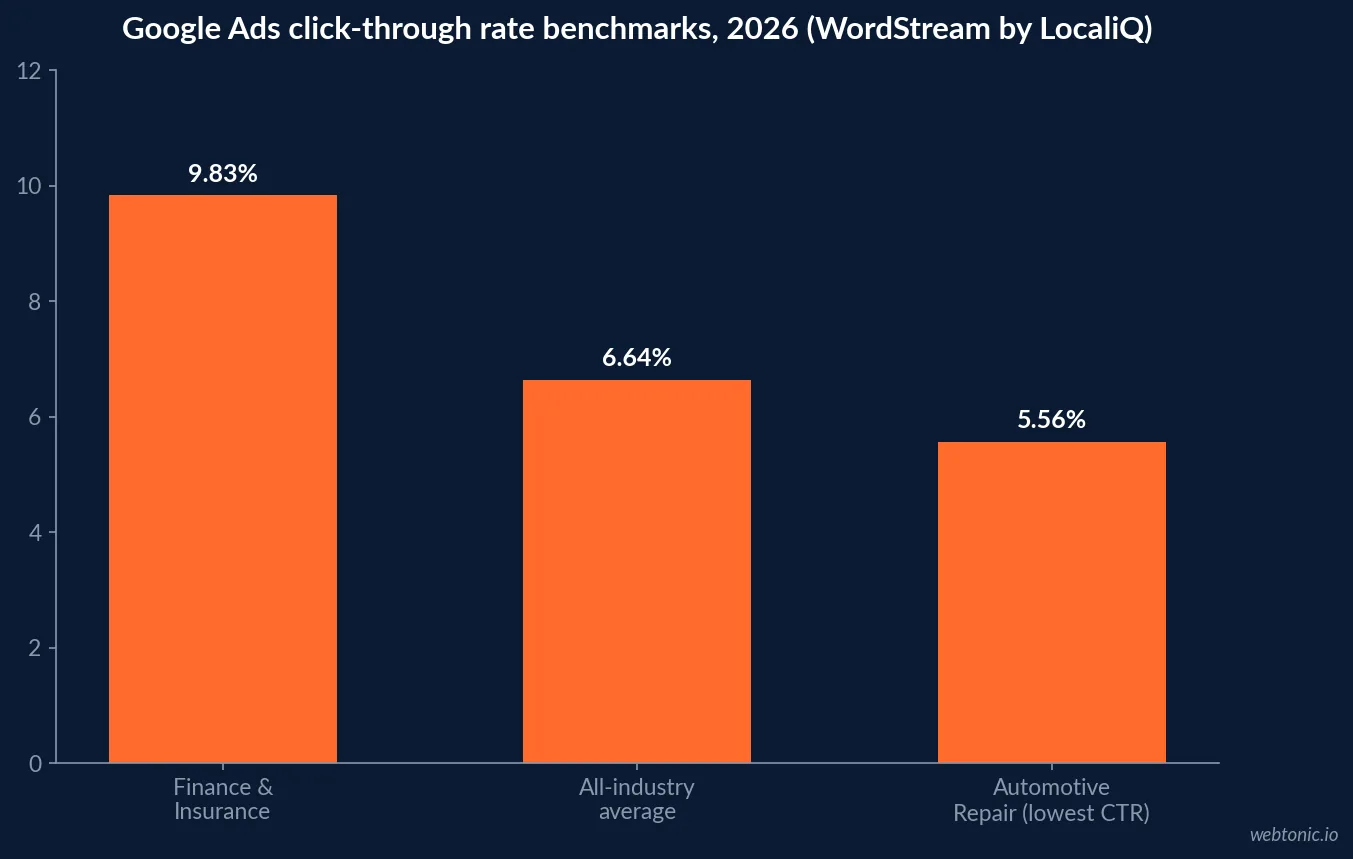
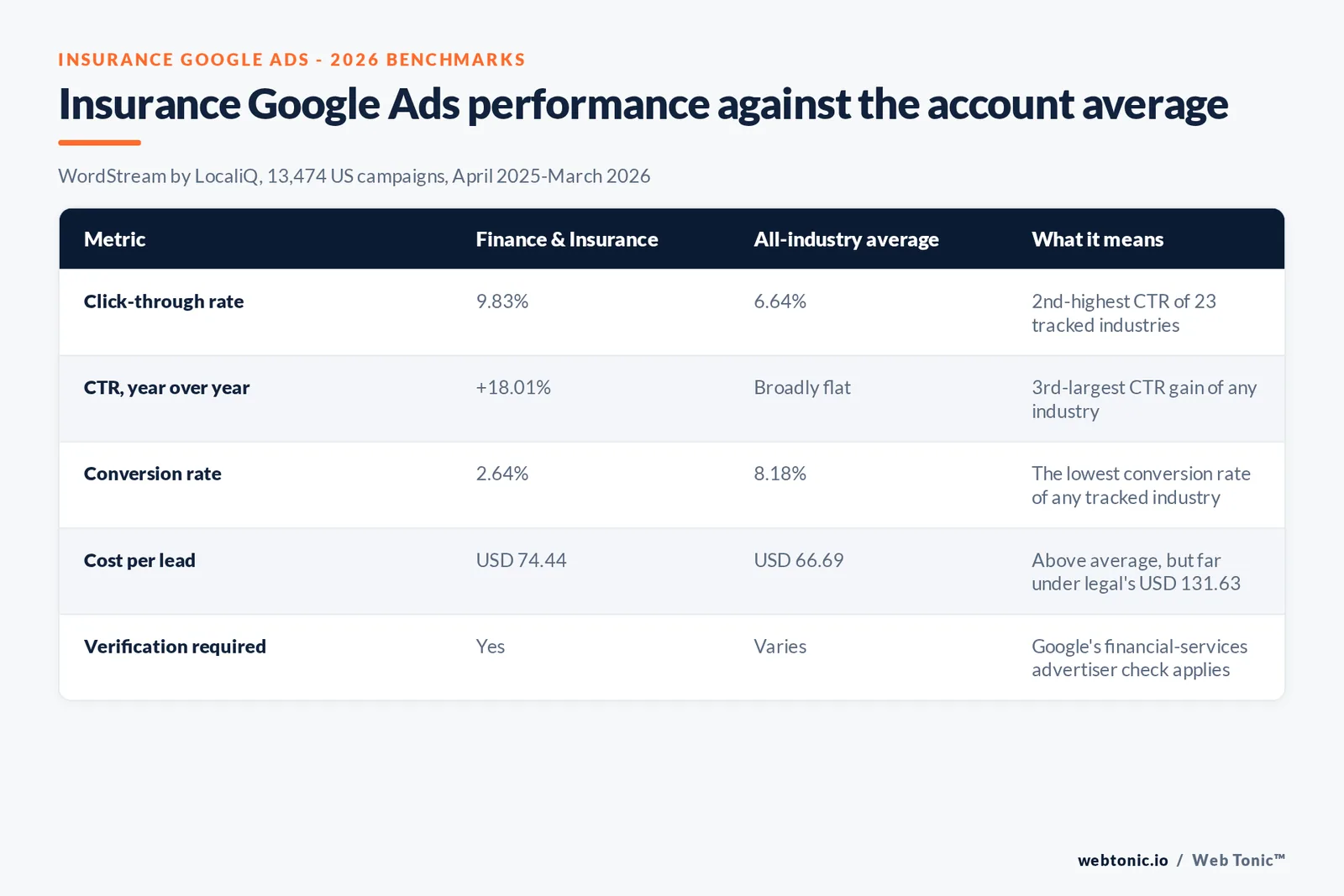
WordStream by LocaliQ's 2026 Search Advertising Benchmarks report, built from over 13,474 US-based Google and Microsoft Ads campaigns run between April 2025 and March 2026, put the Finance and Insurance category's click-through rate at 9.83% - the second-highest of 23 tracked industries, behind only Arts and Entertainment at 12.75%. Year over year, insurance's CTR grew 18.01%, the third-largest gain of any industry in the report, which the report's own analysts attribute partly to consumers "searching for finance or insurance help" amid economic uncertainty.
The category's conversion rate tells the opposite story: 2.64%, the lowest of any industry WordStream tracks, against an 8.18% all-industry average. High interest, low on-site conversion is the defining shape of this category's paid search.
| Metric (2026) | Finance & Insurance | All-industry average | Source |
|---|---|---|---|
| Click-through rate | 9.83% | 6.64% | WordStream by LocaliQ |
| CTR, year over year | +18.01% | Broadly stable | WordStream by LocaliQ |
| Conversion rate | 2.64% | 8.18% | WordStream by LocaliQ |
| Cost per lead | USD 74.44 | USD 66.69 | WordStream by LocaliQ |
| Overall cost per click (all industries) | n/a | USD 5.42 | WordStream by LocaliQ |
Why insurance's cost per lead sits where it does
At USD 74.44, insurance's cost per lead runs above the USD 66.69 all-industry average but comfortably under the three most expensive tracked categories: Attorneys and Legal Services (USD 131.63), Furniture (USD 106.70) and Real Estate (USD 102.51). Notably, both Furniture and Real Estate pay more per lead than insurance despite insurance's much stronger click-through rate - the arithmetic works because CPL is a function of CPC divided by conversion rate, and insurance's 2.64% conversion rate is dragging the number up even with relatively efficient clicks.
The overall market direction is favorable: 2026 marked the first year-over-year decline in overall cost per lead in five years across the WordStream dataset, reversing a run of " significant fluctuations including a 12% increase in CPC and 25% increase in CPL" reported in prior cycles.
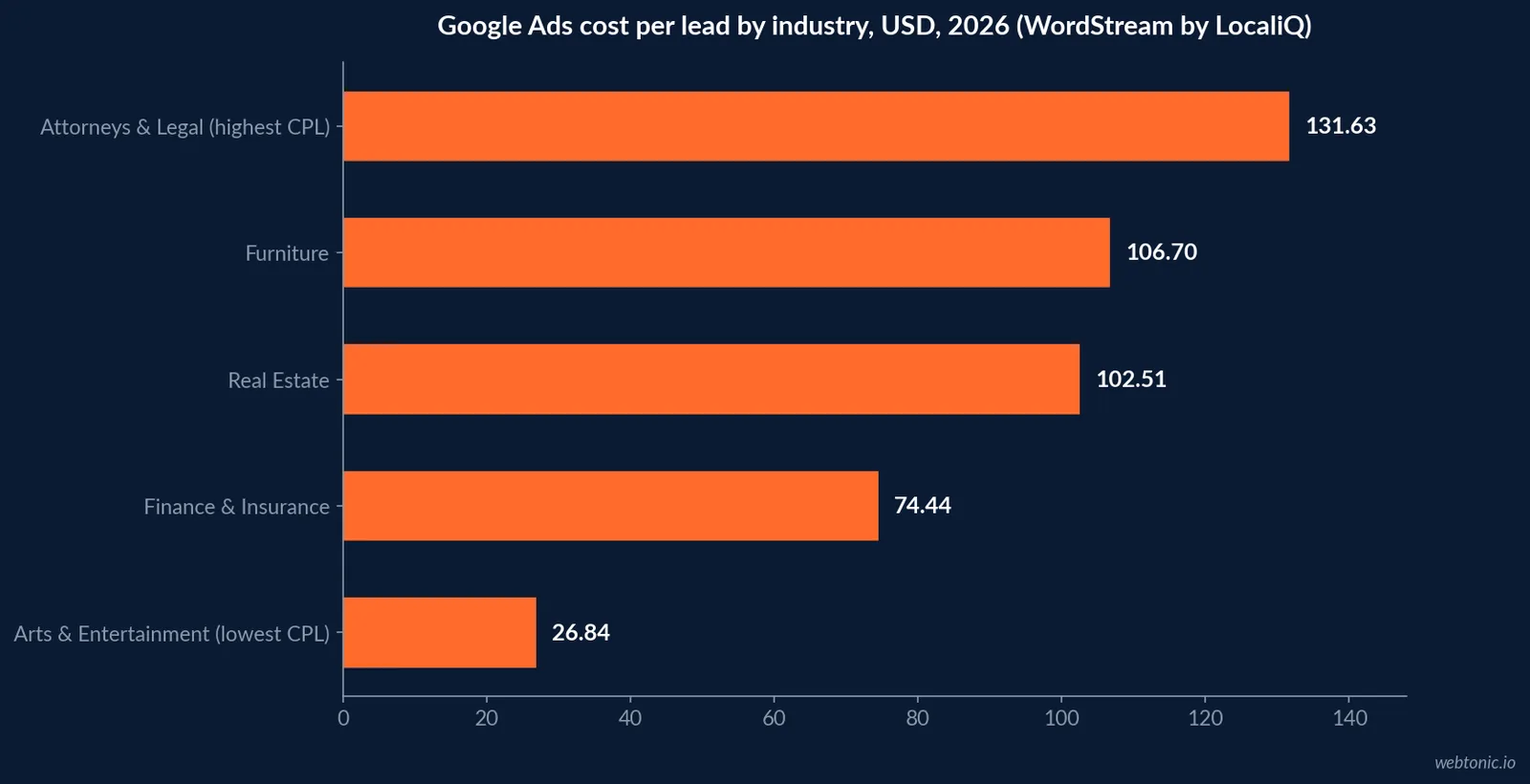
| Cost-per-lead ranking (2026, selected industries) | CPL (USD) | Source |
|---|---|---|
| Attorneys and Legal Services (highest tracked) | 131.63 | WordStream by LocaliQ |
| Furniture | 106.70 | WordStream by LocaliQ |
| Real Estate | 102.51 | WordStream by LocaliQ |
| Finance and Insurance | 74.44 | WordStream by LocaliQ |
| All-industry average | 66.69 | WordStream by LocaliQ |
| Arts and Entertainment (lowest tracked) | 26.84 | WordStream by LocaliQ |
What happens after the click: the shopping funnel itself moved
J.D. Power's 2026 U.S. Insurance Shopping Study found that as auto insurance price increases begin to cool, shoppers are "easing off the panic button" without becoming complacent - consistent with LexisNexis Risk Solutions data showing 47.3% of all auto policies were shopped at least once in the past year, the highest level recorded since it began tracking in 2020. Separately, J.D. Power's U.S. Insurance Digital Experience Study found insurers are missing opportunities to convert that shopping activity: digital price and coverage comparison tools nearly double a shopper's likelihood of considering a purchase, and most insurance websites and apps still don't offer them.
That is the missing half of a CPL number. A campaign can hit a below-average cost per lead and still underperform on quote-to-bind if the landing page doesn't give the shopper the comparison tools J.D. Power's own research says move consideration.
| Post-click shopping signal (2026) | Figure | Source |
|---|---|---|
| Auto policies shopped at least once in the past year | 47.3% | LexisNexis Risk Solutions |
| Highest shopping rate since tracking began (2020) | Confirmed 2026 | LexisNexis Risk Solutions |
| Purchase consideration lift from comparison tools | Nearly 2x | J.D. Power 2026 Digital Experience Study |
| Auto/home policies now purchased fully digitally | A growing share* | J.D. Power 2026 Digital Experience Study |
*J.D. Power's release describes this as an increasing share of new policies without a single published percentage in the public release; treat it as a direction, not a fixed benchmark, until the full study is reviewed.
The all-industry context that shows why insurance is unusual
Insurance's CTR-conversion split is unusual even against the categories that sit near it in the 2026 WordStream ranking. Real Estate saw the largest year-over-year cost-per-click increase of any tracked industry at +27.27%, while Education and Instruction logged the year's single biggest CTR gain at +31.71% and the steepest CPC decline at -22.79% - both moving in the opposite direction from insurance's pattern of a large CTR gain (+18.01%) alongside a still-low conversion rate. That contrast is useful context for anyone benchmarking an insurance account against "the industry" loosely: insurance is not moving like the typical high-CTR category, and typical fixes for a low conversion rate (better keywords, tighter match types) address CTR, not the funnel gap documented above.
| Cross-industry context metric (2026) | Figure | Source |
|---|---|---|
| Largest CPC increase of any industry | Real Estate, +27.27% | WordStream by LocaliQ |
| Largest CTR gain of any industry | Education and Instruction, +31.71% | WordStream by LocaliQ |
| Largest CPC decline of any industry | Education and Instruction, -22.79% | WordStream by LocaliQ |
| Industries with conversion rate increases in 2026 | 87% of tracked industries | WordStream by LocaliQ |
What the LexisNexis shopping data adds to the media plan
The LexisNexis U.S. Insurance Demand Meter, tracked since 2020, found 47.3% of all auto insurance policies were shopped at least once in the past year - the highest rate recorded since the meter began. That figure describes a market where nearly half of the existing book is actively comparing quotes at any given time, which is a retention signal as much as an acquisition one: an insurer with a weak digital experience isn't just losing net-new Google Ads clicks to competitors, it's losing renewal-eligible policyholders who are already shopping.
Read against the CTR and conversion figures above, that reframes the account's real target. A 2.64% conversion rate on new-business keywords is one problem; a shopping rate above 47% on the existing book is a second, adjacent problem that a Google Ads account alone cannot fix, and one that the digital comparison tools J.D. Power flagged as missing would address for both audiences at once. The premiums driving that shopping behavior are themselves rising: the Insurance Information Institute, citing NAIC data, put average auto insurance expenditure at USD 1,282 in 2023, up from USD 1,127 in 2022 - the kind of premium pressure that keeps a shopping rate above 47% from being a one-year anomaly. A media plan that treats every quote request the same, regardless of whether it comes from a first-time buyer or a renewal-eligible policyholder actively shopping because of a rate increase, will keep pricing both against the same 2.64% blended conversion rate instead of the two very different rates each segment actually converts at.
The verification step that can suspend the account entirely
Google's financial services advertiser verification policy names insurance among the products requiring verification against a market-specific regulator or registry, with enforcement dates that have continued to expand market by market through 2026 - a separate verification is required for each targeted location. This sits alongside state-level insurance advertising rules governing claims and disclosures. A lapsed or incomplete verification doesn't raise CPL - it removes the account's ads entirely, which makes it the single highest-severity risk on this list, ahead of any bid or budget decision.
Where this leaves the 2026 media plan
Insurance Google Ads campaigns are already winning the click - a 9.83% CTR most categories would take immediately. The number worth fixing is the 2.64% conversion rate, and the evidence points to the landing page and quote flow rather than the auction: J.D. Power's own research ties comparison tools directly to purchase consideration, and LexisNexis confirms shoppers are actively comparing more than ever. Before increasing budget against a below-average CPL, confirm the account's financial-services verification is current and that the landing page gives shoppers a reason to convert beyond the ad itself.
Our Google Ads practice builds that landing-page layer alongside the campaign, our data and analytics team connects the ad account to real quote-and-bind outcomes rather than form fills, and our guide to building a Google Ads strategy covers the account-structure side of this in more depth.
Frequently Asked Questions
What is a good click-through rate for insurance Google Ads?
Benchmark against 9.83%, not the 6.64% all-industry average. WordStream by LocaliQ's 2026 Search Advertising Benchmarks report, built from over 13,000 US campaigns run April 2025 through March 2026, found Finance and Insurance posted the second-highest CTR of 23 tracked industries, behind only Arts and Entertainment (12.75%), and the category's CTR grew 18.01% year over year - the third-largest CTR gain of any industry tracked.
Why does insurance have such a low Google Ads conversion rate?
It's the lowest of any tracked industry: 2.64%, against an 8.18% all-industry average. WordStream doesn't attribute this to a single cause, but the pattern fits a high-consideration, comparison-heavy purchase - insurance shoppers click a lot (hence the high CTR) but convert on-site far less often than categories like Animals and Pets (16.22%) or Automotive Repair (15.51%), because a quote request usually isn't the final purchase decision.
What does an insurance lead cost on Google Ads in 2026?
USD 74.44 per lead, per WordStream's 2026 benchmarks - above the USD 66.69 all-industry average but well below Attorneys and Legal Services at USD 131.63, the most expensive tracked category. Furniture (USD 106.70) and Real Estate (USD 102.51) both cost more per lead than insurance despite insurance's much higher click-through rate, which is the conversion-rate gap showing up in the cost line.
Does the CPL number account for what happens after the click?
No, and that's the gap most insurance advertisers miss. J.D. Power's 2026 U.S. Insurance Shopping Study and U.S. Insurance Digital Experience Study both track the funnel past the ad click, and the digital experience study found insurers are "leaving new business on the table" by not providing digital price and coverage comparison tools that nearly double a shopper's likelihood of considering a purchase. A cheap CPL on a landing page without comparison tools is buying clicks that still convert at 2.64%.
Are there compliance requirements specific to insurance Google Ads accounts?
Yes. Google requires financial-services advertiser verification for insurance advertisers, enforced on a rolling, market-by-market basis through 2026, with a separate verification needed for each targeted location. State-level insurance advertising rules on claims and disclosures apply on top of that. An account that lapses verification can have its ads suspended entirely, which is a bigger risk to CPL than any bid-strategy change.
Sources
WordStream by LocaliQ - Search Advertising Benchmarks by Industry 2026
WordStream by LocaliQ - Digital Benchmarks by Industry: PPC
J.D. Power - 2026 U.S. Insurance Shopping Study
J.D. Power - U.S. Insurance Digital Experience Study (IDES)
CarInsurance.com - reporting on LexisNexis Risk Solutions U.S. Insurance Demand Meter
Insurance Information Institute - Auto insurance facts and statistics (NAIC data)
Google Ads Help - Financial Services Verification: Relevant Regulators and Enforcement Dates