Table of contents
No platform publishes an insurance-specific email benchmark; Mailchimp groups it inside a broader "Business + Finance" category that already underperforms the all-industry average. That gap matters less than what an insurer does with the one email nearly every policyholder actually reads: the renewal notice, timed against the fact that 29% of customers switch carriers every year. This page uses Mailchimp's own published benchmarks, Litmus's July 2026 inbox data and J.D. Power's 2026 shopping research to build an honest, renewal-first program instead of chasing a generic open-rate target.
Key Takeaways
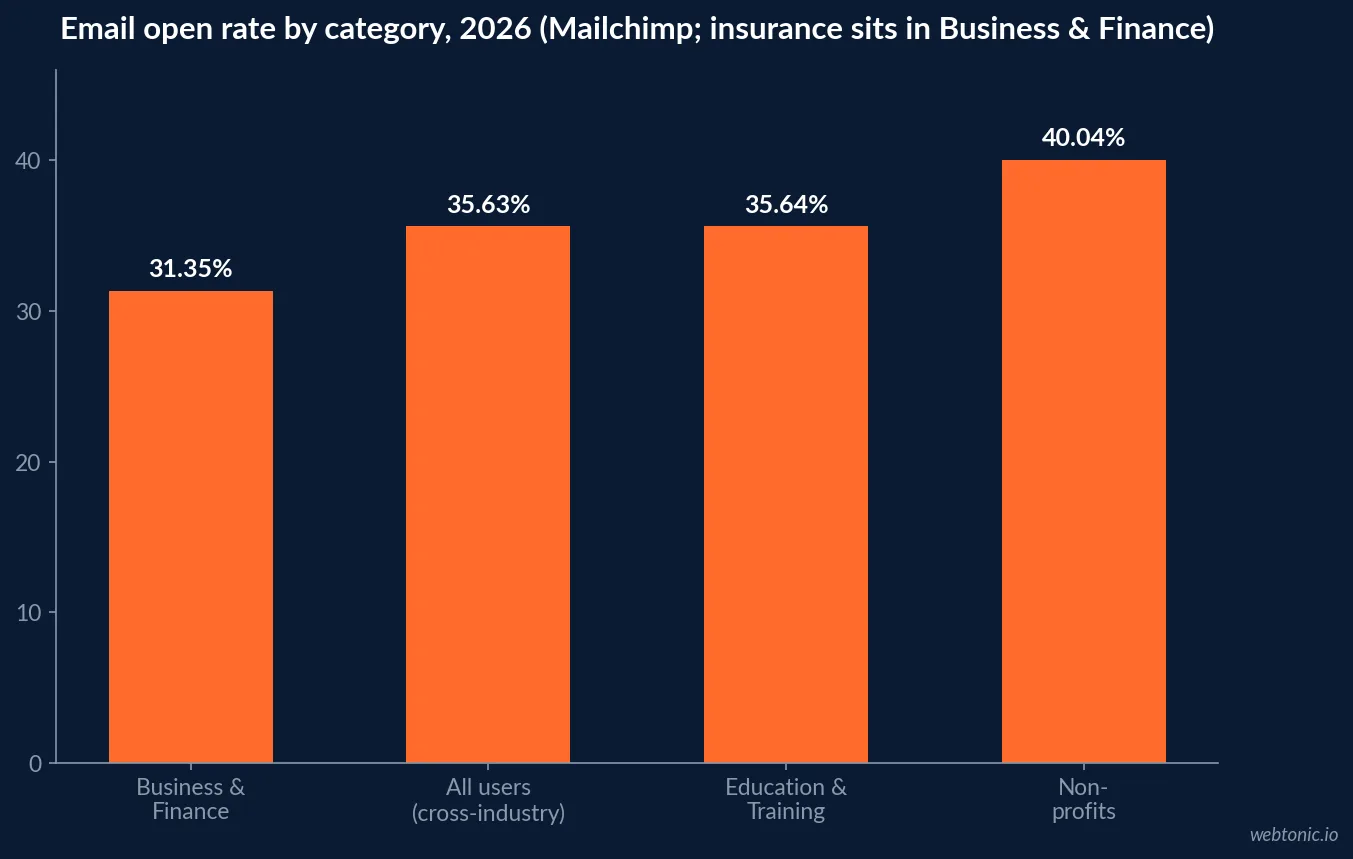
- Mailchimp's Business + Finance category averages a 31.35% open rate.
- That is below the 35.63% all-users average across every category Mailchimp tracks.
- Business + Finance click rate averages 2.78%, close to the 2.62% all-users figure.
- Business + Finance unsubscribe rate runs 0.15%, better than the 0.22% all-users average.
- 29% of insurance customers switched carriers in 2025.
- 57% shopped for auto insurance in 2025, the highest share on record.
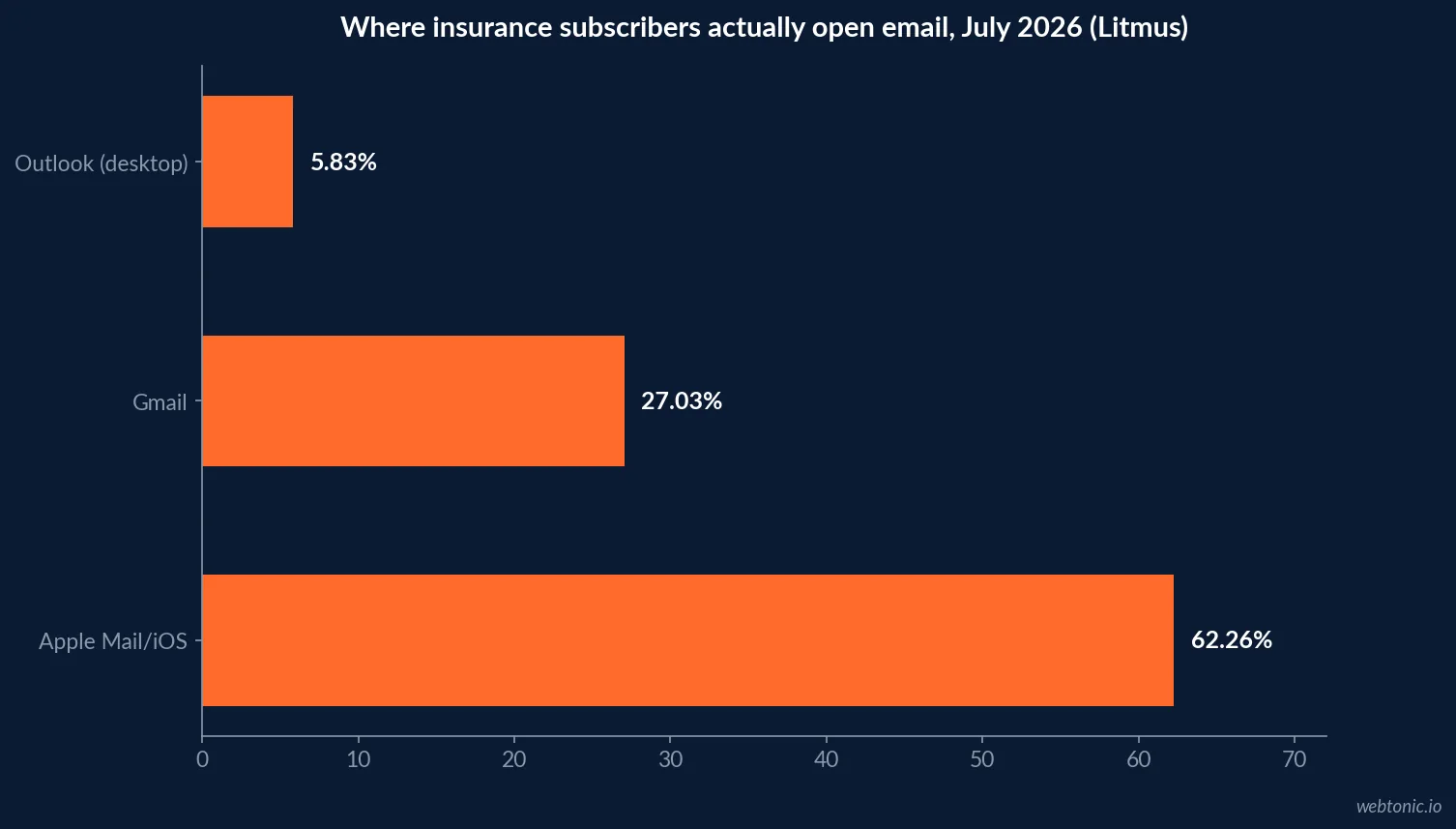
- Apple Mail accounts for 62.26% of email opens as of July 2026.
- Gmail accounts for 27.03%, and Outlook desktop just 5.83%.
- 62% of Americans use social media when researching financial or insurance products.
- Yet 53% still prefer speaking with a financial professional directly.
- 43% would research a policy online but buy it in person.
- 47% of new policies now close through a digital channel.
- The top 10 P/C insurers write roughly half the US market between them.
Why there is no insurance-only email benchmark to quote
Mailchimp's published email marketing benchmarks break performance into broad categories - Business + Finance, Non-Profits, Education + Training, Ecommerce - and insurance sits inside Business + Finance rather than getting its own row. That category averages a 31.35% open rate and 2.78% click rate, against a 35.63% open rate and 2.62% click rate for all users combined. Anyone quoting an insurance-specific open-rate figure from a platform benchmark report is quoting a category average, not an insurance number - this page states that plainly rather than dressing a proxy up as precision.
| Mailchimp category (2026) | Open rate | Click rate | Unsubscribe rate |
|---|---|---|---|
| Business + Finance (insurance sits here) | 31.35% | 2.78% | 0.15% |
| All users (cross-industry average) | 35.63% | 2.62% | 0.22% |
| Education + Training | 35.64% | 3.02% | 0.18% |
| Non-Profits | 40.04% | 3.27% | 0.18% |
| Ecommerce | 29.81% | 1.74% | 0.19% |
The one email that actually earns attention: renewal
Attention is scarce, but intent is not evenly distributed across an insurer's send calendar. J.D. Power's 2026 U.S. Insurance Shopping Study found 29% of insurance customers switched carriers in 2025, and 57% shopped for auto insurance that year - the highest share the study has recorded. A renewal reminder lands exactly when that shopping behavior is most likely to activate, which is why its open and click rates deserve their own tracked segment rather than being averaged into a general newsletter number that undersells its importance.
| Insurance email send type | When it should fire | Why it outperforms a generic send |
|---|---|---|
| Renewal reminder sequence (60/30/7 day) | Ahead of the policy renewal date | Targets the exact window 29% of customers shop in |
| Post-quote nurture | Within 24-48 hours of a quote request | Bridges the gap before the 43% who research online but buy in person |
| Claims-close cross-sell | After a claim resolves well | Trust is highest right after a good claims experience |
| General newsletter / content | Monthly or quarterly | Lowest intent; benchmark against 31.35%, not renewal performance |
Design for the inbox people actually use
Litmus's July 2026 Email Client Market Share report, calculated from over 1 billion tracked opens, found Apple Mail (including iPhone, iPad and Apple's Mail Privacy Protection) at 62.26% of opens, Gmail at 27.03%, and Outlook desktop at just 5.83%. Together Apple and Gmail account for nearly 90% of the inbox an insurance send reaches. A renewal or nurture template built and QA'd for Apple's dark-mode rendering and Gmail's image caching covers almost the entire audience; heavy Outlook-only fixes are a low priority by comparison.
| Email client (July 2026) | Share of opens | Design priority |
|---|---|---|
| Apple Mail / iPhone / iPad | 62.26% | Dark-mode safe, mobile-first layout |
| Gmail (web + app) | 27.03% | Image-caching-safe, preview text tested |
| Outlook (desktop) | 5.83% | Basic fallback support, not the design target |
| Yahoo Mail | 2.59% | Minor - similar caching behavior to Gmail |
Email still has to hand off to a human
LIMRA's 2026 consumer research found 62% of Americans use social media when seeking information on financial or insurance products, but that digital-first research habit does not mean a digital-only close: 53% of consumers still prefer speaking with a financial professional by phone, video chat or in person, and 43% say they would research a policy online but ultimately buy it in person. An insurance email sequence that ends in a hard self-serve checkout is optimizing against a preference most of the audience does not share; ending in a scheduled call or agent introduction usually converts the 35% agent-channel share J.D. Power's data confirms is still active.
| Consumer preference (LIMRA 2026) | Share | Email program implication |
|---|---|---|
| Use social media to research financial/insurance products | 62% | Content can start the conversation |
| Prefer speaking with a financial professional directly | 53% | CTA should offer a call, not just a form |
| Would research online but buy in person | 43% | Nurture toward a human handoff, not checkout |
| New policies now bought through a digital channel | 47% | Some segments genuinely prefer self-serve |
AI tools are entering the shopping journey, but adoption is still thin
J.D. Power's 2026 research found that among insurance shoppers who used a chatbot or virtual assistant on an insurer's website, overall satisfaction reached 645 on the study's 1,000-point scale - 132 points higher than shoppers who did not use one. Yet only 11% of customers actually used a chatbot or virtual assistant during the shopping process. That gap is directly relevant to email: a nurture sequence that links to a well-built AI quote-assistant tool is pointing a small but unusually satisfied segment toward a genuinely better experience, not just adding another untested widget to the funnel.
| AI/chatbot use in insurance shopping (J.D. Power, 2026) | Value |
|---|---|
| Customers who used a chatbot/virtual assistant while shopping | 11% |
| Satisfaction score among chatbot/virtual-assistant users | 645 / 1,000 |
| Satisfaction score among non-users | 513 / 1,000 (132 points lower) |
Deliverability rules changed the baseline for every sender
None of the open-rate benchmarks above matter if a send never reaches the inbox in the first place. Google's own bulk sender guidelines require SPF, DKIM and DMARC authentication, a spam rate that stays under 0.3%, and a one-click unsubscribe header for any sender pushing meaningful volume to Gmail addresses - and Gmail alone accounts for 27.03% of the opens an insurance send will get, per Litmus's July 2026 data cited above. An insurer or agency that has not implemented DMARC is not competing on open-rate quality at all; it is risking bulk folder placement before the subject line is even read.
Compliance layers stack on top of deliverability
Every commercial email, regardless of industry, answers to the FTC's CAN-SPAM Act: accurate header information, a non-deceptive subject line, clear identification as an ad where required, and a working opt-out honored within 10 business days. Insurance email carries a second layer on top: the NAIC's Unfair Trade Practices Act (Model #880) defines misrepresentation and false advertising of insurance policies as a violation in any medium, which reaches an email's coverage claims exactly as it would a billboard or a call script.
| Compliance layer | What it requires | Where insurance email gets it wrong |
|---|---|---|
| CAN-SPAM Act (FTC) | Honest subject lines, working opt-out, sender ID | Vague 'no-reply' addresses with no physical address |
| NAIC Model #880 | No misrepresentation of policy terms, any medium | Renewal emails implying a guaranteed rate before underwriting |
| State-specific agent licensing rules | Ties marketing claims to a licensed entity | Templates reused across states without a review pass |
Building the program around what the data actually shows
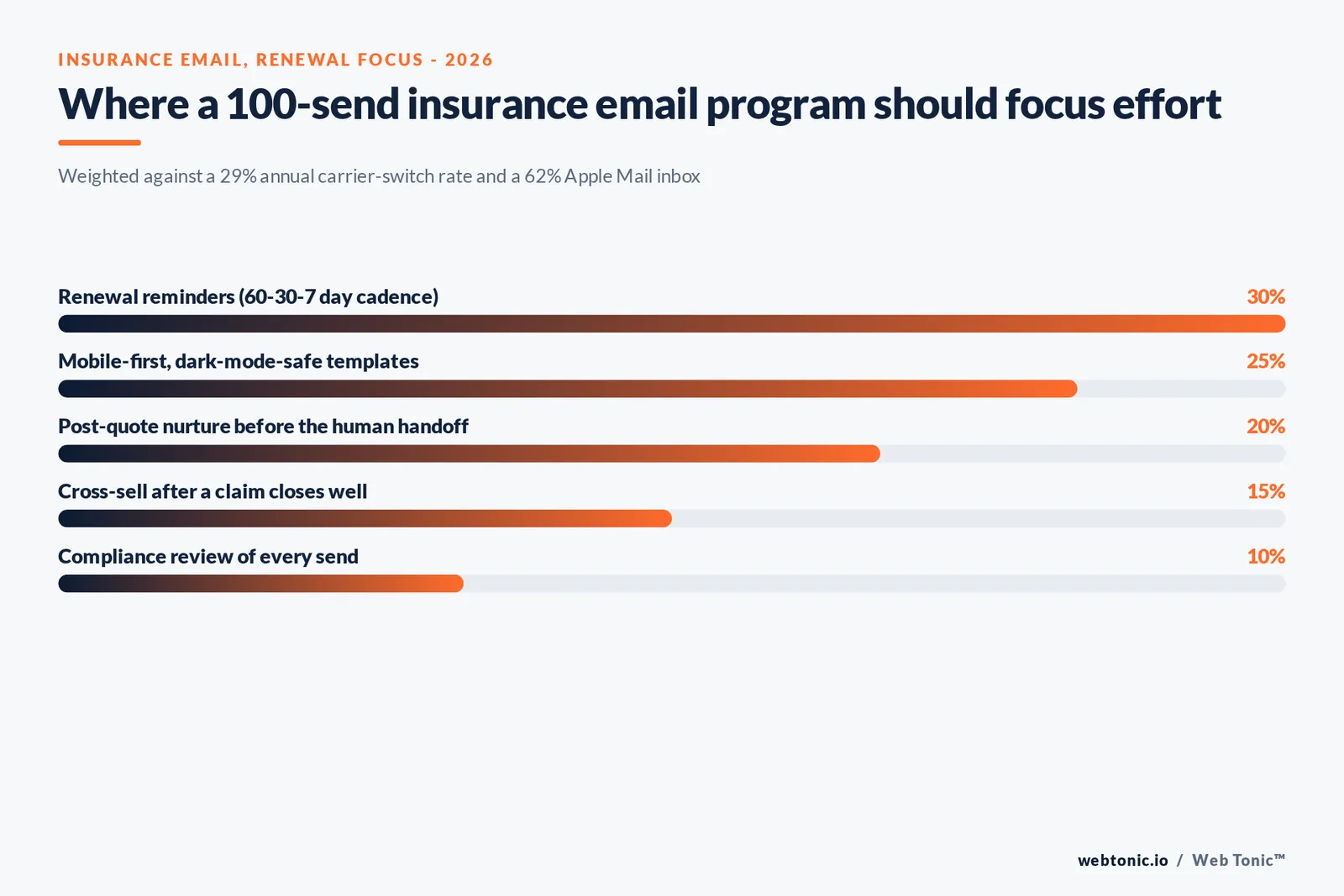
The honest read is that insurance email will rarely beat the all-users open-rate average on a generic send, and that is fine - the number that matters is renewal-sequence performance measured on its own, against the reality that 29% of the audience is genuinely shopping every year. Our growth marketing team builds that renewal-first segmentation rather than optimizing a newsletter template against a benchmark it was never built to hit. For the paid side of the same retention conversation, see our breakdown of what Facebook ads cost, or talk to us about a renewal-focused email program built on 2026 data.
| Program element | Data it answers to | What good looks like |
|---|---|---|
| Renewal reminder cadence | 29% annual switch rate, 57% shopping activity | 60/30/7-day sequence, tracked separately from newsletters |
| Template design standard | 62.26% Apple Mail, 27.03% Gmail | Dark-mode-safe, mobile-first, tested on both |
| CTA design | 53% prefer a human, 43% research-then-buy-in-person | Call/schedule option alongside any self-serve link |
| Compliance sign-off | NAIC Model #880, CAN-SPAM | Every template reviewed before it goes to a full list |
Frequently Asked Questions
Is there an insurance-specific email open rate benchmark?
Not at the major platform level. Mailchimp's own published benchmarks group insurance inside a broader 'Business + Finance' category, which averaged a 31.35% open rate, 2.78% click rate and 0.15% unsubscribe rate in its most recent report - lower than the 35.63% all-users average. Treat that as the closest labeled cross-industry proxy, not an insurance-only number.
Why does the renewal window matter more than any other insurance email?
Because J.D. Power's 2026 U.S. Insurance Shopping Study found 29% of insurance customers switched carriers in 2025, and 57% shopped for auto insurance that year - the highest share in the study's history. A renewal reminder sequence is the one email a policyholder is guaranteed to read with buying intent already active, which makes its open and click performance worth tracking separately from a general newsletter send.
What inbox should insurance email design actually target?
Mostly Apple Mail. Litmus's July 2026 Email Client Market Share report, built from over 1 billion tracked opens, found Apple Mail (including iPhone and iPad) at 62.26% of opens, Gmail at 27.03% and Outlook desktop at just 5.83%. That means dark-mode-safe, mobile-first templates matter far more for an insurance send than desktop-Outlook compatibility.
Should insurance email marketing try to close the sale entirely online?
Not for every segment. LIMRA's 2026 consumer research found 53% of Americans still prefer speaking with a financial professional by phone, video or in person, and 43% say they would research a policy online but ultimately buy it in person. An insurance email program converts best when it nurtures toward that human handoff rather than forcing a self-serve checkout that much of the audience does not want.
What compliance rules apply to insurance email specifically?
Two layers stack. The FTC's CAN-SPAM Act governs every commercial email regardless of industry (honest subject lines, working unsubscribe, physical address). On top of that, the NAIC's Unfair Trade Practices Act (Model #880) defines misrepresentation and false advertising of insurance policies as a violation in any medium, which reaches a renewal email's coverage claims the same way it reaches a billboard.
Sources
Mailchimp - Email Marketing Benchmarks and Metrics Businesses Should Track (2026)
Litmus - Email Client Market Share, July 2026
Insurance Business America, reporting J.D. Power's 2026 U.S. Insurance Shopping/Digital Experience Studies
LIMRA - 2026 Facts About Life Insurance
Insurance Information Institute - Facts + Statistics: Industry Overview
NAIC - Unfair Trade Practices Act, Model #880