Table of contents
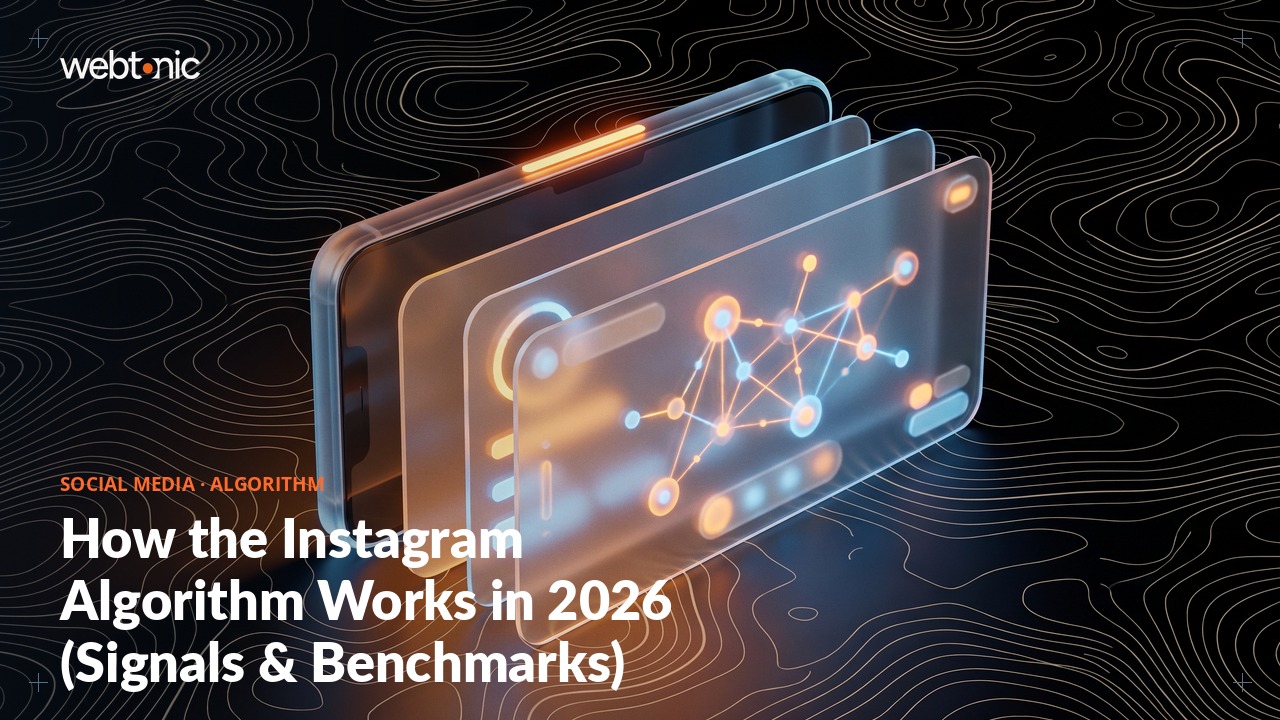
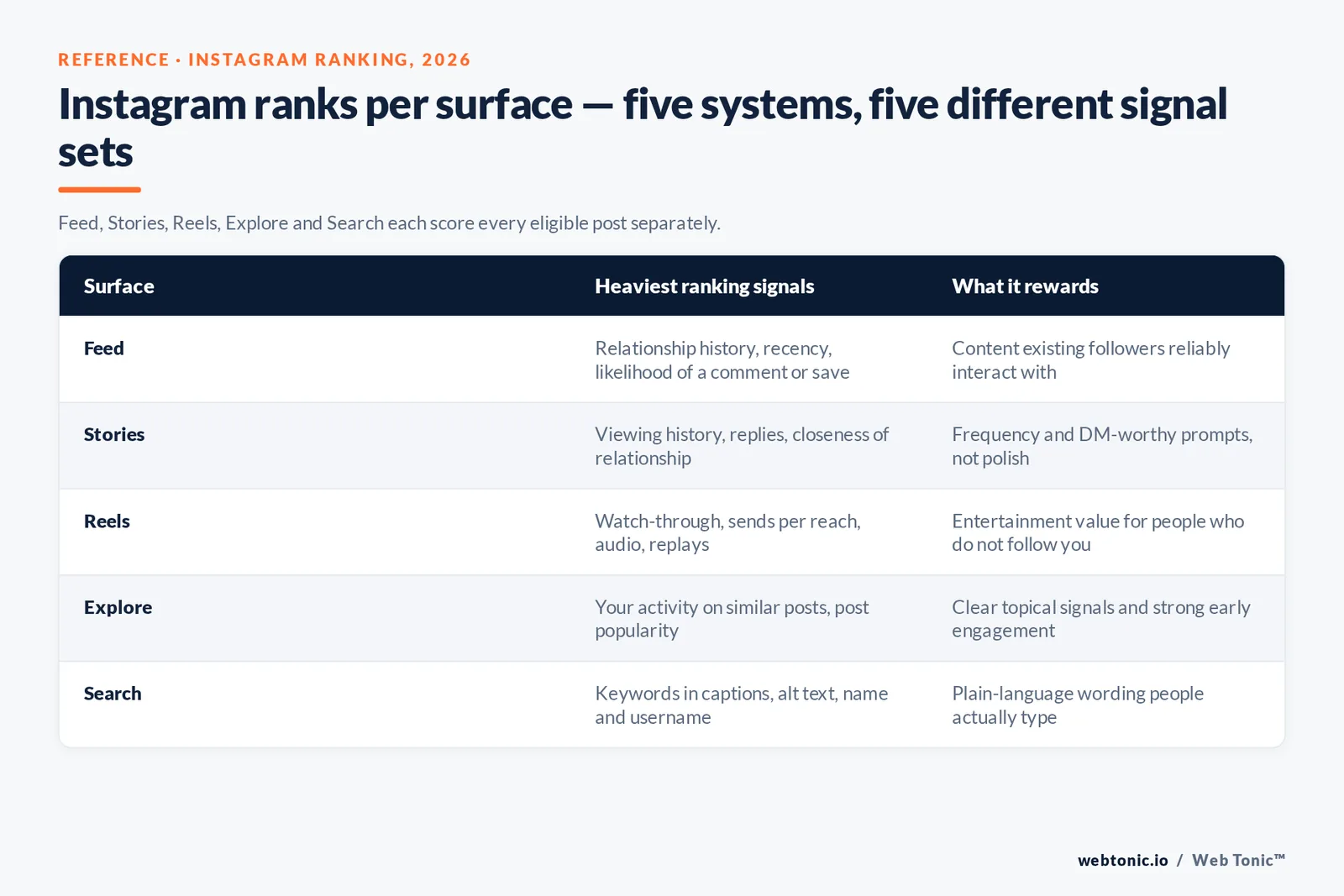
The Instagram algorithm is not one algorithm. It is a set of separate ranking systems — one each for Feed, Stories, Reels, Explore and Search — that score every eligible post per user and per surface.
Understanding which signals each system weighs is the difference between guessing and planning. Across 35 million analysed posts, engagement fell about 24% year over year, so the margin for guessing has shrunk.
Key Takeaways
- Instagram ranks per surface, not per account: Feed, Stories, Reels, Explore and Search each use their own signals.
- Four signal families drive almost every ranking decision: information about the post, information about the poster, your activity, and your history of interacting with that poster.
- Platform-wide engagement averages 0.48% and dropped roughly 24% year over year — a structural reset, not a penalty on your account.
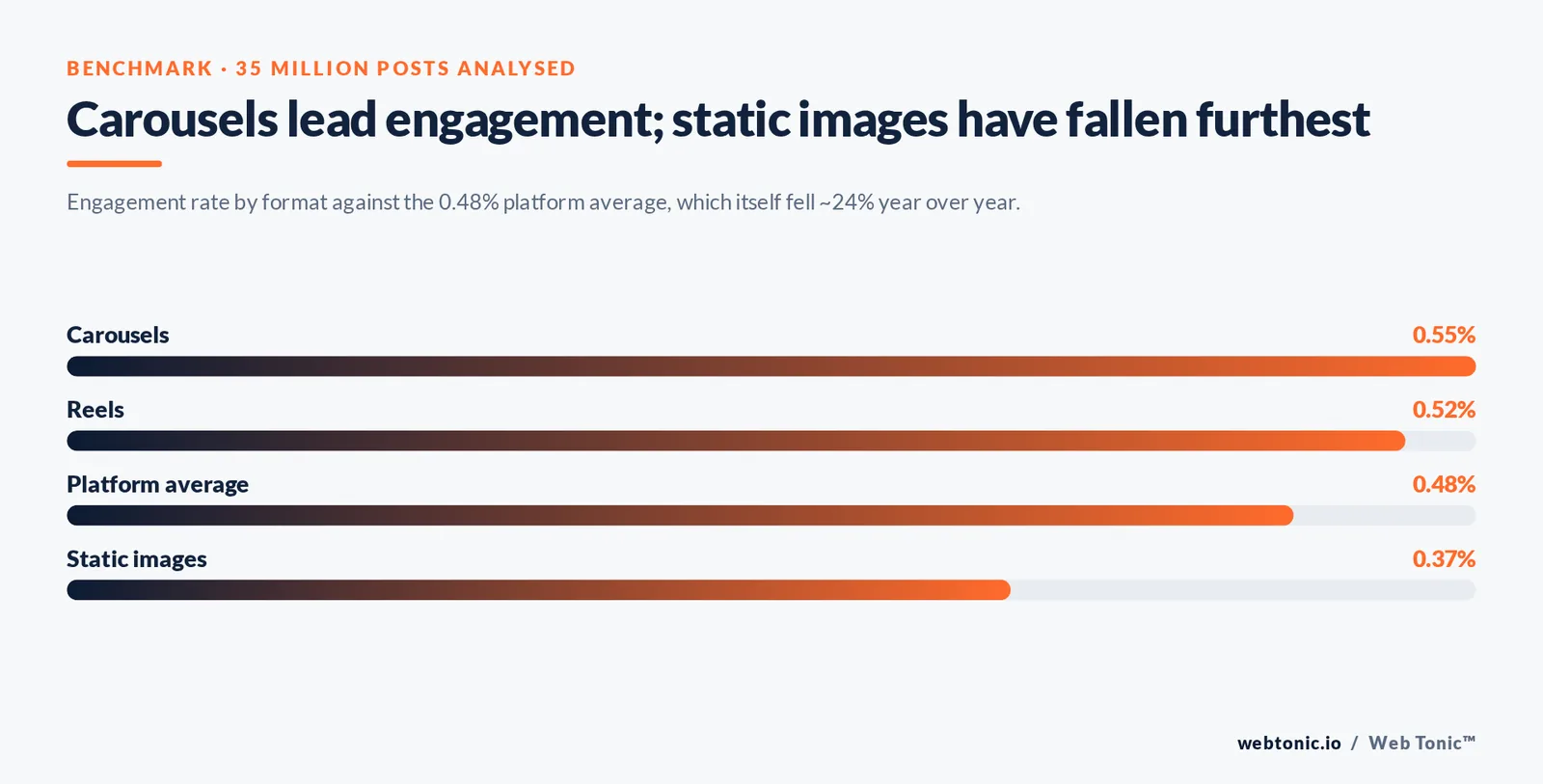
- Carousels lead engagement at 0.55%, Reels sit at 0.52%, and static images have fallen to 0.37% after a 17% yearly decline.
- Carousels also win views because they can resurface a second slide: brands over 100K followers average 35,370 views per carousel versus 16,035 per Reel.
- Reels drive conversation. At 100K–1M followers they average 60 comments against 40 for carousels and 38 for images.
- Sends and saves now matter more than likes; growth has slowed to 22% a year for small accounts and 11.25% for large ones.
- The working posting mix in 2026 is roughly 8 Reels, 5 carousels and 7 images a month, with Stories running continuously underneath.
How the Instagram algorithm actually works
Every time someone opens the app, Instagram assembles a candidate set of posts they could see, then predicts how likely that specific person is to take specific actions — watch, like, comment, save, share, or tap through to the profile. Those predictions are combined into a score, and the score decides the order. Nothing is "boosted" or "suppressed" as a blanket rule; each post is re-scored for each user.
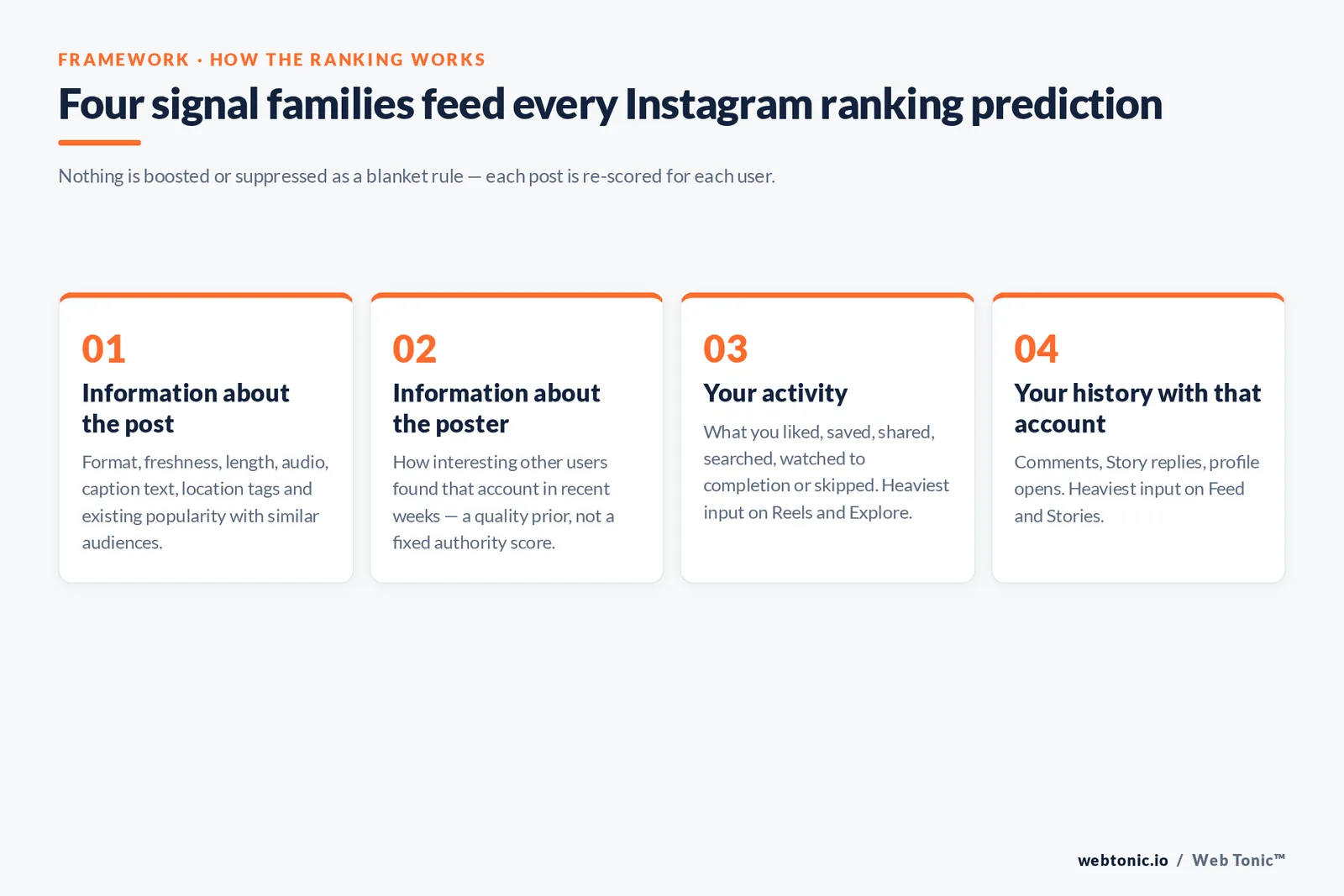
Four signal families feed those predictions:
- Information about the post. Format, freshness, length, audio, caption text, location tags and how popular it already is with similar audiences.
- Information about the person who posted. How interesting other users have found that account in recent weeks — an account-level quality prior, not a fixed authority score.
- Your activity. What you have liked, saved, shared, searched, watched to completion and skipped. This is the heaviest input on Reels and Explore.
- Your history of interacting with that account. Whether you comment, reply to their Stories or open their profile. This is the heaviest input on Feed and Stories.
Sprout Social's breakdown of how the Instagram algorithm ranks content tracks the same structure, and it maps neatly onto how any modern recommendation engine is built: predict engagement probability per user, rank by predicted value. Instagram's version simply has more surfaces than most.
| Surface | Heaviest ranking signals | What it rewards |
|---|---|---|
| Feed | Relationship history, recency, likelihood of a comment or save | Content your existing followers reliably interact with |
| Stories | Viewing history, replies, closeness of the relationship | Frequency and DM-worthy prompts, not polish |
| Reels | Watch-through, sends per reach, audio, replays | Entertainment value for people who do not follow you |
| Explore | Your activity on similar posts, post popularity | Clear topical signals and strong early engagement |
| Search | Keywords in captions, alt text, name and username | Plain-language wording people actually type |
The 2026 benchmarks you should be judged against
Context first: Socialinsider's 2026 Instagram benchmark study of 35 million posts found overall engagement at 0.48%, down about 24% year over year. In Q2 2026 it slipped further to 0.45%: Reels 0.48%, carousels 0.50%, images 0.33%.
That decline is not your fault, and it is not the algorithm punishing brands. Content supply exploded while human attention stayed fixed, and public engagement migrated into private engagement — sends, saves and DMs the public metrics never see.
| Format | Engagement rate | Year-over-year | Best used for |
|---|---|---|---|
| Carousels | 0.55% | Flat — most resilient | Education, frameworks, saves, authority |
| Reels | 0.52% | Stable, no longer a growth hack | Reach beyond followers, comments, shares |
| Static images | 0.37% | Down 17% | Culture posts, event coverage, carousel slides |
| Stories | Not comparable | The relationship layer | Replies, polls, DM starts, warm audiences |
Views tell a different story from engagement, and it is the most actionable finding in the data. Carousels are the only format Instagram can show twice — if you scroll past without interacting, it often resurfaces the post with a different slide. That double exposure compounds with account size.
| Account size | Reels views | Carousel views | Image views |
|---|---|---|---|
| 1–5K followers | 580 | 993 | 417 |
| 5–10K followers | 1,000 | 2,117 | 1,068 |
| 10–50K followers | 2,460 | 4,275 | 2,340 |
| 50–100K followers | 6,095 | 11,597 | 7,405 |
| 100K–1M followers | 16,035 | 35,370 | 22,900 |
Why sends and saves beat likes now
A like is a cheap, public signal. A send is an expensive, private one — the user is spending social capital to put your post in someone else's inbox. Instagram's ranking systems treat that difference seriously, because sends predict future sessions far better than taps do.
The comment and save data shows how format changes the signal you get. Reels pull conversation; carousels pull saves.
| Account size | Reels comments | Carousel comments | Carousel saves | Reels saves |
|---|---|---|---|---|
| 1–5K followers | 3 | 2 | 1 | 1 |
| 10–50K followers | 12 | 10 | 8 | 7 |
| 50–100K followers | 22 | 15 | 35 | 22 |
| 100K–1M followers | 60 | 40 | 98 | 96 |
So pick the metric before you pick the format. If the objective is community and replies, make Reels and open with a question in the first three seconds. If the objective is authority and saves, make a carousel whose first slide promises something worth keeping. Broader format economics are covered well in Sprout Social's social video research and Socialinsider's cross-platform benchmarks.
Posting frequency, timing and follower growth
Brands shifted their mix hard in the last year: Reels posting rose 33% year over year while image volume fell. The current average month looks like 8 Reels, 5 carousels and 7 images.
| Post type | Posts per month, 2024 | Posts per month, 2025 | Direction |
|---|---|---|---|
| Reels | 6 | 8 | Up 33% |
| Carousels | 4 | 5 | Up |
| Images | 10 | 7 | Down 30% |
Timing matters less than the algorithm folklore suggests, because ranking is not chronological — but early engagement still feeds the prediction, so posting when your own followers are active helps. Use your account's own audience-activity chart rather than a generic chart; Sprout Social's best-times-to-post research is a sensible starting hypothesis, not an answer.
Growth expectations need resetting too. Follower growth is now roughly 22% a year for accounts under 5K, 17.2% at 10–50K, and 11.25% for accounts approaching 1 million — down from 38% and 27% respectively a year earlier. Small accounts still get an early discovery lift; large ones increasingly get shown to their own followers and must earn reach.
A posting strategy that works with the reset
The 2026 reset does not require a new tactic every week. It requires a strategy that assumes reach must be earned per post, and a calendar that brands and creators can actually sustain. The best-performing accounts we review all share the same four habits.
First, they create fewer but more relevant videos. Cutting monthly output by a third and putting the saved time into scripting the first three seconds beats posting daily on autopilot. A creator who publishes three excellent videos a week will out-reach one who publishes seven forgettable ones, because early engagement per post is what the ranking systems read.
Second, they design explicitly for shares. Shares are the cheapest reach on the platform and the hardest to fake. Content that earns shares usually does one of three things: it says something useful enough to forward to a colleague, it is funny enough to send to a friend, or it puts words to a frustration the audience already had. Before publishing, name the person a viewer would send it to. If you cannot, rewrite it.
Third, they treat Stories as the relationship layer. A daily story is not content marketing overhead; it is how interaction history gets built, and interaction history is the single heaviest Feed signal for accounts a user already follows. Polls, question stickers and quick replies generate the DM and reply signals that later lift ordinary posts. Brands that post nothing but polished grid content and no story consistently under-perform accounts half their size.
Fourth, they answer comments like a person. Comments are both a ranking signal and a retention mechanism. Replying within the first hour, in full sentences rather than emoji, measurably increases the number of comments the next post receives — and it is the one lever that costs nothing but time.
A simple weekly rhythm that holds up in practice: three Reels, one carousel, one image or culture post, Stories five to seven times a week, and one deliberate community day where the whole job is replying to comments and DMs. Test posting times against your own audience-activity data rather than a generic best-times chart, and do not chase hashtags — three to five relevant tags per post is the whole hashtag strategy now.
Finally, agree with stakeholders on what "working" means before the quarter starts. Reach and follower count will look worse than last year for structural reasons that have nothing to do with the work. Saves, shares, comments, profile visits and DMs are the metrics that still respond to effort, and they are the ones that predict revenue. Report those, explain the platform-wide reset once, and you will spend far less time defending good content against a declining vanity number.
Hashtags, keywords and how discovery really happens
Hashtags have been demoted from a distribution mechanism to a topical hint. Three to five relevant hashtags help Instagram categorise a post; thirty do not multiply reach, and irrelevant ones actively confuse the topic signal.
Keywords replaced them. Instagram's search surface reads captions, alt text, your name field and your username, so writing the phrase a person would actually type — "sourdough starter troubleshooting", not "#bakelife" — does more for discovery than any hashtag set. WordStream's algorithm guide reaches the same conclusion from a paid-media angle.
| Tactic | Does it still work? | What to do instead |
|---|---|---|
| 30 hashtags per post | No | 3–5 specific, topical tags |
| Engagement pods | No — signals are per-user | Build for sends and saves from real viewers |
| Posting daily regardless of quality | No | Fewer, stronger posts plus daily Stories |
| Keyword-rich captions and alt text | Yes | Write the phrase people search for |
| Trending audio on Reels | Yes, modestly | Use it when it fits the edit, not as a tax |
| Recycling a winning post across formats | Yes | Turn a strong carousel into a Reel and back |
Can users influence what the algorithm shows them?
Yes, and more directly than most people realise. Because ranking is driven by your activity and your interaction history, deliberate inputs retrain the feed within days: mark posts "Not interested", use "Don't recommend this channel", follow and mute selectively, save what you want more of, and search for the topic you want served. Instagram also exposes a chronological Following feed and a Favourites feed, which bypass ranking entirely for the accounts you nominate.
For marketers, that user control is the strategic point. If your audience can curate away from you in two taps, generic brand content is not merely ineffective — it is actively being filtered out. The accounts that survive curation are the ones a person would choose to keep.
What to actually do differently
Scale matters here: Instagram reaches about 2 billion monthly users, roughly 35% of the 5.66 billion people online, per Backlinko's Instagram statistics roundup, with India the largest market at 472.6 million and the United States at 179.9 million. Average time in the app is about 33.9 minutes a day.
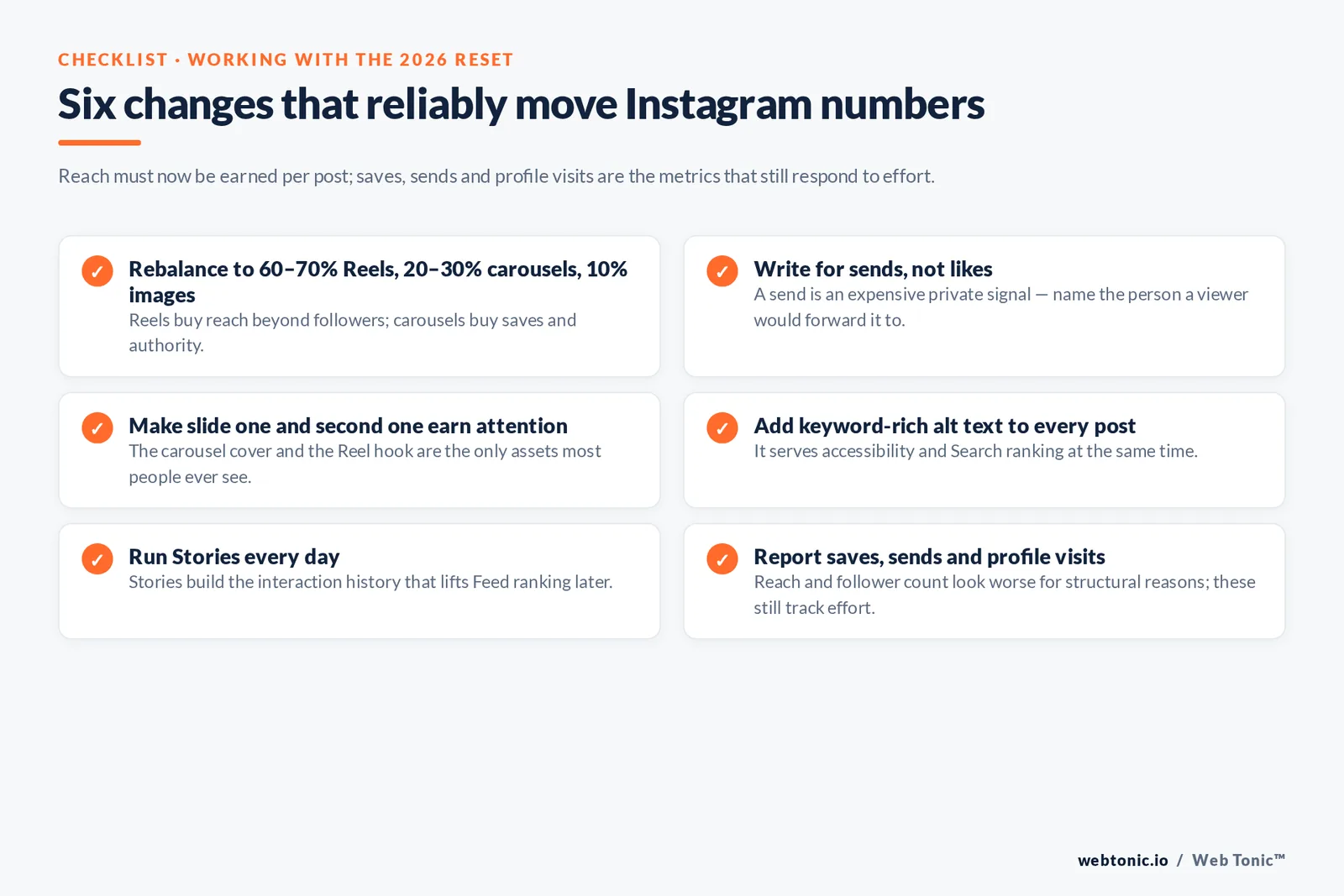
Seven changes reliably move the numbers:
- Rebalance the mix to roughly 60–70% Reels, 20–30% carousels, 10% images. Reels buy reach; carousels buy saves and authority.
- Write for sends. Ask before publishing: who would forward this to one specific person, and why?
- Make slide one and second one earn attention. The carousel cover and the Reel hook are the only assets most people ever see.
- Add keyword-rich alt text to every post. It serves accessibility and Search ranking at the same time.
- Run Stories every day. Stories are where relationship signals get built, and those signals lift Feed ranking later.
- Reply to comments and DMs fast. Reply behaviour is an interaction signal, and audiences notice — DataReportal's Digital 2026 report puts daily social use at about 2 hours 40 minutes, most of it in-app.
- Report on saves, sends and profile visits. Track them alongside reach; eMarketer's Instagram advertising analysis and the Pew Research Center social media fact sheet are useful for setting audience expectations with stakeholders.
If you want a documented content system rather than a monthly scramble, see our performance creative services, our growth marketing services, or browse more platform breakdowns on the Web Tonic blog. You can also get in touch for an account review.
FAQ: Instagram algorithm questions
What are the most important Instagram ranking signals in 2026?
Four families: information about the post, information about the poster, your recent activity, and your interaction history with that account. On Reels and Explore your activity dominates; on Feed and Stories your relationship with the account dominates.
How can I improve organic reach on Instagram?
Optimise for sends and saves rather than likes. Publish roughly 60–70% Reels for reach and 20–30% carousels for saves, add keyword-rich captions and alt text, run Stories daily, and reply quickly to comments and DMs.
Does Instagram favour Reels over posts?
Reels get more distribution to non-followers, but carousels still win on engagement at 0.55% and on views — 35,370 average views versus 16,035 for Reels at 100K–1M followers, because carousels can resurface a second slide.
Can I control what the Instagram algorithm shows me?
Yes. Use "Not interested" and "Don't recommend", save and search the topics you want more of, and switch to the chronological Following or Favourites feeds, which bypass ranking for accounts you nominate.
Do hashtags still work on Instagram?
Only as a topical hint. Three to five relevant hashtags help categorise a post; large sets do not increase reach. Searchable keywords in the caption, alt text and username now do the work hashtags used to.
Why has my Instagram engagement dropped?
Probably not your account. Platform-wide engagement averages 0.48% and fell about 24% year over year, with images down 17%, as content supply outgrew available attention and interaction moved into private sends and DMs.
Sources
Socialinsider, 2026 Instagram organic engagement benchmarks (35M posts) and cross-platform social media benchmarks · Sprout Social: Instagram algorithm guide, best times to post research, social media video statistics · WordStream, Instagram algorithm guide · Backlinko, Instagram user and demographic statistics · DataReportal, Digital 2026 Global Overview Report · eMarketer, Instagram advertising insights · Pew Research Center, social media fact sheet · IBM, recommendation engine explainer. Figures cited as published at the time of writing.