Table of contents
Instagram ads are paid placements bought through Meta Ads Manager and delivered across the Instagram feed, Stories, Reels, Explore and the Shop surface. Every format is bought in the same auction that powers Facebook, so one budget can reach both apps.
This guide covers the ad types, what Instagram advertising really costs in 2026, how to build a campaign in Ads Manager step by step, and how to judge performance once spend is live.
Key Takeaways
- Meta's advertising revenue reached $196.2 billion in 2025, with $58.1 billion in the fourth quarter alone — Instagram ads sit inside that machine.
- Ad impressions across Meta's apps grew 18% year over year in Q4 2025, which pushes more inventory into the same auction.
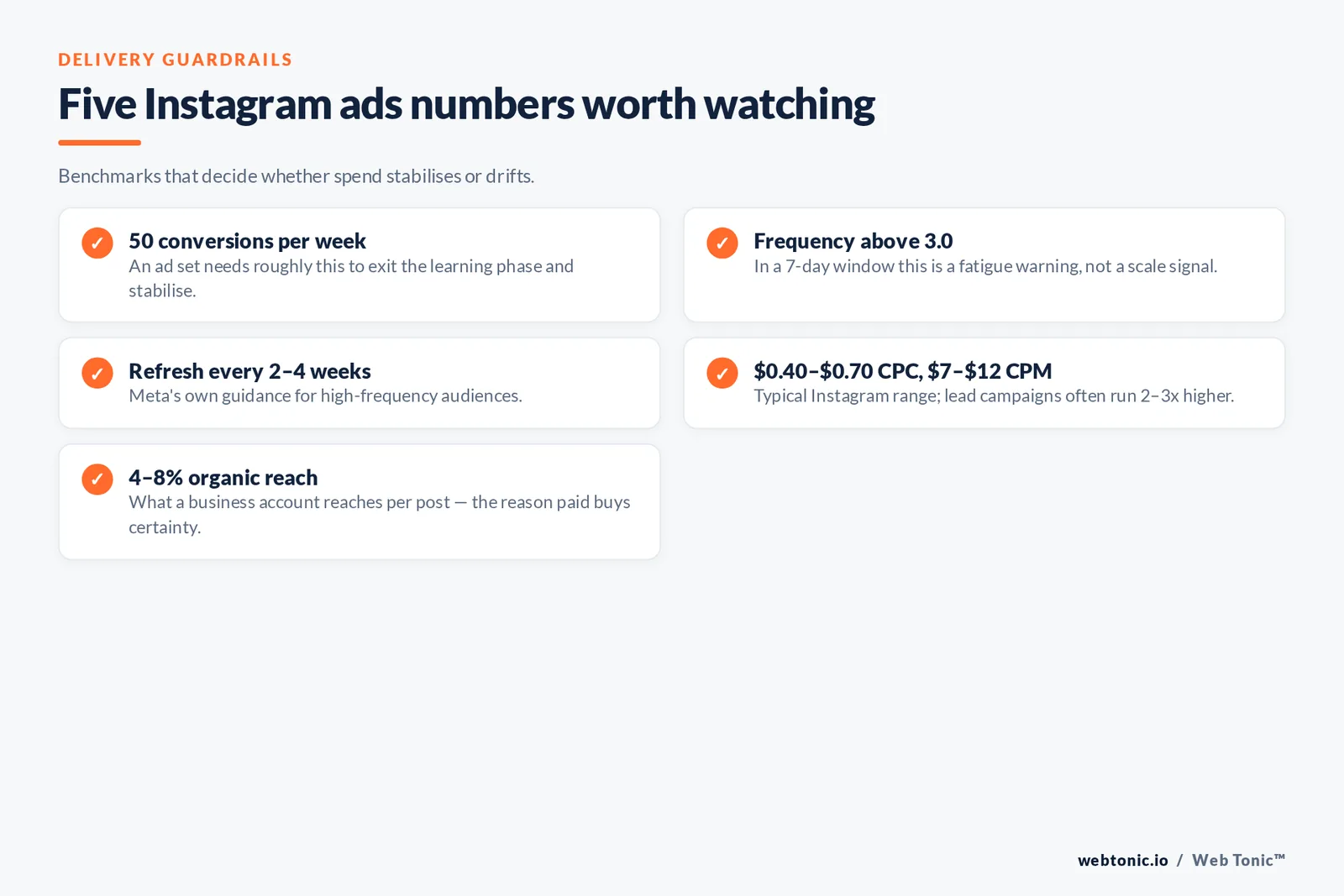
- Typical Instagram ads cost lands at $0.40–$0.70 CPC and roughly $7–$12 CPM, with lead campaigns often 2–3x higher.
- There are 9 core ad formats — image, video, carousel, collection, Reels ads, story ads, Explore ads, shopping ads and partnership ads.
- Reels ads and story ads are full screen, 9:16, and now absorb the majority of new video budget.
- An ad set needs about 50 conversions per week to exit the learning phase and stabilise.
- Meta recommends creative refresh every 2–4 weeks on high-frequency audiences; frequency above 3.0 in a 7-day window is a fatigue warning.
What Instagram ads are and how the auction works
An Instagram ad is a post that a business pays to show to users who do not follow it. The buying happens in Meta Ads Manager, the same console used for Facebook, WhatsApp and Audience Network placements. You do not buy impressions at a fixed rate; you enter an auction where Meta ranks each eligible ad by bid, estimated action rate and ad quality, then serves whichever combination it expects to produce the most value for the users scrolling.
That ranking logic is the single most important thing to internalise. A cheaper bid with a strong Instagram ad frequently beats a higher bid with weak creative, which is why Instagram rewards native-feeling Instagram content over repurposed display banners. Meta's product announcements on the Meta newsroom have pushed steadily in the same direction: fewer manual levers, more weight on creative variety and signal quality.
Scale matters here too. Meta reported $196.2 billion of advertising revenue for full-year 2025 and 3.58 billion daily active people across its apps in December 2025, per its Q4 and full-year 2025 results. Instagram's own share of that is not broken out, but eMarketer's Instagram ad revenue tracking has consistently modelled it as the faster-growing half of the family.
| Auction input | What it means | How you influence it |
|---|---|---|
| Bid | What you are willing to pay for the optimisation event | Bid strategy: lowest cost, cost cap, bid cap or ROAS goal |
| Estimated action rate | Meta's prediction that this person takes your chosen action | Clean conversion signal, correct optimisation event, enough volume |
| Ad quality | Feedback signals: hides, hide-all, negative sentiment | Native creative, honest claims, tight audience-to-offer match |
| Placement | Where the unit renders — feed ads, Reels, Stories, Explore | Advantage+ placements, plus per-placement asset customisation |
The types of Instagram ads, format by format
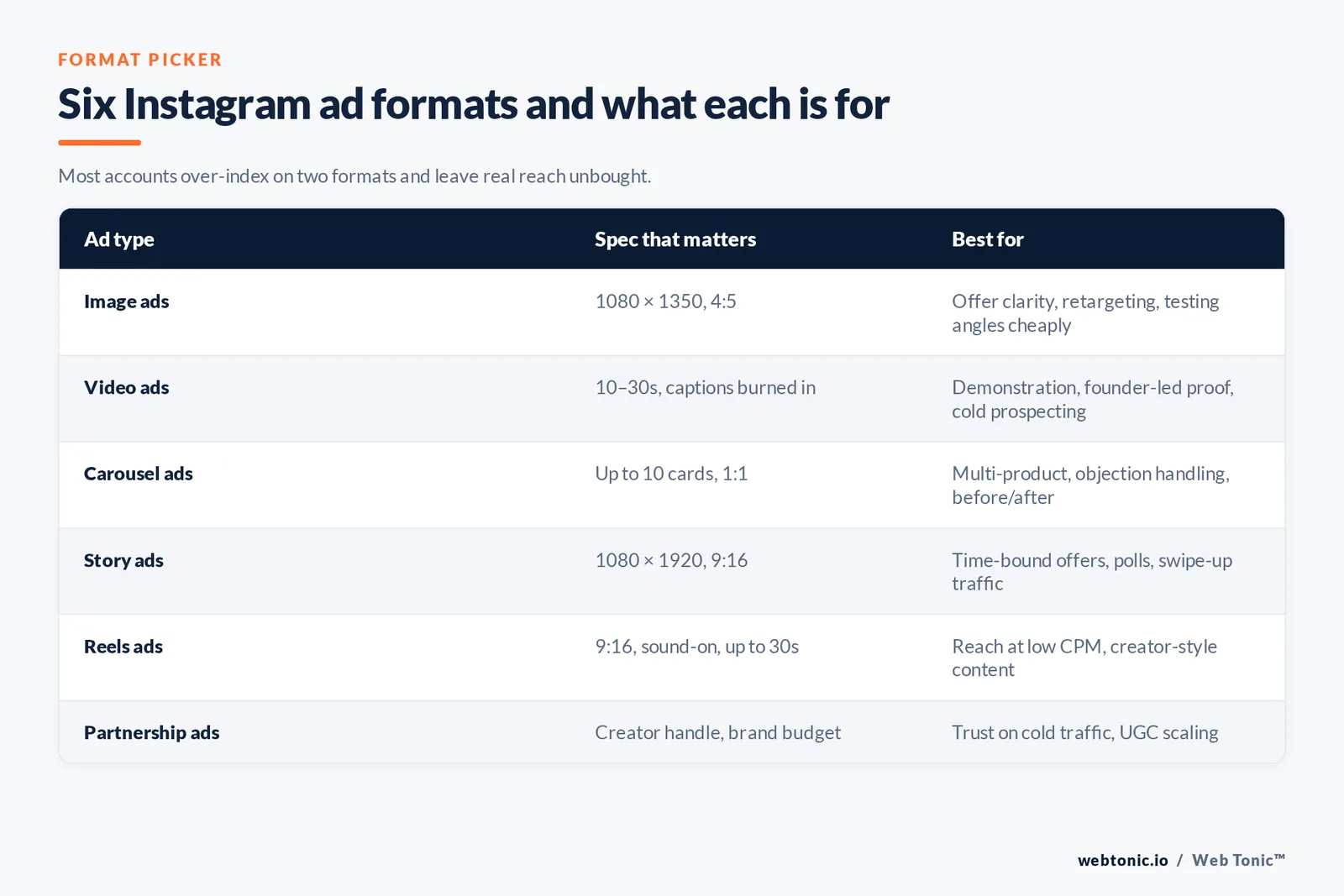
There are nine formats worth knowing. Most Instagram advertising accounts over-index on two of them and leave real reach unbought.
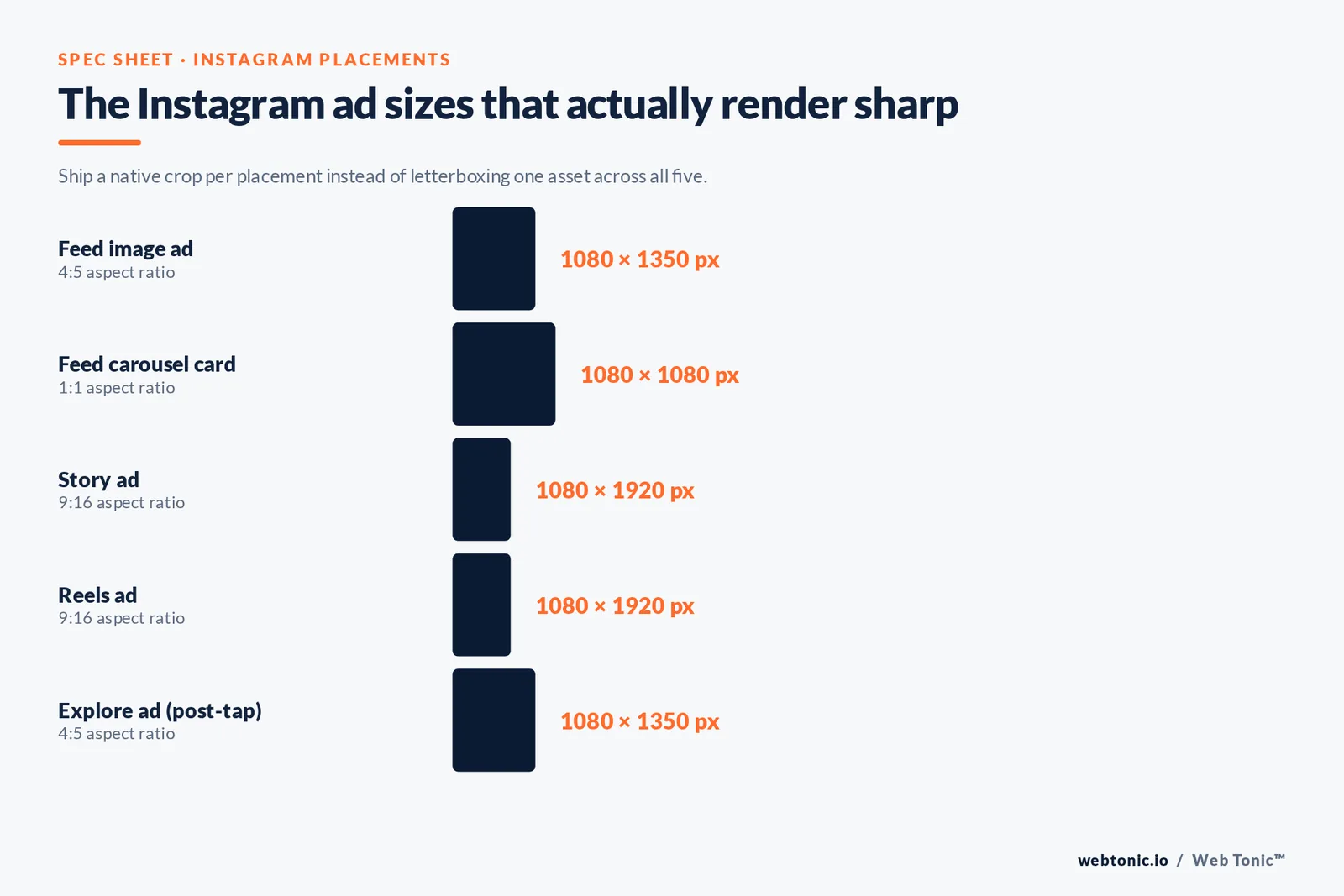
Image ads are a single still, best at 1080 × 1350 for feed. Video ads run up to 60 minutes technically, but the useful range for cold traffic is 10–30 seconds. Carousel ads hold up to 10 cards and are the workhorse for multi-product Instagram campaigns or multi-benefit stories. Collection ads pair a hero asset with a product grid and open into an Instant Experience. Story ads and Reels ads are full screen 9:16 and demand sound-on, hook-first editing. Explore ads appear after someone taps into a post from the Explore grid. Shopping ads pull from a catalogue and tag products directly. Partnership ads — formerly branded content ads — run a creator's post from the creator's handle with your budget behind it, which is why they routinely beat brand-handle equivalents on cold audiences.
Buffer's format walkthrough is a good visual reference for each unit, and Sprout Social's Instagram advertising guide maps formats to funnel stages.
| Ad type | Spec that matters | Best for |
|---|---|---|
| Image ads | 1080 × 1350, 4:5 | Offer clarity, retargeting, testing angles cheaply |
| Video ads | 10–30s, captions burned in | Demonstration, founder-led proof, cold prospecting |
| Carousel ads | Up to 10 cards, 1:1 | Multi-product, objection handling, before/after |
| Collection ads | Hero + 4 product tiles | Ecommerce catalogues, in-app browsing |
| Story ads | 1080 × 1920, 9:16 | Time-bound offers, polls, swipe-up traffic |
| Reels ads | 9:16, sound-on, ≤30s | Reach at low CPM, creator-style content |
| Explore ads | Feed specs, post-tap placement | Incremental reach on discovery-minded users |
| Shopping ads | Catalogue feed required | Direct product sales, dynamic retargeting |
| Partnership ads | Creator handle, brand budget | Trust on cold traffic, UGC scaling |
How to choose your campaign objective
The objective you select in Ads Manager decides which optimisation events the campaign can buy, so this single choice shapes every cost you will report later. Choose it based on the business action you need, not the metric that looks best in a screenshot.
Awareness buys the cheapest reach and suits product launches where the goal is that more users simply know the brand exists. Traffic sends people to a landing page and is the objective most often chosen by mistake — it optimises for clicks, and clicks are not customers. Engagement is right for local businesses and event promotion where saves, comments and message replies are the real outcome. Leads is the objective for service businesses, and it works with either an on-site form or an in-app Instagram lead form. App promotion exists for app installs and in-app events. Sales is the ecommerce default and the only objective that will optimise properly against catalogue purchases.
One rule that saves money: pick the objective closest to revenue that still generates about 50 events a week. If purchases are too rare at your spend level, optimise one step earlier — add to cart, or qualified lead — and let the campaign gather signal there instead of starving on a thin conversion event.
| Objective | Choose it when | Watch this metric |
|---|---|---|
| Awareness | Launching a product or entering a new market | Reach, CPM, frequency |
| Traffic | Content distribution or an unmeasurable offsite action | Cost per landing page view |
| Engagement | Local business, events, DM-led selling | Cost per message or engagement |
| Leads | Services, B2B, high-consideration purchases | Cost per qualified lead |
| Sales | Ecommerce with a catalogue and clean tracking | ROAS and blended MER |
How to create Instagram ads in Ads Manager, step by step
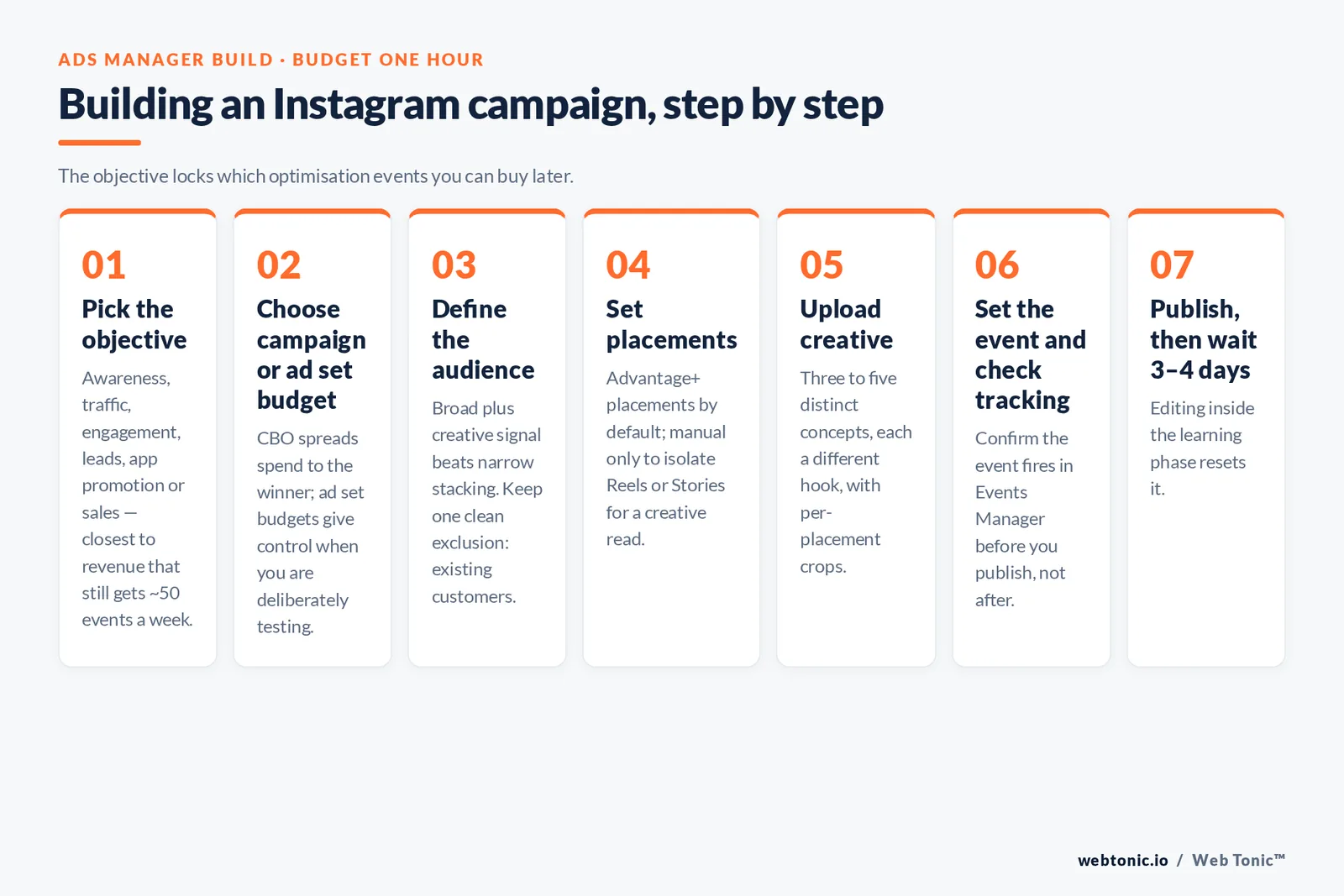
The path below assumes a Meta Business Suite account, a connected Instagram professional account and a working pixel or Conversions API feed. Budget an hour for the first campaign build.
- Step 1 — pick the objective. Awareness, traffic, engagement, leads, app promotion or sales. The objective locks which optimisation events are available later, so choosing "traffic" when you want purchases is the most expensive early mistake in Meta ads.
- Step 2 — choose campaign budget or ad set budget. Campaign budget optimisation spreads spend to whichever ad set is winning; ad set budgets give you control when you are deliberately testing.
- Step 3 — define the target audience. Broad plus creative signal outperforms narrow stacking in most accounts now. Keep one clean exclusion: existing customers.
- Step 4 — set placements. Advantage+ placements by default. Use manual placements only to isolate Reels ads or story ads for a creative read.
- Step 5 — upload creative. Three to five distinct creative concepts — images and videos, each with a different hook, and per-placement crops so nothing is letterboxed.
- Step 6 — set the optimisation event and check tracking. Confirm the event fires in Events Manager before you publish, not after.
- Step 7 — publish, then leave it alone for 3–4 days. Editing inside the learning phase resets it.
If you are building the measurement layer at the same time, our data intelligence work covers event mapping and attribution, and performance creative covers the asset volume this system eats.
Organic posts versus paid Instagram ads
Most Instagram advertising budgets start because organic reach stopped working. That is the right diagnosis, but the wrong conclusion if you then abandon organic entirely — the two systems feed each other.
Organic content on Instagram now reaches roughly 4–8% of your followers per post for most business accounts, and Reels reach non-followers unpredictably. Paid Instagram ads buy certainty: you choose the audience, the placements and the spend, and delivery is guaranteed as long as the budget holds. What organic still does better is prove which content deserves paid amplification. A post that earns strong saves and shares organically is the cheapest possible test of a creative idea before you put budget behind it as a Reels ad or a story ad.
The practical workflow: publish 8–12 organic posts a month, watch which ones earn outsized saves, then promote the winners inside Meta Ads Manager as paid campaigns with a proper conversion objective. Teams running both sides together consistently see lower cost per result than teams treating advertising and organic social as separate departments. Sprout Social's Instagram statistics are a useful baseline for what organic engagement should look like before you decide it has failed.
| Dimension | Organic posts | Paid Instagram ads |
|---|---|---|
| Reach | 4–8% of followers, unpredictable on Reels | Bought — scales with budget and CPM |
| Cost | Production time only | $7–$12 CPM plus production |
| Speed | Weeks to compound | Hours to first data |
| Audience control | Whoever the ranking system chooses | Geography, lookalikes, exclusions, retargeting |
| Best use | Testing creative ideas cheaply | Scaling the ideas that already worked |
What Instagram advertising costs in 2026
Instagram advertising costs move with vertical, geography, season and creative quality, so treat any single number as a starting range rather than a forecast. Practitioner data from WordStream's Instagram ads cost analysis puts average CPC between $0.40 and $0.70 for well-run accounts, and Socialinsider's Instagram ads benchmarks place CPM in the $7–$12 band for most consumer categories.
Two structural pressures are worth pricing in. Ad impressions grew 18% year over year in Q4 2025 while average price per ad also rose, meaning both supply and competition expanded at once. And Q4 remains the most expensive quarter of the year — plan for CPMs 20–40% above your November baseline through Black Friday.
| Objective | Typical CPM | Typical CPC / CPA |
|---|---|---|
| Awareness / reach | $3.50–$6.00 | $0.10–$0.30 CPC |
| Traffic | $6.50–$9.00 | $0.40–$0.75 CPC |
| Engagement | $6.00–$12.00 | $0.10–$0.40 per engagement |
| Leads | $14.00–$22.00 | $1.20–$3.50 CPC |
| Sales / conversions | $12.00–$18.00 | $0.85–$1.60 CPC |
On budget floors: there is no platform minimum beyond roughly $1–$5 per day per ad set, but a conversion campaign starved below $20–$30 per day rarely gathers enough signal to optimise. Below that, buy reach or engagement instead and accept it as brand spend.
Targeting: the target audience decisions that still matter
Detailed interest targeting on Instagram has lost most of its edge. With 1,000+ interest options still listed, the temptation is to stack them, but Meta's own delivery models now find buyers faster from broad pools plus a strong conversion signal. The levers that still move outcomes are: a clean customer list upload for lookalikes, a first-party event feed via Conversions API, exclusions that prevent paying to reach existing customers, and geography.
Retention data from Socialinsider's Instagram benchmarks and audience composition data in Statista's Instagram dossier are useful for sizing before you build. For global penetration by market, DataReportal's Digital 2026 report is the cleanest free source.
One compliance note for creator work: if a partnership ad runs on a creator's handle, the disclosure rules in the FTC's influencer disclosure guidance still apply. Paid partnership labels are not optional.
Creative: what actually separates winners
Across Instagram ads accounts, creative explains more of the variance in performance in results than any targeting choice. Three rules hold up.
First, the first 3 seconds decide the outcome — hook rate (3-second views ÷ impressions) above 25% is the threshold worth chasing. Second, produce for the placement you selected: a 4:5 feed asset pasted into Stories loses roughly 20% of the visible frame. Third, volume of creative beats polish. Accounts that ship 8–12 new concepts a month consistently outrun accounts shipping two beautifully finished ones, because the auction only rewards what it can test.
Watch frequency as your fatigue trigger. When 7-day frequency crosses 3.0 and CTR drops more than 15% from its first-week baseline, the asset is done — refresh rather than raise bids. Sprout's industry benchmarks are a fair external yardstick for engagement norms in your category.
Creative specs: images, videos and placement fit
Every placement crops differently, so one master asset per campaign is a false economy. Build a small kit and Ads Manager will select the right version per surface.
For feed ads, export images at 1080 × 1350. For story ads and Reels ads, export videos at 1080 × 1920 and keep every logo, price and caption inside the middle 80% of the frame so the interface does not cover them. Explore ads reuse the feed crop. Collection ads and shopping ads pull product images straight from your catalogue, which means feed hygiene — titles, prices, availability — becomes a creative job rather than a technical one.
Video length: 10–30 seconds for prospecting, up to 60 seconds for demonstration content, and always with burned-in captions because a large share of users watch with sound off. Partnership ads are the exception worth planning around: creator-shot videos deliberately look less polished, and that is the point.
Measuring Instagram ads performance without fooling yourself
Platform-reported conversions in Ads Manager are modelled, and they will not tie to your backend. Build the habit of reading three layers together: in-platform performance for creative decisions, blended metrics — total revenue ÷ total ad spend — for business decisions, and incrementality tests for the questions that actually matter.
A workable monthly rhythm: check MER weekly, run one geo holdout or conversion-lift test per quarter, and audit event quality monthly in Events Manager. Guidance on measurement standards from IAB's insights library is worth reading before you commit to a stack. Teams that want this run for them can see how we structure it in growth marketing, or browse more social advertising playbooks on the Web Tonic blog.
| Metric | Healthy signal | What it tells you |
|---|---|---|
| Hook rate | >25% | The first frame earns attention |
| Hold rate | >10% to thruplay | The story keeps attention |
| CTR (link) | 0.9%–2.0% | Offer and creative align |
| Frequency (7d) | <3.0 | Audience is not saturated |
| Event match quality | 6.0+ / 10 | Meta can attribute your conversions |
Common mistakes that quietly waste budget
Five recur in almost every Instagram ads audit. Optimising for the wrong event, usually landing page views instead of purchases. Splitting $40 per day across six ad sets so none exits learning. Editing live ad sets every 48 hours, restarting the learning phase each time. Running one creative for 90 days and blaming the algorithm. And judging a lead-gen account on cost per lead when 60% of those leads never qualify — fix the feedback loop by sending qualified-lead events back to Meta, not by lowering the bid.
Frequently Asked Questions
How much do Instagram ads cost per day?
Ad sets can technically run from about $1–$5 per day, but conversion campaigns need roughly $20–$30 per day minimum to gather enough signal. For lead generation in competitive verticals, plan $50–$100 per day per ad set before expecting stable cost per lead.
Do I need a Facebook page to run Instagram ads?
Yes. Ads Manager is a Meta-level tool, so an Instagram professional account must be connected to a Facebook page inside Business Manager before you can buy placements. You can still run ads that appear only on Instagram.
Which Instagram ad type performs best?
For cold prospecting, Reels ads and partnership ads usually deliver the lowest cost per result because they look native and buy cheap reach. For retargeting and ecommerce, collection ads and shopping ads convert best because they shorten the path from tap to product.
How long until Instagram ads start working?
Expect 3–7 days for the learning phase to settle on a properly funded ad set, and about 50 optimisation events per week to leave learning entirely. Judging results before day four almost always leads to a premature edit.
Can I run Instagram ads without a website?
Yes. Lead forms, Instagram Direct message campaigns, WhatsApp click-to-message and app install objectives all keep the conversion inside Meta's apps, which suits local services and app businesses. Reach out via our contact page if you want that mapped to your funnel.
Sources: Meta Q4 & FY2025 results (investor.atmeta.com) · Meta newsroom · eMarketer Instagram ad revenues · WordStream Instagram ads cost · Socialinsider Instagram ads benchmarks and Instagram benchmarks · Sprout Social Instagram advertising guide and industry benchmarks · Buffer Instagram ads guide · Statista Instagram dossier · DataReportal Digital 2026 · FTC influencer disclosure guidance · IAB insights. Figures verified July 2026.