Table of contents
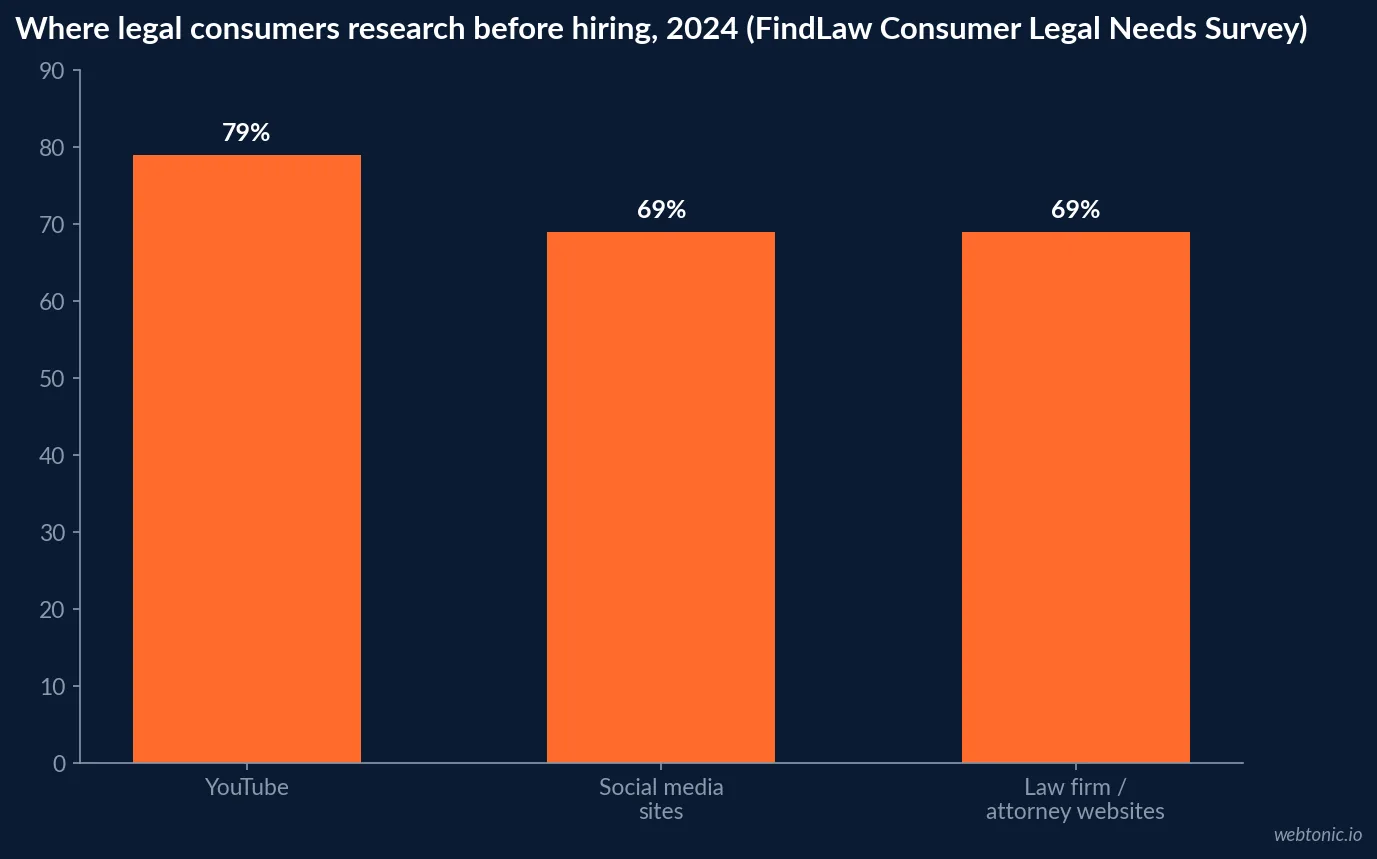
Social media sites tie a law firm's own website at 69% of legal consumers who research online before hiring, second only to YouTube at 79%, per FindLaw's 2024 Consumer Legal Needs Survey. That is real evidence that social channels sit inside the research path for most immigration prospects - it is not proof that social media closes the case, which no published source measures directly.
Key Takeaways
- 79% of legal consumers researching online for video used YouTube (FindLaw, 2024).
- 69% used social media sites - tied with law firm or attorney websites, also at 69%.
- 40% of consumers rely on personal recommendations to choose an attorney (Martindale-Avvo, 2024).
- But 61% of those same consumers still do their own online research afterward to verify the recommendation.
- 62% of Hispanic adults use Instagram versus 45% of White adults (Pew Research, 2025).
- 58% of Asian adults and 54% of Black adults use Instagram.
- 32% of all U.S. adults now use WhatsApp, up from 23% in 2021.
- 71% of U.S. adults use Facebook; 50% use Instagram; 37% use TikTok (Pew Research, 2025).
- 84% of U.S. adults use YouTube - the single largest platform by reach.
- Meta's advertising policy bars targeting or excluding by national origin, even for organic-adjacent audience strategy.
- No published study measures what share of immigration law hires originate on a social platform specifically.
What the "drives most inquiries" claim actually rests on
FindLaw's 2024 U.S. Consumer Legal Needs Survey found that among legal consumers who searched online for video content, 79% used YouTube, 69% used social media sites, and 69% used law firm or attorney websites directly. That is a tie at second place between social platforms and a firm's own site - a real, sourced signal that social media sits inside the research funnel for most legal prospects, immigration included.
What it does not show is which channel actually converts a browser into a signed client. No source in this research area publishes an attribution study that traces a hired-attorney outcome back to a specific platform for immigration cases specifically, so any claim beyond "social is part of the research path" is not supported by the underlying data.
| Research channel (2024) | Share of legal video researchers | Rank | Source |
|---|---|---|---|
| YouTube | 79% | 1st | FindLaw Consumer Legal Needs Survey |
| Social media sites | 69% | Tied 2nd | FindLaw Consumer Legal Needs Survey |
| Law firm / attorney websites | 69% | Tied 2nd | FindLaw Consumer Legal Needs Survey |
Recommendations still open the door first
Martindale-Avvo's 2024 Legal Consumer Report found that 40% of consumers rely on recommendations from family, friends or other lawyers to pick an attorney - still the single largest starting point in that data. The same report found that 61% of those consumers go on to conduct their own online research anyway, to verify the recommendation before committing to it.
Read together with FindLaw's figures, the sequence looks like: a referral gets a firm on the shortlist, then a social profile, website and review history decide whether that firm survives the follow-up check. A firm with no social presence is not necessarily losing the referral, but it is giving up a chance to confirm it.
| Consumer behavior (2024) | Share | What it means for social strategy | Source |
|---|---|---|---|
| Rely on personal recommendation to choose an attorney | 40% | Referrals still start the search | Martindale-Avvo |
| Go on to research the recommendation online anyway | 61% | Social/web presence has to hold up under a check | Martindale-Avvo |
| Used social media sites while researching online | 69% | Social is inside that follow-up check | FindLaw |
Which platform actually reaches which immigrant community
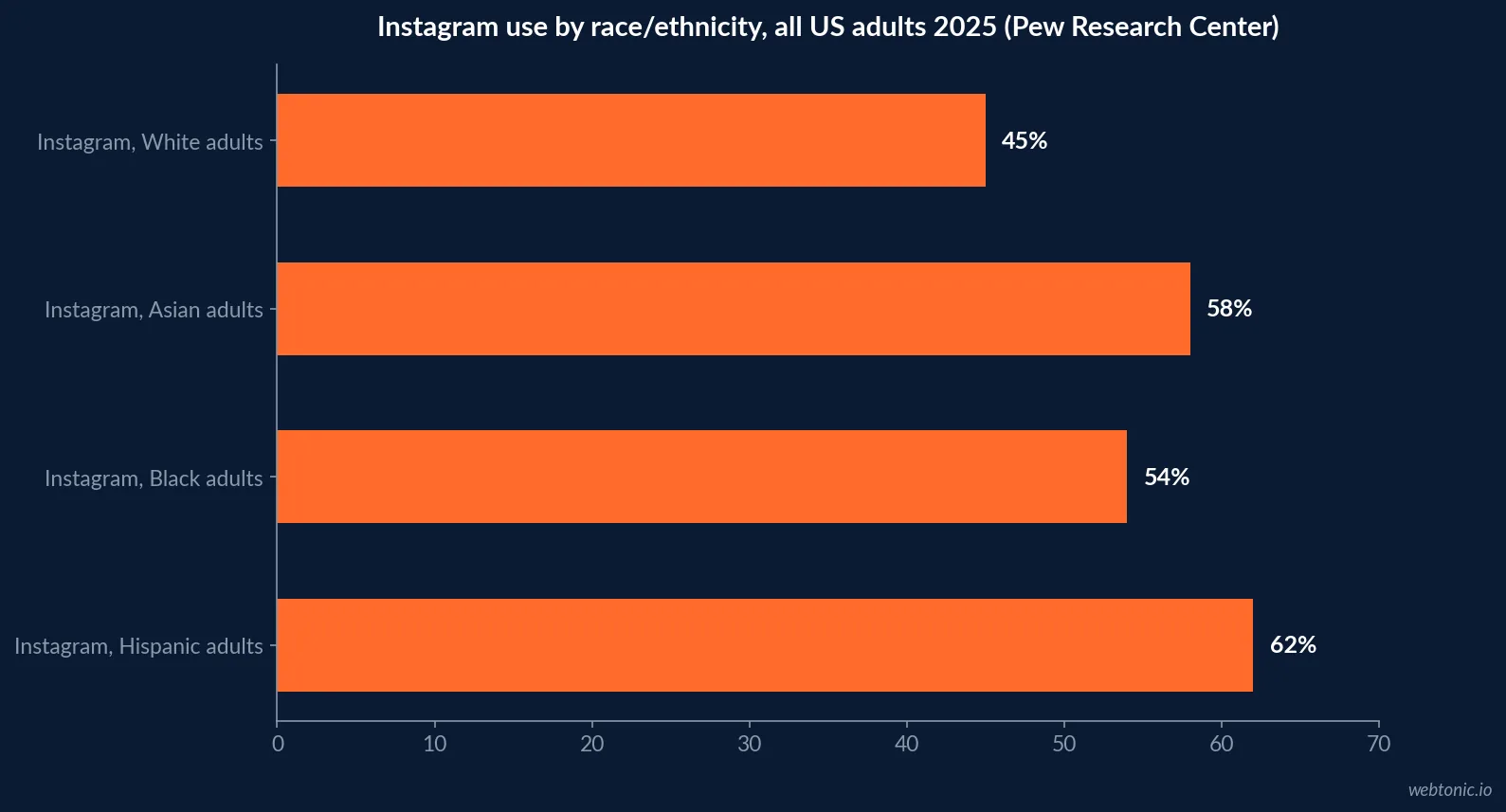
Pew Research Center's Americans' Social Media Use 2025 report, based on a survey fielded February to June 2025, finds meaningful gaps by race and ethnicity that matter for audience planning: 45% of White adults report using Instagram, compared with 62% of Hispanic adults, 58% of Asian adults and 54% of Black adults. Overall platform reach ranks YouTube highest at 84% of U.S. adults, followed by Facebook at 71%, Instagram at 50%, TikTok at 37%, and WhatsApp at 32%, up from 23% in 2021.
None of this is measured by immigration status, so treat it as a proxy for which channels reach which communities generally, not as an immigration-specific finding. WhatsApp's growth is worth flagging separately: it is widely used for cross-border family communication in multilingual households, which makes it a plausible client-communication channel even without a Pew breakout tying usage to immigration status directly.
What organic content should carry on each channel
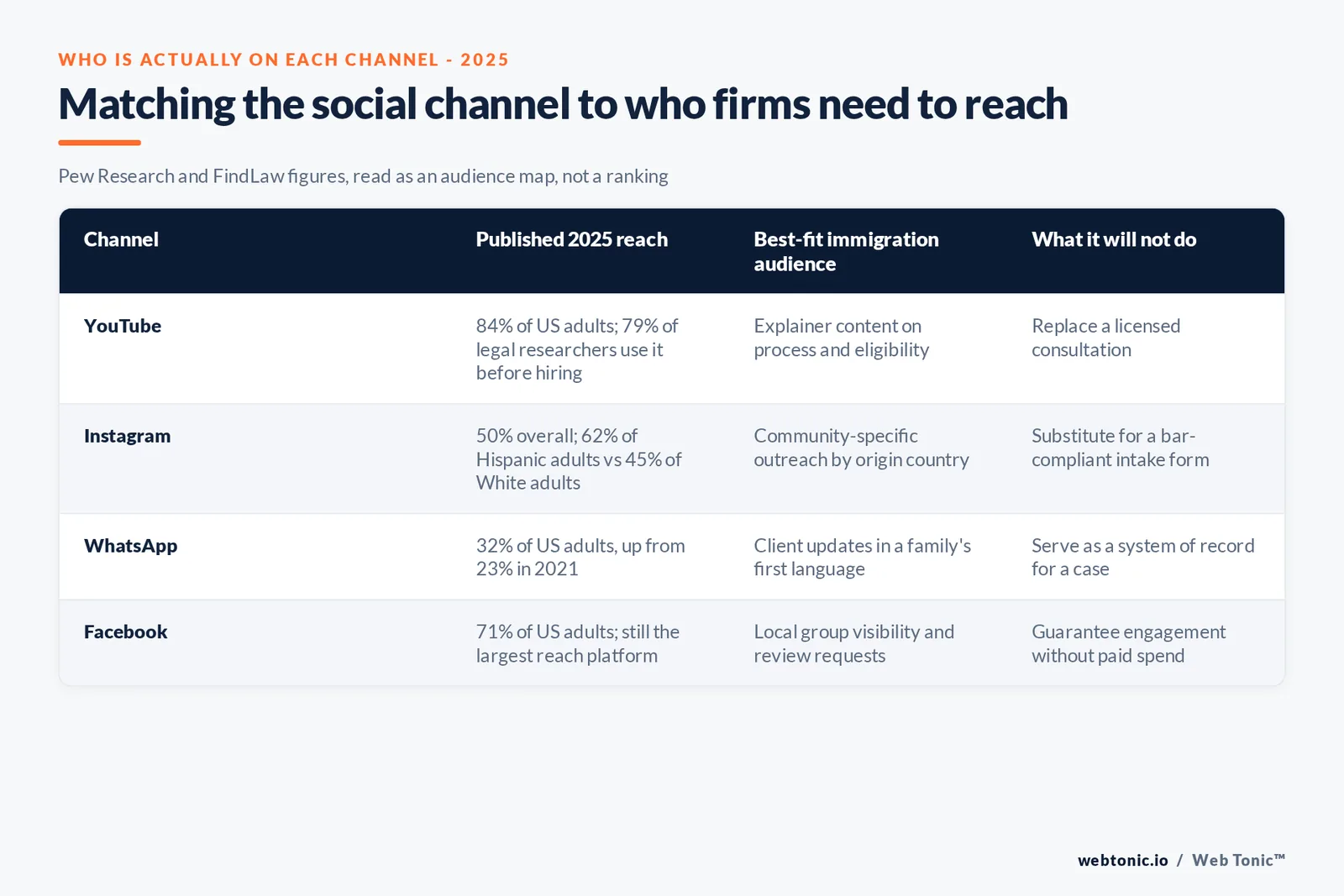
Given that YouTube leads FindLaw's research-behavior data at 79%, an immigration firm's video budget is better spent on process explainers - what a specific visa category actually requires, what a filing timeline looks like against the current USCIS backlog - than on channels with smaller reach. Instagram and Facebook, which Pew's 2025 data shows reaching a larger and more racially varied audience than TikTok, are the more efficient home for shorter updates, review requests and the kind of content a prospect checks during the 61% follow-up research Martindale-Avvo documents.
WhatsApp sits differently: at 32% of U.S. adults and disproportionately used for cross-border family communication, it is better suited to direct client updates on an open case than to public-facing marketing content, since it functions as a messaging app rather than a discovery surface.
| Platform | What FindLaw/Pew data supports using it for | What it is not built for |
|---|---|---|
| YouTube | Process explainers, eligibility walkthroughs | Real-time case status updates |
| Instagram / Facebook | Review requests, short updates, community visibility | Confidential case communication |
| Direct updates to an existing client relationship | Public marketing or new-client discovery | |
| TikTok | Awareness content, lower current reach than the above | A primary channel absent dedicated video capacity |
The targeting line a firm cannot cross
A firm building content or an ad audience around a specific community still has to stay inside Meta's own rules. The platform's Discriminatory Practices policy explicitly bars ads that target or exclude audiences by national origin, among other protected personal attributes. That restricts paid targeting directly, and the same logic should guide organic strategy: a firm can publish content in a specific language or address a specific country's visa process without building its actual ad audience around national origin as a selection criterion.
Our performance creative team and the agencies we track for paid social both work inside that constraint by default; talk to us about what a compliant, community-aware social program looks like for a specific caseload.
Social media is also where impersonation scams spread
A firm's social presence is not just a marketing surface; it is also part of how prospects tell a real attorney from a scam. USCIS warns that only attorneys or accredited representatives can give immigration legal advice, and fraudulent "notarios" increasingly use social platforms and messaging apps to reach exactly the multilingual, first-generation audience this page's Pew data shows using Instagram and WhatsApp at above-average rates. A firm's own bar number, credentials and a direct link to its official profile, posted consistently across every platform it uses, is a low-cost defense that also happens to be good marketing practice.
That consistency matters more for immigration than for most practice areas precisely because the client population being targeted by both legitimate firms and scammers overlaps almost completely.
| Trust signal | Where to post it | Why it matters for immigration specifically |
|---|---|---|
| State bar number | Every profile bio, plus pinned post | Distinguishes the firm from unaccredited notarios |
| Link to the official website | Every platform's bio field | Gives a verifiable destination beyond the social profile itself |
| Consistent name and photo across platforms | All active accounts | Makes impersonation accounts easier to spot and report |
| Plain-language accreditation explainer | A pinned video or post | Directly counters the notario confusion USCIS warns about |
Measuring what social actually contributes, without overclaiming
Because no published study attributes signed immigration cases to a specific social platform, a firm should build its own bridge between FindLaw's research-behavior data and its own intake numbers rather than importing an external conversion figure that does not exist for this practice area. The workable proxy is a "how did you hear about us" field on every intake form, cross-tabbed against which social accounts a lead followed or engaged with before contacting the firm - not a perfect attribution model, but a far better one than assuming the 69% research-behavior figure translates directly into 69% of new matters.
Tracking that intake field consistently for even two quarters will tell an immigration firm more about its own social contribution than any cross-industry benchmark can, precisely because FindLaw's and Martindale-Avvo's figures describe the market in aggregate, not this specific firm's caseload.
| Intake tracking field | What it captures | Why aggregate benchmarks cannot replace it |
|---|---|---|
| "How did you hear about us?" | Self-reported first touch | Directly ties a matter to a channel, which FindLaw's survey does not |
| Social account engagement before contact | Whether a lead followed/liked/commented first | Distinguishes passive reach from active interest |
| Language of the intake conversation | Which language the client used | Tests whether Pew's ethnicity gaps translate into actual leads |
| Time from first social touch to signed retainer | Sales-cycle length by channel | No published study measures this for immigration law |
Frequently Asked Questions
Do social channels really drive most immigration law firm inquiries?
The honest answer is qualified. FindLaw's 2024 U.S. Consumer Legal Needs Survey found that among legal consumers who searched online for videos, YouTube was the top source at 79%, followed by social media sites at 69% and law firm or attorney websites also at 69%. That shows social media is a major research stop, tied with the firm's own website, but no source measures what share of actual signed immigration cases originate on social platforms specifically - the data describes research behavior, not attribution to a final hire.
Which social platforms do immigrant communities actually use?
Pew Research Center's 2025 Americans' Social Media Use report finds real gaps by race and ethnicity: 45% of White adults report using Instagram, compared with 62% of Hispanic adults, 58% of Asian adults and 54% of Black adults. WhatsApp usage sits at 32% of all U.S. adults, up from 23% in 2021, and is widely reported as disproportionately used inside immigrant and multilingual households for cross-border family communication, which makes it a relevant channel for client updates even without a Pew figure broken out by immigration status specifically.
Does word of mouth still beat social media for finding a lawyer?
It remains the single biggest starting point, but it does not end the search. Martindale-Avvo's 2024 Legal Consumer Report found that almost half of consumers, 40%, rely on recommendations from family, friends or other lawyers when selecting an attorney - but 61% of those same people go on to do their own online research anyway to verify the recommendation. A referral gets a firm considered; an active social and web presence is what survives that follow-up check.
What can a Meta ads audience legally target for a firm serving specific communities?
Not national origin directly. Meta's Discriminatory Practices policy explicitly bars targeting or excluding audiences by national origin, alongside other protected personal attributes, which applies to organic community-building strategy as much as paid targeting. A firm can create content in a specific language or address a specific country's process without building an ad audience around national origin as a targeting criterion.
Should an immigration firm treat TikTok the same as Instagram or Facebook?
Not on the current adoption numbers. Pew's 2025 data puts overall U.S. adult TikTok use at 37%, well below Facebook's 71% and Instagram's 50%, though it has grown from smaller shares in recent years. For an immigration firm without dedicated video production capacity, Facebook and Instagram currently reach a larger share of the adult population that FindLaw's data shows is already checking social media before hiring.
Sources
FindLaw, 2024 U.S. Consumer Legal Needs Survey
Martindale-Avvo, 2024 Legal Consumer Report (PDF)
Pew Research Center, Americans' Social Media Use 2025 (PDF)
Meta Transparency Center, Discriminatory Practices policy