Table of contents
Manual dispatch and manual follow-up lose the two things automation is built to protect: response speed and consistency. ServiceTitan's own contractor survey, Klaviyo's own send-level benchmarks and Podium's published pricing set the numbers below - not a vendor round-up, but each platform's own reported data.
Key Takeaways
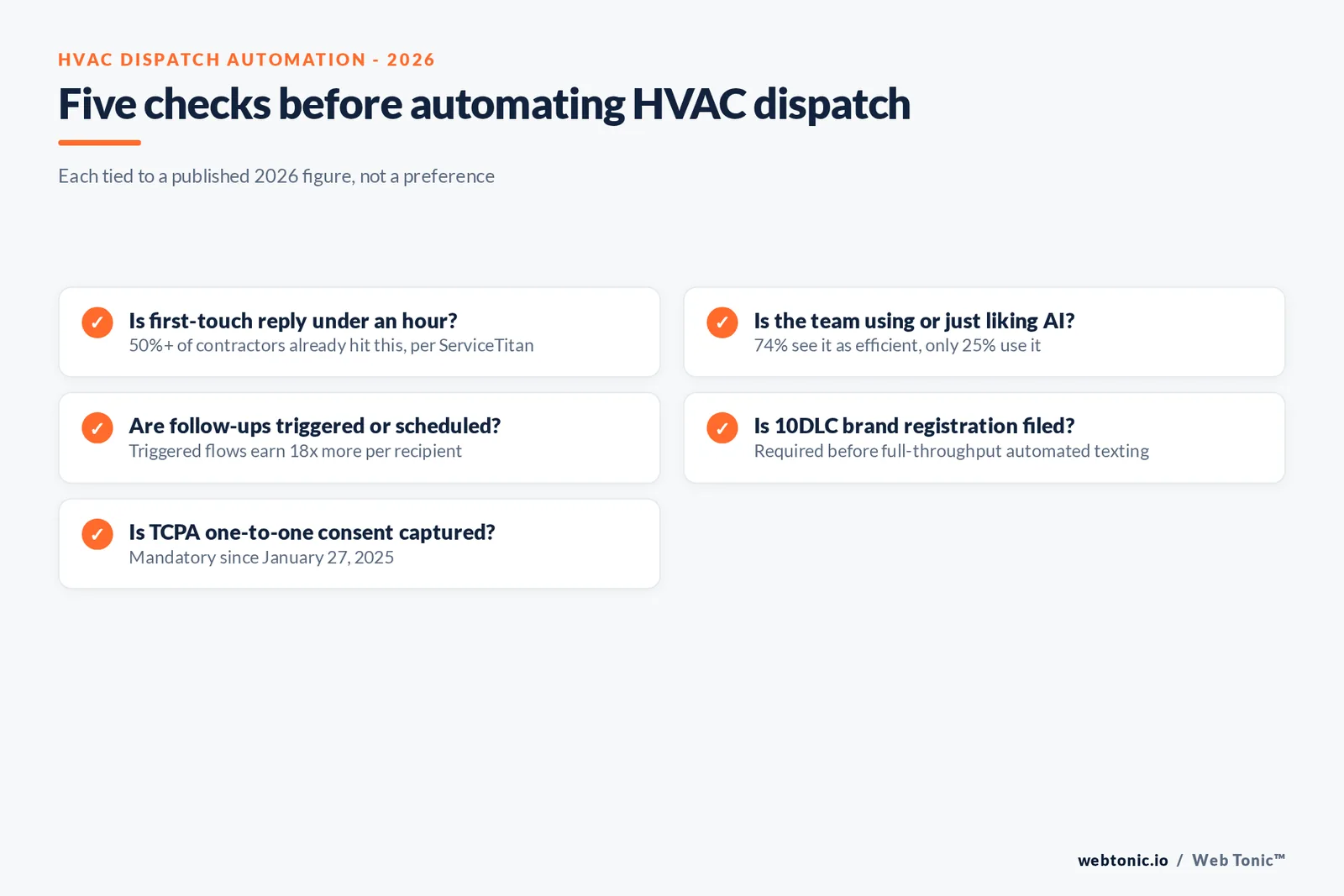
- More than 50% of residential contractors now respond to new leads within the first hour, per ServiceTitan's 2026 survey of 1,000 contractors.
- Fast response time is named the top competitive edge in that same report.
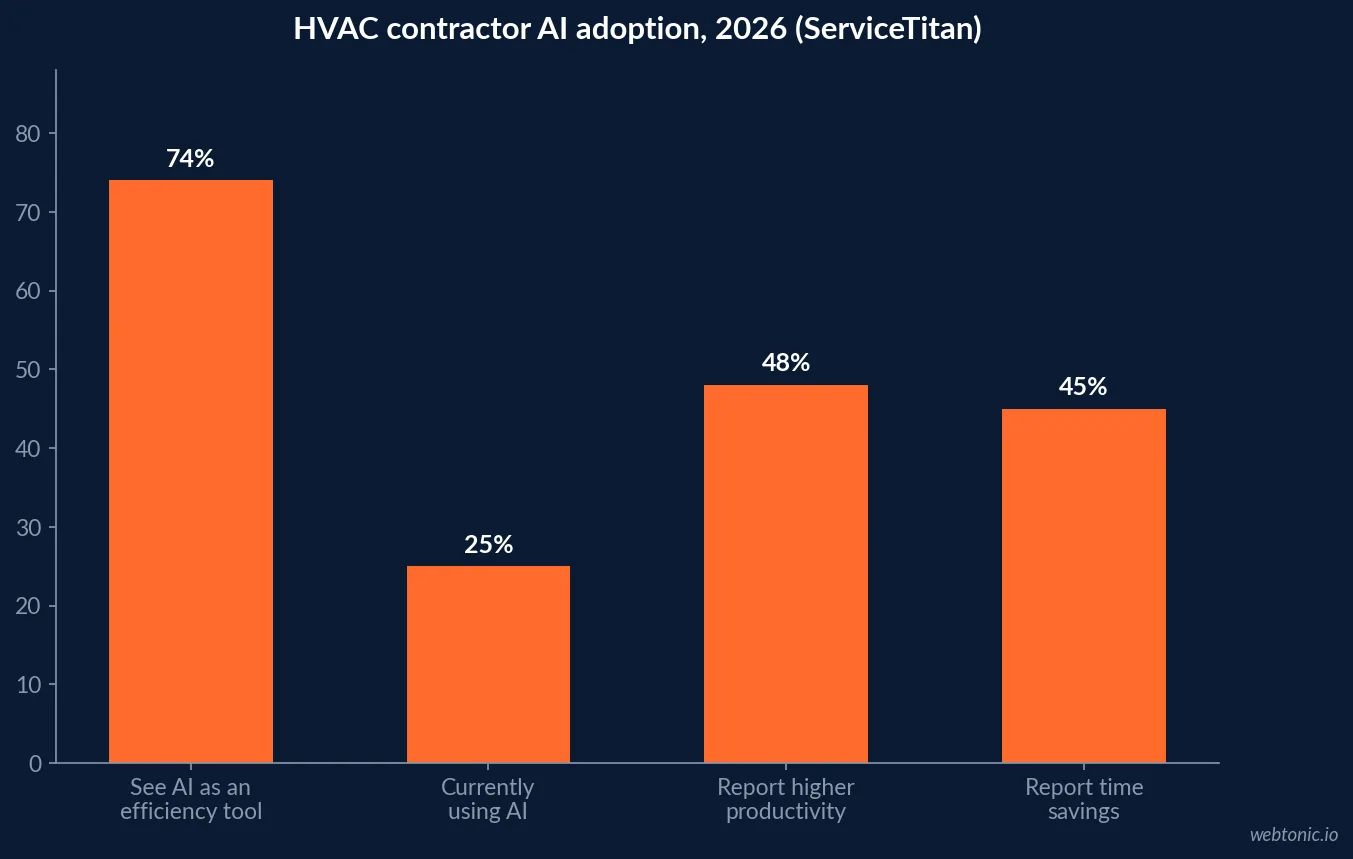
- 74% of contractors view AI as an efficiency tool, but only about 25% are currently using it - a 49-point adoption gap.
- Early AI adopters report 48% higher productivity and 45% time savings, per ServiceTitan.
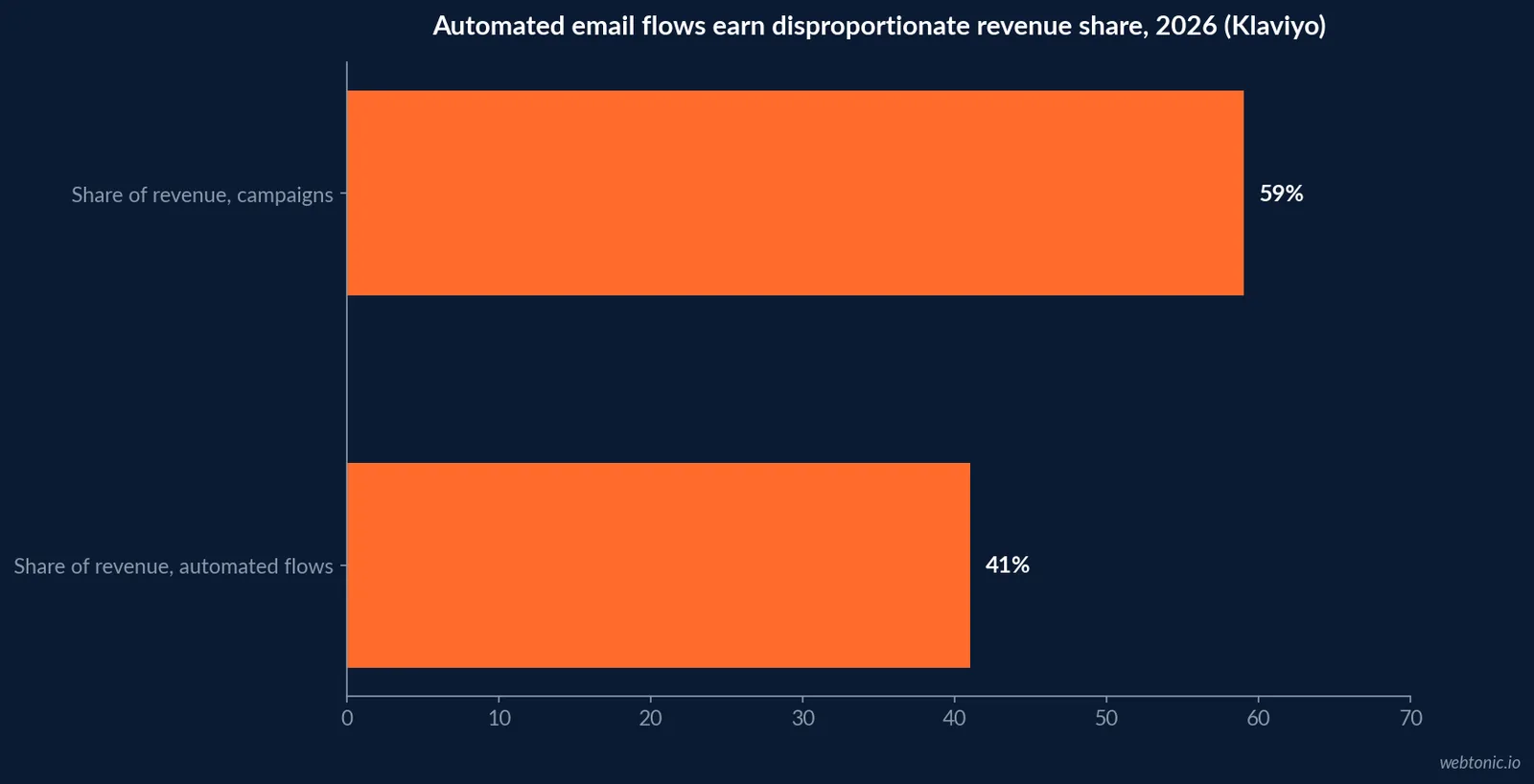
- Automated email flows generate 41% of total revenue from just 5.3% of sends, per Klaviyo's 2026 benchmark of 183,000-plus customers.
- Flow-based email drives revenue per recipient about 18 times higher than manually scheduled campaigns.
- Flow click rates run 5.58% versus 1.69% for campaigns - over 3 times higher.
- 48% of flow-driven revenue comes from new buyers, versus just 16% for manual campaigns.
- Top-decile automated flows reach a USD 7.79 revenue-per-recipient and 10%-plus click rates.
- Podium's own pricing lists Core at USD 399/month and Pro at USD 599/month, both billed annually.
- US locations carry a USD 5/month 10DLC compliance fee on top of the base plan, per Podium's pricing page.
- January 24, 2025: the 11th Circuit vacated the FCC's one-to-one consent rule before it took effect; TCPA prior express written consent still gates automated texts.
- A2P 10DLC brand registration through The Campaign Registry typically clears in 2 to 3 business days before high-throughput texting is allowed.
- Google's Local Services Ads platform surfaces an estimated response time as fast as "a few minutes" directly inside the ad once a business logs 2+ message leads.
- A 49-point gap between AI interest (74%) and AI use (25%) is the single biggest automation opportunity ServiceTitan's report identifies for 2026.
- None of the automation figures above require replacing existing field-service software - Klaviyo and Podium both sit on top of the customer data a shop already has.
- Response-speed and workflow-adoption data, read together, make the case that automated first-touch replies protect more revenue than automated marketing sends alone.
Benchmarks at a glance
| Automation metric | 2026 figure | Source |
|---|---|---|
| Contractors replying within the first hour | 50%+ | ServiceTitan Residential State of the Trades Report |
| Contractors who see AI as an efficiency tool | 74% | ServiceTitan |
| Contractors actually using AI | ~25% | ServiceTitan |
| Revenue share from automated email flows | 41% (from 5.3% of sends) | Klaviyo 2026 benchmark |
| Podium Core / Pro monthly price | USD 399 / USD 599 | Podium (own pricing page) |
Response speed is the competitive edge, and most shops are still slow
ServiceTitan's 2026 Residential State of the Trades Report, a survey of over 1,000 residential contractors, states plainly that fast response time is what's giving residential contractors the competitive edge in 2026, and finds more than half of contractors now respond to new leads within the first hour. The same ServiceTitan press release reports 74% of contractors view AI as an efficiency engine, yet only about 25% are currently using it - and the ones who do report 48% higher productivity and 45% time savings.
What automated follow-up does that manual sends do not
Klaviyo's 2026 email marketing benchmarks, based on more than 183,000 Klaviyo customers, found that automated flows drive almost 41% of total email revenue from just 5.3% of total sends, with revenue per recipient roughly 18 times higher than manually scheduled campaigns and click rates over 3 times higher (5.58% vs. 1.69%). Flows also pull in 48% of their revenue from new buyers, versus 16% for campaigns - meaning an automated welcome or missed-call-text sequence is doing more new customer work than a manual promotional blast.
This data is cross-industry ecommerce, not HVAC-specific - no vendor publishes a trades-only version - but the send-volume-to-revenue gap is the clearest available evidence that automating the message a customer is most likely to act on beats manually scheduling more of them.
| Email metric | Automated flows | Manual campaigns | Multiple | Source |
|---|---|---|---|---|
| Share of total sends | 5.3% | 94.7% | - | Klaviyo 2026 |
| Share of total revenue | 41% | 59% | - | Klaviyo 2026 |
| Click rate | 5.58% | 1.69% | 3.3x | Klaviyo 2026 |
| Share of revenue from new buyers | 48% | 16% | 3x | Klaviyo 2026 |
| Top-decile revenue per recipient | USD 7.79 | n/a | - | Klaviyo 2026 |
What dispatch and reputation automation costs
Podium's own pricing page, a tool many HVAC shops use for lead routing, review requests and text-based dispatch, lists Core at USD 399 a month and Pro, which adds AI-driven lead routing and deeper automation, at USD 599 a month - both on annual contracts, with a USD 5 a month 10DLC compliance fee per US location layered on top. Those are list prices for the category, not a Web Tonic quote, and they set the floor a shop should expect to pay for dispatch-adjacent automation software.
| Podium plan (own pricing page) | Monthly price | What it adds |
|---|---|---|
| Core | USD 399 | Lead conversion platform, review management, basic automations |
| Pro | USD 599 | Everything in Core, plus AI concierge and advanced automations |
| Per-location 10DLC fee | USD 5 | Required for compliant automated texting |
The compliance layer automation has to run inside
Two regimes govern automated SMS dispatch and marketing texts. The FCC's 2023 one-to-one consent rule was due to start on January 27, 2025, but the 11th Circuit vacated it on January 24, 2025 (Insurance Marketing Coalition v. FCC), so it never took effect; automated marketing texts still need the consumer's prior express written consent under the TCPA. Separately, carriers require A2P 10DLC brand and campaign registration through The Campaign Registry - brand approval typically clears in 2 to 3 business days - before automated texts from a business number reach full throughput without carrier filtering.
On the inbound side, Google's Local Services Ads help center confirms that once a business logs two or more message leads, an estimated response time - as fast as "a few minutes" - can surface directly inside the ad, turning automated first-response speed into a visible ranking and trust signal, not just an internal metric.
Manual vs. automated: the practical split
None of the sources above argue for automating everything. ServiceTitan's report ties competitive advantage to response speed specifically, and Klaviyo's data shows automation's edge concentrates in trigger-based messages, not scheduled ones. The practical split most shops land on: automate the first-touch reply and appointment reminders, keep manual judgment on estimate follow-up and win-back offers where a human read on the conversation still beats a template.
| Workflow | Automate or keep manual? | Evidence |
|---|---|---|
| First-touch lead reply | Automate | 50%+ already respond within the hour; speed is the edge |
| Appointment / dispatch reminders | Automate | Flow-based sends outperform manual by 18x RPR |
| Review request after job completion | Automate | Podium and similar platforms built for this |
| Estimate follow-up on a stalled quote | Manual judgment, automated cadence trigger | Klaviyo: flows still need human-written content |
| Win-back offer for a lapsed maintenance customer | Manual review, automated send | Blend of retention data and flow economics |
Sequencing the rollout: dispatch first, marketing second
ServiceTitan's own framing of its 2026 data is instructive: the report ties competitive advantage to response speed, not to marketing automation broadly. That argues for sequencing a rollout - automate the dispatch and confirmation layer before automating the promotional-email layer, since the first-touch reply is the message competing directly against a customer who is also calling competitors.
The growth marketing layer - win-back sequences, seasonal tune-up campaigns, referral-ask emails - is still worth automating once dispatch is handled, because Klaviyo's data shows the revenue-per-send gap holds for any triggered message, not only transactional ones. A reporting layer that tracks response time against the ServiceTitan benchmark is the fastest way to know which stage of the rollout is paying off.
| Rollout stage | What gets automated | Benchmark it targets | Typical timeline |
|---|---|---|---|
| Stage 1: Dispatch | First-touch text/call confirmation, ETA updates | 50%+ respond within the hour | Weeks 1-4 |
| Stage 2: Service reminders | Maintenance due dates, seasonal tune-up nudges | 86%+ agreement renewal KPI (sibling page) | Weeks 4-8 |
| Stage 3: Reputation | Post-job review requests | 71% referral share (sibling page) | Weeks 6-10 |
| Stage 4: Win-back | Lapsed-customer re-engagement sequences | 39% repeat-revenue share (sibling page) | Ongoing |
Compliance work belongs in every stage above, not as an afterthought: the TCPA and 10DLC requirements described earlier apply the moment stage 1 goes live, since the first automated text a customer receives is also the first one that needs documented consent behind it.
What a shop should measure before scaling automation further
The response-time and AI-adoption data above both point to the same operational question: is the shop's current response speed already inside the "more than half within the hour" band ServiceTitan measured, or still behind it? A shop behind the benchmark gets more return from automating stage 1 (dispatch) than from any marketing-email automation, because the response-speed gap is the one Google's Local Services Ads platform surfaces directly to shoppers. A shop already ahead of the benchmark gets more marginal return from stage 2 through 4, where the send-level revenue gap Klaviyo measured is the more relevant number.
A marketing partner running this kind of audit typically starts by pulling 90 days of lead-to-first-contact timestamps against the ServiceTitan benchmark before recommending which stage to automate next - the data usually settles the question faster than a platform demo does. The audit itself takes a day or two once the raw timestamps are exported; the harder part is usually agreeing on which leads count as "first contact" when a shop runs phone, text, web-form and Local Services Ads messaging leads through separate systems that were never designed to reconcile with each other.
Frequently Asked Questions
How fast do HVAC contractors currently respond to new leads?
ServiceTitan's 2026 Residential State of the Trades Report, a survey of 1,000 residential contractors, found more than half now respond to new leads within the first hour, and the report names fast response time as the main competitive edge separating winning contractors from the rest of the market in 2026. That is a manual-plus-automated blend, not a pure automation figure, but it sets the bar any automated dispatch workflow has to beat.
Is automated follow-up actually driving more revenue than manual sends?
Klaviyo's 2026 benchmark report, drawn from over 183,000 customers, found automated flows generate nearly 41% of total email revenue from just 5.3% of total sends, with revenue per recipient roughly 18 times higher than manual campaigns and click rates over 3 times higher. The data is cross-industry ecommerce, not HVAC-specific, but it is the clearest published evidence that automated, trigger-based messages outperform manually scheduled ones per send.
What does dispatch and reputation automation software cost?
Podium's own pricing page lists Core at USD 399 a month and Pro, which adds AI-driven lead routing and automation, at USD 599 a month, both on an annual contract, plus a USD 5 monthly 10DLC compliance fee per US location. Those are list prices for the platform category HVAC shops use for lead conversion and review automation - not a quote for any specific vendor.
What compliance rules apply to automated SMS dispatch and reminder texts?
Two regimes. The FCC's 2023 one-to-one consent rule was due to start on January 27, 2025, but the 11th Circuit vacated it on January 24, 2025 (Insurance Marketing Coalition v. FCC), so it never took effect; automated marketing texts still need the consumer's prior express written consent under the TCPA. Separately, carriers require A2P 10DLC brand and campaign registration through The Campaign Registry before automated texts from a business number reach customers at full throughput and deliverability.
Should a small HVAC shop automate dispatch before it automates marketing?
The response-time data argues yes. ServiceTitan's report ties fast response directly to competitive advantage, and the lead-response literature (see the sibling automation page for plumbing) shows contact odds fall fast with every extra minute of delay. Automating the first reply - a text confirming receipt and an ETA - captures more of that response-time advantage than automating a marketing email send, which is a lower-urgency channel.
Sources
ServiceTitan - 2026 Residential State of the Trades Report
ServiceTitan - press release on AI adoption findings
Klaviyo - 2026 Email Marketing Benchmarks
Podium - official pricing page
FCC - One-to-One Consent Rule for TCPA (2025)
Google - Local Services Ads: manage leads and jobs