Table of contents
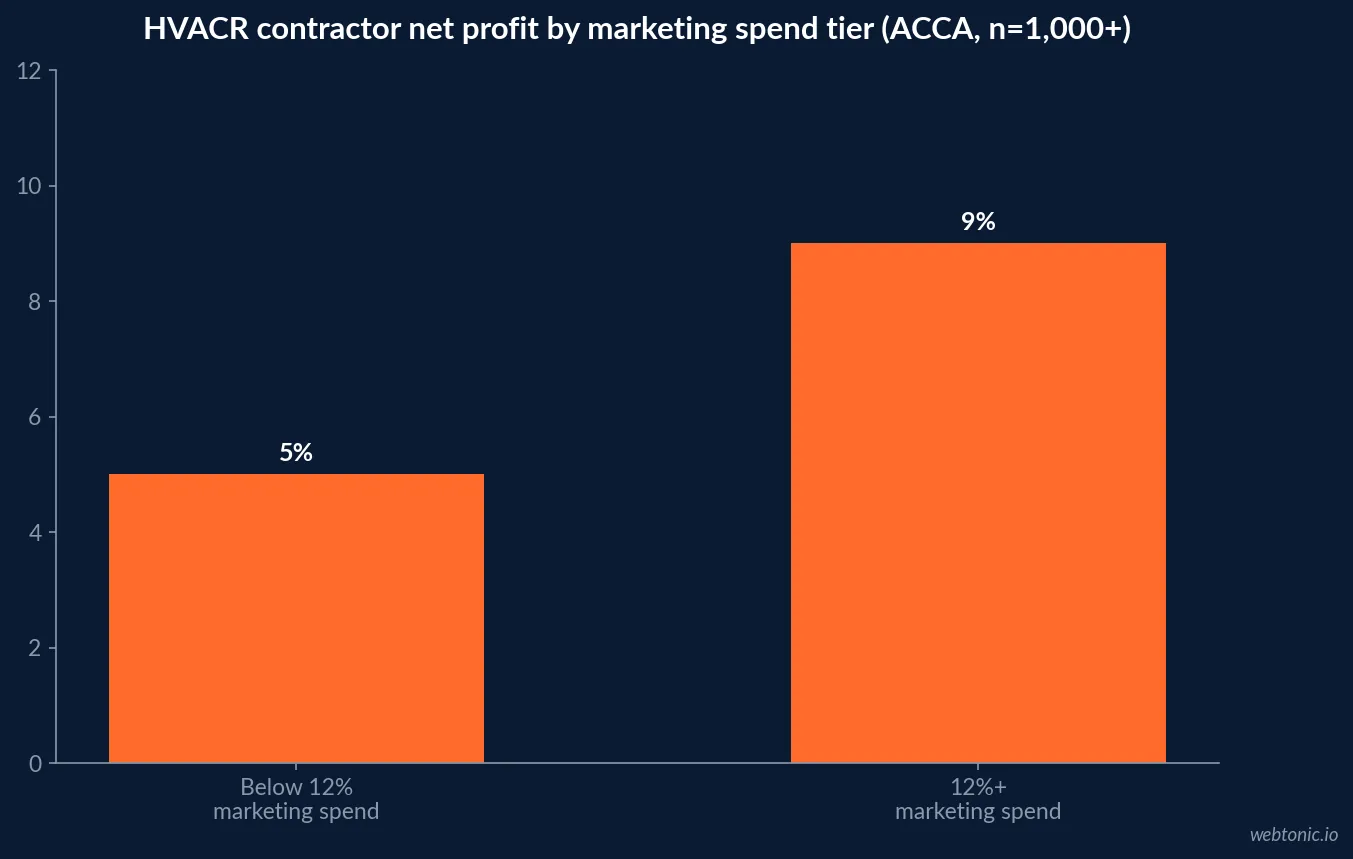
ACCA's own 1,000-contractor study links HVAC marketing budget to margin (a correlation, not proof of cause): the average HVACR contractor spends 6% of revenue on marketing, but the group spending 12% or more reports 9% net profit against 5% for everyone else. The published lead-source and call-handling data below shows where that budget goes and where it leaks before it ever reaches the shop's schedule.
Key Takeaways
- The average HVACR contractor spends 6% of annual revenue on marketing and advertising.
- Contractors investing 12%+ of revenue in marketing report 9% net profit versus 5% for the rest.
- Top reported lead sources: Google Business Profiles, company websites, paid digital ads, outbound calling/texting.
- 56% of HVACR contractors run field service management software, but most under-use its marketing tools.
- Flat-rate pricing on service calls is linked to 7% net profit versus 4% for other pricing methods.
- Offering financing on every job lifts the financed-sales share to 35% versus 17% selective offering.
- Only 52% of home-services calls (a category including HVAC) are answered by a person.
- Just 38% of answered calls are flagged as a lead.
- 55% of home-services businesses never ask the caller to book the job.
- ChatGPT-referred calls carry a 45% phone lead rate, the highest of any channel tracked.
- Paid search comes in second at a 40% phone lead rate.
- Average 2025 cost per lead for Heating & Furnaces search ads: $129.02.
- Average conversion rate on those same search ad clicks: 7.48%.
- Average cost per click for Heating & Furnaces search ads: $9.30.
- Four or more proposal options lift close rates by 10% and shift premium equipment mix from 26% to 42%.
The budget-to-margin link, straight from ACCA's own data
ACCA's Contractor of the Future study, based on responses from more than 1,000 HVACR contractors, found the average contractor spends 6% of annual revenue on marketing and advertising. Contractors who invest at least 12% report net profits of 9%, against 5% for the rest of the sample. ACCA's own writeup does not claim the spending caused the margin - it is a correlation across a large contractor sample - but it is the clearest published number tying an HVAC marketing line item to a profitability outcome, and it is roughly double the industry's reported average spend.
| ACCA Contractor of the Future finding (n=1,000+) | Figure |
|---|---|
| Average marketing/advertising spend, % of revenue | 6% |
| Net profit at 12%+ marketing spend | 9% |
| Net profit below that threshold | 5% |
| Net profit, flat-rate service pricing | 7% |
| Net profit, other service pricing methods | 4% |
| Financed sales share when financing offered on every job | 35% vs. 17% selective |
Where that budget is reported to go
ACCA's survey lists Google Business Profiles, company websites, paid digital ads, and outbound calling and text messaging as HVACR contractors' top reported lead sources - a mix, not a single dominant channel. That mix shows up in the paid-search cost data too: WordStream's 2025 Google Ads Benchmarks puts the average cost per lead for Heating & Furnaces search ads at $129.02, with a 7.48% conversion rate and a $9.30 cost per click - a real cost, but below Roofing & Gutters' $228.15 and only slightly above the $90.92 home-services average, which is consistent with paid ads sitting alongside GBP and website traffic rather than replacing them.
| Home services search ad benchmark (2025) | Heating & Furnaces | Category average |
|---|---|---|
| Average cost per click | $9.30 | $7.85 |
| Average conversion rate | 7.48% | 7.33% |
| Average cost per lead | $129.02 | $90.92 |
The call-handling gap sitting downstream of every lead source
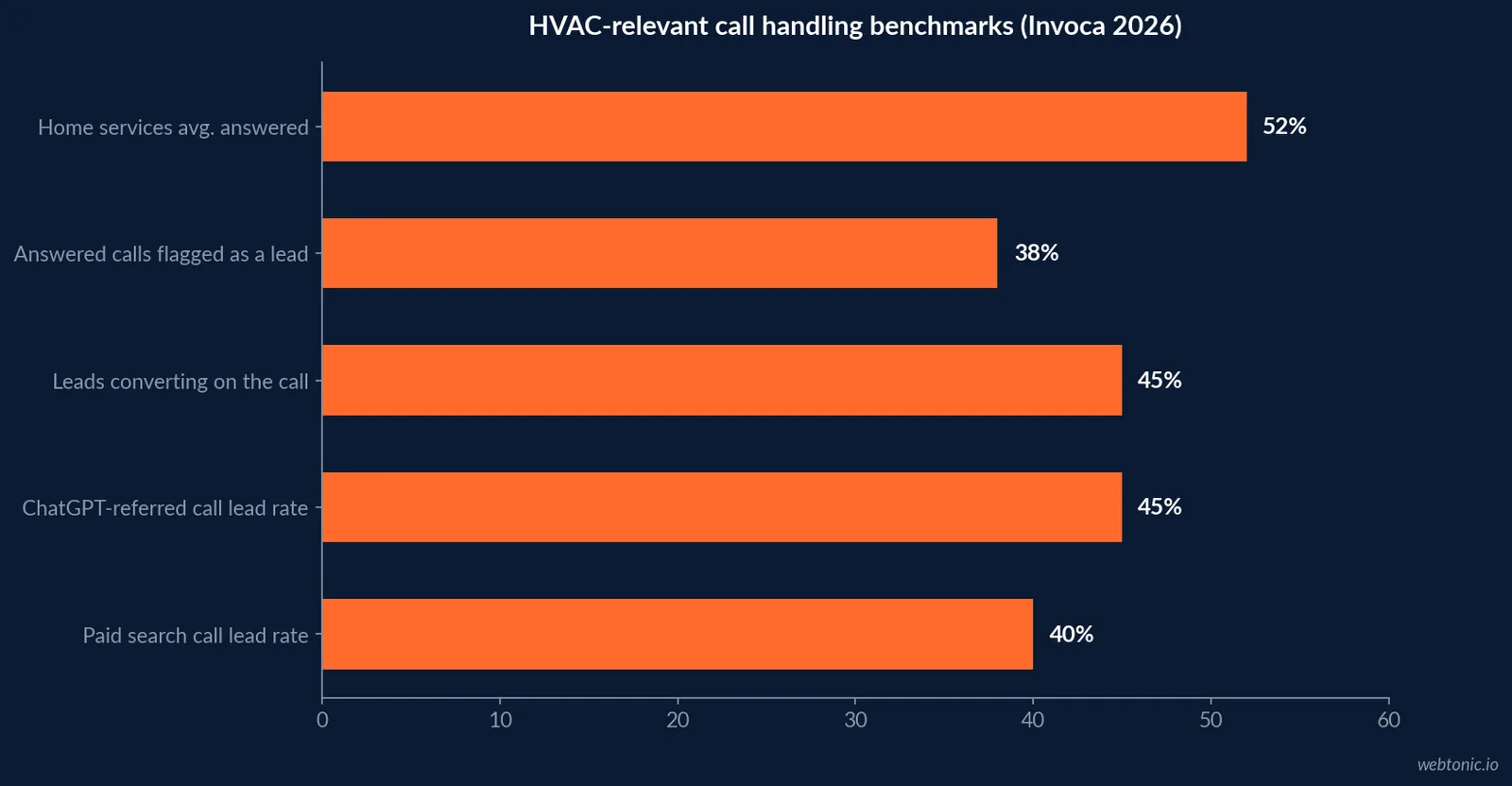
Generating the call or the form fill is only half the funnel. Invoca's Home Services Lead Conversion Benchmarks Report 2026, built on anonymized call data across trades including HVAC, found only 52% of calls are answered by a person, just 38% of answered calls are flagged as a lead, and 55% of home-services businesses never actually ask the caller to book the job. Every dollar spent generating the ring is wasted the moment the call goes unanswered or the technician forgets to ask for the appointment - a process fix that costs nothing incremental in media spend.
The early AI-search signal worth watching
Invoca's 2026 report also found ChatGPT-referred calls now carry the highest phone lead rate of any channel tracked, at 45% - about five points ahead of paid search at 40%. It is the first year Invoca had enough volume to measure generative-AI-referred calls at all, so this is an early signal, not an established benchmark, but it is a real, sourced 2026 figure and a reason HVAC demand-gen planning should not treat AI-referred traffic as noise going into next year.
| Call source | Phone lead conversion rate (2026) |
|---|---|
| ChatGPT-referred calls | 45% |
| Paid search | 40% |
| Home services average, all answered calls | 38% flagged as a lead |
The commercial HVAC exception: when the buying pattern looks more like B2B
Residential HVAC demand is mostly trigger-driven - a system fails, a homeowner searches - but a meaningful share of the trade sells into commercial buildings, where the purchase looks closer to a B2B decision with multiple stakeholders and a longer cycle. Demand Gen Report's 2024 B2B Buyer's Survey - a cross-industry B2B benchmark, not an HVAC-specific study - found 77% of B2B buyers still completed a purchase in the past year despite operating with roughly 25% less budget, while 26% of organizations reported including more people in the decision and 20% reported spending more time researching. Read that as a directional signal for the commercial side of an HVACR book of business, not a residential-service benchmark - the two buying patterns should not be planned with the same content or the same follow-up cadence.
| Buying pattern | Typical trigger | What Invoca/ACCA/Demand Gen Report data implies |
|---|---|---|
| Residential HVAC | Equipment failure, seasonal discomfort | Fast decision; speed-to-lead and call handling dominate |
| Commercial HVAC (B2B-adjacent) | Budget cycle, facility upgrade, compliance | Multiple stakeholders; longer nurture, per Demand Gen Report's cross-industry data |
The market context behind the trigger: why HVAC demand is rarely optional
HVAC has one structural advantage over most home-services categories: the trigger event is near-universal. The U.S. Energy Information Administration, cited in ServiceTitan's 2026 HVAC Statistics roundup, reports that nearly 90% of U.S. households use air conditioning, and residential systems account for roughly 40% of the overall HVAC market - the rest split across commercial and industrial installs. Fortune Business Insights, cited in the same roundup, values the global HVAC market at $157.71 billion in 2023, growing to an estimated $228.74 billion by 2030 at a 5.5% CAGR. That scale is exactly why the ACCA budget-to-margin data above matters: a market this large and this trigger-dependent rewards contractors who are visible before the failure happens, not only after.
| HVAC market context (Fortune Business Insights / EIA, via ServiceTitan 2026) | Figure |
|---|---|
| Global HVAC market value, 2023 | $157.71 billion |
| Projected global HVAC market value, 2030 | $228.74 billion |
| Projected CAGR, 2023-2030 | 5.5% |
| U.S. households using air conditioning | ~90% |
| Residential share of the overall HVAC market | ~40% |
What proposal structure and financing add on top of the media plan
The same ACCA study found offering four or more proposal options lifts close rates by 10% and shifts the premium-equipment mix from 26% to 42% of total sales. On financing, contractors offering it on every job finance 35% of sales versus 17% for those offering it only selectively, and close rates rise by 11% when financing is presented at all. None of this is media spend - it is what happens after the lead converts to an in-home estimate, and it changes the return on the demand-generation dollars already spent to get that appointment.
| Sales-process lever (ACCA, n=1,000+) | Reported effect |
|---|---|
| Offering 4+ proposal options | +10% close rate; premium mix 26% to 42% |
| Financing offered on every job vs. selectively | 35% vs. 17% of sales financed |
| Presenting financing at all | +11% close rate |
| Flat-rate pricing on service calls | 7% net profit vs. 4% for other methods |
| Field service software adoption | 56% of contractors, largely under-used |
Building the mix instead of guessing at it
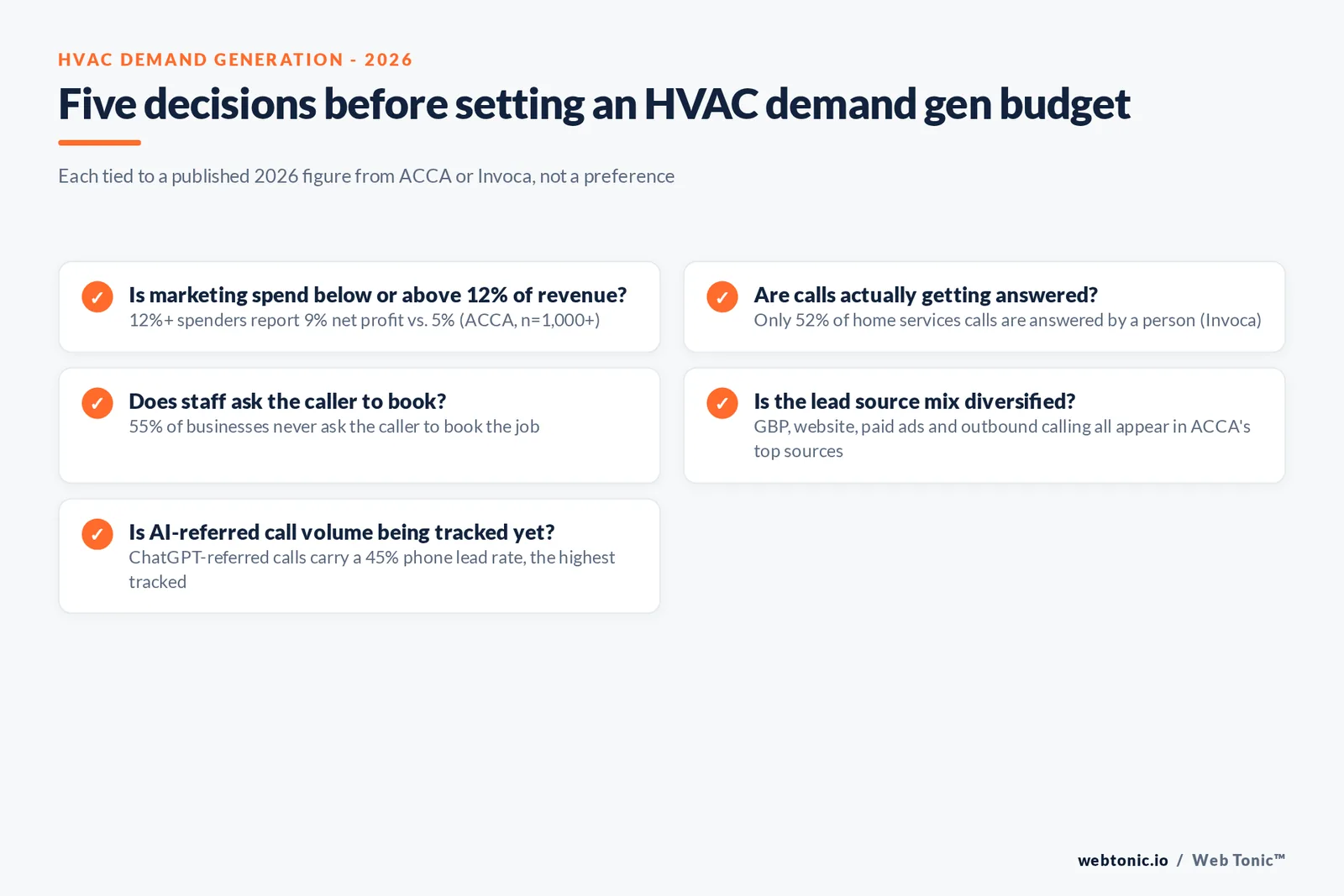
The published data supports a specific order of operations: fix the call-answer and ask-to-book gaps first, because they cost nothing incremental and Invoca's own numbers show the size of the leak; then size the marketing budget against the 6%-versus-12% margin data rather than an arbitrary round number; then split that budget across Google Business Profile, website, paid search and outbound contact per ACCA's own reported mix, watching AI-referred call volume as an emerging line. Our growth marketing practice and data and analytics practice build that sequence against a contractor's own call and CRM data; talk to us if the leak is bigger than the channel mix.
Frequently Asked Questions
How much of revenue should an HVAC contractor budget for demand generation?
ACCA's Contractor of the Future study, based on more than 1,000 contractors, found the average HVACR contractor spends 6% of annual revenue on marketing and advertising, but contractors who invest at least 12% report net profits of 9% versus 5% for everyone else. That is not proof that spending more causes higher margins on its own - the study does not isolate cause from correlation - but it is the clearest published benchmark tying an HVAC marketing budget line to a profitability outcome.
What generates the most HVAC leads, according to contractors themselves?
ACCA's survey lists Google Business Profiles, company websites, paid digital ads, and outbound calling and text messaging as HVACR contractors' top reported lead sources, in roughly that order of mention. None of those four is presented as a single dominant channel - the data supports a mix, which lines up with the fact that 56% of HVACR contractors now run field service management software but most under-use its marketing automation tools, according to the same study.
What happens to an HVAC lead after the ad or search click - does it actually get answered?
Not always. Invoca's Home Services Lead Conversion Benchmarks Report 2026, built on anonymized call data across trades including HVAC, found only 52% of home-services calls are answered by a person, only 38% of answered calls get flagged as a lead, and 55% of home-services businesses never ask the caller to book the job. That is a call-handling gap sitting downstream of whatever channel generated the ring.
Is paid search a cost-efficient channel for HVAC demand generation?
It is competitive but not the most expensive in the home-services set. WordStream and LocaliQ's 2025 benchmarks put the average cost per lead for Heating & Furnaces search ads at $129.02, with a 7.48% conversion rate and a $9.30 cost per click - cheaper per lead than Roofing & Gutters ($228.15) but above the $90.92 home-services average, which is why ACCA's own lead-source list places paid ads alongside, not above, Google Business Profile and website traffic.
Which channel is showing the fastest-growing lead quality signal for HVAC in 2026?
Invoca's 2026 report found ChatGPT-referred calls now carry the highest phone lead rate of any channel tracked, at 45%, about five points ahead of paid search at 40%. It is the first year Invoca had enough volume to measure generative-AI-referred calls at all, so treat it as an early signal rather than an established benchmark, but it is a real, sourced figure - not a projection.
Sources
ACCA - Inside the Contractor of the Future Study
Invoca - Home Services Lead Conversion Benchmarks Report 2026
WordStream - Google Ads Benchmarks 2025
LocaliQ - 2025 Search Ad Benchmarks for Home Services
Google Ads Help - About Demand Gen campaigns
Demand Gen Report - Rethinking Buyer Engagement in Modern B2B Marketing (2024 B2B Buyer's Survey)
ServiceTitan - HVAC Statistics: The Data You Need to Know for 2026 (Fortune Business Insights / EIA)