Table of contents
HVAC cold email only works as B2B outreach -- to property managers, facilities departments, general contractors and distributors -- and its 2026 benchmarks come from platform-wide vendor data, not an HVAC-specific study. This page keeps the two labelled separately: what the vendors report, and what the rules now require before any of it reaches an inbox.
Key Takeaways
- The platform-wide average cold email reply rate is 3.43%.
- Top-performing senders exceed a 10% reply rate.
- 58% of all replies come from the first email in a sequence.
- The remaining 42% of replies come from follow-ups.
- A separate vendor's median reply rate sits at just 1.5%.
- That figure is drawn from 56,614 measured campaigns.
- Median open rate on the same platform is 26%, from 37,000 campaigns.
- Google's bulk-sender rule applies at 5,000 messages a day to Gmail.
- Google's own spam-complaint ceiling is 0.3%.
- Yahoo requires a DMARC policy of at least p=none.
- One-click unsubscribe has been mandatory for bulk senders since Feb 1, 2024.
- CAN-SPAM's 16 CFR 316 requires a real postal address on every message.
- LinkedIn's own 2026 data reports a 28.5% connection acceptance rate.
- That figure comes from 13.2 million connection requests.
- Instantly's 2026 report is drawn from billions of emails.
Who HVAC cold email is actually for
Residential HVAC demand is not built through cold email -- homeowners searching for a repair or a system replacement start on a lead marketplace, a search engine or a referral, and unsolicited email to a consumer inbox is a fast way to damage a sending domain's reputation for every other message the company sends. The channel makes commercial sense on the B2B side: reaching property management companies, facilities directors, general contractors bidding new-construction mechanical work, and equipment distributors. Every benchmark below should be read against that audience, not a homeowner list.
What one vendor's platform data shows
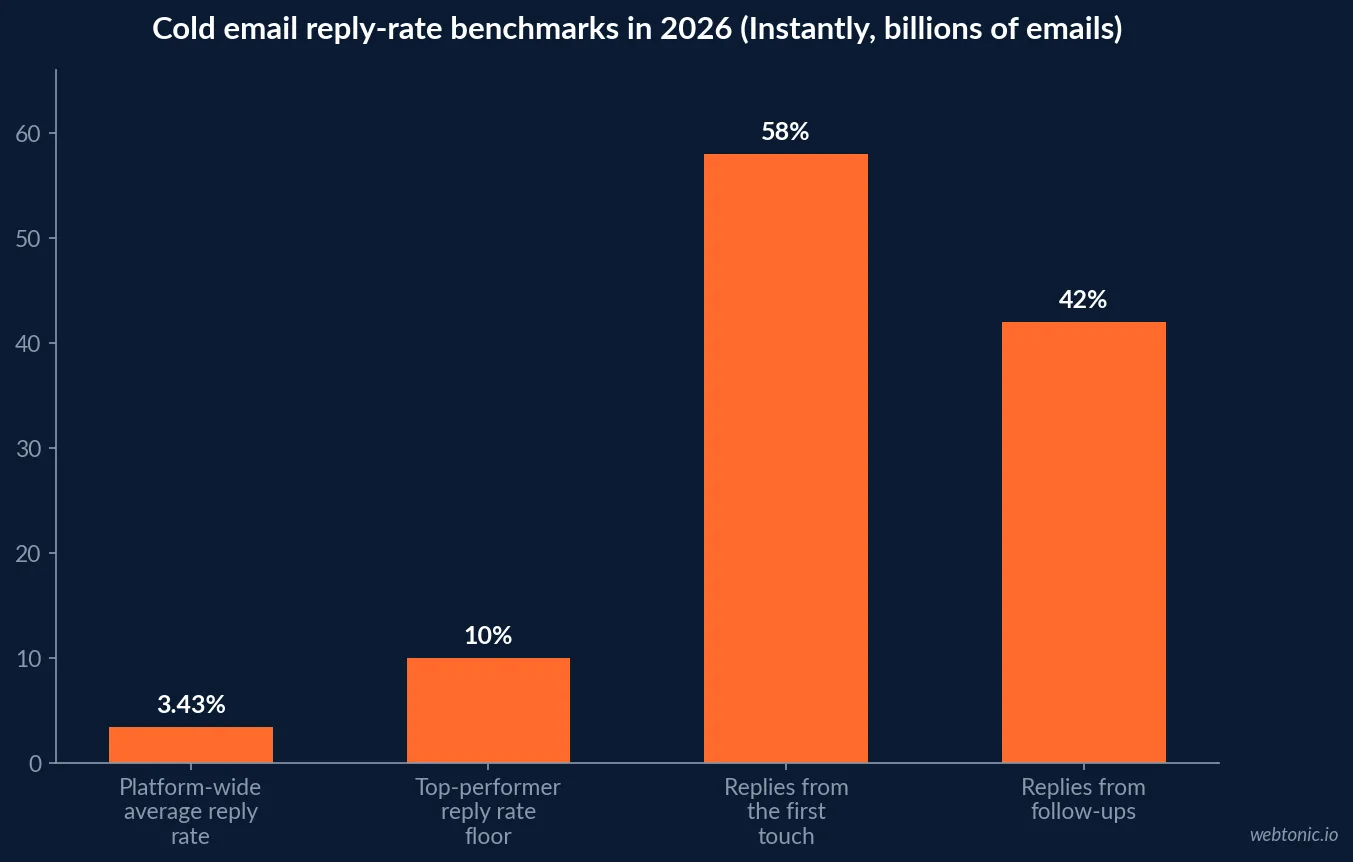
Instantly's Cold Email Benchmark Report 2026, built from billions of email interactions across more than 700,000 businesses on its platform, reports an average reply rate of 3.43%, with top-performing senders exceeding 10% -- two to four times the average. It also found 58% of all replies come from the first message in a sequence and the remaining 42% come from follow-ups, and that the best-performing campaigns keep individual emails under roughly 80 words.
| Instantly 2026 benchmark (own platform data) | Figure |
|---|---|
| Average reply rate | 3.43% |
| Top-performer reply rate | 10%+ |
| Replies from the first touch | 58% |
| Replies from follow-ups | 42% |
| Best-performing email length | Under 80 words |
Why a second vendor reports a lower median -- and why both numbers matter
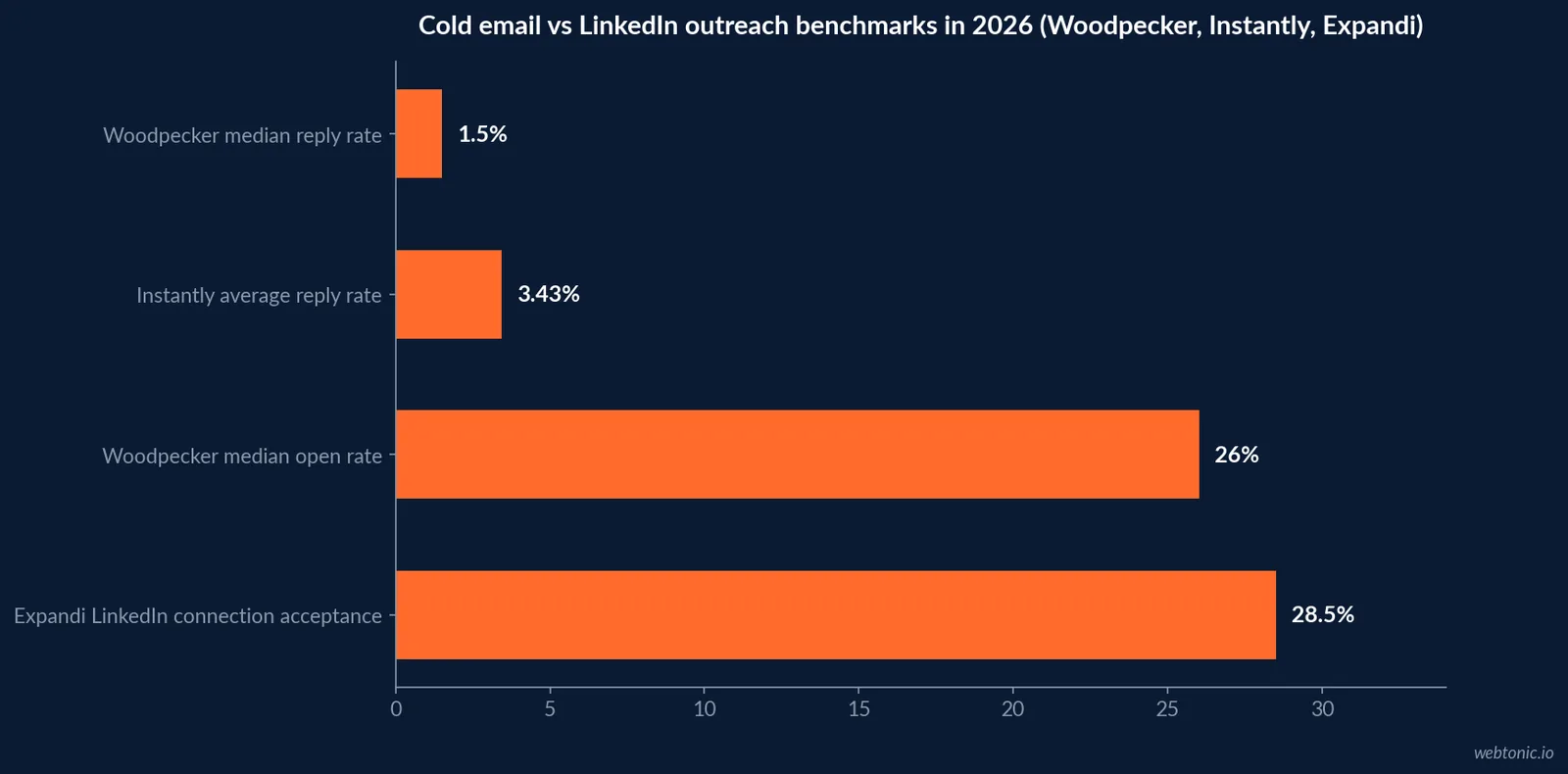
Vendors do not agree on the number, and the honest response is to show both rather than pick the flattering one. Woodpecker's own benchmark tool, built from platform data on the last 90 days of 2025 and updated 2026-08-05, reports a median reply rate of just 1.5% across 56,614 measured campaigns and a median open rate of 26% across 37,000 campaigns. The gap between 1.5% and 3.43% is not a contradiction -- it reflects different sender populations (Instantly's figure covers a broader mix including highly optimized senders, Woodpecker's median includes every campaign regardless of list quality) and different measurement windows. For a budget, use the lower, more conservative figure; treat the higher one as an achievable target once targeting and copy are tuned.
| Vendor benchmark (2025-2026) | Metric | Figure | Sample |
|---|---|---|---|
| Woodpecker | Median reply rate | 1.5% | 56,614 campaigns |
| Woodpecker | Median open rate | 26% | 37,000 campaigns |
| Instantly | Average reply rate | 3.43% | Billions of emails, 700k+ businesses |
| Instantly | Top-performer reply rate | 10%+ | Same dataset |
| Expandi | LinkedIn connection acceptance | 28.5% | 13.2 million connection requests |
The rules that decide whether any of it arrives
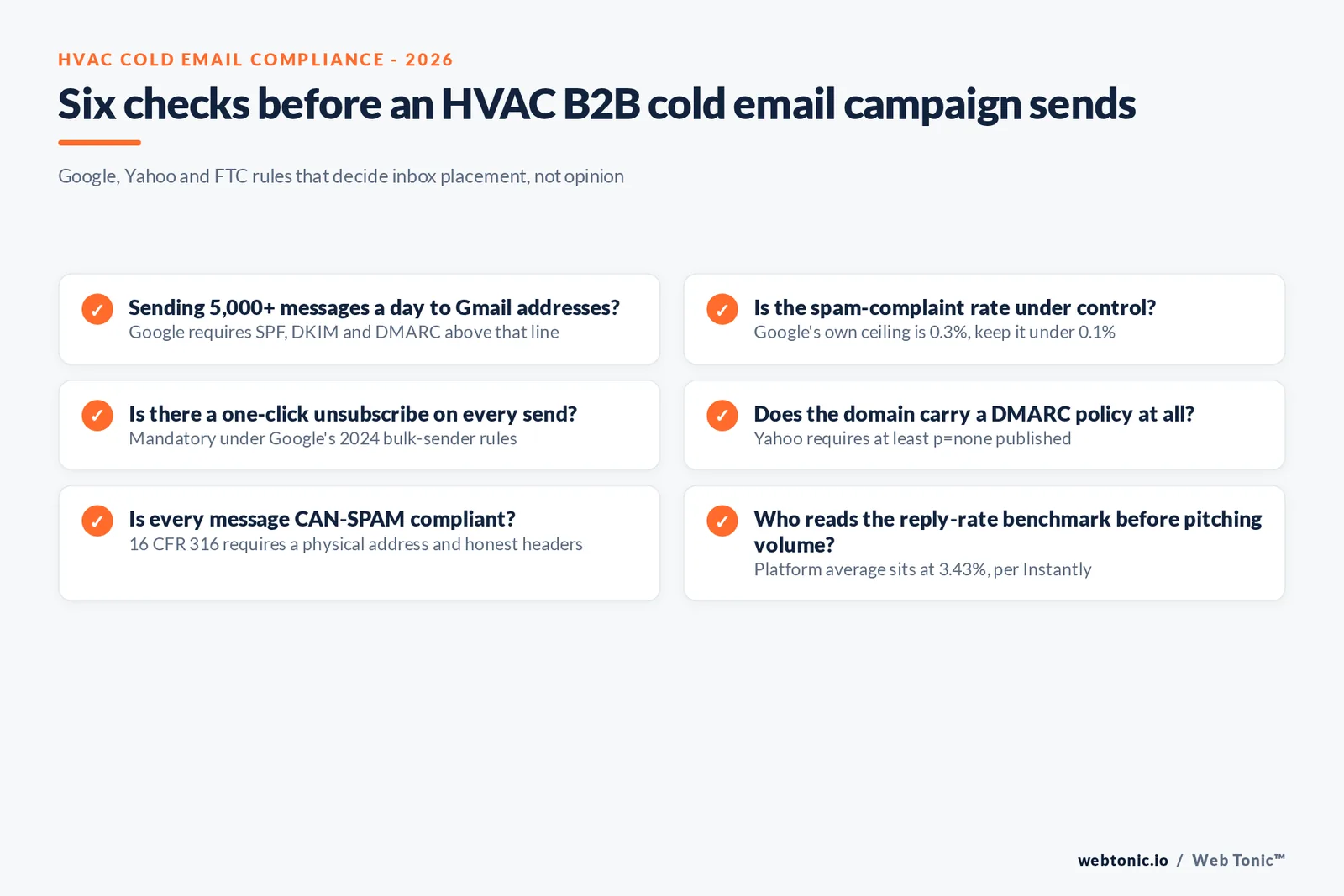
Since February 1, 2024, Google's bulk-sender guidelines require any sender delivering 5,000 or more messages a day to Gmail addresses to authenticate with SPF, DKIM and DMARC, keep the spam complaint rate below Google's published 0.3% ceiling, and provide one-click unsubscribe. Yahoo's sender requirements mirror the authentication stack and require at minimum a p=none DMARC policy published on the sending domain, without naming an exact bulk-sender volume threshold. Underneath both, the CAN-SPAM Act and its implementing 16 CFR 316 rule require a functioning opt-out, honest header and subject-line information, and a valid physical postal address on every commercial email, B2B or B2C.
| Sender rule (effective 2024-2026) | Requirement | Source |
|---|---|---|
| Google bulk-sender threshold | 5,000+ msgs/day to Gmail addresses | support.google.com/a |
| Google authentication | SPF, DKIM, DMARC all required above threshold | support.google.com/a |
| Google spam-complaint ceiling | Under 0.3%, aim below 0.1% | support.google.com/a |
| Yahoo DMARC minimum | p=none published at minimum | senders.yahooinc.com |
| CAN-SPAM opt-out | Honored within 10 business days, honest headers | FTC / 16 CFR 316 |
Cold email versus LinkedIn for reaching a facilities contact
The two channels are not interchangeable, but the 2026 data that exists favors LinkedIn on raw response rate for cold, unestablished outreach. Expandi's State of LinkedIn Outreach: H2 2026, built from 13.2 million connection requests and 6.7 million outbound messages across more than 13,000 active accounts, reports a 28.5% connection acceptance rate -- roughly eight times Instantly's average cold email reply rate. The trade-off is scale and cost: LinkedIn outreach is throttled by weekly connection-request limits per seat, while a cold email sequence can reach a far larger facilities contact list per inbox once deliverability is under control. In practice, HVAC B2B teams get the best of both by using LinkedIn to identify and warm a named contact, then moving the relationship to email for scheduled proposal and quote follow-up.
Volume per inbox and the infrastructure it implies
Because the Google bulk-sender threshold sits at 5,000 messages a day per domain, not per inbox, HVAC B2B teams running meaningful volume typically spread sending across several inboxes on a warmed domain well under that line, rather than push a single mailbox toward the threshold and risk the authentication and spam-rate scrutiny that comes with it. That structural choice -- more inboxes at lower volume each -- is also what keeps an individual sender's reply rate closer to Instantly's reported average than to a spam-flagged campaign's real-world near-zero rate.
What a realistic HVAC B2B sequence looks like
Given Instantly's finding that 58% of replies land on the first message and the remaining 42% require follow-up, a facilities-focused sequence should plan for at least two to three follow-ups rather than a single send. Given the same source's finding that top performers keep messages under roughly 80 words, a proposal-stage HVAC pitch belongs in a linked one-pager, not in the body of the email itself. None of this replaces a properly built list of verified facilities and property-management contacts -- deliverability collapses fastest when volume is aimed at a purchased, unverified list.
Putting a number on the channel before scaling it
Budget on Woodpecker's 1.5% median reply rate for a new domain and list, expect Instantly's 3.43% average once targeting and copy are proven, and treat anything near 10% as an outcome to chase, not to plan around. If the paid side of HVAC B2B demand generation needs the same rigor, our growth marketing practice builds the channel mix, and our guide to building a Google Ads strategy is a useful companion for the paid-search side of the same facilities-targeting problem.
Segmenting the facilities contact list before writing copy
Property managers, general contractors and equipment distributors respond to different offers, and a single generic sequence sent to all three under-performs a segmented one against every benchmark above. Property managers care about response time and preventive-maintenance scheduling; general contractors care about bid turnaround and commercial capacity; distributors care about volume pricing and account terms. Segmenting a list this way before sending is free relative to the deliverability infrastructure cost -- moves the realistic reply rate toward Instantly's higher figures rather than Woodpecker's floor. Our performance creative team builds the segmented copy once the list itself is clean.
| Facilities contact segment | What they respond to | Sequence angle |
|---|---|---|
| Property managers | Response time, preventive maintenance | Scheduled inspection offer |
| General contractors | Bid turnaround, commercial capacity | Subcontractor qualification pitch |
| Equipment distributors | Volume pricing, account terms | Account-level partnership pitch |
What a monthly reporting cadence should track
Because Google and Yahoo enforce their sender rules on a rolling basis rather than a point-in-time audit, a monthly reporting cadence should track deliverability health alongside reply rate, not instead of it. A campaign that hits Instantly's 3.43% average while quietly drifting toward Google's 0.3% spam ceiling is not actually healthy -- it is one complaint spike away from every future send being throttled.
| Monthly metric to track | Healthy range | Source of the benchmark |
|---|---|---|
| Reply rate | 1.5% floor, 3.43% target | Woodpecker / Instantly 2026 |
| Spam complaint rate | Under 0.3%, aim below 0.1% | Google bulk-sender guidelines |
| Open rate | Around 26% median | Woodpecker 2026 platform data |
| Follow-up share of replies | Roughly 42% of total | Instantly 2026 benchmark report |
Frequently Asked Questions
Do HVAC companies actually cold-email homeowners?
No, and they should not try. CAN-SPAM and the FTC's own guidance govern commercial email regardless of recipient, but homeowners searching for HVAC service overwhelmingly start on a lead marketplace or a search engine, not an inbox, and unsolicited consumer email invites spam complaints that damage domain reputation for every other message a company sends. The commercially sound use of cold email in HVAC is B2B: property managers, general contractors, facilities departments and equipment distributors.
What is a realistic reply rate to expect?
Two vendors publish two different medians from their own platform data, and both are useful. Instantly's 2026 Cold Email Benchmark Report, analyzing billions of emails across more than 700,000 businesses, puts the average reply rate at 3.43%, with top performers exceeding 10%. Woodpecker's own benchmark tool, built from more than 56,000 campaigns sent through its platform, puts the median reply rate at 1.5%. The gap is real -- Instantly's dataset skews toward more actively managed campaigns, Woodpecker's median includes a wider spread of smaller senders -- so budget against the lower number and treat anything above it as upside.
What changed with the Google and Yahoo 2024 sender rules?
Since February 1, 2024, Google requires any sender delivering 5,000 or more messages a day to Gmail addresses to authenticate with SPF, DKIM and DMARC, keep spam complaint rates below its published threshold, and offer one-click unsubscribe. Yahoo requires the same authentication stack without publishing an exact volume threshold. For an HVAC company running outbound to facilities contacts, the rules apply the moment volume crosses that line, even though the audience is entirely B2B.
Is cold email or LinkedIn outreach more effective for reaching facilities managers?
The channels are not directly comparable on the same metric, but the 2026 data that does exist favors LinkedIn on response rate. Expandi's own H2 2026 report, built from 13.2 million connection requests, reports a 28.5% connection acceptance rate -- well above either vendor's cold email reply rate. LinkedIn works better for identifying and reaching a named facilities decision-maker; cold email scales better once that contact is known and needs to be nurtured over multiple touches.
How many follow-ups actually matter?
Instantly's 2026 data, drawn from billions of emails, found 58% of all replies come from the first message in a sequence and the remaining 42% come from follow-ups, meaning a one-and-done cold email strategy leaves nearly half the achievable replies on the table.
Sources
Instantly - Cold Email Benchmark Report 2026
Woodpecker - Cold email benchmarks (own platform data)
Expandi - State of LinkedIn Outreach: H2 2026
Google - Email sender guidelines
Yahoo - Sender best practices
FTC - CAN-SPAM Act compliance guide for business
eCFR - 16 CFR Part 316, CAN-SPAM Rule