Table of contents
No affiliate network publishes a residential HVAC commission table, so this page prices the channel from what actually exists: lead-marketplace contract terms, manufacturer dealer rebates and cross-vertical partnership data. The unit of analysis is HVAC contractor spend on partner-driven demand, not a single commission rate.
Key Takeaways
- No network reports an HVAC-specific affiliate commission rate.
- Angi caps subscription fee increases at 10% per contract term.
- Rheem Pro Partner pays up to USD 525 CashBack per qualifying unit.
- Rheem's 2026 fall window adds up to an 8% financing promotion.
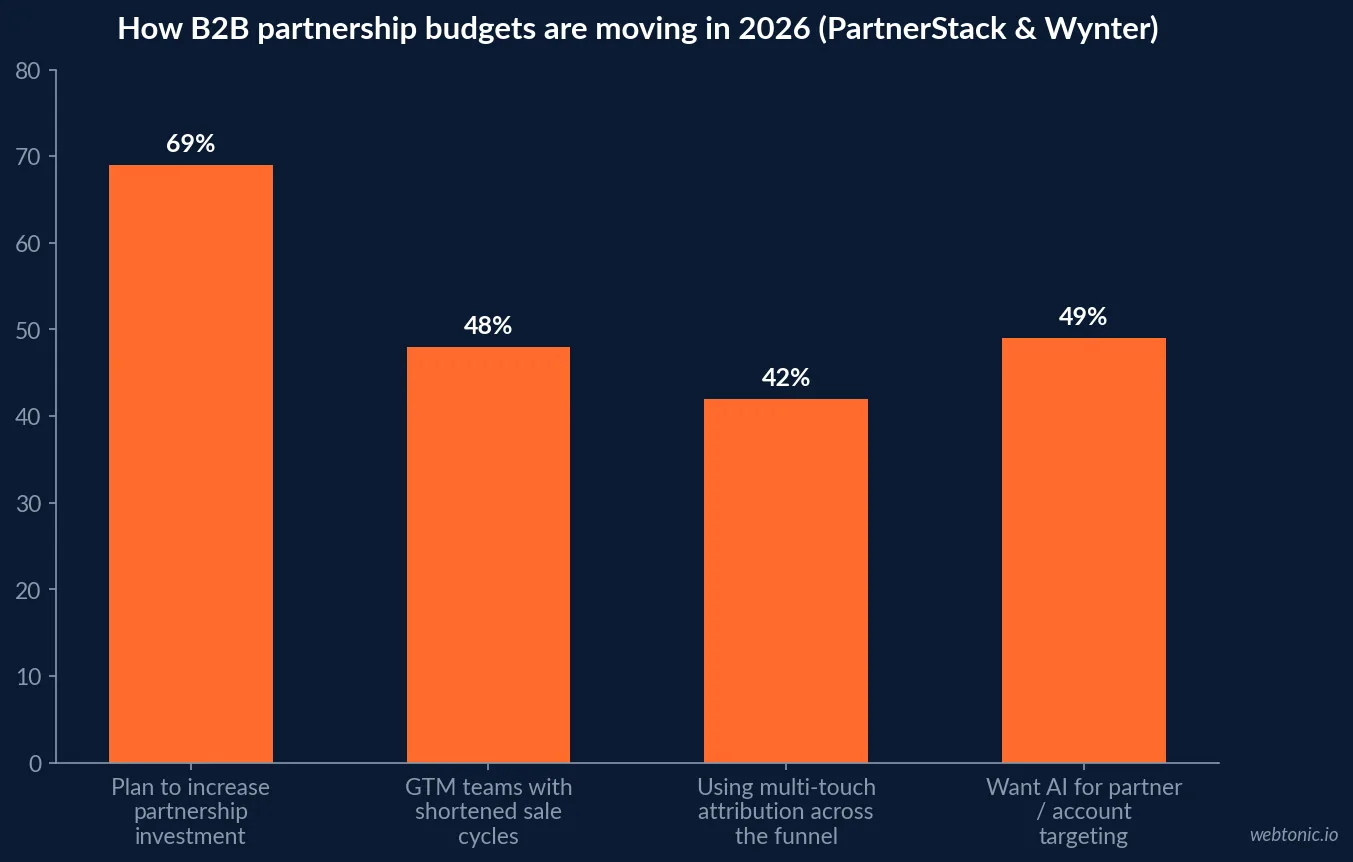
- 69% of B2B teams plan to raise 2026 partnership investment.
- 48% of aligned go-to-market teams saw shortened sale cycles.
- 42% of B2B teams use multi-touch attribution across the funnel.
- 49% want AI for partner and account targeting.
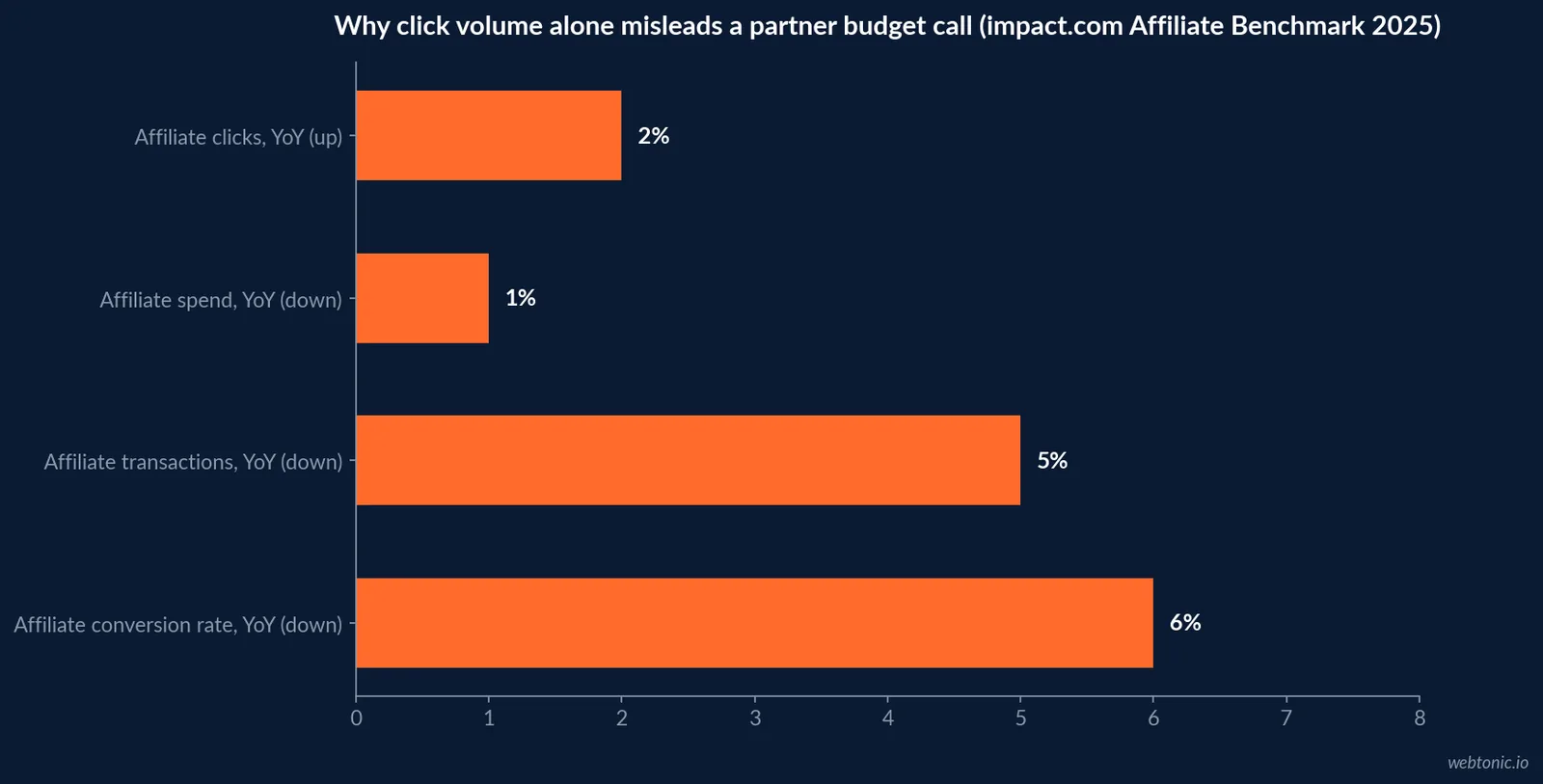
- Affiliate clicks rose 2% year over year in 2025.
- Affiliate conversion rates still fell 6% in the same period.
- Affiliate transactions fell 5% year over year.
- Affiliate consumer spend fell just 1%, despite fewer transactions.
- 74% of brands earn 11 to 30% of revenue from affiliate.
- FTC's 16 CFR 255 disclosure rule was finalized in 2023.
- Angi matches a homeowner request with no more than five pros.
- Impact.com's 2025 benchmark analyzed 2,368 North American retail brands.
- 97% of brands are already using AI inside partnership programs.
Why HVAC has no affiliate rate card
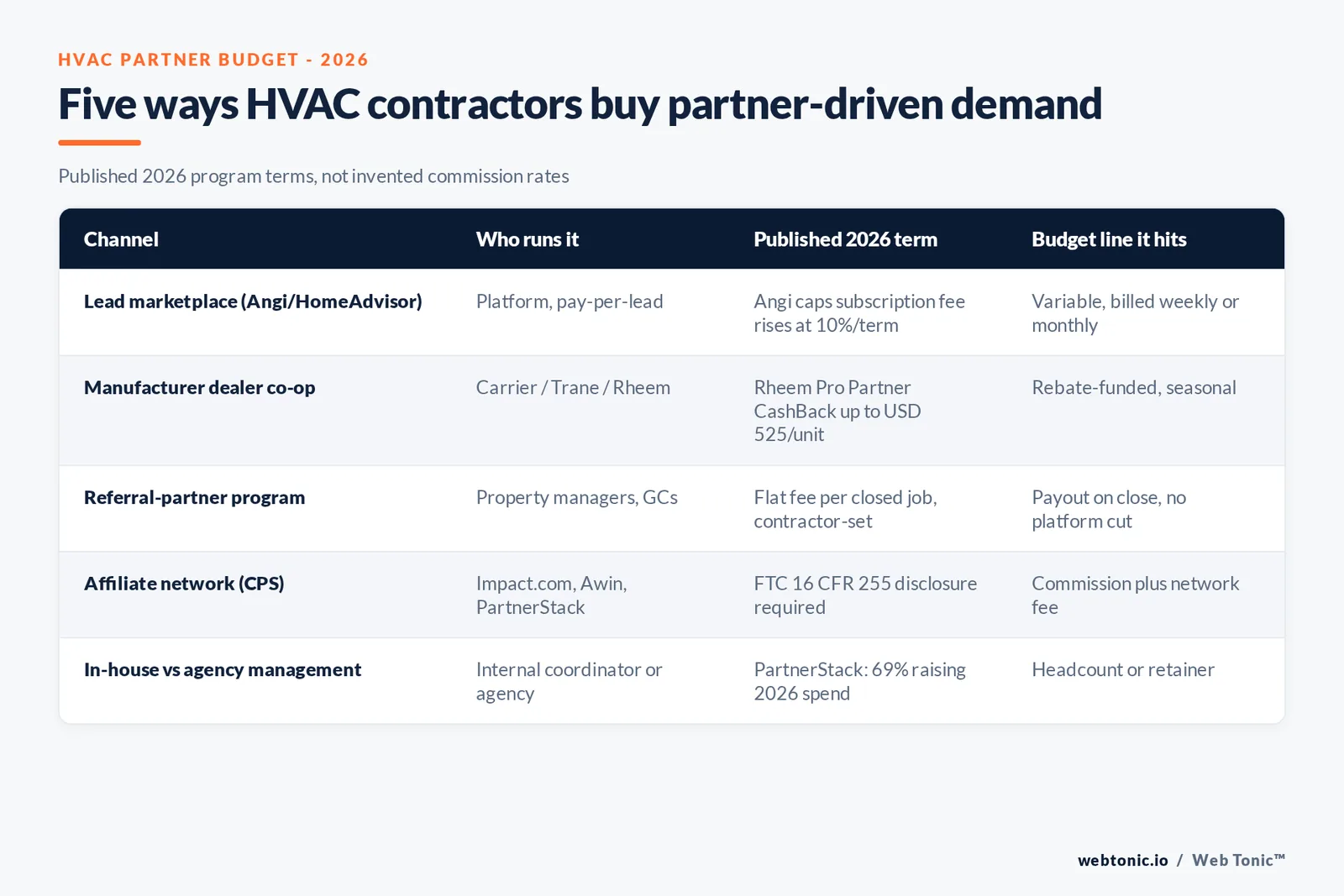
Awin, Impact.com, PartnerStack, CJ Affiliate and Rakuten Advertising each publish sector-level benchmarks, and none of the public ones break out residential HVAC as a category. That is not an oversight -- affiliate networks are built for repeat, low-friction ecommerce purchases, and an HVAC system replacement is a high-consideration, quote-driven, once-a-decade purchase. The channel exists for HVAC contractors, but it shows up as three separate budget lines: pay-per-lead marketplaces, manufacturer dealer rebate programs, and locally negotiated referral-partner deals.
Anyone quoting a fixed "HVAC affiliate commission rate" is quoting a guess. What follows is the published 2026 evidence for each of the three real budget lines, plus the cross-vertical partnership data the industry is actually tracking.
Line item one: lead marketplaces
Angi's own Help Center states plainly that "lead fees change based on task, homeowner location, and demand for the work" and will not publish a rate sheet. Its own worked example: a contractor with a USD 500 monthly budget who has used USD 480 of it can still receive one more matched lead worth USD 40, bringing total spend to USD 520 for the month -- Angi's own illustration of how the budget cap is a target, not a ceiling. Its Pro Agreement discloses that Angi may raise a subscription fee by up to 10% per contract term, and that each homeowner request is matched to no more than five pros, meaning every lead purchased is shared competitive exposure, not exclusivity.
| Lead-marketplace mechanic (2026) | Published term | Source | Budget effect |
|---|---|---|---|
| Per-lead pricing | Varies by task, location, demand -- no fixed rate | Angi Help Center | Cannot be quoted as a flat CPL |
| Budget overrun example | USD 500 budget can still spend to USD 520 | Angi Help Center | Treat the monthly budget as a soft cap |
| Subscription fee increase | Up to 10% per contract term | Angi Pro Agreement | Build in an annual escalation line |
| Lead exclusivity | Matched to up to 5 pros per request | Angi Help Center | Price competitive close rate into the CPL, not just the fee |
| Thumbtack pricing model | Pro sets exact per-service lead price | Thumbtack Help Center | Contractor, not platform, controls the ceiling |
Line item two: manufacturer dealer rebate programs
The closest thing HVAC has to a published commission table lives inside manufacturer channel programs. Rheem's Pro Partner brochure documents CashBack of up to USD 525 per qualifying installed unit during named 2026 promotional windows, combinable with up to an 8% Residential KwikComfort financing promotion. Trane and Carrier run parallel tiered dealer programs -- Comfort Specialist and Factory Authorized Dealer respectively -- that bundle co-op advertising funds, rebate administration and training requirements rather than a simple per-sale commission.
These programs are not "affiliate marketing" in the SaaS-network sense, but they are the mechanism that actually pays a contractor for driving a specific manufacturer's product to a sale, which is the economic role affiliate marketing plays elsewhere.
| Manufacturer program (2026) | Structure | Published figure | Source |
|---|---|---|---|
| Rheem Pro Partner | CashBack per unit installed | Up to USD 525/unit | Rheem Pro Partner brochure |
| Rheem KwikComfort financing add-on | Financing rate promotion | Up to 8% | Rheem distributor guidelines |
| Trane Comfort Specialist | Tiered dealer certification | Co-op ad funds, training requirement | Trane for-dealers page |
| Carrier Factory Authorized Dealer | Tiered dealer certification | Rebate administration via distributor portal | Carrier rebates page |
Line item three: referral partners and disclosure cost
The third budget line is the one no platform prices: direct referral relationships with property managers and general contractors, typically a flat per-closed-job fee set by the contractor rather than a network. The cost that platforms and referral partners share is compliance. The FTC's revised 16 CFR 255 Endorsement Guides, finalized in 2023, require a "clear and conspicuous" disclosure whenever a material connection exists between an endorser and the business recommended -- including a referral fee paid to a property manager or a rebate paid to a dealer. That is a process cost, not a line-item cash cost, but skipping it is the one mistake with regulatory exposure attached.
Why the closest network data still misleads a click-based budget
Even outside HVAC, the affiliate channel's own 2025 numbers argue against buying on click volume. impact.com's Affiliate Benchmark 2025, analyzing 2,368 North American retail brands, found clicks up 2% year over year while conversion rate fell 6%, transactions fell 5% and consumer spend fell only 1% -- shoppers clicked more to compare, then bought less often but bigger. A budget built on cost-per-click or cost-per-lead without a close-rate check inherits that same distortion, and it is a bigger risk in HVAC where the average job value is far higher than a retail cart.
| Cross-vertical affiliate signal (2025-2026) | Figure | Source | Read for HVAC budgeting |
|---|---|---|---|
| Affiliate clicks, YoY | +2% | impact.com Affiliate Benchmark 2025 | Rising traffic is not rising demand |
| Affiliate conversion rate, YoY | -6% | impact.com Affiliate Benchmark 2025 | Price a lead on close rate, not CTR |
| Affiliate transactions, YoY | -5% | impact.com Affiliate Benchmark 2025 | Volume can fall while spend holds |
| Brands earning 11-30% of revenue from affiliate | 74% | impact.com State of Affiliate Marketing 2025 | Affiliate is a supporting, not sole, channel for most brands |
| Brands using AI in partnership programs | 97% | impact.com State of Affiliate Marketing 2025 | Manual dealer-portal tracking is now the exception, not the rule |
In-house coordination versus outside management
PartnerStack's 2026 report with Wynter found 69% of B2B SaaS companies raising partnership investment, 48% of aligned go-to-market teams reporting shortened sale cycles, and 49% of senior leaders wanting AI applied to partner and account targeting. None of that is HVAC-specific, but it is the clearest signal available that the coordination overhead of running multiple lead marketplaces and multiple manufacturer programs at once is a real, growing line item industry-wide -- and one more companies are choosing to staff or outsource rather than absorb informally.
For a single-location HVAC company running two or three manufacturer programs and a handful of property-manager referrals, in-house coordination is typically cheaper than an agency retainer. The inflection point is when the number of concurrent programs makes tracking rebate deadlines, lead budgets and disclosure requirements a part-time job on its own.
Where cost-per-acquisition sits against paid channels
Because no network prices HVAC affiliate CAC directly, the fair comparison is structural: a paid search or paid social lead carries a transparent, auction-set cost per click but no manufacturer rebate attached, while a dealer-program lead effectively discounts the installed unit's cost basis by up to USD 525 (Rheem) in exchange for exclusivity to that manufacturer's product line. A lead-marketplace lead sits in between -- priced per lead like paid media, but shared with up to five competing pros, which suppresses close rate relative to an exclusive paid lead. None of the three is categorically cheaper; each trades a different variable (exclusivity, product lock-in, or platform dependency) for its price.
A simple budget model for the first year
Set a lead-marketplace monthly budget as a target, not a ceiling, and expect actual spend to run slightly over it per Angi's own worked example. Enroll in one manufacturer's dealer program per major product line carried, since Rheem, Trane and Carrier programs are not typically stacked on the same installed unit. Set aside a fixed, small amount of time -- not budget -- to write and post disclosure language for every referral and rebate relationship under 16 CFR 255. Revisit the mix quarterly, since lead-marketplace per-lead pricing is dynamic and manufacturer promotional windows are seasonal.
Fraud and attribution risk specific to local trades
Cookie-based attribution, the mechanism ecommerce affiliate networks rely on, does not apply cleanly to HVAC: the buying journey runs through phone calls and in-home quotes, not a tracked checkout link. That is why Angi and HomeAdvisor bill on a matched-lead event rather than a last-click conversion, and why manufacturer rebates are claimed by serial number and installation date rather than by pixel. The fraud risk that remains is lead quality -- a shared lead can be resold or duplicated across the five-pro match Angi discloses -- not cookie stuffing, which is the fraud vector ecommerce affiliate programs actually guard against.
What this means for next year's budget line
Price the channel as three separate, honestly-labeled lines -- lead marketplace, manufacturer program, referral partner -- rather than one blended "affiliate" number, because no vendor or network will hand over a blended rate. If the paid-media side of the account needs the same discipline, our growth marketing practice can model channel mix against a shared CAC target, and our write-up on what paid search actually costs is a useful CAC anchor for the comparison above.
Building a simple RFP checklist for a partner-management vendor
If the coordination overhead does justify outside help, the RFP question list is short: which lead marketplaces and manufacturer portals does the vendor already track, how does it document 16 CFR 255 disclosure for each referral relationship, and does its reporting separate lead-marketplace spend from manufacturer-rebate value the way this page does. A vendor that blends all three into one "affiliate ROI" number is hiding the same distinction the networks themselves refuse to blend. Our data and analytics practice builds exactly that separated reporting when a client's mix outgrows a spreadsheet.
| RFP question | Why it matters | Red flag answer |
|---|---|---|
| Which lead marketplaces do you actively manage? | Angi and HomeAdvisor terms change per contract | A vague "all major platforms" |
| How is 16 CFR 255 disclosure documented? | FTC enforcement risk sits with the contractor | No written disclosure process |
| Do you separate rebate value from lead cost in reporting? | Blended numbers hide the real CAC | One combined ROI figure |
| How many manufacturer programs can you track at once? | Rheem, Trane and Carrier terms are seasonal | Fewer than the programs already enrolled |
| What is the reporting cadence? | Lead pricing and rebate windows both move monthly to quarterly | Annual reporting only |
Reading a dealer-program invoice against a lead-marketplace invoice
A dealer-program rebate arrives as a credit against an already-installed unit, while a lead-marketplace charge arrives before the job is won at all. That timing difference is the practical reason contractors often under-budget the lead-marketplace side: the invoice comes due whether or not the lead converts, while the rebate only ever appears attached to a completed sale.
| Invoice timing (2026) | When the cost lands | Risk if under-budgeted |
|---|---|---|
| Lead marketplace (Angi) | Charged on lead match, before any job is won | Spend without a matching sale |
| Manufacturer dealer rebate (Rheem) | Credited after install, tied to a completed sale | No cost risk, only a missed upside |
| Referral partner payout | Paid on close, contractor-controlled timing | Cash flow predictable, volume is not |
Frequently Asked Questions
Does HVAC have its own affiliate marketing network?
No. Awin, Impact.com, PartnerStack, CJ Affiliate and Rakuten Advertising all publish sector benchmarks for retail, SaaS, travel and finance, but none breaks out a residential HVAC vertical. Contractors budgeting for this channel are really budgeting for three adjacent things: lead marketplaces (Angi, HomeAdvisor), manufacturer dealer rebate programs (Carrier, Trane, Rheem) and locally negotiated referral-partner deals with property managers and general contractors.
What does Angi actually charge, in Angi's own words?
Angi's own Help Center says lead fees 'change based on task, homeowner location, and demand for the work' and will not publish a rate card. Its Pro Agreement does disclose one hard number: Angi may raise a subscription fee by up to 10% per contract term. Budget for a variable per-lead cost plus a capped but real annual increase, not for a flat quote.
Are manufacturer dealer programs a form of affiliate marketing?
Functionally, yes -- they pay a contractor for driving a manufacturer's product to a sale, the same logic as a commission. Rheem's Pro Partner program documents CashBack of up to USD 525 per qualifying unit plus up to an 8% financing promotion during named 2026 windows. Carrier and Trane run parallel Factory Authorized Dealer and Comfort Specialist tiers with co-op advertising funds and rebate administration through their own distributor portals.
What compliance cost does the FTC add to this budget?
The FTC's revised 16 CFR 255 Endorsement Guides, finalized in 2023, require a 'clear and conspicuous' disclosure whenever a material connection -- a fee, a rebate, a referral payment -- exists between an endorser and the business being recommended. For an HVAC contractor paying or being paid for referrals, that means a documented disclosure line on any partner-facing marketing, not a large cash cost but a real one in the time it takes to build the process.
Should a small HVAC company manage this in-house or hire an agency?
PartnerStack's 2026 data with Wynter found 69% of B2B teams increasing partnership investment and 49% wanting AI for partner and account targeting, which signals the tooling and headcount question is live industry-wide, not HVAC-specific. For a single-location contractor running two or three dealer programs and a handful of property-manager referrals, in-house coordination is usually cheaper than a retainer; once a company runs live listings on multiple lead marketplaces plus multiple manufacturer programs, the coordination overhead starts to justify outside help.
Sources
Angi Help Center - Opportunities and leads FAQ
Angi Help Center - Billing FAQ
Angi - Pro Agreement (subscription fee terms)
Thumbtack Help Center - Set my lead prices
Rheem - Pro Partner Heating & Cooling contractor brochure
Trane - Resources for dealers and distributors
Carrier - Rebates on HVAC systems
eCFR - 16 CFR Part 255, Endorsement Guides
PartnerStack & Wynter - State of Partnerships in GTM 2026
impact.com - Affiliate Benchmark 2025
impact.com - State of Affiliate Marketing Research Report 2025