Table of contents
No study prices HVAC account-based marketing specifically, so this page tracks where the budget is actually going using B2B-wide ABM Leadership Alliance and N.Rich benchmark data. The unit of analysis is this year's ABM allocation decision - which model, which owner, which platform - not a per-lead cost.
Key Takeaways
- One-to-one ABM leads adoption at 75% of programs.
- One-to-many follows at 68%, one-to-few at 61%.
- 45% of programs run only one model; 30% run all three.
- 67% of teams treat ABM as a core go-to-market motion, not a side campaign.
- Only 26% call their own ABM program a success.
- Just 22% run ABM on a dedicated platform.
- 64% of programs are CMO or VP-Marketing led.
- 44% sit with a demand generation team.
- Sales leadership owns only 13% of programs, RevOps just 8%.
- Only 31% agree marketing and sales collaborate effectively on ABM.
- A mid-size account program starts near USD 5,000 a month.
- Larger programs run USD 7,000 to 15,000 a month.
- IFMA counts 25,000-plus facility management members in 140-plus countries.
- ABM took 30% of the average 2023 marketing budget B2B-wide.
- 66% of programs planned to raise that spend again in 2024.
- 81% rate ABM ROI higher than other marketing, but only 52% measure it.
Where the budget goes first: choosing a model
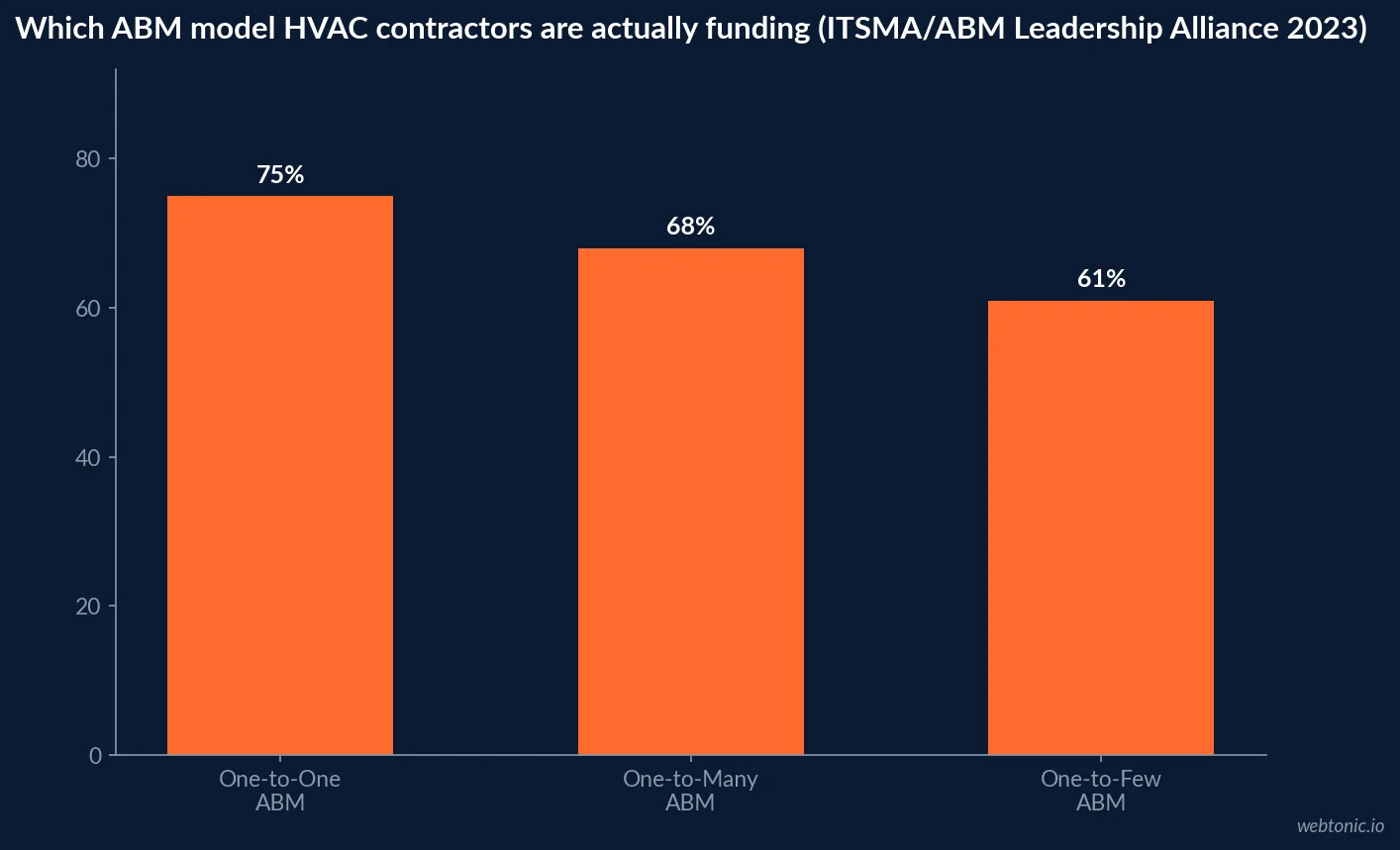
The Momentum ITSMA and ABM Leadership Alliance 2023 ABM Benchmark Study found one-to-one ABM - a small number of named top accounts, each with a bespoke plan - is the most widely used model, at 75% of programs. One-to-many, a broader named list run through shared campaigns, follows at 68%, and one-to-few, a mid-size tier between the two, sits at 61%. Most programs run more than one: only 45% deploy a single model, while 30% run all three at once.
For an HVAC contractor, that typically means one-to-one against a handful of named hospital or multi-site retail accounts, one-to-few against a regional property-management tier, and one-to-many against the wider facility-manager population reached through paid social and shared content.
| ABM model | Share of programs using it | How many run one model only | Source |
|---|---|---|---|
| One-to-one | 75% | 45% run only one model | ITSMA/ABM Leadership Alliance 2023 |
| One-to-many | 68% | (usually paired with one-to-one) | ITSMA/ABM Leadership Alliance 2023 |
| One-to-few | 61% | 30% of programs run all three | ITSMA/ABM Leadership Alliance 2023 |
Is the money actually working once it is spent?
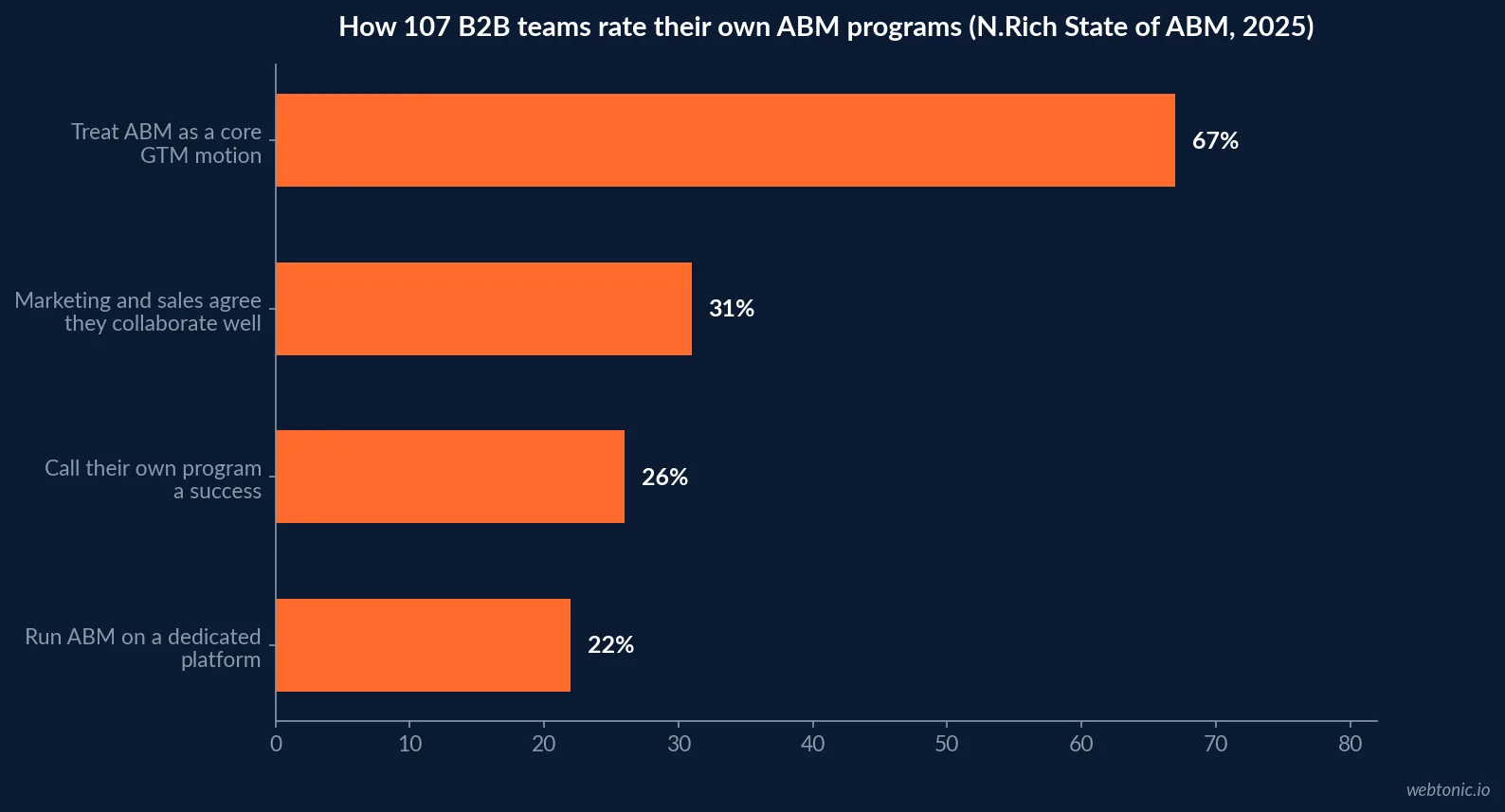
Here is the honest part most vendor pitches skip. N.Rich's 2025 State of ABM report, surveying 107 B2B go-to-market leaders, found 67% now treat ABM as a core GTM alignment motion rather than a campaign tactic - yet only 26% describe their own program as successful, and just 22% run it on a dedicated ABM platform. Most still coordinate through LinkedIn, a CRM, and spreadsheets.
That gap between adoption (67%) and self-rated success (26%) is the real budget risk in HVAC ABM: the spend on outreach is easy to approve, the spend on the platform and the process discipline that makes it measurable is what usually gets cut first.
| Program maturity signal | Share of 107 teams surveyed | Read on the gap | Source |
|---|---|---|---|
| Treat ABM as a core GTM motion | 67% | Adoption is high | N.Rich State of ABM 2025 |
| Agree marketing/sales collaborate well | 31% | Alignment is the actual bottleneck | N.Rich State of ABM 2025 |
| Call their own program a success | 26% | Fewer than 1 in 3 will say it worked | N.Rich State of ABM 2025 |
| Run ABM on a dedicated platform | 22% | Most still run it on spreadsheets | N.Rich State of ABM 2025 |
Who owns the budget decision
N.Rich's ownership breakdown shows ABM budget decisions stay concentrated with marketing leadership: 64% of programs are led by a CMO or VP of Marketing, 44% by a demand generation team specifically (categories overlap in the survey), while sales leadership owns just 13% of programs and RevOps only 8%. That concentration is not necessarily a problem - but it means the facility-manager accounts an HVAC contractor is chasing are being prioritized by marketing's read of the pipeline, not sales' read of which accounts are actually in motion, unless the two functions deliberately close that gap.
| Who leads the ABM program | Share of programs | Source |
|---|---|---|
| CMO or VP of Marketing | 64% | N.Rich State of ABM 2025 |
| Demand generation team | 44% | N.Rich State of ABM 2025 |
| Sales leadership | 13% | N.Rich State of ABM 2025 |
| RevOps | 8% | N.Rich State of ABM 2025 |
The account list this budget is actually reaching
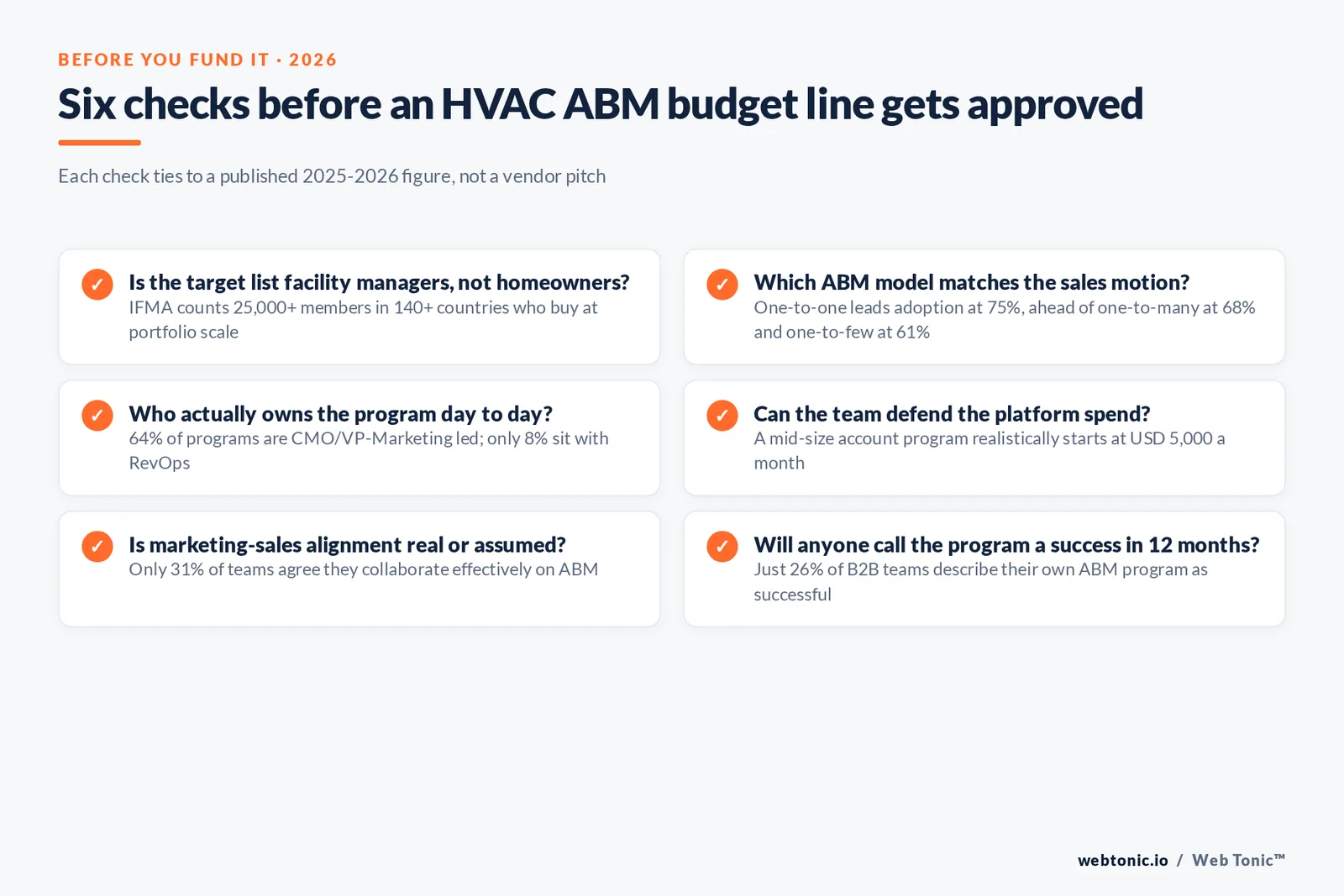
The addressable population behind an HVAC one-to-many program is real and countable. IFMA, the International Facility Management Association, counts 25,000-plus members in over 140 countries as of its January 2025 membership announcement. That is the honest frame: this is B2B commercial-account targeting - facility managers overseeing HVAC maintenance contracts across a portfolio of buildings - not consumer HVAC lead-gen, and it should be planned and reported as a separate program from residential paid search.
| Target population | Sizing source | Reported figure | Fit for HVAC ABM |
|---|---|---|---|
| Facility managers, global | IFMA, Jan 2025 | 25,000+ members, 140+ countries | Core one-to-many audience |
| Commercial building operators | BOMA International, 2024 | 16,500+ members, 10.5B+ sq ft managed | Portfolio-scale re-fit and maintenance decisions |
| High-spend property teams | BOMA attendee data, 2024 | 64% spend USD 1M+/yr on building products | Budget already exists for the service contract |
What the platform spend actually buys
Once the model and the owner are decided, the platform cost is the next real line item. N.Rich's published pricing states a realistic starting point of USD 5,000 a month for a mid-size account program, moving to USD 7,000-15,000 a month for a larger account list or multiple simultaneous campaigns. N.Rich also reports an average cost per account engagement of USD 1-3 on its own platform, against USD 10-50 on LinkedIn for comparable engagement - a real efficiency argument, from the vendor's own numbers, for running the facility-manager list through a dedicated account-based channel rather than paid social alone.
None of that replaces the budget-share context from the broader ABM benchmark data: B2B programs averaged 30% of total marketing spend on ABM in 2023, and 66% planned to raise that again in 2024. An HVAC contractor should model the platform cost against that 30% figure, not treat it as a bolt-on to whatever residential budget is left over.
For an HVAC contractor whose facility accounts respond better to physical touches than digital ones - a portfolio-wide maintenance renewal, for instance - gifting platform Reachdesk publishes plans starting at USD 20,000 a year, with a USD 2,500 minimum order for custom branded merchandise sourced outside the platform. The ABM Leadership Alliance's own 2023 benchmark study summary notes that the highest-performing programs typically combine a digital motion with at least one high-touch tactic rather than running either channel alone.
| Cost item | Published figure | Source |
|---|---|---|
| Mid-size account program, monthly | USD 5,000 | N.Rich pricing page |
| Larger account list/multi-campaign, monthly | USD 7,000-15,000 | N.Rich pricing page |
| Cost per account engagement, N.Rich platform | USD 1-3 | N.Rich pricing page |
| Cost per comparable engagement, LinkedIn | USD 10-50 | N.Rich pricing page |
| Gifting plan, annual | USD 20,000 | Reachdesk pricing page |
| Average ABM share of 2023 marketing budget | 30% | ITSMA/ABM Leadership Alliance 2023 |
Why the ownership gap matters more than the model choice
It is tempting to treat the one-to-one versus one-to-many decision as the highest-leverage choice in this budget, but the maturity data argues otherwise. A program with the right model and no real sales-marketing alignment still lands in the 74% that do not call themselves a success, because the facility-manager accounts marketing prioritizes are not necessarily the ones the field sales team is already talking to. Fixing that requires a shared, single account list reviewed by both functions on a set cadence - not a better ABM platform.
That is also where the model choice and the ownership question intersect: a one-to-one motion against five or ten named accounts is far easier for sales and marketing to keep aligned on than a broad one-to-many list, which is one reason 75% of mature programs still run it even after adding one-to-many and one-to-few on top.
Putting the budget decision together
The pattern for HVAC this year is consistent across every source above: fund a one-to-one motion for the handful of named facility accounts worth a dedicated relationship, layer a one-to-many program against the wider IFMA-adjacent population, put a named owner and a real collaboration process behind it rather than assuming marketing ownership equals alignment, and price the platform at the published USD 5,000-a-month floor rather than a vendor's custom quote. Skipping the process-and-measurement half of that list is exactly how a program ends up in the 74% that do not call themselves a success.
For the account-based data infrastructure this requires, see Web Tonic's data intelligence services, for the paid-social layer of a one-to-many program see Web Tonic's Meta Ads services, and to talk through a facility-manager account list, contact Web Tonic.
Frequently Asked Questions
Which type of ABM should an HVAC contractor actually fund?
The ABM Leadership Alliance 2023 benchmark study found one-to-one ABM is the most widely deployed model, used by 75% of programs, ahead of one-to-many at 68% and one-to-few at 61%. For an HVAC contractor, one-to-one usually means a handful of named hospital, school, or multi-site retail facility accounts; one-to-many covers the wider list of facility managers reached through shared paid social and content. Most mature programs run both at once rather than picking one.
Is HVAC account-based marketing actually working for the companies trying it?
Honestly, often not yet. N.Rich's 2025 State of ABM report, surveying 107 B2B go-to-market leaders, found only 26% describe their own program as successful, and just 22% run it on a dedicated ABM platform - most still coordinate through LinkedIn, a CRM, and spreadsheets. That is not a reason to skip ABM; it is a reason to budget for the platform and the alignment work, not just the outreach.
Who should own the HVAC ABM program - marketing, sales, or a mix?
N.Rich's ownership data shows programs stay concentrated in marketing: 64% are led by a CMO or VP of Marketing, 44% by a demand generation team, while sales leadership owns just 13% and RevOps only 8%. But ownership on paper does not equal alignment - only 31% of teams agree marketing and sales collaborate effectively on ABM, which is the gap that actually determines whether facility-manager accounts close.
What does an ABM platform cost for an HVAC contractor's facility-account list?
Published vendor pricing, not a quote request. N.Rich states a realistic starting point of USD 5,000 a month for a mid-size account program, moving to USD 7,000-15,000 a month for a larger facility-manager list or multiple campaigns. That is the honest floor for a dedicated ABM platform, separate from whatever paid media or gifting budget sits on top of it.
How big is the facility-manager account list an HVAC contractor is actually targeting?
IFMA, the International Facility Management Association, counts 25,000-plus members across 140-plus countries as of its January 2025 membership update - a real, addressable population for a one-to-many program, distinct from the smaller named list a one-to-one motion would target inside that same population.
Sources
Momentum ITSMA & ABM Leadership Alliance, 2023 ABM Benchmark Study
N.Rich, 2025 State of ABM report
N.Rich, pricing page
IFMA, membership announcement
BOMA International, 2025 fact sheet
ABM Leadership Alliance, 2023 benchmark study summary
Reachdesk, pricing page