Table of contents

Hulu advertising is Disney's streaming ad business: non-skippable video inside Hulu's on-demand and live TV inventory, bought either self-serve from a few hundred dollars or through Disney Advertising for national campaigns.
Here is how the formats, targeting, buying routes and benchmarks actually work in 2026 — and how a Hulu buy compares with the rest of connected TV.
Key Takeaways
- Streaming now accounts for more than 40% of all US television viewing time, per Nielsen's monthly Gauge report.
- Hulu ads are non-skippable, which is why completion rates on streaming inventory routinely exceed 95%.
- Two buying routes: self-serve for small budgets, Disney Advertising for national and upfront deals.
- Standard creative lengths are 15 and 30 seconds; specials like pause ads and binge ads sit alongside them.
- Hulu inventory is sold inside a single Disney streaming stack alongside Disney+ and ESPN.
- Disney has confirmed Hulu will be folded fully into the Disney+ app, consolidating one of the largest ad-supported streaming audiences in the US.
What Hulu advertising is
Hulu sells advertising against its ad-supported subscription tiers. A viewer on the lower-priced plan sees a limited ad load between and during episodes; a viewer on the premium plan sees none. That structure — documented on Hulu's plan comparison page — makes the ad-supported base the product advertisers are buying.
Ownership matters here, because it changed the sales motion. Disney moved to full control of Hulu after buying out Comcast's minority stake, a transaction tracked through Disney's investor relations disclosures. Hulu is therefore no longer sold as a standalone network. It is one component of the Disney streaming portfolio, packaged with Disney+ and ESPN through Disney Advertising's streaming products, and increasingly delivered inside the same app: Disney has said the Hulu experience will be fully integrated into Disney+, a shift covered extensively in the trade press.
For a media buyer, the practical consequence is that a Hulu line item is a premium, professionally produced, brand-safe environment — closer to a broadcast buy than to social video — with digital targeting and measurement wrapped around it.
Why streaming inventory behaves differently
Two properties define the channel and both are structural rather than tactical. Ads cannot be skipped, and they play on the largest screen in the house. Nielsen's Gauge has recorded streaming passing the combined share of broadcast and cable, with streaming now above 40% of total US TV time — a threshold it crossed for the first time in 2025 and has held since.
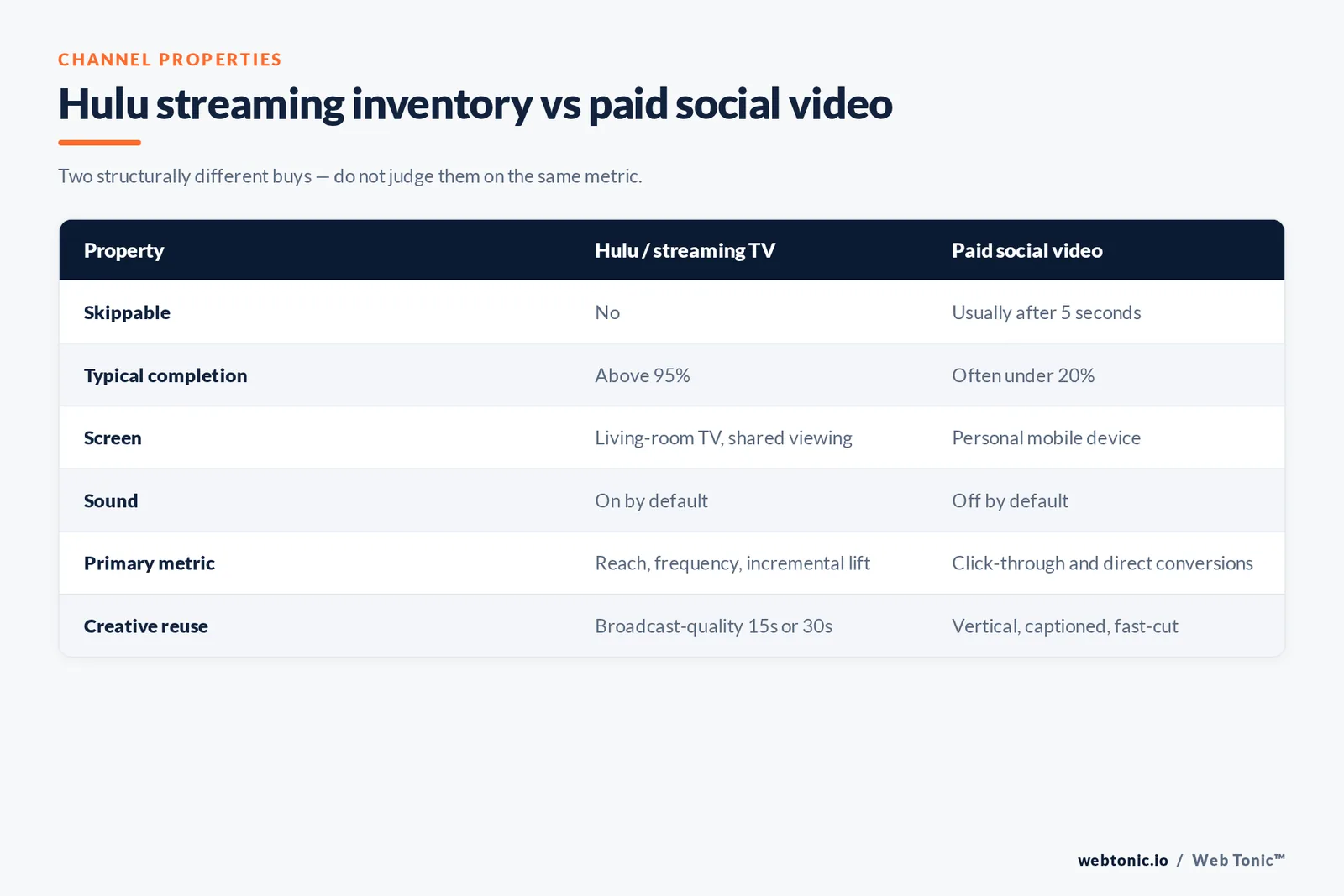
That combination produces the metric profile CTV buyers are used to: near-total video completion, low frequency ceilings, and no reliance on sound-off creative. It also produces the channel's weakness — you cannot optimise a Hulu campaign on clicks. Attribution has to come from lift studies, incrementality tests, or modelled conversion paths, which is exactly how eMarketer's CTV analysts and the IAB's video research programme recommend planning the medium.
| Property | Hulu / streaming TV | Paid social video |
|---|---|---|
| Skippable | No | Usually after 5 seconds |
| Typical completion | Above 95% | Often under 20% |
| Screen | Living-room TV, shared viewing | Personal mobile device |
| Sound | On by default | Off by default |
| Primary metric | Reach, frequency, incremental lift | Click-through and direct conversions |
| Creative reuse | Broadcast-quality 15s or 30s | Vertical, captioned, fast-cut |
The ad formats you can buy
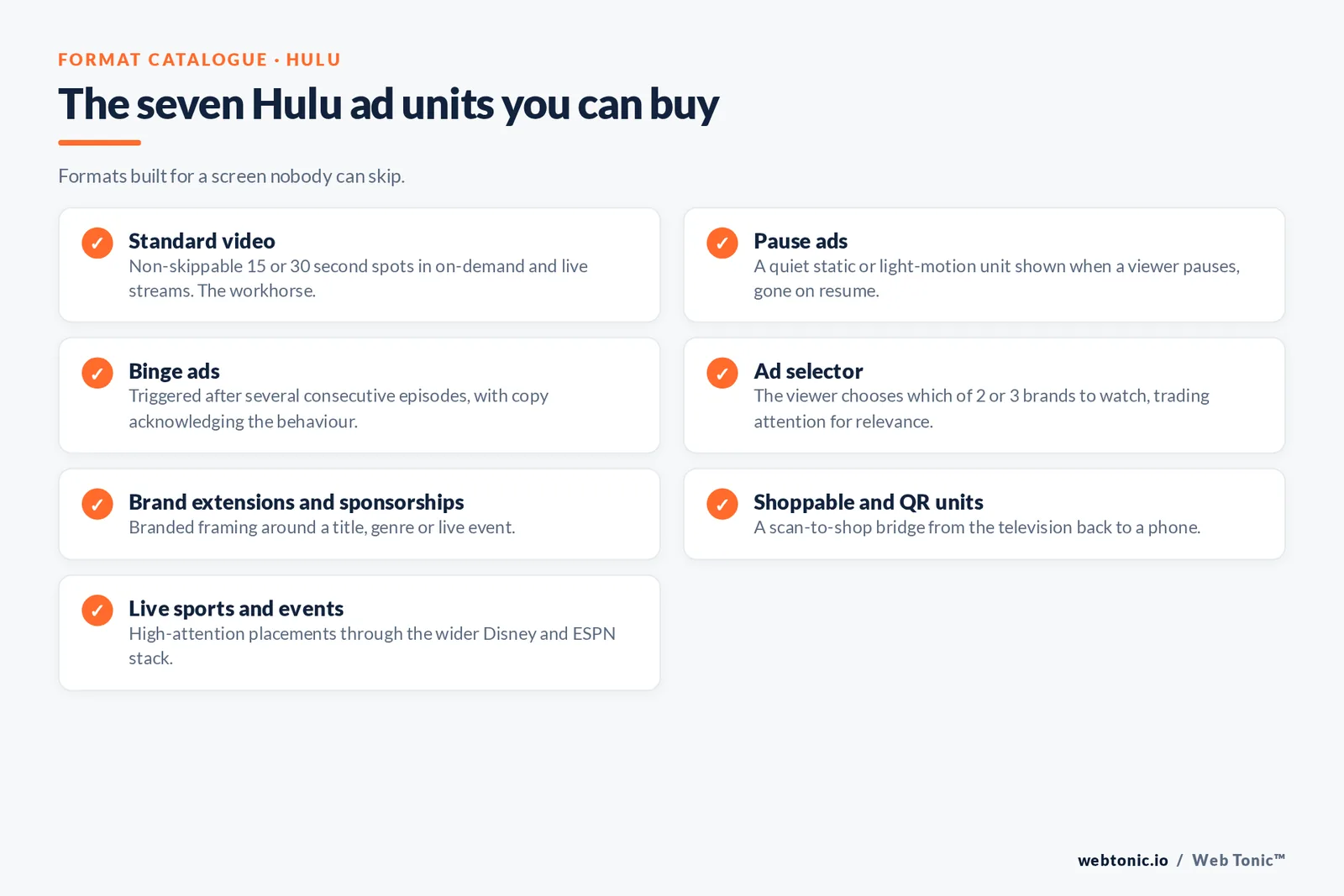
Hulu's format catalogue is unusually rich for a streaming service, because the platform spent years building interactive units that broadcast could not offer. The viewer-facing ad experience article describes what subscribers actually see.
- Standard video — non-skippable 15 or 30 second spots in on-demand and live streams. The workhorse.
- Pause ads — a quiet static or light-motion unit that appears when a viewer pauses playback, then disappears on resume.
- Binge ads — triggered after a viewer watches several consecutive episodes, acknowledging the behaviour with tailored copy.
- Ad selector — the viewer chooses which of 2 or 3 brands to watch, trading attention for relevance.
- Brand extensions and sponsorships — branded framing around a title, genre or live event.
- Shoppable and QR-driven units — a scan-to-shop bridge from the television back to a phone.
- Live sports and event inventory — high-attention placements available through the wider Disney and ESPN stack.
How to actually buy it
There are two doors, and choosing the wrong one wastes weeks.
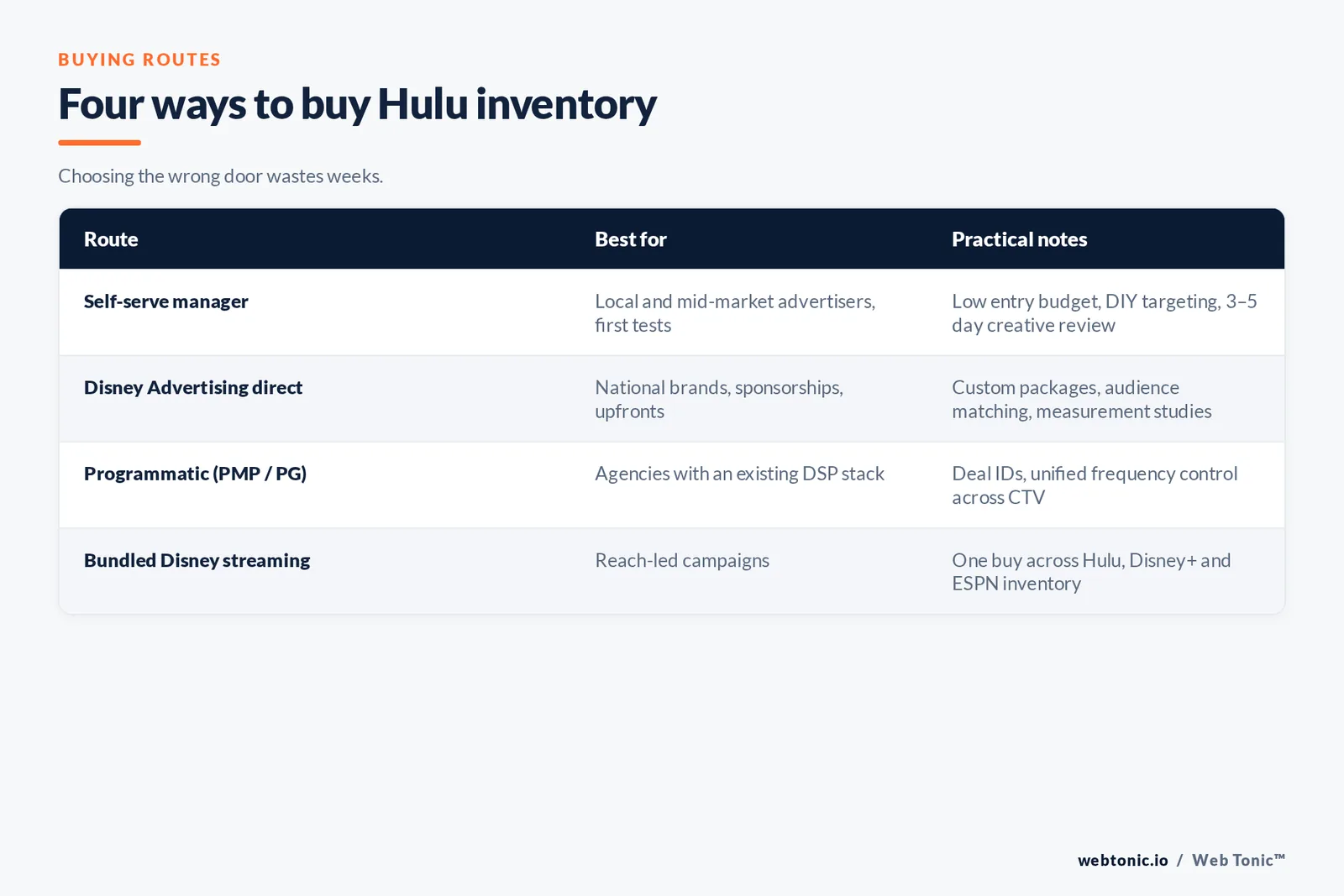
Self-serve suits small and mid-sized advertisers testing streaming for the first time. You upload a video asset, set a geographic and demographic target, define a budget and flight dates, and launch without a salesperson. Entry budgets sit in the low hundreds of dollars, which is why this route opened streaming TV to businesses that could never afford a national spot. Creative approval takes a few business days, so plan for a 3–5 day lead time before your intended start date.
Managed buying through Disney Advertising suits national campaigns, upfront commitments, custom sponsorships and anything needing first-party audience matching or a measurement partnership. This is also the only door to premium live sports packages and cross-portfolio deals spanning Hulu, Disney+ and ESPN. Programmatic access exists too, through private marketplaces and programmatic guaranteed deals with the major demand-side platforms.
| Route | Best for | Practical notes |
|---|---|---|
| Self-serve manager | Local and mid-market advertisers, first tests | Low entry budget, DIY targeting, 3–5 day creative review |
| Disney Advertising direct | National brands, sponsorships, upfronts | Custom packages, audience matching, measurement studies |
| Programmatic (PMP / PG) | Agencies with an existing DSP stack | Deal IDs, unified frequency control across CTV |
| Bundled Disney streaming | Reach-led campaigns | One buy across Hulu, Disney+ and ESPN inventory |
Targeting and measurement
Targeting on Hulu spans the familiar geographic and demographic layers, content genre and daypart, plus behavioural and interest segments and first-party data onboarding for advertisers who can match a customer file. Frequency capping is the setting most campaigns get wrong: without a firm cap, a modest budget will hit a narrow slice of households a dozen times and generate irritation rather than recall. Cap at roughly 3–4 exposures per household per week and widen the audience instead.
Measurement should be planned before launch, not after. Three approaches carry the load: geographic holdout tests, brand lift or survey-based studies, and modelled attribution that credits view-through activity. Media-mix modelling remains the fairest treatment of an upper-funnel channel, and the reporting cadence matters as much as the method — a two-week read on a reach campaign is noise. Industry coverage in TV Tech and Ad Age tracks how measurement standards keep shifting across the sector, and MediaPost follows the buy-side response.
Our own approach is to run streaming alongside search and social rather than in isolation, wiring results into one reporting layer through data intelligence so a Hulu buy is judged on incremental demand instead of last-click credit. The creative side sits with performance creative, because a broadcast-quality 30 second spot and a vertical social cut-down are not the same asset.
Ad load, viewer tolerance and where budgets leak
Streaming's economics rest on a smaller ad load than linear television, and that scarcity is the product. Where a traditional cable hour can carry 15 minutes or more of commercials, ad-supported streaming tiers run a fraction of that, and Hulu has historically capped the load on its lower-priced plan to protect the viewing experience. Fewer spots per hour means less clutter competing with your message, but it also means impressions are finite and priced accordingly.
Three leaks account for most wasted streaming budget. The first is over-narrow targeting: stacking demographic, genre and behavioural filters shrinks the addressable pool until the same households absorb the whole flight. The second is under-capped frequency, which converts reach spend into repetition. The third is flight length — a two-week burst rarely builds enough cumulative reach to shift anything measurable, whereas the same money spread across 6 to 8 weeks compounds. Budget pacing beats bid tinkering on this channel almost every time.
Creative rules that decide whether it works
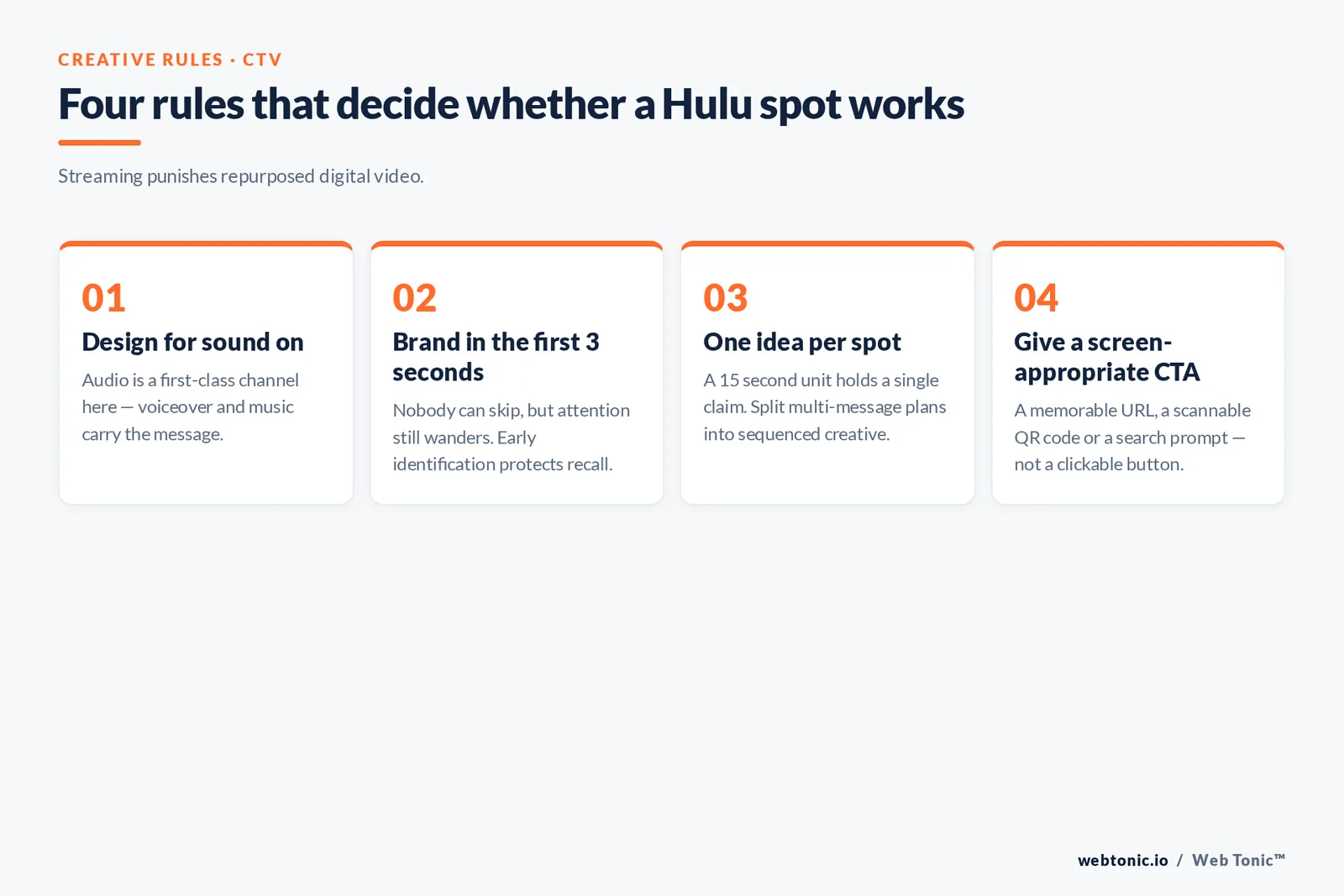
Streaming punishes repurposed digital video. Four rules hold consistently across CTV campaigns.
- Design for sound on. Audio is a first-class channel here, not an afterthought — voiceover and music carry the message.
- Brand in the first 3 seconds. Nobody can skip, but attention still wanders. Early identification protects recall.
- One idea per spot. A 15 second unit holds a single claim. Split multi-message plans into sequenced creative.
- Give a screen-appropriate call to action. A URL people can remember, a QR code they can scan, or a search prompt — not a clickable button.
Refresh cadence is the quiet killer. A single spot running for a full quarter against a capped audience will fatigue; rotating 2 or 3 executions keeps frequency productive. Guidance from Think with Google on video creative effectiveness translates cleanly to streaming, and consumer research from Nielsen's insights library reinforces the point about audio and early branding.
Is Hulu the right streaming buy for you?
Hulu deserves budget when you have television-quality creative, a reach or awareness objective, and a measurement plan that does not depend on clicks. It is the wrong choice when the only asset available is a vertical social clip, when the campaign must prove itself on a two-week cost-per-acquisition target, or when the budget is thin enough that reaching a meaningful audience at a controlled frequency is impossible.
The most reliable way in is a geographic test: pick two comparable markets, run streaming in one and hold the other back, and measure the difference in branded search volume and direct traffic. It is a cheap way to learn whether the channel moves your demand curve. If you want that test designed, run and read properly, get in touch — or see how we structure media across channels in our services and on the blog.
Frequently asked questions
How much does it cost to advertise on Hulu?
Self-serve buying starts in the low hundreds of dollars, which makes a first test accessible to local advertisers. Pricing is quoted on a cost-per-thousand-impressions basis and varies with targeting precision, content genre and seasonality; live sports and holiday inventory carry the steepest premiums. National managed buys are negotiated and typically start far higher.
Can small businesses advertise on Hulu?
Yes. The self-serve route was built for exactly that, and it requires no agency and no minimum commitment beyond the platform's entry budget. The practical constraint is creative: you still need a finished 15 or 30 second video that looks credible on a living-room television.
Are Hulu ads skippable?
No. Standard Hulu video ads are non-skippable, which is the core reason completion rates on the platform sit above 95%. Interactive formats such as the ad selector give viewers a choice of brand rather than a way out.
How does Hulu advertising compare with other streaming platforms?
Hulu's advantages are premium professionally produced content, a mature interactive format set, and packaging alongside Disney+ and ESPN. Rival ad tiers on other services can offer larger raw scale or cheaper impressions, but generally with fewer format options. Buying two or three platforms through one demand-side platform is the usual way to control cross-platform frequency.
What happens to Hulu advertising as Hulu moves into Disney+?
Inventory continues to be sold through Disney Advertising; the change is that the audience and the app consolidate. For advertisers this simplifies planning — one Disney streaming buy instead of separate negotiations — and improves frequency management across previously separate audiences.
Sources
Nielsen — The Gauge monthly streaming share data and insights library · Hulu Help Center — plans and ad experience · Disney Advertising — streaming solutions · The Walt Disney Company investor relations · Variety television news coverage · eMarketer — connected TV advertising insights · IAB video research insights · TV Tech · Ad Age · MediaPost · Think with Google — video creative effectiveness. Platform plans, formats and pricing change frequently; verify current details with Disney Advertising before planning a buy.